Traditional Farm
A farmhouse, barn, stable and small machinery yard create a versatile focal point. This type of scene works particularly well beside villages, branch lines and layouts representing Eras III and IV.


Farms, stables, barns, tractors, animals, fields and farm tracks turn open countryside into a believable rural miniature world. The key is to make the relationship between buildings, cultivated areas and machinery clearly visible.
Designing farming scenes on a model railway means more than simply placing a tractor beside a barn. A believable farm includes residential and working buildings, access routes, farmyards, pastures, fields, animals and an appropriate selection of machinery. Even a few carefully chosen elements can create a scene whose purpose is immediately understandable.
A particularly useful starting point is the range of agriculture buildings . The current category includes small farmsteads, barns, stables, granaries, horse stables, open shelters, alpine buildings and larger agricultural complexes. The selection is particularly extensive in H0, while TT, N, Z and G also offer interesting rural buildings.
The next question is how the farm is used. A dairy farm needs a stable, pasture and cows. An arable farm is more likely to require machinery sheds, grain storage, larger fields and suitable tractors and agricultural machines . Horse keeping requires paddocks, stables and fencing. A historic smallholding, on the other hand, can work with only a few buildings and one small tractor.
Agricultural scenery becomes especially convincing when it is integrated into the surrounding model railway landscape. A farm track connects the farmyard with the fields, a village road links the farm with the settlement, and a branch line passes beside fields and pastures. On larger layouts, grain stores, agricultural cooperatives or loading roads can even create a direct connection between farming and railway freight operation.
A farmhouse, barn, stable and small machinery yard create a versatile focal point. This type of scene works particularly well beside villages, branch lines and layouts representing Eras III and IV.
Larger fields, tractors, ploughs, trailers, combine harvesters and grain storage dominate the scene. Machinery and buildings need clearly visible access routes and working areas.
Stables, paddocks, pastures, cows, horses or sheep define the scene. Animals should be arranged in small groups rather than distributed evenly across the entire area.
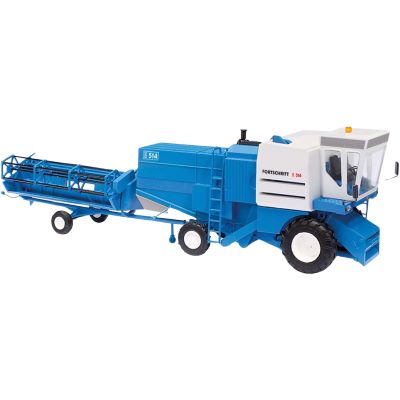
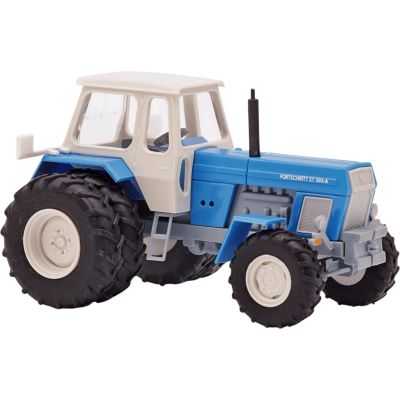
Larger halls, Fortschritt and Belarus machinery, trailers, silos and extensive fields are particularly suitable for East German layouts representing the later parts of Eras III and IV.
Do not fill every area between the stable, barn and machinery shed with grass, figures or accessories. Tractors need space to turn, trailers need room for manoeuvring, and areas in front of large doors are often surfaced or compacted. Open space is therefore an important part of a believable farmyard.
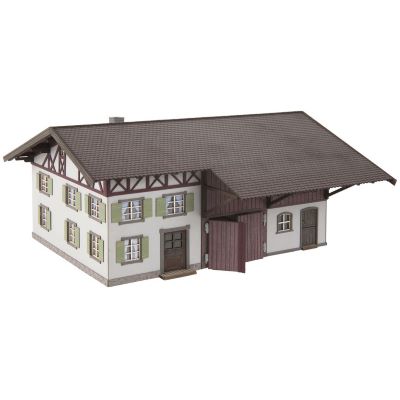
An agricultural building should explain what happens on the farm. The Auhagen 11439 Farm combines a dwelling house, barn and stable into one coherent H0 ensemble. Groups of buildings like this make it easier to create a functional farm layout.
Barn doors should face an accessible yard. A stable belongs close to the pasture or exercise area, a grain store needs vehicle access and a silage clamp is more appropriate for a larger agricultural operation. If buildings are placed only where there happens to be an empty space, the resulting access routes and workflows can quickly become implausible.
On smaller layouts, a single farmhouse with a barn can already be enough. Part of the building can stand at the layout edge or disappear behind vegetation. This creates the impression that the farm continues beyond the visible section of the model railway.
House, garden and yard entrance form the human centre of the farm.
Doors, trailers and loading areas should remain easily accessible.
Include a direct connection to the pasture, paddock or exercise area.
Larger yards and suitable access routes complete the scene.
The current Modellbahnshop agricultural machinery range includes tractors, combine harvesters, trailers, ploughs, fertiliser equipment and other working vehicles. A believable scene should make the purpose of each vehicle clear.
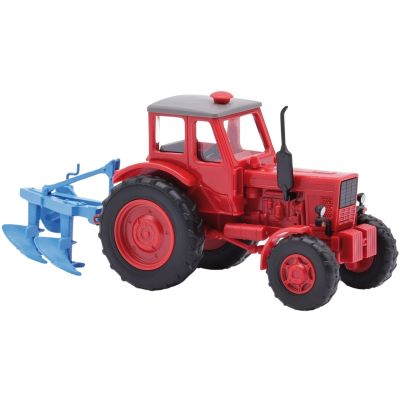
The most versatile agricultural vehicle. Tractors fit farmyards, farm tracks and cultivated fields and can be combined with trailers, ploughs and other implements.
A major focal point for harvest scenes. The cutting unit should suit the field being represented and needs enough space rather than being squeezed between buildings.
Ploughs, harrows and similar implements belong on or beside a visibly cultivated field. Parallel furrows strengthen the visual connection to the machinery.
Trailers connect the field and the farmyard. Depending on the scene, they carry grain, manure, hay or other materials and make transport processes visible.
Fertiliser spreaders, tank trailers and other specialist equipment add much more variety than using tractors without working implements.
Older tractors and smaller implements suit earlier eras and smaller farm structures. The size and design of the vehicles tell a great deal about the period being represented.
Agriculture only works convincingly when there is cultivated land. A brown field needs a recognisable working direction. Plough furrows, seed rows and tramlines make it clear that the area is genuinely being farmed.
Meadows provide a good contrast to cultivated fields. Use grass fibres and grass mats in several colours and heights. A pasture can be shorter and more heavily worn than an unmown meadow along a field edge.
Harvest scenes use a noticeably different colour palette: gold and straw tones, visible soil and individual wheel tracks replace rich green. Combine harvesters, trailers and straw areas then create a clearly recognisable summer or early-autumn working scene.
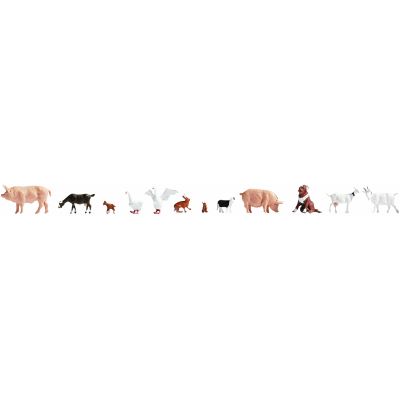
The Animals category includes farm animals for H0, TT, N, Z, G and other scales. The goal is not to use the largest possible number of animals, but to create a plausible scene.
Place them in small groups on a pasture, farmyard or alpine meadow. Add fencing and a logical route to the stable.
A paddock, stable or shelter provides a believable setting for horse figures.
Particularly suitable for larger meadows, hillsides and shepherding scenes.
Small farmyard or stable areas are more believable than pigs distributed freely over a large meadow.
Ideal for farmyards, gardens and small secondary scenes directly beside the farmhouse or stable.
A few domestic animals beside the buildings add everyday life without overwhelming the agricultural focus of the scene.
Select dairy farming, arable farming, a smallholding, GDR LPG cooperative, horse keeping or alpine farming as the main theme.
Use only buildings and vehicles that suit the chosen type of farm.
Arrange the farmhouse, stable and barn so that doors and access routes remain usable.
Use a tractor model to check whether the farmyard appears large enough.
Build the farm track, entrance and surfaced working areas.
Every path should lead to a logical destination.
Make fields, meadows, paddocks and field margins clearly recognisable as areas with different uses.
Do not make every large area the same colour.
Place tractors, trailers and harvesting machinery where their purpose can be understood immediately.
Match the era and vehicle scale to the layout theme.
Enclose paddocks and pastures and arrange animals in a few natural groups.
Do not forget stable access and gates.
Add wheel tracks, earth, straw and differently worn areas subtly.
Place dirt according to function rather than distributing it evenly.
Farm tracks, village roads or loading points connect agriculture with the railway landscape.
The purpose of the farm scene should remain understandable from the normal viewing distance.
Smaller farms, draught animals, limited machinery and simple field tracks create a historic appearance.
Classic tractors, smaller trailers and a mixture of older and newer farm buildings work particularly well together.
Fortschritt, Belarus and IFA machinery, larger halls and extensive fields define this theme.
Larger tractors and harvesting machinery require wider tracks, bigger doors and more generous working areas.
Locomotives and railway vehicles can sometimes look similar for decades, while tractors, cars and agricultural machinery often reveal the represented year much more quickly. Match farm vehicles, buildings and surrounding road scenes to the same period.
Agriculture becomes especially interesting for model railway operation when the surrounding landscape provides a reason for freight traffic. A rural cooperative, grain store or loading road can connect grain, fertiliser, agricultural machinery and other goods with the station.
The railway then becomes part of a transport chain. Tractors and trailers move goods from the field to the loading point, while freight wagons continue the journey. Even one loading siding at a small rural station can turn this into a logical operating sequence.
| Gauge | Scale | Particular Strength | Agricultural Potential |
|---|---|---|---|
| Z | 1:220 | Large landscapes in a small area | Fields, small farms and selected animals |
| N | 1:160 | Expansive fields and villages | Farms, stables, animals and agricultural landscapes |
| TT | 1:120 | Good balance between area and detail | Particularly suitable for GDR and LPG scenes |
| H0 / H0e / H0m | 1:87 | Very large product selection | Farms, animals, machinery and complete working scenes |
| 0 | approx. 1:45 | Strong detail | Individual farm and vehicle scenes become particularly prominent |
| 1 / G | large scales | Distinctive buildings and animals | Stables, paddocks, garden railway and large-scale scenes |
Farms, barns, stables, grain stores, alpine buildings and farmyard structures.
Tractors, combine harvesters, trailers, ploughs and agricultural equipment.
Cows, horses, sheep, pigs, chickens and further animals.
Create pastures, meadows, field margins and vegetated areas.
Earth, sand, field materials and ground textures for agricultural scenery.
Further commercial vehicles for farmyards, village roads and rural traffic.
Separate pastures, paddocks and farmyard areas logically.
Combine fields, paths, vegetation and terrain into one coherent landscape.
The product finder loads current products from agriculture buildings, tractors and agricultural machinery, animals, grass and ground materials. Archived products and items explicitly marked as no longer offered are excluded. Stock and delivery information are not displayed on the product cards.
Current farming products will be loaded …
Tractors and trailers need a logical route between the road, farmyard and fields.
Leave room in front of barns and machinery sheds for manoeuvring, loading and unloading.
Place a plough on a field, a trailer in a transport scene and a combine harvester beside the harvest area.
A pasture, paddock or visible stable entrance makes livestock farming understandable.
A historic smallholding and highly modern large machinery only work together when a deliberate transitional period is being represented.
Earth, wheel tracks, worn patches and different land uses create much more realism.
Begin with a clearly defined type of farm. Arrange buildings, farmyards, tracks, cultivated fields, pastures, machinery and animals so that their use remains logical.
Typical buildings include a farmhouse, stable and barn. Depending on the farm, grain stores, machinery sheds, silage clamps, horse stables, open shelters and other outbuildings can be added.
Tractors and trailers are particularly versatile. Ploughs, combine harvesters, fertiliser spreaders and other specialist machines can be added according to the work being represented.
Fortschritt and Belarus models are particularly characteristic. Suitable IFA commercial vehicles and trailers can complement LPG cooperative and harvest scenes.
Depending on the type of farm, cows, horses, sheep, pigs, goats, chickens, geese, dogs and cats are all suitable. The number and grouping should match the farm being represented.
Use short to medium grass fibres, individual worn patches, fencing and a few natural groups of animals. Areas around gates and watering points can appear more heavily used.
Paint the base brown and add fine ground material. Plough furrows, seed rows or tramlines should follow a clearly recognisable working direction.
H0 has a particularly wide range of farm buildings, tractors, agricultural machines and animal figures. TT and N also provide many possibilities, while Z and G can be used for distinctive rural scenes.
Yes. H0, H0e and H0m all use the same 1:87 scale for buildings, figures, animals and road vehicles. Only the prototype railway track gauge differs.
Grain stores, loading roads, rural cooperatives and small stations can create a reason for freight traffic. Farm tracks, tractors and trailers connect the farm with the loading point.
A small section of a farm with a barn, farm track and a few visible field rows is enough. Allow fields or buildings to continue visually beyond the layout edge to suggest a larger landscape.
The harvest field, combine harvester, trailers and access route should work together. Golden crop colours, stubble, wheel tracks and visible soil reinforce the seasonal appearance.
Discover further guides covering fields, meadows, forests, roads, water scenery, buildings, gauges, track and layout planning on the central Modellbahnshop guide page.