
Bestseller


Our categories


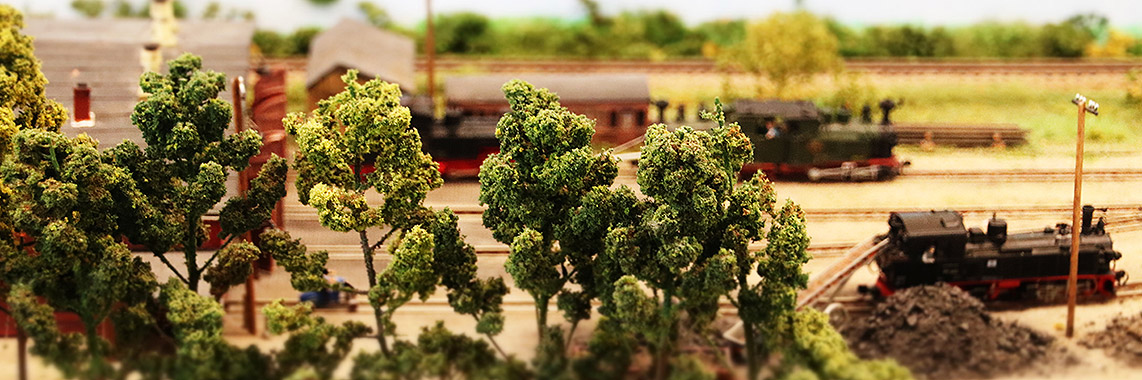
Model Plants for Realistic Landscape Design on Model Railways
Are you looking for model plants that make your model railway look significantly more natural, lively, and realistic?
Then you have come to the right place: with suitable model plants, you can design meadows, forest edges, gardens, railway embankments, and village or town scenes so that open areas become a believable miniature landscape with depth, structure, and atmosphere.
Choosing the Right Model Plants for Your Model Railway
Model plants are among the most important elements in landscape construction because they give a layout its natural liveliness. Without suitable deciduous trees, coniferous trees, bushes, hedges, and flowers, many scenes look too empty, too flat, or too technical.
This is exactly where the right planting shows how strongly it changes the overall effect. A finely designed group of trees, a dense hedge line, blooming garden areas, or a natural forest edge immediately bring more calm, depth, and credibility to the layout. That is precisely why this category is one of the most rewarding areas for beginners and experienced model builders.
For you as a buyer, this category is especially interesting if you want to refine landscapes, bring open areas to life, or make existing scenes more harmonious. With the right model plants, you create exactly the natural transitions that make a model railway look high-quality.
The wide variety is particularly attractive. This allows you to design rural branch lines, urban parks, front gardens, mountain landscapes, or railway embankments in a very targeted and harmonious way.
Why Are Model Plants So Important on a Layout?
Natural vegetation takes up a lot of space on almost every model railway layout. That is exactly why it is immediately noticeable when trees, hedges, or bushes are not designed convincingly. With well-chosen model plants, the entire layout appears calmer, more natural, and significantly higher in quality.
Many model railway enthusiasts appreciate this category because it can quickly create visible improvements. Even a believable forest edge, a small row of trees, or a few flowers by a house can turn a simple area into a harmonious scene with more atmosphere.
More Naturalness with Targeted Planting
Plants in particular are among the details that are seen especially often on a layout. That is why clean and suitable design is especially worthwhile here.
Which Model Plants Are Available?
The selection ranges from individual deciduous trees and coniferous trees to bushes and hedges, as well as fine flowers for gardens, meadows, and small everyday scenes. This makes it possible to create very different landscape impressions.
Deciduous trees are ideal for parks, village areas, avenues, and summer landscapes. Coniferous trees are perfect for mountains, forests, and winter scenes. Bushes and hedges provide natural boundaries and calm transitions. Flowers add extra colour and fine everyday details to garden and landscape areas.
This variety in particular makes the category so attractive. You can place individual plants selectively or use several variants to create entire landscape areas in a very harmonious way.
Typical Products at a Glance
| Product type | Typical use | Especially suitable for |
|---|---|---|
| Deciduous trees | Summer and natural vegetation | Village, park, avenue, landscape |
| Coniferous trees | Dense forest and mountain scenes | Mountains, forest, winter landscape |
| Bushes | Fine loosening up and transitions | Forest edge, embankment, garden, roadside |
| Hedges | Natural boundaries and structure | Front garden, property, park, edge of town |
| Flowers | Colourful and lively accents | Garden, meadow, village, station surroundings |
From a Group of Trees to a Small Flower Meadow
With the right model plants, you can design both large landscape areas and small detailed scenes in a believable way. That is exactly what makes this category so versatile.
Which Layouts Are Model Plants Especially Suitable For?
Model plants are suitable for practically every model railway because almost every layout contains natural areas, paths, properties, or landscape sections. Whether you are designing a rural branch line, an urban layout, a mountain route, or a small diorama – suitable plants make the difference.
They are especially effective at forest edges, on slopes, along railway embankments, in front gardens, on meadows, along roads, or in park areas. In precisely these places, the planting determines whether a scene appears calm and convincing or rather unfinished.
This category is also very interesting for existing layouts. Often, targeted retrofitting with a few bushes, a hedge, or a small group of trees is enough to make open areas appear significantly livelier and more natural.
Typical Areas of Use
| Layout area | Benefit |
|---|---|
| Forest edge and landscape | More depth and natural vegetation |
| Village and residential area | More everyday life and believable gardens |
| Mountains and hillside | More structure and landscape calm |
| Railway embankment and route | Better integration of the track route into the terrain |
| Diorama | Very strong effect in a small area |
Ideal for Natural Scenes and Calm Transitions
If your model railway should not only be built but also look genuinely alive as a landscape, model plants are among the most important design elements.
Which Products Are Especially Worthwhile for Beginners?
If you would like to start with model plants, simple and versatile products are especially recommended. These include deciduous trees, coniferous trees, bushes, and small hedges because these products are easy to place and immediately create a visible effect.
For beginners, it is often useful to start with a small area, such as a forest edge, a front garden, or a section of embankment. This makes it easy to see how strongly the effect of a scene can be improved with just a few plants. Anyone who wants to expand later can add flowers, larger groups of trees, or finer transitions.
If you want to create a visible eye-catcher right away, a small group of trees or a mixed combination of deciduous and coniferous trees is often a very good choice. These motifs immediately look natural and quickly bring more depth to the layout.
Recommendations for Getting Started
| Starter product | Why useful? | Typical use |
|---|---|---|
| Deciduous trees | Natural, versatile, and quickly effective | Village, park, landscape |
| Coniferous trees | Ideal for forest and mountains | Forest, slope, winter scene |
| Bushes | Very good for natural transitions | Forest edge, embankment, garden |
| Hedges | Practical for properties and calm structuring | Front garden, edge of town, park |
Better to Plant Selectively Than Too Much at Once
Especially with model plants, a deliberately chosen group often has a stronger effect than a distribution that is too uniform. This keeps the scene calm, clear, and believable.
Which Gauges Are Model Plants Suitable For?
Model plants are suitable for many common gauges and can be integrated very flexibly into different layout concepts. The selection is especially strong in classic gauges, but smaller scales also benefit greatly from finely placed vegetation.
Especially in smaller gauges, trees, bushes, and hedges create a particularly strong effect in a small space, while in larger gauges individual plants can appear very present and distinctive. That is why it is worth choosing not only according to the plant type, but also according to the desired effect in the overall layout scene.
Gauges in Comparison
| Gauge | Typical use | Advantage |
|---|---|---|
| H0 | Classic home layouts with many landscape details | Very large selection and strong visibility |
| N | Compact layouts with a fine landscape effect | High impact in a small area |
| TT | Compact but expressive planting scenes | Good balance of presence and space requirements |
| Z and others | Fine and specialised landscape projects | More freedom for individual scenes |
The Effect in the Landscape Is More Important Than Size Alone
A model plant should not only fit technically, but also be visually integrated harmoniously into the scene. This keeps the overall appearance calm and believable.
What Should You Look for When Buying?
When buying model plants, you should pay attention above all to the area of use, plant type, gauge, height, density, and later placement. These points help you choose a product that not only looks good, but also truly suits the layout.
Before buying, consider whether you mainly want to design a forest, village, garden, edge of town, or mountain landscape. This determines whether deciduous trees, coniferous trees, bushes, hedges, or flowers are more suitable. The surroundings also play an important role: a calm branch line often requires different vegetation than a park or a dense forest edge.
Those who choose deliberately usually achieve a strong effect with just a few suitable plants. Especially with planting, calm and logical integration is often the key to a convincing scene.
Important Selection Criteria at a Glance
| Criterion | Why important? |
|---|---|
| Area of use | Helps with choosing the right scene |
| Plant type | Determines the effect in the layout image |
| Gauge | Basis for scale and fit |
| Height and density | Important for a calm and natural appearance |
| Surroundings | Determines harmony and credibility |
| Effect | Helps when deciding between an accent and area design |
Choosing Well Means Planting Landscapes Sensibly
Model plants work best when they are logically integrated into terrain, paths, and the surroundings of buildings. This is exactly when a believable and high-quality model world is created.
Buy Model Plants and Make Your Model Railway More Natural
Whether deciduous trees, coniferous trees, bushes, hedges, or flowers: with the right model plants, you give your model railway more naturalness, more depth, and an especially believable landscape effect. This turns an open area into a lively scene with character.
With a deliberate selection according to gauge, plant type, and area of use, you will find exactly the products that suit your layout. This creates harmonious landscape scenes, more atmosphere, and lasting enjoyment of your model railway.