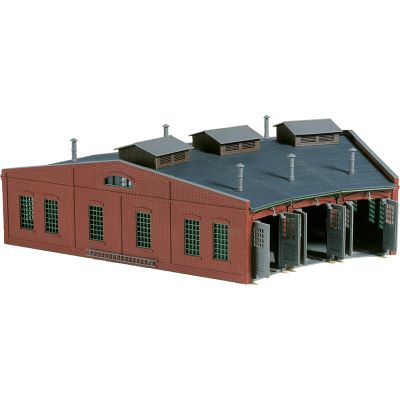
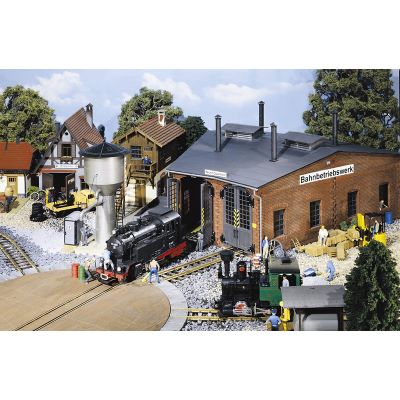
Stabling Locomotives
Locomotives wait under cover for their next duty. Each road can be reached individually via the turntable.


Roundhouses are among the most impressive buildings in a locomotive depot. Several locomotive roads fan out around a turntable, combining stabling, maintenance, servicing and visible shunting operation within one distinctive railway scene.
A roundhouse is a locomotive shed whose individual shed tracks converge radially or in a fan shape towards a common centre. A turntable is normally positioned in front of the building and distributes locomotives from the approach track to the individual locomotive roads.
Anyone wishing to plan a model railway roundhouse should therefore consider the building and turntable together from the beginning. Gauge and building size are important, but so are the angular spacing of the locomotive roads, the length of the turntable bridge and the length of the locomotives that will use the depot.
The main advantage of the prototype design is the relatively compact distribution of many shed tracks. Instead of connecting each locomotive road through a separate turnout ladder, the turntable distributes the locomotives. Steam locomotives that were preferably operated chimney-first could also be turned for their next duty.
Roundhouses were therefore especially common at locomotive depots during the steam era. Locomotives could be inspected, stabled and prepared for their next service. Water cranes, coaling facilities, sand supplies, ash pits, workshops and staff areas could all be positioned around the shed.
The building is only one part of the locomotive depot. Its full effect comes from the combination of turntable, locomotive roads and visible railway work.
Locomotives wait under cover for their next duty. Each road can be reached individually via the turntable.
Inspection pits, tools, staff and spare parts explain smaller maintenance jobs. Removable roofs make such interior scenes particularly attractive on a model railway.
The turntable in front of the roundhouse can both distribute and completely turn locomotives, creating an additional operational movement in its own right.
Several locomotive roads do not require a large turnout ladder. This produces the characteristic fan-shaped track geometry of historic locomotive depots.
Drivers, fitters, workbenches, lighting and open doors transform a building façade into a visibly active railway workplace.
Historic roundhouses can remain on layouts representing later eras as museums, workshops or vehicle halls. Historic buildings and modern rolling stock can therefore be combined convincingly.
Roundhouses often require more space than expected. In addition to the building itself, the turntable, approach track, servicing tracks and suitable clearances all need room. A full-size paper or cardboard template helps prevent space problems.
Measure the longest intended locomotive over the buffers. It must fit completely on the turntable bridge and inside the locomotive road. Tender locomotives are often the critical vehicles.
Current products include 7.5°, 9°, 12° and 15° arrangements. The smaller the angle, the more closely neighbouring track axes lie together and the more locomotive roads can form a broad arc.
Mark the centre of the turntable and draw the track axes radially. The roundhouse should only be positioned permanently after all intended track exits work correctly.
Keep space beside the roundhouse for the approach track, stabling tracks and at least a few servicing facilities. This makes the building appear part of a complete depot instead of an isolated kit.
The calculator shows the angular spread between the centreline of the first and last locomotive road. This makes it easier to compare roundhouses with different numbers of stalls.
The angle describes the spacing between adjacent radial track axes or locomotive roads. It is one of the most important compatibility characteristics of a model railway roundhouse.
| Spacing | Verified Current Example | Planning Effect |
|---|---|---|
| 7.5° | Fleischmann 9475 N | Closely spaced locomotive roads designed for Fleischmann turntable geometry. |
| 9° | Saxonia Modellbau Bw Dresden-Altstadt TT | Narrow fan geometry for a highly prototype-specific depot. |
| 12° | Märklin 72887 with turntable 74862 | Coordinated geometry for the current Märklin C-track turntable system. |
| 15° | Auhagen TT, Vollmer H0, Kibri H0, FALLER Z and Pola G | A wider track fan used by numerous classic roundhouse designs. |
Important: the same gauge does not automatically mean compatible geometry. An H0 roundhouse using 12° track spacing does not automatically match a turntable or roundhouse system designed around 15° exits. Always compare the specific product data.
For particularly prototype-orientated TT depot projects, the current range also includes the Saxonia Modellbau Bw Dresden-Altstadt roundhouse with 9° spacing and the TT version with 15° spacing . These two versions demonstrate why geometry should be selected before the building is purchased.
The turntable connects approach, servicing, stabling and roundhouse tracks. Its bridge must be long enough for the locomotives being used. At the same time, the arrangement of its track exits determines which roundhouse geometry can be connected logically.
Current model railway turntables are offered particularly for H0, N, TT and G. Powered versions provide motorised positioning, while simpler manual models are useful for small depots and dioramas. The Turntables category includes complete turntables, track exits and extension components.
One especially closely coordinated system combines Märklin 74862 with the three-road Märklin 72887 locomotive shed. Both use a 12° pitch. In N gauge, the Minitrix 66570 provides eight track connections and can be expanded to as many as 24 connections. Other roundhouses instead use 7.5°, 9°, 15° or other geometry.
During the steam era in particular, locomotives were prepared and maintained between duties. Depending on the location, this could include taking water, loading coal and sand, cleaning, disposing of ash, carrying out minor repairs and finally stabling the locomotive.
Complete turntables, track exits and extensions for H0, N, TT and G.
Coal bunkers, cranes and equipment for classic steam-locomotive depots.
Water cranes, water towers and other locomotive-depot buildings.
Interior and exterior lighting for sheds, workshops and night operation.
Drivers, firemen and workshop staff for understandable railway work scenes.
Materials for coal stores, working surfaces and dirty locomotive depot areas.
| Gauge | Scale | Current Possibilities | Planning Focus |
|---|---|---|---|
| Z | 1:220 | Five-road FALLER Freilassing roundhouse | Large locomotive-depot theme within a very small footprint. |
| N | 1:160 | Fleischmann and FALLER models with several locomotive roads | Combine a turntable and longer steam locomotives within a compact area. |
| TT | 1:120 | Auhagen and Saxonia Modellbau | Distinguish carefully between 9° and 15° geometry. |
| H0 | 1:87 | FALLER, Vollmer, Kibri, Märklin and further manufacturers | Largest product choice, but also significant space requirements. |
| 0 | approx. 1:45 | Specialist and scratch-built projects | Allow for very large radii and substantial building depth from the beginning. |
| 1 | 1:32 | Individual building and modular projects | The roundhouse itself becomes a dominant layout feature. |
| G / IIm | often approx. 1:22.5 | Expandable Pola roundhouse | Allow a very large footprint and a suitable G-gauge turntable. |
Decide which locomotives will actually be housed in the shed. Spare roads can be useful, but an oversized roundhouse can visually dominate a small layout.
Check 7.5°, 9°, 12° or 15° geometry as well as the bridge length. The specifications of the actual products are more important than general assumptions based only on gauge.
Draw the turntable, tracks and building outline on paper or cardboard. This reveals the real space requirement before the baseboard or scenery is altered.
Every locomotive should run from the turntable into its road without a lateral offset. Even small angular errors become clearly visible with long locomotives.
Removable roofs simplify interior detailing and later maintenance. Test all doors with the largest locomotive before the building is installed permanently.
Workbenches, tools, staff, lighting and a few spare parts are enough to make the area visible through open doors look actively used.
Locomotive servicing should lie along the route between the main line and the shed. Ballast, coal residue, fine dust and operating wear visually connect the buildings with the railway tracks.
Test the turntable, power supply, doors and all shed tracks completely before permanently closing the surrounding scenery.
The following current models demonstrate different scales, numbers of locomotive roads and track geometries. Availability information is deliberately not reproduced on this guide page.
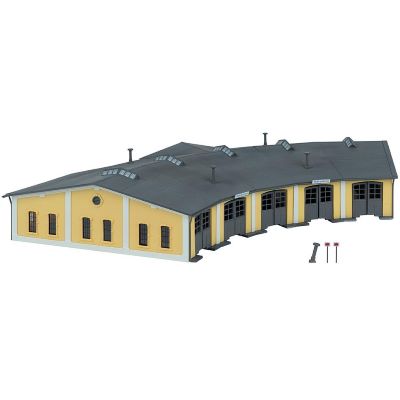
Five-road Z-gauge roundhouse with 15° spacing for locomotives up to approximately 120 mm long.
View Product →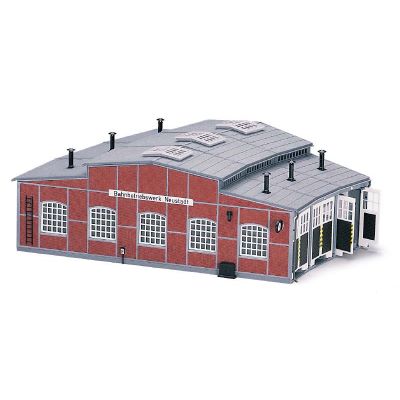
Classic N-gauge roundhouse with three locomotive roads, movable doors and 7.5° track exits for compatible Fleischmann turntable geometry.
View Product →
Three-road expandable N-gauge shed for locomotives up to approximately 180 mm long.
View Product →
Five-road model of the historic Freilassing roundhouse for locomotives up to approximately 290 mm long.
View Product →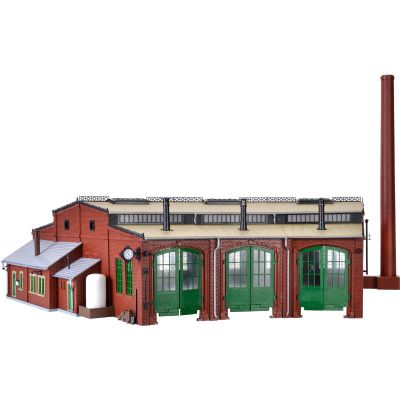
Three-road model based on the Horb locomotive depot with 15° geometry and a mechanical door-closing arrangement.
View Product →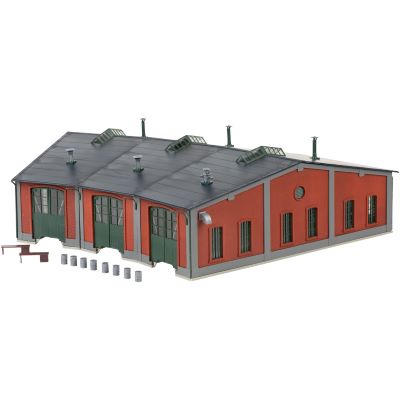
Three locomotive roads with approximately 300 mm usable internal length and 12° geometry for compatible Märklin and Trix turntables.
View Product →
Historic brick roundhouse based on the famous Ottbergen steam locomotive depot, with an expandable three-road basic unit.
View Product →
Powered N-gauge turntable with eight track connections, expandable to as many as 24 connections using additional edge segments.
View Product →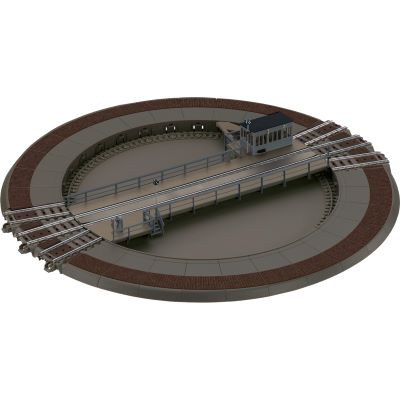
Digital H0 turntable with a 263 mm bridge and 12° track pitch, designed to match the Märklin 72887 locomotive shed.
View Product →When this section approaches the viewport, the finder checks current English product pages from Railway Facilities Building and Turntables. Products can be filtered by name, gauge, manufacturer, track spacing and product group. Recognised archive, B-stock and clearance pages are excluded, and no availability information is displayed.
Current roundhouse and turntable products will be loaded when this section approaches the viewport …
The roundhouse and turntable do not necessarily have to come from the same manufacturer. Gauge, track spacing, turntable bridge length and track-exit geometry are the decisive factors.






A convincing locomotive depot begins with a technically compatible system. Roundhouse, turntable, track exits and locomotive fleet should therefore be planned together before the buildings are permanently installed.
A roundhouse has several radially arranged locomotive roads that are normally reached using a central turntable. This creates the characteristic fan-shaped footprint.
Tracks in a conventional rectangular locomotive shed normally run parallel. In a roundhouse they are arranged at different angles around one common centre.
For typical prototypical operation, yes. The turntable distributes locomotives between the radial shed tracks and can also turn them completely.
It describes the angular spacing between neighbouring locomotive roads or track centrelines. The turntable exits must be compatible with this geometry.
Current products include examples with 7.5°, 9°, 12° and 15° track spacing. Compatibility should always be checked using the specifications of the particular products.
That depends on the available space and intended locomotive fleet. Three roads are already enough for a convincing small depot. Five or more roads create a much more imposing scene.
The longest intended locomotive must fit completely inside the shed road and on the turntable bridge. These two dimensions need to be checked independently.
Yes. FALLER offers the five-road Freilassing roundhouse in Z, while current N-gauge models include products from Fleischmann and FALLER.
Auhagen offers a three-road TT roundhouse with 15° spacing. Saxonia Modellbau also offers larger TT models representing Dresden-Altstadt with 9° and 15° geometry.
H0 offers the broadest selection, with current products from manufacturers including FALLER, Vollmer, Kibri and Märklin.
Lighting, workshop details, railway staff, inspection pits, subtly dirty working surfaces and a believable operating sequence from locomotive servicing via the turntable to the shed all improve the effect.
Yes. Historic roundhouses can remain in use as workshops, stabling halls or railway museums, making them plausible on layouts representing later eras.
Content and product links checked on . Please additionally check track spacing, locomotive length, turntable bridge length and turntable compatibility on the respective product pages.
Further detailed guides covering locomotive sheds, stations, signal boxes, track, scenery, gauges, digital technology and realistic railway operation can be found in the central Model Railway Guide.