Modellbahn Keks
Welcome!
Our cookies offer you a fast, relaxed and full-featured shopping experience. Some are necessary to operate the website and its functions. Others help us to improve our services. If you agree to this, simply consent to the use of cookies for preferences, statistics and marketing by clicking on "OK". Alternatively, you can deactivate individual cookies under "Customise cookies" or all cookies, except those required for the function of our website, under "Reject all".
NOCH autumn trees in yellow, red, brown and green shades for an autumn model railway landscape
Autumn Foliage · Forests · Fields · Golden Landscape

Create Autumn Scenery on a Model Railway

Yellow birches, red and orange deciduous trees, golden larches, harvested fields, increasingly dry meadows and fallen leaves transform a layout into an especially colourful and atmospheric model railway landscape.

Seasonal Transition Instead of a Uniform Orange Landscape

What Makes a Convincing Autumn Landscape?

Creating autumn scenery on a model railway does not mean colouring every existing tree red, orange and yellow at the same time. A natural seasonal impression comes from the combination of foliage that is still green, the first yellow leaves, stronger autumn colours, brown areas of ground and branches that are already becoming bare. Autumn is a transition, and the model landscape should show that transition as well.

It is particularly important to decide which part of autumn is being represented. In early September a landscape can still look largely like summer. During golden autumn, yellow, orange and red deciduous trees dominate. By late autumn, the canopies become more open, grass turns duller and browner, while considerably more fallen leaves collect on the forest floor, beside paths and in gardens.

Evergreen firs, spruces and pines retain their basic green appearance and form an important contrast with deciduous trees. Larches are an attractive exception: their needles turn golden yellow and add considerable variety to mixed woodland. This contrast is especially effective along mountain railway routes.

Ground surfaces and agriculture also change. Fields may already be harvested, show stubble or contain freshly cultivated soil. Meadows become more muted and contain increasing amounts of beige and golden grass. Fallen leaves collect beneath trees. Autumn scenery therefore brings fields and meadows , forests and agriculture especially closely together.

One Point in the Season Creates a Coherent Overall Scene

Early Autumn, Golden Autumn or Late Autumn?

The most important design decision is the exact point within the season. Once this has been selected, trees, grass, fields and ground can be coordinated logically.

Early Autumn

Much of the summer green remains. The first birches, larches and individual deciduous trees turn yellowish. Meadows remain relatively green but can already contain fibres in old-gold shades. This stage is particularly suitable when an existing summer layout is to be converted gradually into autumn.

Golden Autumn

The colours can now become considerably stronger. Yellow, orange, rust red and reddish brown take centre stage. It remains important to include some green trees and evergreen conifers. This produces a colourful forest without making it look like one continuous orange decorative surface.

Late Autumn

Brown and earth colours become increasingly important. Canopies become more transparent, leaves lie on the ground and tall grass appears beige or straw-coloured. Bare branches, dark damp soil and individual remaining yellow leaves are especially convincing at this stage.

Tell the Season Through Specific Scenes

Autumn Scenes for Forests, Villages, Railways and Agriculture

Several different scenes make a layout lively. The important point is that all of them should represent approximately the same stage of autumn.

Golden Mixed Forest

Deciduous trees in green, yellow, orange and red are combined with darker conifers. Different tree heights and partially open canopies create depth and prevent large uniform blocks of colour.

Fallen Leaves on a Railway Embankment

Fallen leaves can collect beneath trees around the embankment toe and in shallow slope depressions. Vegetation immediately beside sleepers and the ballast shoulder should remain more restrained so that the railway area still looks maintained and technically believable.

Harvested Field

Stubble, rows of soil, vehicle tracks and occasional straw bales show that the harvest has finished. A freshly cultivated field also creates an effective dark contrast with colourful trees and pale dry meadows.

Autumn Park

Individual large specimen trees, benches, paths and small piles of leaves are ideal for urban and village scenes. Fallen foliage can be clearly visible on paths and lawns without covering every part of the surrounding scenery.

Orchard After the Harvest

Fruit trees, fallen leaves, occasional fruit and a meadow that is becoming more muted create a calm rural scene. A field track or small farm connects the orchard naturally with the agricultural surroundings.

Damp Forest Edge

Dark earth, moss, brown leaves and individual green bushes suit shaded areas particularly well. Beside a stream vegetation can remain green for longer than on sunny slopes.

Design tip: do not distribute autumn colours according to a regular pattern such as one red tree, one yellow tree and one green tree. Small groups of similar shades together with occasional standout trees look more natural. Repeat the same colours elsewhere on the layout to create one coherent landscape.

Bright Colours Need Calm Counterpoints

The Colour Palette for a Believable Model Railway Autumn

Autumn colours are particularly powerful because they contrast strongly with ballast, buildings and railway vehicles. Neutral areas are therefore essential. Brown earth, grey paths, green coniferous woodland and muted meadows prevent yellow and orange from dominating the complete layout.

Remaining Green
Golden Yellow
Orange
Autumn Red
Reddish Brown
Old Gold
Damp Earth
Build Up Leaves, Grass and Ground in Layers

Combine Autumn Vegetation Naturally

1

Make the Ground Darker and More Earthy

Ground
Fallen leaves need a believable surface underneath

Prepare forest floors, paths and less vegetated areas using several brown and earth colours. Fallen leaves can then be spread loosely without having to cover every visible surface.

2

Retain Some Summer Green

Transition
Not every plant changes colour at the same time

Early autumn is especially convincing when some existing summer vegetation remains. Add yellowish grass fibres and the first autumn-coloured trees instead of completely rebuilding every green area.

3

Group Tree Colours

Forest
Use colour transitions instead of random individual points

A forest can, for example, change gradually from green through yellow to reddish brown. Repeat several shades within the group. Evergreen conifers and golden-yellow larches create additional structure.

4

Use Fallen Leaves Sparingly

Ground Texture
More leaves collect beneath trees than in the middle of open meadows

Suitable locations include the forest floor, gardens, path edges, ditches and areas protected from wind. Yellow, red, orange and brown foliage materials can be mixed to create natural blends and small leaf piles.

5

Break Up Meadows with Old Gold and Beige

Grass
Late autumn becomes more muted and strongly textured

Combine short green base fibres with early-autumn, old-gold, hay and late-autumn shades. Longer fibres suit forest edges, ditches and lightly maintained embankments.

6

Change Agriculture with the Season

Harvest Time
Fields create large and calm areas of colour

Harvested fields, stubble and dark cultivated soil strengthen the autumn impression more effectively than additional brightly coloured decoration. Vehicles and figures should then be placed only where a clear activity is taking place.

Autumn Scenery from Z Gauge to Garden Railways

Select Autumn Materials to Match the Gauge

Grass flock, loose leaves, foliage flakes and many ground-cover materials can be used across several model railway scales. Ready-made trees, tall bushes and visible individual leaves should nevertheless match the proportions of the chosen scale.

Gauge / Scale Particular Strength Autumn Recommendation
Z · 1:220 Extensive scenery within minimal space Use very fine foliage and small colour groups rather than coarse individual leaves.
N / Nm · approx. 1:160 Long forest routes and broad landscapes Create colour transitions using many smaller tree canopies.
TT · 1:120 Balance between broad scenery and detail Combine trees, fields and leaf-covered ground into larger coherent scenes.
H0 / H0e / H0m / H0f · 1:87 Very large choice of vegetation products Model individual trees, leaf piles, branches and several grass lengths in detail.
0 / 0e / 0m · approx. 1:45 Strong close-up visual impact Create more open canopies and refine ground layers especially carefully.
1 · 1:32 Fine individual trees can become the main feature Pay particular attention to tree species, branch structure and individual foliage colour.
G / II / IIm Combination of model scenery with real vegetation Combine weather-resistant scenery products with suitable real garden plants on outdoor layouts.
From Summer Green to a Golden Model Railway Autumn

Create Autumn Scenery in Eight Steps

Step 1 · Choose the Point in the Season

Select Early, Golden or Late Autumn

First decide how far the seasonal transition has progressed. This decision determines the grass colour, quantity of fallen leaves, appearance of tree canopies, fields and ground surfaces.

Step 2 · Prepare the Ground

Give Soil, Forest Floors and Paths Darker Texture

Brown and ochre shades create the base. Especially in late autumn, the ground should be visible more often between grass, bushes and tree trunks than in dense summer scenery.

Step 3 · Modify the Grass

Mix Green with Early Autumn, Hay and Old Gold

Do not use only brown fibres. Small areas of remaining green add depth. Long straw-coloured blades work especially well beside forest edges, ditches and uncut areas.

Step 4 · Colour Groups of Trees

Use Several Autumn Shades Instead of One Orange

Yellow birches, reddish oaks, golden larches and still-green trees together create a much more natural mixed forest. Repeat some colours within the same group to connect the overall scene.

Step 5 · Add Fallen Leaves

Concentrate Them in Areas Protected from Wind

More foliage can collect beneath tree canopies and beside walls, fences and paths. Several small leaf piles look more convincing than one uniform closed scattering layer across the complete layout.

Step 6 · Adapt the Fields

Make the Harvest and Cultivated Soil Visible

Combine harvested areas with stubble, vehicle tracks and freshly worked soil. These large calm landscape surfaces provide balance between colourful woodland and settlements.

Step 7 · Add Small Scenes

Use Hikers, Gardening and Harvesting Deliberately

Figures should have a recognisable activity. A hiker on a forest path, people raking leaves or a tractor beside a field communicate the season much more effectively than figures placed randomly.

Step 8 · Check the Colour Balance

View the Layout from a Normal Distance

If everything looks too orange, add green, brown and neutral surfaces. If the scene is too dark, a few yellow or golden individual trees are often enough to guide the eye and restore the autumn atmosphere.

Common Mistake: Every Tree Has the Same Degree of Autumn Colour

Tree species, location, light and timing all influence foliage colour. Even in a clearly autumnal forest, green, yellow, orange, red and already partially bare trees stand side by side. This lack of perfect synchronisation is one of the most important tools for creating natural autumn scenery.

Select Products by Landscape Layer

Products for Autumn Trees, Leaves, Meadows and Forest Floors

Autumn scenery combines ready-made trees with grass fibres, foliage, bushes and ground materials. Several different product categories should be combined to achieve a varied and believable result.

NOCH 25070 set of seven autumn-coloured model trees
NOCH · H0/TT · Trees

NOCH 25070 Autumn Trees

Seven differently coloured trees for woodland, parks and trackside autumn scenery.

View Product →
HEKI 2000 autumn forest set with ten autumn-coloured model trees
HEKI · H0 · Forest

HEKI 2000 Autumn Forest

Ten trees in different sizes for larger autumn woodland groups.

View Product →
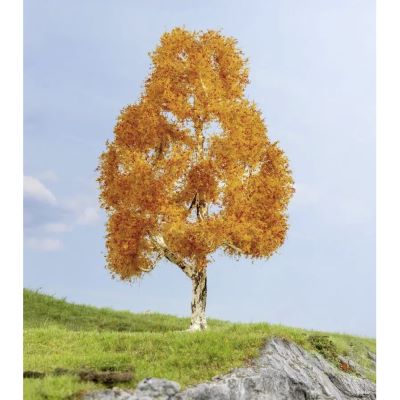
NOCH 20114 autumn oak with red, yellow and orange foliage
NOCH · All Gauges · Oak

NOCH 20114 Autumn Oak

Distinctive specimen tree for golden-autumn scenery, parks and forest edges.

View Product →
NOCH 20129 autumn birch with yellow foliage
NOCH · All Gauges · Birch

NOCH 20129 Autumn Birch

Fine yellow autumn tree for forest edges, paths and parks.

View Product →
NOCH 20167 autumn larch with golden-yellow needles
NOCH · All Gauges · Larch

NOCH 20167 Autumn Larch

Golden-yellow conifer for mixed woodland, slopes and mountain railway routes.

View Product →
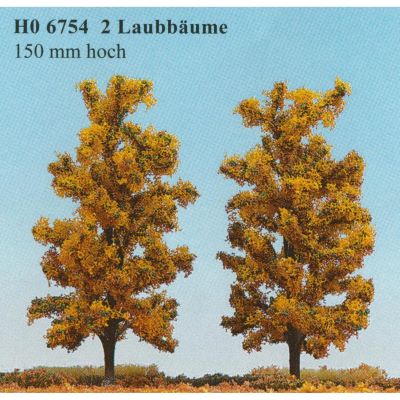
Busch 6754 autumn-yellow deciduous trees for H0
Busch · H0 · Deciduous Trees

Busch 6754 Autumn-Yellow Trees

Two larger trees for bright yellow foreground accents.

View Product →
Busch 3609 set of three autumn-coloured model railway bushes
Busch · H0 · Bushes

Busch 3609 Autumn Bushes

Yellow, orange and reddish shrubs for paths and forest edges.

View Product →
NOCH 07168 autumn leaves set in yellow, red, reddish brown and orange
NOCH · All Gauges · Leaves

NOCH 07168 Autumn Leaves Set

Four foliage colours for trees as well as forest floors and small piles of fallen leaves.

View Product →
HEKI 1682 autumn-brown leaf foliage for model railway vegetation
HEKI · All Gauges · Foliage

HEKI 1682 Autumn-Brown Leaf Foliage

Flexible foliage material for trees, undergrowth, forest edges and late-autumn scenery.

View Product →
HEKI 1566 autumn foliage flakes for trees and forest floors
HEKI · All Gauges · Foliage

HEKI 1566 Autumn Foliage Flakes

Yellowish foliage flakes for tree canopies, shrubs and autumn ground areas.

View Product →
Silhouette 002-23 2 mm early autumn grass flock
Silhouette · All Gauges · Early Autumn

Silhouette 002-23 Early Autumn

Short fibres for the transition from summer-green to autumn meadows.

View Product →
Silhouette 004-24 4.5 mm late autumn grass flock
Silhouette · All Gauges · Late Autumn

Silhouette 004-24 Late Autumn

Longer fibres for muted meadows, forest edges and overgrown embankments.

View Product →
Current Products Directly from Suitable Shop Categories

Filter Autumn Products and Load More Dynamically

When this section approaches the viewport, the finder checks current products from tree, grass, bush and foliage categories. Products can then be filtered by search term, gauge, manufacturer, autumn stage and product group. Detected archived items are excluded and availability information is deliberately not shown on product cards.

Suitable autumn products will be loaded when this section approaches the viewport …

Manufacturer Worlds at Modellbahnshop

Manufacturers for Autumn Model Railway Vegetation

Ready-made autumn trees and loose scenery materials from different manufacturers can be combined particularly effectively. Differences in colour and texture prevent vegetation from looking artificially uniform.

Autumn Often Looks More Natural When Several Manufacturers Are Mixed

Combine high-quality specimen trees with more economical woodland sets, self-foliated background trees and several different grass fibres. This creates different canopy shapes, colour intensities and vegetation heights.

Open Manufacturer Overview
Frequently Asked Questions About Autumn Scenery

Questions About Autumn on a Model Railway

These answers cover autumn colours, fallen leaves, grass, woodland, agriculture, gauges and converting an existing summer landscape.

Which Colours Suit an Autumn Landscape?

A natural combination retains some green and, depending on the stage of autumn, adds yellow, gold, orange, red, reddish brown, beige and darker earth colours. Too many equally intense colours quickly look artificial.

How Does Early Autumn Differ from Golden Autumn?

During early autumn most vegetation can still remain green, with the first yellow and golden shades appearing only in selected areas. During golden autumn the foliage colours become much stronger and orange, red and reddish brown become increasingly important.

How Do You Create a Realistic Autumn Forest?

Combine different tree species, heights and colour stages. Some trees remain green while others turn yellow, orange or red. Coniferous trees create darker contrasts, while fallen leaves, earth and undergrowth complete the forest floor.

Should Fallen Leaves Be Spread Everywhere?

No. The most plausible areas are beneath trees, at forest edges, beside paths, in gardens, hollows and other places protected from wind. Leaves should be used much more sparingly on open meadows and immediately beside the track.

Which Grass Colour Suits Autumn?

Early autumn can still contain plenty of medium green. Later in the season, old gold, hay, beige and muted green shades become suitable. Several colours and fibre heights look much more natural than one continuous brown grass surface.

Which Trees Are Especially Interesting for an Autumn Layout?

Birches create distinctive yellow accents, oaks provide stronger warm colours and larches add golden-yellow coniferous areas. Mixed tree sets are useful for building larger woodland scenes economically and with plenty of visual variety.

How Do You Represent Late Autumn on a Model Railway?

Tree canopies become thinner, the forest floor becomes more visible and meadows appear more muted. More fallen leaves, bare branches, dark-brown soil and straw-coloured grasses communicate the transition towards winter.

Can a Summer Layout Be Converted into an Autumn Layout?

Yes. Existing green trees can remain in part. Add individual autumn trees, yellowish grass fibres, fallen leaves and harvested fields. This creates a believable seasonal transition without rebuilding the entire layout.

Which Autumn Scene Works Well on a Small Layout?

One autumn-coloured specimen tree beside a station, a small tree group on a railway embankment, a harvested field or fallen leaves beside a woodland path needs little space while communicating the season very clearly.

Can Autumn Materials Be Used for Every Model Railway Gauge?

Grass flock, foliage and many scatter materials can generally be used across several gauges. Ready-made trees and larger bushes should nevertheless match the represented scale in both height and visible structure.

Content updated on . Please additionally check dimensions, gauge assignments and processing instructions on the respective product page.

Discover More Landscape and Model Railway Topics

The central guide connects seasonal landscapes with meadows, forests, water, mountains, railway embankments, layout planning, gauges, rolling stock and technology.

Open the Model Railway Guide