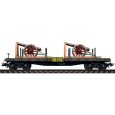
Brawa 50571 Staubbehälterwagen Ucs 908 "akw" der DB AG, Ep. V

Delivery time: 1 ‐ 2 business days (Germany)
Check availability in store:
- Oberwiesenthal: not on stock *
- Store Oschatz: can be picked up immediately
- * The product can be delivered to this store within 2-4 business days. Simply select the "Pickup to Store" type of delivery during the checkout prozess.

Share with friends:
Brawa 50571 Staubbehälterwagen Ucs 908 "akw" der DB AG, Ep. V Product Details
BRAWA presents an H0 model of the DB AG dust container wagon Ucs 908 "akw" with the road number 21 80 910 5 876-6 from Era V. The wagon impresses with many lovingly placed details and features, making it a unique model and a highlight on any model railway layout. The model has close coupling kinematics in accordance with the NEM standard, brake shoes at wheel level and individually applied tank covers and valves.
Information about the prototype: The German Federal Railroad (DB) developed a new 2-axle storage container car with two upright containers together with the Waggonunion. Westwagon delivered the first ten wagons to the DB for testing in 1953. As they still had a Hik brake system, they were designated Kd 54. In addition, like the following 150 wagons, which came from Talbot and Westwaggon, they had a double hook running gear. As this led to problems in conjunction with the very special underframe construction, all subsequent deliveries were fitted with a running gear with single hooks. After just 50 wagons, the container volume was increased to 2 x 13.5 m³. The wagons proved to be very successful, so that a total of 1232 Kds 54 were procured by 1965. At the same time, 1293 Kds 56 wagons with 2 x 17.5 m³ containers were built for lighter dust goods. Due to the 4 m³ larger containers, these wagons were correspondingly higher. To secure parked wagons, some of the Kds 54/56 had a platform-operated handbrake. In contrast to the other new DB freight wagons, in which the handbrake platform was bolted to the underframe, it was directly integrated here. As a result, the length over buffers (LüP) of the wagons equipped in this way remained unchanged and only the tare weight increased. Measured against the total number of over 2,500 wagons built, equipping the Kds 54/56 with a handbrake was relatively rare. With the introduction of the 12-digit UIC number, the Kds 54 were renumbered as Ucs 908. Similarly, the Kds 56 became Ucs 909, and both types formed the backbone of the DB's accumulated freight wagons for many years. The first disposals took place in 1967 when 86 wagons were sold. Further sales to EVA and VTG followed in later years. In the 1990s, DB AG transferred most of its wagons to its subsidiary MEG. The remaining DB AG wagons were mostly leased out or used, for example, for the internal transportation of brake sand for traction units. In addition to cement, the wagons also transported various other powdery goods over the years. These include, among others: Stone powder, quartz sand, kieserite, gypsum, sodium sulphate, Thomas sulphate, sugar, salt, aluminum hydroxide. The wagons were then usually permanently based at a station.
Features:
- Gauge: H0
- Era: V
- Length over buffers: 98.2 mm
- Exchange set for alternating current: 2187
- Road number: 21 80 910 5 876-6
- Variants without handbrake and with handbrake platform
- Individually attached container covers and valves
- Brake shoes at wheel level
- Individually attached steps and steps
- Fine printing and paintwork
- Extra axle brake linkage
- Extra attached brake system
- Close coupler kinematics according to NEM standard
Specs:
- Type: Dustbin trolley
- Gauge: H0
- Rail Company: DB AG
- Era: V
- Color: Grey
- News: 2022
Further links:
CAUTION: Not suitable for children under 3 years. Danger of swallowing! Age recommendation from 14 years.
Achtung! Maßstabs- und originalgetreue Kleinmodelle sowie Elektrozubehör für erwachsene Sammler. Nicht geeignet für Kinder unter 14 Jahren
Zum Betrieb des vorliegenden Produkts darf als Spannungsquelle nur ein nach VDE 0570-2-7/DIN EN 61558-2-7 gefertigter Spielzeug-Transformator verwendet werden.