Modellbahn Keks
Welcome!
Our cookies offer you a fast, relaxed and full-featured shopping experience. Some are necessary to operate the website and its functions. Others help us to improve our services. If you agree to this, simply consent to the use of cookies for preferences, statistics and marketing by clicking on "OK". Alternatively, you can deactivate individual cookies under "Customise cookies" or all cookies, except those required for the function of our website, under "Reject all".
Snow-covered winter scenery on a model railway with trees, buildings and seasonal details
Scenery Construction · Snow · Ice · Winter

Snow & Winter Scenery for Model Railways

Fresh powder snow, drifted embankments, frozen streams, snow-covered firs, winter figures and an atmospheric Christmas market can transform a model railway into a believable winter world. Here you will find materials, techniques and suitable products for small dioramas as well as complete layouts.

Winter Scenery Construction

What Makes Realistic Model Railway Winter Scenery?

Snow and winter scenery for model railways involves much more than covering the complete layout in white. In the real world, snow remains for different lengths of time depending on the surface. Roofs and meadows can be deeply covered, while railheads, driven roads and frequently used paths remain partly clear. Drifts form on embankments, irregular patches appear beneath trees, and damp areas can include ice, slush or frozen remains of old snow.

A convincing layout is best built in several layers. A muted base in light grey or earthy tones prevents unnatural gaps from showing through. Snow paste can then shape the terrain, while fine powder snow or snowflakes create the final surface. Small amounts of glitter or crystal effects can be added to frozen areas. Tracks, vegetation, figures and small everyday scenes follow afterwards.

Winter scenes work with many different model railway themes: a rural branch line in the hills, a Swiss mountain railway, a snow-covered station, a Christmas market or a modern main line. Further basic scenery techniques can be found in the Model Railway Scenery Guide .

Powder, Paste and Flakes

Create Realistic Snow on a Model Railway

Different snow materials perform different tasks. A convincing result is normally created by combining several textures instead of covering everything with one uniform material.

1

Powder Snow for Fine Surfaces

Fine snow powder works well for freshly fallen snow on meadows, paths, roofs and relatively flat terrain. Several thin applications look more natural than one heavy layer. Small irregularities in the surface can remain visible.

2

Snow Paste for Depth and Drifts

Paste can be modelled precisely. It can create snow piles beside roads, drifts along walls, irregular embankments or compacted snow on platforms. A final layer of fine snow powder helps blend the modelled paste into the surrounding scenery.

3

Use Crystals and Glitter Sparingly

Snow glitter and crystals create small light reflections. They work especially well on frozen areas or selected sunlit patches of snow. Too much glitter across an entire landscape can quickly look artificial.

Open the Complete Winter Category

Browse snow powders, pastes, winter trees, Christmas market scenery, lighting and other winter products together.

Winter & Christmas
Frozen Water

Ice, Icicles and Frozen Water Surfaces

A frozen stream or lake should not have exactly the same colour everywhere. Muted blue, grey and green tones can remain visible beneath transparent or milky ice layers. Snowy banks, small open areas and matt transitions connect the frozen surface naturally with the surrounding landscape.

How Can Model Ice Look Believable?

Begin with a smooth water surface that has already been coloured. Transparent materials create depth, while very thin white or matt layers suggest frozen water. Icicles work well below rock overhangs, roofs, bridges and wall edges. Snow paste can then blend the transition between the bank and the ice.

For additional materials and techniques for open and frozen water, explore the model water and scenery products in the English shop.

Trees and Vegetation

Create Snow-Covered Forests, Firs and Winter Bushes

Vegetation turns a white surface into a landscape. Plant structure is especially visible in winter: bare deciduous trees reveal fine branches, conifers carry snow unevenly and low bushes partly emerge through the snow cover.

A

Coniferous Forest

Snow-covered firs and spruces quickly create a continuous winter forest. Vary tree heights and spacing to avoid the appearance of a uniform plantation. Sheltered sides of trees can carry slightly more snow.

B

Bare Deciduous Trees and Bushes

Winter trees without dense foliage allow paths, buildings and railway lines to remain more visible. Small shrubs should not disappear completely beneath the snow. Individual branches and dry plant remains provide additional depth.

Discover more trees, bushes and vegetation for layered forest scenery in Model Plants and Bushes .

Life in the Winter World

Stage Winter Sports, Stations and Christmas Markets

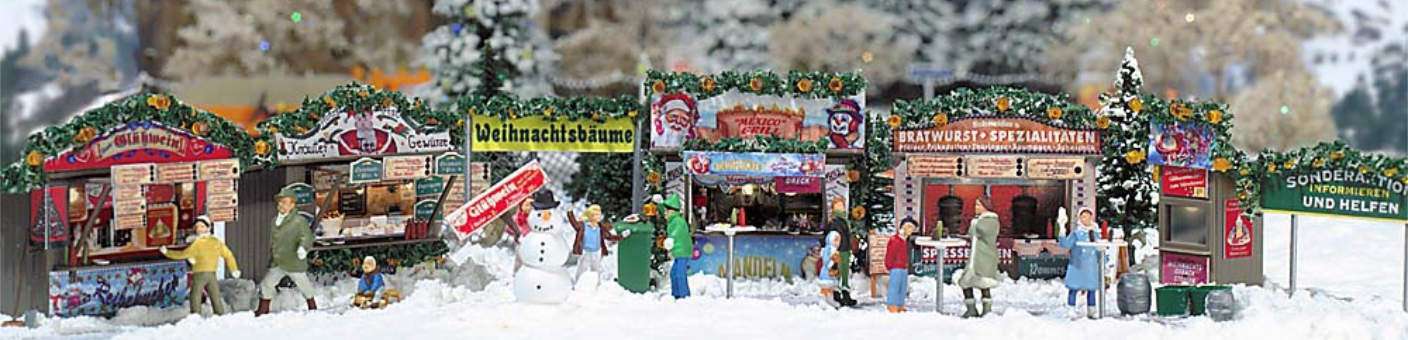
Figures and small actions clearly establish the season. Children in the snow, skiers, walkers, winter workers and illuminated Christmas markets work especially well when each scene remains compact and fits its surroundings.

Less White Often Looks More Realistic

Convincing winter scenery needs contrast. Platform edges, cleared roads, used track, timber, rocks, walls and vegetation can remain visible. These interruptions make the snow appear deeper and more effective.

From Z Gauge to Gauge II

Which Winter Scenery Works for Which Gauge?

Snow itself has no model scale. Trees, figures, buildings, vehicles and visible material grain must nevertheless match the chosen model size. Coarse flakes can quickly look oversized in smaller gauges.

Gauge Scale Winter Scenery Especially Suitable For
Z 1:220 Very fine powders and restrained textures Large snow areas and small dioramas
N 1:160 Fine snow cover, small trees and figures Long winter routes and mountain scenery
TT 1:120 Good balance between texture and broad surfaces Branch lines, uplands and towns
H0 / H0e / H0m 1:87 Very broad selection of scenery accessories Alpine railways, stations and Christmas markets
0 / 0e approx. 1:45 Clearly visible tracks and fine surface details Dioramas and highly detailed scenes
1 1:32 Large plants and detailed snow structures Modules and premium individual scenes
G / IIm typically approx. 1:22.5 Large, robust scenery elements Garden railways and large narrow-gauge scenes
II 1:22.5 Particularly three-dimensional detail Large modules and dioramas

For garden railways, use only materials and decorations suitable for the planned outdoor environment. Compare all model sizes in the Model Railway Gauge Comparison .

Step by Step

How Do You Build Winter Scenery on a Model Railway?

1

Plan the Winter Scene First

Basic Decision
Fresh Snow, Thaw or Deep Winter?

Decide whether the complete layout should be deeply covered or only partly wintery. Before applying material, define cleared roads, platforms, tyre tracks, forests and deeper snow zones.

2

Prepare the Base

Colour Effect
Do Not Use Pure White as the Only Base Colour

A matt base in light grey, earth or muted winter tones prevents obvious gaps. Rocks, walls, paths and vegetation should be finished before the final snow layers are applied.

3

Apply Snow in Layers

Surface
Control Thin Applications

Apply snow adhesive or another suitable scenery medium to small areas and distribute fine powder snow. Further layers can be added after drying, making depth and transitions easier to control.

4

Model Snowdrifts

Terrain Structure
Snow Does Not Accumulate Equally Everywhere

Apply snow paste irregularly along walls, fences, embankments and roadsides. A fine powder layer over the dried paste visually connects the modelled snow with the surrounding terrain.

5

Keep Track and Paths Operational

Railway Operation
Do Not Block Functional Areas

Railheads, turnout blades, electrical contacts and moving parts must remain reliable. Visually, snow and ice can reach close to the track, while technically important surfaces remain clear. Roads should receive suitable tyre and snow-clearing tracks.

6

Add Winter Life

Fine Details
Tracks and Footprints Tell the Story

Trees, bushes, icicles, figures, vehicles and lighting complete the scene. Footprints should lead logically towards figures, snow piles should correspond with cleared paths, and a Christmas market needs room for visitors rather than untouched snow everywhere.

Practical Knowledge

Avoid Common Snow and Winter Scenery Mistakes

Everything Is Completely White

Visible rocks, timber, vegetation, paths and cleared areas create contrast and make snow more convincing.

Texture Is Too Coarse

In Z, N and TT especially, use fine material. Large flakes can look like coarse ballast at small scales.

Uniform Snow Depth

Wind, traffic and vegetation change the snow cover. Drifts and thinner areas produce more natural relief.

Covering Railway Mechanisms with Snow

Do not permanently glue scenery material onto turnout blades, electrical contacts, railheads or sensitive moving mechanisms.

Directly from the Current Webshop

Find Snow, Winter and Christmas Products Intelligently

The product finder reads the current English “Christmas Landscaping” category directly from Modellbahnshop. Search by product name, manufacturer, gauge or application. Smaller webshop preview images are automatically replaced with the 400-pixel product-image version.

Showing the checked winter selection. Current webshop products will be loaded when this section is reached.
Manufacturer Worlds

Brands for Snow, Winter Scenery and Figures

Select a manufacturer logo to open the corresponding English brand world at Modellbahnshop.

Discover further scenery, figure and accessory manufacturers in the Model Railway Manufacturers Overview .

Frequently Asked Questions

FAQ About Snow and Winter Scenery on Model Railways

These answers cover material selection, snow depth, ice effects, gauges and reliable operation of a winter model railway.

Which material is suitable for model railway snow?

Powder snow works well for a fine snow covering. Snow paste is better for drifts, snow piles and sculpted transitions. Both can be combined and supplemented with restrained crystal or glitter effects.

Which is better: powder snow or snow paste?

Neither material replaces the other. Powder snow creates a fine surface, while snow paste adds volume. For realistic winter scenery, model the terrain first and use a thin powder layer as the final surface.

How do you put snow on model railway trees?

Snow should mainly remain on horizontal and sheltered areas. Ready-made snow-covered firs are especially convenient. When creating your own winter trees, use suitable adhesive and fine snow material sparingly so that branches and tree structure remain visible.

How do you create a frozen model railway lake?

First colour the base in muted blue, grey and green tones. Transparent or slightly matt layers can then create the ice effect. Irregular snowy areas around the banks and differences in surface gloss make the lake more believable.

Can snow be placed directly on model railway track?

Scenic snow can reach close to the track. Railheads, turnout blades, contacts and moving components should nevertheless remain free of permanently adhering material. Test turnouts carefully after every construction stage.

Which gauge is especially suitable for winter scenery?

Every gauge is suitable. N and Z allow extensive landscapes in limited space, TT provides a balanced compromise, H0 offers a particularly broad selection of accessories, and G is suitable for large-scale scenes. H0e and H0m work especially well for mountain and narrow-gauge railways.

How can a winter layout look realistic rather than purely Christmas-themed?

Focus on natural winter features: varying snow depth, bare vegetation, cleared roads, tyre tracks, ice and muted colours. Christmas trees and market stalls can then be added as one specific scene instead of dominating the entire layout.

Which scenes work well on a snow-covered model railway?

Suitable scenes include railway stations, winter service vehicles, walkers, skiers, children in the snow, snow-covered forest paths, Christmas markets and small winter-sports areas. Figures and tracks should form logical groups.

Can winter scenery remain permanently on the layout?

Yes. Winter can be used as a permanent layout theme, especially for mountain, Alpine, Christmas and narrow-gauge railways. If seasonal variation is preferred, Christmas markets, figures and illuminated items can be installed on removable scenery sections.

What is important for G-gauge winter scenery in the garden?

Buildings, electrical equipment, decoration and scenery materials used outdoors must be suitable for the expected weather conditions. Real temporary snow can create an attractive scene, while permanent model-snow products should only be used according to the manufacturer's instructions.

Create Your Own Winter World

Combine snow, ice, winter trees and suitable scenes into a believable landscape and discover matching products directly at Modellbahnshop.

Discover Winter Products

From Winter Scenery to a Complete Model Railway Project

Gauges, layout planning, track, digital technology, vehicles, scenery construction, maintenance and further topics are collected in the central guide world.

Open the Model Railway Guide