
BLS Model Railway – Swiss Railway Classics for H0, TT and N
Bern–Lötschberg–Simplon as a Prototype for Model Railways
BLS stands for Bern–Lötschberg–Simplon and is one of the best-known names in Swiss railway history. Anyone designing a model railway with an alpine character, long ramps, electric locomotives, freight traffic, car shuttle trains or modern regional trains will find BLS a particularly versatile prototype. The railway connects the Bern region, the Bernese Oberland, Valais and international north-south traffic in an impressive way. For model railway enthusiasts, this theme is especially appealing because historic brown electric locomotives, modern green and silver BLS machines, BLS Cargo locomotives in the Alpinists design and suitable passenger or freight wagons can be combined into believable train formations.
BLS is not just a name on a locomotive, but an entire railway theme. On a layout, it creates mountain routes with tunnels, stone viaducts, avalanche galleries, marshalling yards, car shuttle terminals and connections to international freight traffic. These models are especially suitable for model railway scenes set in Switzerland, but also for layouts showing traffic between Germany, Switzerland and Italy. Anyone focusing on locomotives will find further basics for building a coherent fleet on the locomotives landing page.
Why BLS Models Are So Popular
BLS models combine several collector interests: classic Swiss electric traction, distinctive colour schemes, modern digital and sound models and a highly individual route profile. The Lötschberg axis was closely associated with powerful electric locomotives from an early stage. This makes BLS especially exciting for fans of electric traction. While historic locomotives such as Ae 6/8, Ce 4/4 or Re 4/4 shape the character of older eras, Re 420, Re 465, Re 485 and Vectron variants stand for modern operations. BLS Cargo also brings international freight trains into play, which can be ideally combined with container wagons, tank wagons, sliding-wall wagons or pocket wagons.
Representing BLS Believably on a Layout
A believable BLS scene lives from its surroundings. Typical elements include steep approaches, tunnel portals, retaining walls, short station tracks, overhead lines and powerful electric locomotives in front of passenger or freight trains. A BLS locomotive looks especially impressive when it is not running in isolation, but is integrated into a small operating story: a freight train on its way across the Alps, a regional train in GoldenPassLine livery, a car shuttle train at the loading track or a historic brown locomotive in front of an Era III coach set.
Typical Motifs for BLS Layouts
- Mountain route with tunnel, gallery and bridge
- Car shuttle terminal with open loading wagons and waiting area
- Modern freight traffic with BLS Cargo locomotives
- Swiss regional traffic with green and silver vehicles
- Historic electric locomotive scenes from Eras III, IV and V
The History of BLS – from the Lötschberg to a Modern Railway
BLS was founded in 1906 as the Bernese Alpine Railway Company Bern–Lötschberg–Simplon. Its aim was to connect Bern and the Swiss Plateau more effectively to the international north-south axis. Construction of the Lötschberg line was technically demanding because the railway had to be routed through difficult alpine terrain. The line with the Lötschberg Tunnel quickly developed into an important part of Swiss rail traffic. For model railway enthusiasts, this combination of mountain landscape, engineering structures and powerful electric locomotives is an ideal starting point.
Over the decades, BLS changed from a classic alpine railway into a modern transport company. Today the name stands not only for rail transport, but also for buses, shipping and car shuttle services. For model railways, however, the railway remains particularly interesting: passenger trains, freight trains, car shuttle operation and international services provide many prototypes for different gauges. Anyone interested in freight train themes can integrate BLS Cargo very effectively into modern train formations.
The Lötschberg as the Heart of the System
The Lötschberg stands for demanding railway operation. Long gradients, tunnels and the interaction of passenger, freight and car shuttle traffic shape the image. On a model railway layout, the complete route does not have to be recreated. Even a small section with a tunnel portal, rock face, overhead line and a BLS train is enough to capture the atmosphere of the Swiss alpine railway. Such scenes can be represented very effectively in H0 with imposing electric locomotives. In N gauge, by contrast, a long mountain line with realistic train lengths can be created in a compact space.
Car Shuttle Operation as a Special BLS Theme
The BLS car shuttle is an independent and very suitable model railway motif. The Kandersteg–Goppenstein connection at the Lötschberg and the Brig–Iselle connection at the Simplon bring road vehicles onto the railway and therefore link model railway and model cars. On a layout, this creates varied operation: cars drive to the loading ramp, are placed on wagons and then disappear into the tunnel. This is exactly what makes BLS wagons such as modern loading wagons particularly interesting.
Suitable Additions for Car Shuttle Scenes
- Cars and motorhomes as loads
- Loading track with ramp and waiting area
- Overhead line and Swiss signals
- BLS locomotives from Era V or VI
- Rock backdrop with tunnel portal towards Valais

BLS Locomotives in Model Form – from Ae 6/8 to Vectron
The range of BLS locomotives extends from classic older electric locomotives to modern multi-system machines. Historic models such as the Ae 6/8 show the powerful brown Swiss locomotive tradition. Such machines are ideal for Era III layouts with covered freight wagons, passenger coaches and stone station buildings. Modern BLS models, by contrast, bring the present day to the layout: Re 420, Re 465, Re 485 and Vectron variants look convincing in front of Intercity, regional and freight trains.
Roco BLS Models
Roco offers numerous BLS locomotives in H0, including modern machines with sound, digital decoders and fine printing. The Re 465 in Kambly design, the Re 485 of BLS Cargo and various Re 420 or Re 4/4 variants are especially popular. Such models are ideal motive power for layouts of Eras V and VI. They fit Swiss passenger coaches, modern freight wagons and international train movements. Anyone who already has a layout with overhead lines gets a strong visual centrepiece with a BLS locomotive from Roco.
Roco Re 465, Re 485 and Re 420
The Re 465 stands for modern BLS traction and is a real eye-catcher thanks to striking advertising and special liveries. The Re 485 is especially closely associated with BLS Cargo and is suitable for transalpine freight trains. The Re 420, in turn, creates an interesting bridge between classic Swiss locomotive technology and modern BLS operating reality. Especially in H0, these locomotives can be used very vividly in sound versions.
For Which Layouts Are Modern BLS Locomotives Suitable?
Modern BLS locomotives fit Era V and VI layouts, international freight traffic, Swiss regional and long-distance traffic and routes with dense overhead wiring. They look particularly good on double-track main lines, in stations with through traffic and in front of long freight trains.
Märklin, Piko, Kuehn and Other Manufacturers
Märklin, Piko, Kuehn, Minitrix, Rivarossi and Exact-Train also cover the BLS theme. Märklin mainly appeals to H0 AC operators and offers strong collector pieces with historic electric locomotives. Piko brings modern BLS Cargo themes to the layout. Kuehn is interesting for TT enthusiasts, while Minitrix and Fleischmann make BLS motifs possible in N gauge. Exact-Train complements the theme with high-quality wagon models that play an important role in car shuttle operation.
BLS Cargo – International Freight Trains through the Alps
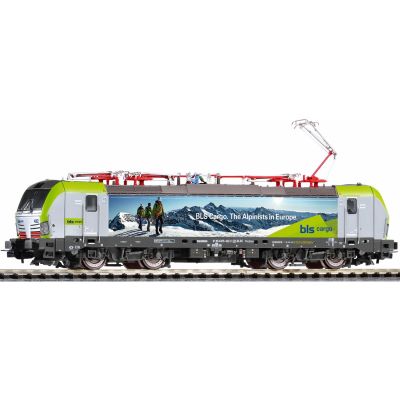
BLS Cargo is especially interesting for transalpine freight traffic. The distinctive locomotives in the Alpinists design combine Swiss identity with modern rail freight transport. Very realistic train formations can be built on the model railway: container trains, tank wagon trains, sliding-tarpaulin wagons, pocket wagons and mixed freight trains fit well behind Re 485, Re 475 or Vectron locomotives. The theme is also popular because it is not limited to Switzerland. BLS Cargo locomotives can be used in international train services with wagons from Germany, Italy, Belgium or the Netherlands.

Re 485 and Vectron in Modern Freight Traffic
The Re 485 and modern Vectron locomotives are ideal models for long freight trains. They carry striking BLS Cargo designs and bring colour to model railway operation. In front of container wagons or tank wagons, they immediately create the impression of a powerful north-south connection. These trains look imposing in H0, while longer train formations can be represented on compact layouts in TT and N.
Which Wagons Fit BLS Cargo?
Modern freight wagons from almost all European railway companies fit BLS Cargo. Container wagons, pocket wagons, tank wagons, sliding-wall wagons and car transport wagons are especially suitable. A believable international mix is more important than uniform wagon colour. This makes a freight train lively and close to the prototype.
Recommended Train Formation
- BLS Cargo Re 485 or Vectron as train locomotive
- Container wagons or pocket wagons for intermodal traffic
- Tank wagons for transit goods
- Mixed freight wagons for shunting scenes
- Overhead line and long station tracks as suitable surroundings
BLS Passenger Coaches and GoldenPassLine
In addition to freight trains, passenger traffic is also part of the BLS theme. GoldenPassLine models, EW III coaches or suitable dining cars bring the tourist character of Switzerland to the layout. The Minitrix coach sets are especially interesting in N gauge because they allow prototype-like train lengths in limited space. A BLS passenger train looks particularly harmonious in an alpine landscape when it runs through tunnels, across bridges and past small stations.
H0, TT or N Gauge – Which Size Fits BLS?
H0 offers the strongest effect for individual locomotives. Details, printing, sound functions and light changes come into their own especially well here. TT is a good compromise between space requirement and train length. For BLS Cargo and modern freight trains, TT is very attractive because longer trains can also be realised on medium-sized layouts. N gauge is ideal for Lötschberg atmosphere: long routes, several tunnels, curves in mountain scenery and complete train compositions can be shown compactly.
Sorting BLS by Era
Era III shows classic brown electric locomotives, older coaches and a calm alpine railway atmosphere. Era IV brings the transition to more modern locomotives and more mixed coach and wagon fleets. Era V is interesting for the period after restructuring, new colour concepts and more international train movements. Era VI stands for modern BLS Cargo, digital vehicle technology, Vectron, Re 465 Refit, GoldenPassLine and current car shuttle operation.
Quick Overview
| Era | BLS Theme | Suitable Models |
|---|---|---|
| III | Classic Swiss alpine railway | Ae 6/8, Ce 4/4, historic coaches |
| IV | Transition to more modern operation | Re 4/4, passenger and freight wagons |
| V | New colour concepts and BLS Lötschberg Railway | Re 420, Re 4/4, BLS freight wagons |
| VI | BLS Cargo, car shuttle and modern trains | Re 465, Re 485, Vectron, GoldenPassLine |
Selected BLS Models at Modellbahnshop




Questions and Answers about BLS Models
Which BLS Locomotive Is a Good Starting Point?
For H0 operators, a modern Re 465, Re 485 or Re 420 is a very good starting point because these locomotives can be used in many ways. They fit passenger coaches, freight wagons and in some cases special trains. Anyone operating AC layouts will find a suitable solution with Märklin BLS models. For TT, the Kuehn BR 485 BLS Cargo is an exciting choice, while Minitrix coaches or N-gauge locomotives with a BLS connection are suitable for N gauge.
Can BLS Models Be Combined with German Wagons?
Yes, especially in freight traffic this is very realistic. BLS Cargo operates in international traffic, so modern freight wagons from different railway administrations can be used together. With passenger coaches, the combination should be more closely based on era and area of operation.
Which Colours Are Typical of BLS?
Historically, brown electric locomotives are particularly characteristic. Modern vehicles often show green, silver, blue, white or striking advertising and special designs. BLS Cargo models stand out especially through multicoloured Alpinists designs.
How Do I Build a Small BLS Scene?
Even a short layout section is enough: a tunnel portal, a rock face, overhead line, a small station building and a BLS locomotive in front of two to four wagons immediately create a Swiss atmosphere. For more operation, a freight siding or car shuttle loading track can be added. This creates a varied theme with high recognition value even in a small space.
Conclusion: BLS Brings the Swiss Alpine Railway to the Model Railway
BLS models combine history, modern technology and an unmistakable Swiss landscape. Whether historic Ae 6/8, modern Re 465, BLS Cargo Re 485, Vectron New Alpinisti, GoldenPassLine coaches or car shuttle operation: the theme offers suitable possibilities for almost every gauge and era. The combination of a strong prototype, distinctive designs and varied operation is especially attractive. Anyone who wants to expand their layout with a Swiss theme will find BLS a believable, versatile and visually powerful foundation.