Modellbahn Keks
Welcome!
Our cookies offer you a fast, relaxed and full-featured shopping experience. Some are necessary to operate the website and its functions. Others help us to improve our services. If you agree to this, simply consent to the use of cookies for preferences, statistics and marketing by clicking on "OK". Alternatively, you can deactivate individual cookies under "Customise cookies" or all cookies, except those required for the function of our website, under "Reject all".
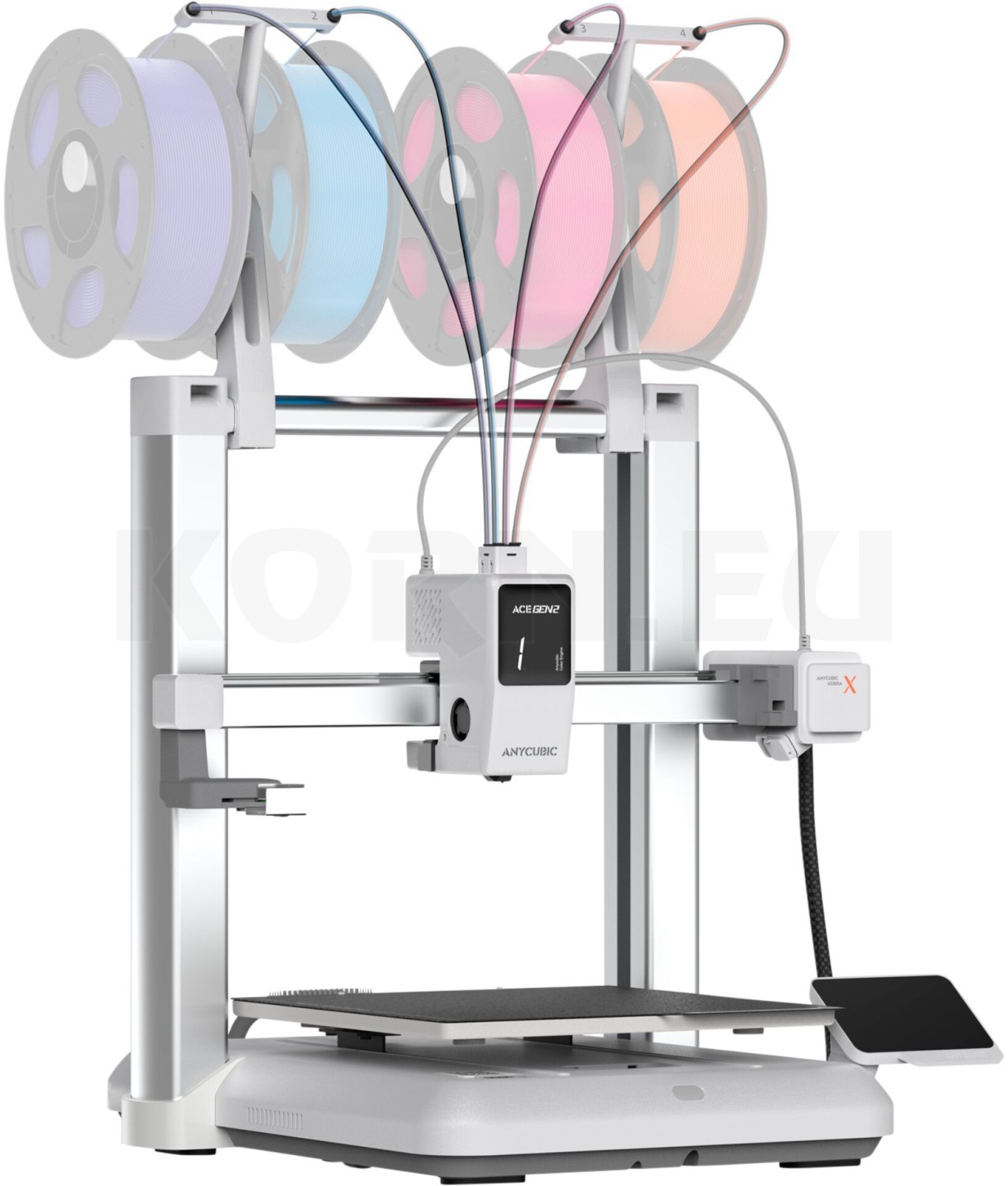
Anycubic Kobra X FDM 3D Printer
The right solution for your project

Buy a 3D Printer or Use a 3D Printing Service?

Owning a printer is particularly worthwhile if you regularly develop models, try out variations and enjoy the technology. For an occasional special model, a printing service may make more sense. The key factors are total costs, the quality you need, the learning involved and a suitable workspace.

Start with your requirements

Do you want finished parts or to make them yourself?

Buy a 3D printer or use a 3D printing service? Start by writing down the specific projects you have planned next. A single driver figure, several building façades and regularly needed assembly jigs have different requirements. Count the usable parts you actually need, rather than theoretical printing hours. Low material consumption alone will not save you money if your printer is rarely used.

Printing your own models suits you

You want to modify your own designs, test fits and repeatedly make similar parts. You set aside time for slicing, material profiles and maintenance. Turning a design into a finished part is part of the hobby for you, and you have a suitable workspace ready.

Compare printers and materials

Using a printing service suits you

You need a few special models and mainly want to build, paint or run trains. You have a ready-to-use file or a clear design brief. You are happy to allow time for discussions and delivery, while saving space and avoiding the purchase of your own printing equipment.

Compare quotes properly

Combining both approaches can also make sense: print building shells and jigs on your FDM printer, and order occasional delicate parts from a service provider. A club or makerspace can help you get started; check its access arrangements, support and costs directly.

More than the price per gram

Printing at home compared with a printing service

Which tasks are still your responsibility?
Criterion Your own 3D printer Printing service
Getting started Budget for the printer, accessories, workspace and learning time. Prepare your file and requirements, then request a quote.
Changes Print revised versions to your own schedule. Agree on the new version and place another order if necessary.
Material choice Depends on your printer, equipment and experience. Access to several processes and materials, depending on the provider.
Time involved Handle preparation, monitoring, maintenance and finishing yourself. Allow for discussions, waiting, shipping and any work you have agreed to do yourself.
Quality Print profiles, design and production must work together. Explicitly agree on the surface finish, tolerances and condition on delivery.
Repeat production Reuse proven files and settings. Record the file version, material and options for repeat orders.

A professional service does not automatically deliver a fully painted model. Equally, owning a printer does not automatically produce replacement parts that fit. Always compare parts finished to the same stage: for example, cleaned, cured, with supports removed and ready for priming.

Three typical model railway tasks

Quantity is only part of the decision

Twenty platform benches

A batch of identical benches is easy to compare once you have specified the scale, level of detail and finish on delivery. For twenty benches needed just once, a service quote may cost less than buying a complete setup. If you plan more platforms and variations, the initial costs are spread across more usable parts.

A custom station building

Here, part size, windows, the roof and possible division into sections matter. Your own printer makes test pieces and corrections easier during construction. A service can produce larger or specialist parts. Also consider scratch-building buildings from sheet materials and adding printed details.

A rare replacement part

For a single handle, body component or bracket, designing the part may take more effort than printing it. First check whether a usable file exists. Fit, loading and material choice are crucial; a similar appearance does not prove that a part will work as a replacement.

Gauge changes the task: in T, Z and N, tiny details are particularly challenging, while TT and H0 often require a balance between definition and strength. In OO, S, 0 and 1, larger assemblies and dividing models into sections become more important. II, IIm and garden railways also require evidence that the material is suitable for outdoor use. H0e, H0m, TTm, Nm, 0e and 0m use the same scale for details as their parent scale. The gauge comparison helps you identify the right scale.

Compare the same scope of work

Include these costs in your comparison

Printing at home involves the printer, necessary accessories and workspace setup. For each usable part, add material including supports, electricity, a share of wear costs, cleaning supplies and a realistic allowance for failed prints. With resin, pay particular attention to washing and post-curing equipment. Consider printers and 3D accessories together.

For a printing service, include the quoted unit price, preparation, minimum order charges, post-processing and shipping. Include design costs on both sides wherever they differ. Compare prices consistently, either including or excluding VAT. For private modellers, the final amount actually payable is the natural basis for comparison.

You can deliberately value your spare time at zero euros. That does not make it disappear: still record the minutes required. If you enjoy learning printing techniques, this time is part of the hobby. If you want a finished layout as quickly as possible, the same effort may count against printing your own parts.

A simple comparison for equivalent parts

At what quantity could buying a printer pay off?

Enter your own estimates and a comparable quote. All preset figures are illustrative examples, not shop prices or printing service quotes. The investment includes only costs you have yet to incur as part of this decision. The service price must cover the same level of finishing.

Using the example values, printing 20 parts yourself costs €640 including the investment; the service costs €210. Under these assumptions, printing at home becomes at least as cost-effective from 74 parts onwards.

Own production cost = investment + quantity × (printing cost per part + minutes ÷ 60 × hourly value). Service cost = fixed costs + quantity × service price per part. The break-even calculation assumes constant unit prices and a one-off fixed service charge. It does not account for volume discounts, further orders, financing, residual value or capacity limits.

The threshold is not a buying recommendation: it applies only to comparable parts of suitable quality. Twenty small benches and twenty large buildings are not interchangeable quantities. Repeat the comparison for your typical project and also test a less favourable scenario with more work or failed prints.

You can add one-off costs for learning or special jigs to the investment if you wish to put a value on them. CAD work common to both options should either be included on both sides or excluded from both. Also account for your time spent discussing the job with the service: where appropriate, allocate it to the service unit price or fixed costs. This lets you compare the same effort without counting any item twice.

The right model starts with the right data

What to prepare before buying or ordering prints

A 3D printing service needs printable geometry or a separate commission to design it. Photos and hand sketches alone are not ready-to-print files. Specify reference measurements, the required dimensions and the target scale. For an existing file, check whether it has already been scaled correctly.

STL describes the surface as a triangle mesh; the unit of measurement must be correct when importing it. Whether 3MF, OBJ or STEP is also accepted depends on the provider. Automatic file repair does not replace checking thin connecting sections, holes and joints. Design rules depend on the material, process and loads the part will face.

Record which surfaces will remain visible, where support marks are acceptable and which dimensions must fit precisely. Also check whether you are allowed to use the file for the intended print and share it with a service provider. If in doubt, ask the rights holder before uploading it.

A clear brief reduces follow-up questions

How to compare printing service quotes

Request quotes using the same file, quantity and material requirements. Describe your model railway project rather than simply asking for the lowest possible layer height. A sample bench or façade section is a better way to judge whether definition, surface finish and strength meet your expectations.

  • Geometry: specify the file version, target scale, external dimensions and critical fits.
  • Material: explain the required properties, colour and whether the part will be used indoors or outdoors.
  • Condition on delivery: agree on support removal, cleaning, post-curing and surface finishing.
  • Price: check the separate costs for design, file checking, samples, the production batch and shipping.
  • Schedule: allow for production, possible follow-up questions and transport.
  • Repeat orders: keep a record of the unchanged file, material designation and approved sample.

For very thin parts, also ask about packaging. A successful print must survive transport. Assess the first part before ordering a larger batch, and report discrepancies with photos and measurements. Keep an approved reference sample so that later deliveries can be compared with it.

Plan delivery dates and repeat orders

For an exhibition or a fixed construction deadline, allow a buffer for the first sample. Do not order a large batch just before you need it. When printing at home, also account for available machine time, material changes and possible reprints. A short print time alone does not guarantee a completion date.

For recurring parts, create a small project folder containing the approved file, a dimensioned sketch, the material designation and sample photos. Record any changes from earlier versions too. This helps you reprint parts yourself and prevents a service provider from accidentally receiving an older version. A clear version name is often more useful than a long email with corrections scattered throughout.

Bring technology, space and interest together

What you need for your own printing workshop

FDM uses filament and is useful for many building shells, workshop aids and larger shapes. Resin printing cures liquid resin layer by layer and is often suitable for small visible details. Choose according to your parts; the printer buying guide helps you select a machine.

Alongside the printer, allow space for materials, tools and post-processing. FDM can release particles and volatile substances; little noticeable odour is not proof of safety. Resin requires suitable protective measures, cleaning and post-curing according to the manufacturer's instructions. Follow safety data sheets and requirements for ventilation and disposal. A low printer price cannot compensate for the lack of a suitable workspace.

Practical plan: one bench first, then twenty

This planning example is not a report of our own comparative print tests. Prepare a bench file and a comparable service quote. To print it yourself, you need suitable material, a slicer, callipers, appropriate deburring tools and the post-processing equipment required for the process.

Produce and check a sample

Check the legs, seat, scale and stability. After a thin coat of primer, check that details remain visible. Apply the same assessment criteria to both options.

Record the actual effort

Note material use, failed attempts, active working minutes and additional consumables. Separate machine running time from your own working time and allocate shared preparation across the parts.

Only then approve the batch

Correct the file or order before producing the remaining parts. Save the right version and use the sample to decide whether to continue printing yourself, order from a service or combine both options.

Avoid common decision-making mistakes

Four checks before your final decision

Only compared material costs?

First add accessories, failed prints, finishing and working time where relevant. Then check that both options deliver parts in the same usable condition.

The model does not fit?

Check units and scale before changing the print profile or printer. Then check critical dimensions using a test piece; an attractive preview does not prove an accurate fit.

Not getting the surface finish you want?

First clarify the process and visible surfaces. Then check orientation, support contact points and the agreed finishing work. Higher resolution alone will not fix every cause.

A printer for just one project?

List realistic follow-up projects. If you have none, compare a printing service, a kit or scratch-building. Enjoying the technology can still be a valid reason to buy a printer in its own right.

Explore the manufacturers' ranges

Compare printers, materials and accessories within each system.

From comparison to the right material

Browse the current FDM and resin range

The product list loads items from the linked categories. Search by name, colour or item number and combine process, category and manufacturer filters. Check specific printer and material compatibility on the product page.

The product list is being prepared. You can open the categories directly.

View all 3D tools

Frequently asked questions about buying and ordering prints

How many models make owning a 3D printer worthwhile?

There is no universal minimum quantity. Investment, part size, your own costs, service prices and working time determine the threshold. Compare equivalent parts using the calculator and check whether you actually need that quantity.

Is a printer worthwhile for twenty platform benches?

For a one-off batch, a printing service may be cheaper. Your own printer becomes more appealing when you have further projects, variations and an interest in making parts yourself. A sample should confirm the required quality before you decide.

Can I order printed models without CAD skills?

Yes, if a suitable file exists or you commission the design separately. You still need to describe the scale, dimensions and intended use. Ask beforehand whether file checking and corrections are included in the quote.

Do models from a printing service arrive fully painted?

Only if this has been explicitly agreed. Printing, support removal, cleaning, post-curing, priming and painting are separate services. Compare quotes according to the condition in which you have actually ordered the parts.

How should I calculate costs if I already own a printer?

Include only additional investment required for the new project. Running costs, wear and working time still matter. If you need a different process or additional accessories, include those expenses in the comparison.

Is printing your own parts always faster?

No. A prepared, proven model may be produced at short notice. Learning, failed attempts and post-processing can cancel out that advantage. A service also involves discussions, production scheduling and shipping; compare the time until you have a usable part.

Further reading: Formlabs on in-house and outsourced SLS printing, The printing order process at Sculpteo, Checking print files and NIOSH on the 3D printing workplace.

Plan your next step around a specific model

Combine the 3D printing knowledge hub with suitable materials and proven modelling techniques.

Explore the model railway guide