
Integrated Track Roadbed
The moulded ballast body provides a defined track height and a stable base on a level layout surface.


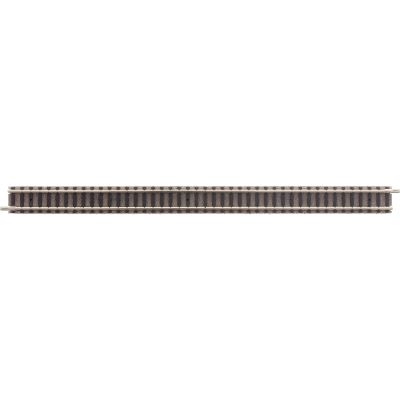
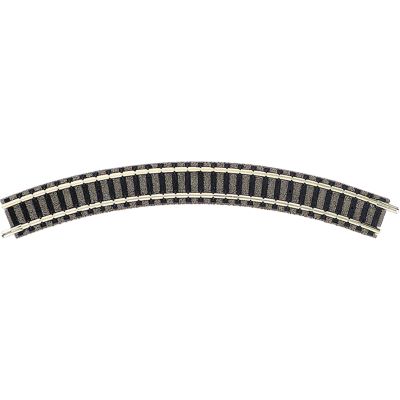
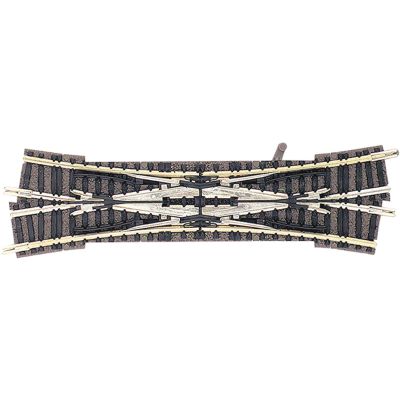
The illustrated overview of Fleischmann piccolo track with an integrated ballast bed: straights, flexible track, compensation track, fixed radii, connection and functional track, buffer stops, manual turnouts, curved turnouts, double-slip turnouts, turntable track and multipacks.
Range reviewed:
Fleischmann piccolo is an N gauge track system with an integrated plastic ballast bed. The rail profile, sleepers and roadbed form a stable track element. Routes can therefore be assembled, aligned and altered again quickly when required.
The system belongs to N gauge at a scale of 1:160. The model track gauge is 9 millimetres. The nickel-silver rail profiles are 2.1 millimetres high. Standard straight 9101 is 111 millimetres long; product 9100 has twice the standard length at 222 millimetres.
Straights in different lengths, a variable compensation section and a 777-millimetre flexible track simplify planning. Fixed curves in four radius groups permit compact circles, parallel routes and larger visible alignments.
Connection track, manual and electromagnetic uncoupling track, contact track, buffer-stop track, turntable extensions and various turnout types expand the basic system.
The roadbed can remain visible, be treated with colour or be blended into the scenery with additional ballast. A level surface, clean connections and sufficient power feeds remain important for permanently reliable operation.
The moulded ballast body provides a defined track height and a stable base on a level layout surface.
Straights, partial sections, fixed radii and turnouts can be combined to create circles, parallel routes and station tracks.
The long flexible track permits flowing alignments, transition curves and individually adapted straight sections.
The piccolo system combines four fixed radius groups with different curve angles. The technically possible radius should always be compared with the required minimum radius of the locomotives and coaches being used.
| Geometry | Radius | Products | Angle Division | Typical Application |
|---|---|---|---|---|
| R1 | 192 mm | 9120, 9122, 9123 | Main curve and short partial curves | Very compact routes; check vehicle specifications carefully |
| R2 | 225.6 mm | 9125, 9127, 9128 | 45°, 15° and 7.5° | Compact outer parallel circle and angle compensation |
| R3 | 396.4 mm | 9130, 9131 | 30-degree main curve and partial curve | Larger visible routes and station approaches |
| R4 | 430 mm | 9135, 9136 | 30° and 15° | Outer parallel circle and reverse curve for the standard turnout |
| Flexible Track | Individual | 9106 | Freely planned | Transition curves and flowing routes |
| Standard Turnout | 430 mm | 9170, 9171 | 15° | Stations, passing loops and storage tracks |
| Curved Turnout | R1 / R2 | 9168, 9169, 9174, 9175 | Curved route | Branching inside a compact curve |
Small radii save space but are not suitable for every vehicle. Long coaches and multiple units benefit from larger radii.
The connection track contains a suppression component and is intended for analogue operation. A suitable feed without an interfering capacitor should be used on a digital layout.
Colour, weathering and additional ballast can blend the plastic body visually into a station, main line or branch line.
Every product receives its own card with a catalogue number, precise description, permanently assigned main image and direct shop link. Search terms can include “9100”, “flexible track”, “R2”, “uncoupling track”, “curved turnout”, “9184” or “MBSET10172”.
A track system with integrated roadbed still requires a level track base, suitable radii, reliable electrical connections and easily accessible turnout areas.
Standard straights, the compensation section, standard turnouts, curved turnouts and double-slip turnouts permit different station arrangements.
Flexible track and larger radii create smoother routes. The integrated roadbed can be treated with colour.
Fixed geometry and robust track are suitable for clearly organised storage areas and repeatable vehicle tests.
Check the minimum radius of the longest locomotives, coaches and multiple units.
Combine standard straights, partial sections, compensation track, curves and turnouts to create closed geometry.
Define power feeds, contact track, uncoupling track and future turnout drives before adding the scenery.
Test every route with different vehicles before fixing the track permanently or adding extra ballast.
Additional ballast should be applied sparingly along the roadbed edges. Moving parts on turnouts, uncoupling track and contact track must remain free of adhesive and loose material.
The following answers provide guidance about roadbed, track gauge, rail height, radii, flexible track, connection track, uncoupling track, turnouts and multipacks.
Fleischmann piccolo is the N gauge track system with an integrated plastic ballast bed and nickel-silver rail profiles.
The model track gauge is 9 millimetres. N gauge uses a scale of 1:160.
The rail-profile height is 2.1 millimetres.
Product 9101 is 111 millimetres long. Product 9100 has twice the standard length at 222 millimetres.
The fixed radius groups include R1 at 192, R2 at 225.6, R3 at 396.4 and R4 at 430 millimetres.
The variable straight can be adjusted between 83 and 111 millimetres and closes remaining gaps in a track plan.
The flexible track is 777 millimetres long and can be used for individual radii and flowing routes.
The connection track is intended for analogue operation and contains a suppression component. A suitable feed without an interfering capacitor should be used on a digital layout.
Product 9112 is an electromagnetic uncoupling track. Product 9114 is operated manually. Both are 111 millimetres long.
With suitable magnets, the contact track can trigger electrical switching operations for signals or accessories, for example.
Turnouts 9170 and 9171 are 111 millimetres long. The diverging angle is 15 degrees and the diverging radius is 430 millimetres.
The multipacks combine 20 identical straight sections or two flexible track sections. They are suitable for longer routes and larger station areas.
The product page expressly identifies product 9119 as track without roadbed. It therefore does not belong in this piccolo overview of track with roadbed.
Yes. The roadbed edges in particular can be treated with colour and blended into the scenery with additional ballast. Moving track parts must remain free.
Plan radii, turnouts, power feeds, train lengths and maintenance access together before fixing the track permanently and adding the surrounding scenery.