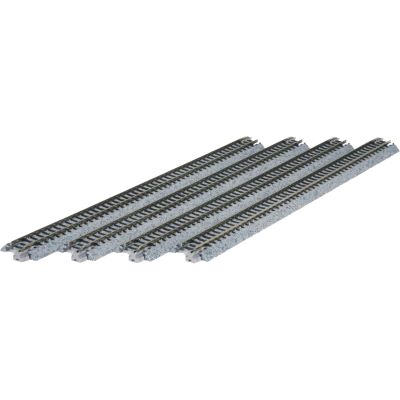
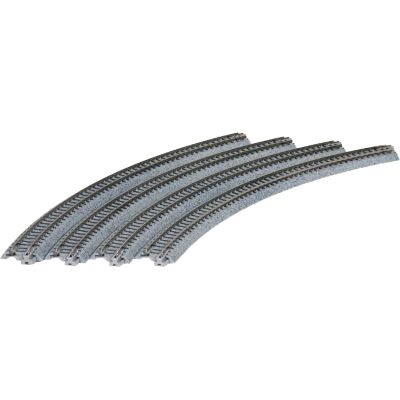
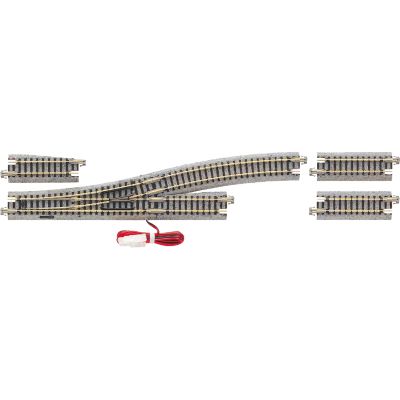
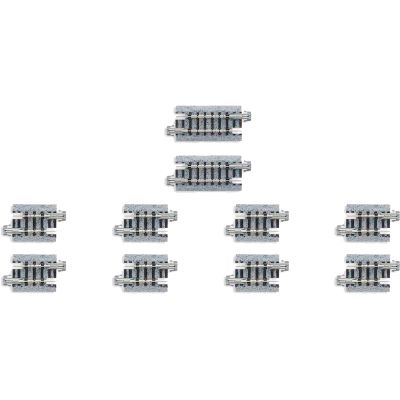
Stable Plug-In Connection
Track sections are connected without separate tools. The connectors align the rails and support reliable electrical contact.


The illustrated overview of currently listed Kato UNITRACK for N gauge: straight track, short compensation sections, fixed curves, buffer stops, electric turnouts and matching control accessories.
Range reviewed:
Kato UNITRACK is an N gauge track system with integrated roadbed. Rails, sleepers and the grey-speckled roadbed form one stable track element. Routes can therefore be assembled, tested, altered and rebuilt quickly.
The track belongs to N gauge at a scale of 1:160. The model track gauge is 9 millimetres. The listed standard track has a rail height of 2.2 millimetres, a roadbed width of 25 millimetres and an overall height of approximately 7.3 millimetres.
The plug-in system connects the rail ends mechanically and electrically. The sections click distinctly into place and therefore remain dimensionally stable even on temporary table, floor or test layouts.
Straights of different lengths close gaps in a track plan. Fixed curves cover radii from 183 to 718 millimetres. Electric left- and right-hand turnouts create passing loops, stations and storage tracks.
The integrated roadbed can remain visible or be blended into a landscaped layout. For permanent installation, the base, transitions, electrical power feeds and future accessibility should nevertheless be planned carefully.
Track sections are connected without separate tools. The connectors align the rails and support reliable electrical contact.
The fixed roadbed simplifies rapid assembly and provides a stable, repeatable track position on level surfaces.
Different straight lengths, angles and radii can be combined to form circles, parallel routes, stations and passing loops.
The currently listed range includes curve radii from 183 to 718 millimetres. Eight 45-degree sections, twelve 30-degree sections or twenty-four 15-degree sections form a complete circle. The minimum radius specified by the vehicle manufacturer remains decisive.
| Product | Radius | Angle | Circle Requires | Planning Guidance |
|---|---|---|---|---|
| 20-172 | 183 mm | 45° | 8 sections | Very compact radius; check vehicle specifications carefully |
| 20-170 | 216 mm | 45° | 8 sections | Compact layouts, test circles and branch lines |
| 20-100 | 249 mm | 45° | 8 sections | Compact standard circle using few track sections |
| 20-101 | 249 mm | 15° | 24 sections | Fine angle division at a radius of 249 mm |
| 20-110 | 282 mm | 45° | 8 sections | Larger parallel circle and visible routes |
| 20-111 | 282 mm | 15° | 24 sections | Partial curves and geometric compensation |
| 20-120 | 315 mm | 45° | 8 sections | More generous routes for longer vehicles |
| 20-130 | 348 mm | 30° | 12 sections | Even circle with finer division |
| 20-132 | 348 mm | 45° | 8 sections | Large radius using fewer track connections |
| 20-140 | 381 mm | 30° | 12 sections | Visible main lines and longer train formations |
| 20-160 | 481 mm | 15° | 24 sections | Radius matching the electric turnout geometry |
| 20-150 | 718 mm | 15° | 24 sections | Very generous visible curves and station approaches |
A technically available track radius is not automatically suitable for every vehicle. Long passenger coaches and multiple units benefit significantly from larger radii.
The electric turnout geometry uses a parallel track spacing of 33 millimetres. Platforms, signals and overhead-line equipment must be positioned accordingly.
When connecting other N gauge track systems, the rail profile, roadbed height and track centreline must be aligned cleanly and mechanically.
Every item receives its own product card with a catalogue number, precise description, permanently assigned main image and direct product link. Search terms can include “20-000”, “248 mm”, “R 249”, “compensation track”, “left-hand turnout” or “24-840”.
Even rapidly assembled track with roadbed benefits from a scale track plan, level base, sufficiently large radii and readily accessible electrical connections.
The stable roadbed and plug-in system are suitable for table layouts, floor railways, test circles and track plans that are altered regularly.
For permanent installation, roadbed edges, gaps and adjacent scenery can be detailed with colour and additional ballast.
The dimensionally stable geometry simplifies vehicle tests, trial running and clearly organised concealed storage areas.
Check the minimum radius of the longest locomotives, coaches and multiple units before buying track.
Plan straights, curves and turnouts together. Short track and the compensation set close remaining gaps.
Determine power feeds, turnout cables and switches before the track area is covered or integrated into the scenery.
Test every route with different vehicles, directions and speeds before fixing the track permanently.
Track sections should be aligned straight and pushed together completely. For electric turnouts, observe the relevant connection instructions, intended power supply and compatible Kato control components.
The following answers provide guidance about roadbed, track gauge, track geometry, compensation track, electric turnouts, control and permanent layout installation.
UNITRACK is the Kato track system with an integrated roadbed and stable plug-in connection. The track can be connected quickly and separated again when required.
The model track gauge is 9 millimetres. N gauge generally represents standard-gauge vehicles at a scale of 1:160.
Yes. The listed UNITRACK products include an integrated grey-speckled plastic roadbed.
The current overview includes radii of 183, 216, 249, 282, 315, 348, 381, 481 and 718 millimetres.
Eight sections are required for 45-degree curves, twelve for 30-degree curves and twenty-four for 15-degree curves.
The set contains short track sections for finely adjusting a track plan. They can close small remaining differences in length.
Both products concern short straight sections measuring approximately 62 millimetres. Product 20-040 is sold as straight track, while 20-045 is a connector track.
Turnouts 20-220 and 20-221 include an integrated, low-profile solenoid drive. They are controlled through a two-pole connection cable.
The left- and right-hand turnouts have a diverging radius of 481 millimetres and an angle of 15 degrees.
Kato 24-840 is a control module for Kato turnouts. It can be mounted at the side of a compatible Kato Power Pack.
Yes. The track can be installed on a permanent layout and integrated into the scenery. Extensive test running should be completed before permanent fixing.
A transition is generally possible when the track gauge, rail height, roadbed height and track centreline are aligned mechanically. The systems should not be connected while under tension.
Plan the radii, turnouts, power supply, train lengths and accessibility together before installing the track permanently and adding the surrounding scenery.