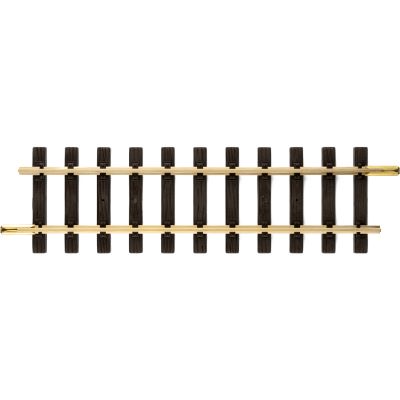
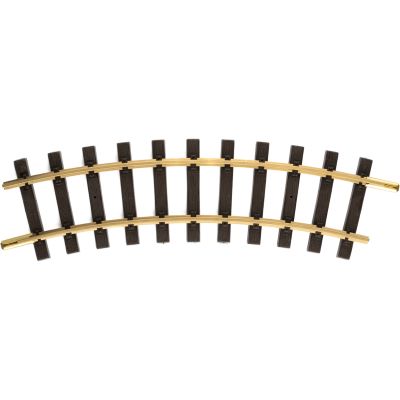
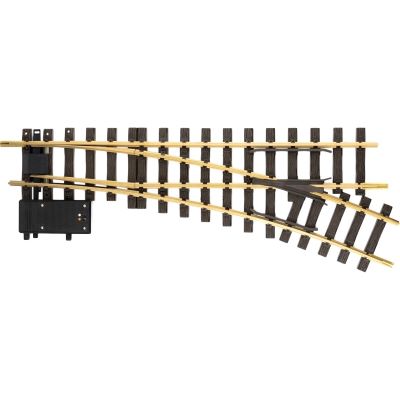
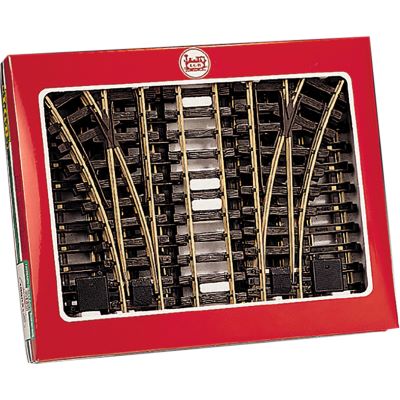
Robust Brass Rail Profiles
The solid rail profiles are designed for heavy vehicles, long trains and regular operation on garden railway layouts.


The illustrated overview of the LGB track system: straights, adjustable track, flexible sleepers, functional track, R1 to R5 curves, manual turnouts, electric turnouts, crossings, track accessories, multipacks and complete track sets.
Range reviewed:
LGB track is robust 45-millimetre track with solid brass rail profiles. It has no integrated ballast roadbed and is laid on a prepared surface, permanent track base or individually constructed ballast bed.
The system is primarily used for garden railways in G gauge or IIm. Many LGB vehicles are based on a scale of 1:22.5. The wide track gauge and robust construction are suitable for large vehicles, compact indoor layouts and extensive outdoor routes.
Straight track from 41 to 600 millimetres, an adjustable track section and several fixed radii provide precisely calculable geometry. Flexible sleeper sections and rail profiles can also be used to build individual lengths and radii.
The system includes isolating track, interruption track, reversing-loop sets, uncoupling track, manual turnouts, electric turnouts, crossings, three-way turnouts and double-slip turnouts.
Buffer stops, rail joiners, insulated joiners, track clips, turnout drives, track contacts, cleaning accessories and complete track packages supplement the range.
The solid rail profiles are designed for heavy vehicles, long trains and regular operation on garden railway layouts.
The track system can be used on indoor layouts, patios, balconies and permanently constructed garden railway routes.
The ballast bed, substructure, drainage, trackside paths and embankments can be designed to suit the individual garden railway route.
The fixed track products cover different space requirements. Twelve 30-degree curves, sixteen 22.5-degree curves or twenty-four 15-degree curves form a complete circle. Larger radii are recommended for long vehicles and a more prototypical appearance.
| Geometry | Radius | Angle | Circle Requires | Typical Application |
|---|---|---|---|---|
| R1 | 600 mm | 30° | 12 pieces | Compact garden railway circle and small indoor layout |
| R1 Partial Curve | 600 mm | 15° | 24 pieces | Compensation, reverse curves and finer planning |
| R1 Short Section | 600 mm | 7.5° | 48 pieces | Small angle corrections and turnout connections |
| R2 | 780 mm | 30° | 12 pieces | Larger parallel circle and visible routes |
| R3 | 1,195 mm | 22.5° | 16 pieces | Generous main lines and station approaches |
| R5 | 2,320 mm | 15° | 24 pieces | Extensive garden railways and long vehicles |
| R5 Partial Curve | 2,320 mm | 7.5° | 48 pieces | Smooth changes of direction and compensation |
| Flexible Track | Individual | Freely planned | According to the plan | Transition curves and individual garden railway routes |
Many short LGB vehicles can negotiate R1. Long bogie coaches, modern multiple units and large locomotives look considerably smoother on R3 or R5.
Outdoor routes require a load-bearing, water-permeable and frost-resistant substructure. Track must not remain permanently in water or soft soil.
Large garden railway layouts benefit from several power-feed points and regularly inspected rail joiners.
Every product receives its own card with a catalogue number, precise description, permanently assigned main image and direct product link. Search terms can include “10000”, “R3”, “reversing loop”, “turnout drive”, “buffer stop” or “19902”.
A reliable garden railway is created through the combination of track geometry, a load-bearing substructure, drainage, electrical power feeds and permanently accessible turnouts.
Brass track, a weather-resistant substructure and generous radii form the foundation of a permanent outdoor route.
Fixed track sections and R1 curves also permit seasonal or semi-permanent garden railway operation in limited spaces.
Straight track, compact radii and track clips are suitable for display layouts, Christmas layouts and temporary exhibition routes.
Check the length, overhang and minimum radius of the largest intended vehicles.
The route must have a load-bearing, frost-resistant and water-permeable substructure.
Power feeds, isolation points, turnout drives and feedback contacts should be defined before the final scenery is added.
Test every route at different temperatures before completing the permanent track formation.
Brass rail profiles change length during significant temperature fluctuations. Outdoor layouts therefore require sufficient expansion space and must not be clamped completely rigidly.
The following answers provide guidance about track gauge, rail material, roadbed, fixed radii, turnouts, outdoor installation, power supply and maintenance.
LGB track has a model track gauge of 45 millimetres and is mainly used for G gauge or IIm.
Many LGB models are based on a scale of 1:22.5. Scale variations may occur depending on the prototype and product.
The track uses solid brass rail profiles. Brass is robust and suitable for operation on garden railway layouts.
No. The sleepers and rails have no permanently moulded ballast body. The track bed is constructed separately.
The overview includes R1 at 600 millimetres, R2 at 780 millimetres, R3 at 1,195 millimetres and R5 at 2,320 millimetres.
Twelve 11000 track sections with an angle of 30 degrees form a complete R1 circle.
Manual turnouts 12000 and 12100 and electric turnouts 12050 and 12150 use the compact R1 geometry.
Many LGB manual turnouts can be fitted with the 12010 electric turnout drive.
Yes. The two-rail track can be operated with analogue or digital control. The power supply and power feeds must suit the system being used.
A load-bearing, water-permeable substructure, frost-resistant ballast bed and sufficient expansion space are recommended.
Remove loose dirt and clean the rail surface using suitable rail-cleaning accessories. Highly abrasive tools should be avoided.
Track clips secure connected track sections on temporary layouts and can reduce unintended separation.
Depending on the set, they may include curved track, straights, turnouts, buffer stops, connection materials or a complete power supply. The relevant product description is decisive.
Larger vehicles run more smoothly and look more prototypical on R3 or R5. The vehicle description states the technically required minimum radius.
Plan radii, the substructure, drainage, power feeds, turnouts and maintenance access together before constructing the route permanently.