Compact Track Geometry
Short track sections and small fixed radii permit train operation in a limited area.


A newly structured overview of the Märklin mini-club track products clearly verified at Modellbahnshop: short straights, fixed curves, 660-millimetre flexible track, a crossing, electric left- and right-hand turnouts, electric curved turnouts, insulating and connecting rail joiners and track-fastening accessories.
Verified as of:
Märklin mini-club is a two-rail track system for Z gauge. The nominal size uses a scale of 1:220 and a model track gauge of 6.5 millimetres.
The track does not include a permanently integrated ballast roadbed. It is fixed to a prepared, level route and can then be ballasted individually.
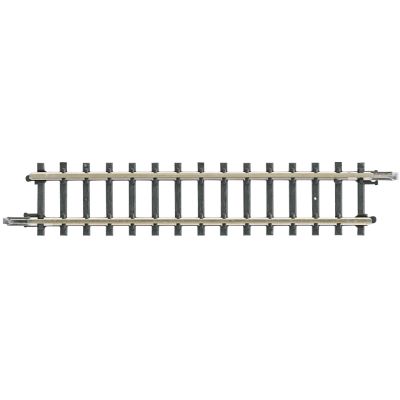
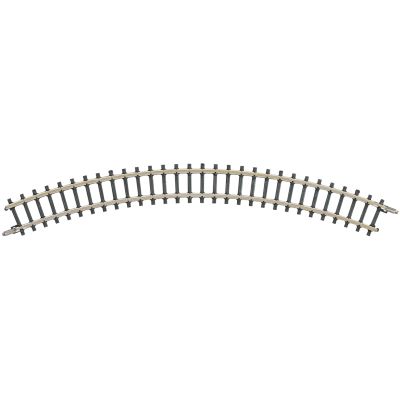
Short straights are suitable for compensating for length differences within compact track plans. Fixed curves permit defined circles and parallel routes.
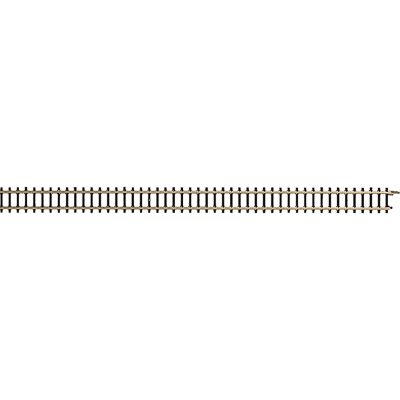
The 660-millimetre flexible track can be used for individual track alignments, transition curves and custom lengths.
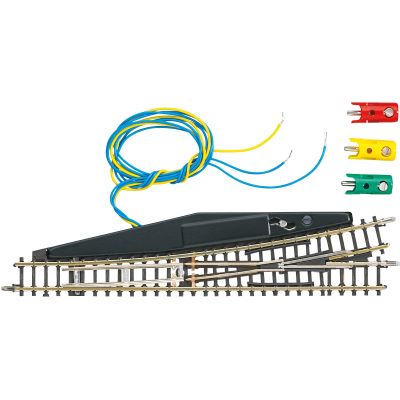
Electromagnetic standard and curved turnouts permit route changes in a small area. The crossing, connecting and insulating rail joiners and track fastening nails complete the track system.
Short track sections and small fixed radii permit train operation in a limited area.
The long track can be shortened and adapted to individual track alignments.
Standard and curved turnouts include an electromagnetic twin-coil drive.
The following table is limited to track and turnouts for which a confirmed Modellbahnshop product page is used on this page.
| Track Element | Dimensions | Angle | Product | Typical Application |
|---|---|---|---|---|
| Short Straight | 25 mm | – | 8504 | Length compensation within a track plan |
| Straight | 55 mm | – | 8503 | Stations and route extensions |
| Small Radius | Radius 145 mm | 45° | 8510 | Very compact track alignment |
| Inner Radius | Radius 195 mm | 30° | 8521 | Circles, curved turnouts and parallel routes |
| Outer Radius | Radius 220 mm | 45° | 8530 | Larger outer track curve |
| Crossing | 112.8 mm | 13° | 8559 | Crossing track alignment |
| Standard Turnout | Radius 490 mm | 13° | 8562, 8563 | Stations and sidings |
| Curved Turnout | Radius 195 mm | 30° | 8568, 8569 | Junction within a curved route |
| Flexible Track | Length 660 mm | Free | 8594 | Individual radii and transition curves |
The smallest track radius is not automatically suitable for every long vehicle.
The rail profiles and sleeper strip should be cut to length without tension and reconnected.
Clean contacts and several power feeds improve operating reliability.
Every card links directly to the confirmed product page at modellbahnshop.de. Search terms can include “8503”, “195 mm”, “flexible track”, “crossing”, “curved turnout”, “rail joiners” or “track nails”.
The small scale requires particularly clean track transitions, a level route and reliable electrical contacts.
Small radii permit complete train operation in a limited area.
Standard turnouts, curved turnouts and the crossing create varied routes.
Flexible track permits free radii and flowing routes.
Check the minimum radius of the longest locomotives and coaches.
Even small irregularities can affect the operation of a Z gauge layout.
Test every connection and route before adding the scenery.
Test the layout slowly and in both directions.
Push the fastening nails in only far enough to avoid deforming the sleepers.
Answers about scale, track gauge, radii, flexible track, the crossing, standard turnouts, curved turnouts and accessories.
Z gauge uses a scale of 1:220.
The model track gauge is 6.5 millimetres.
No. The ballast bed is constructed separately when the layout is built.
The flexible track is 660 millimetres long.
Product 8504 is 25 millimetres long and product 8503 is 55 millimetres long.
Product 8510 is a 45-degree curve with a radius of 145 millimetres.
Product 8521 has a radius of 195 millimetres and an angle of 30 degrees.
Product 8530 has a radius of 220 millimetres and an angle of 45 degrees.
The crossing is 112.8 millimetres long and has a crossing angle of 13 degrees.
Product 8562 is the left-hand electromagnetic turnout and product 8563 is the right-hand turnout.
The turnouts are 110 millimetres long, have a radius of 490 millimetres and a diverging angle of 13 degrees.
Product 8568 is the left-hand electromagnetic curved turnout and product 8569 is the right-hand turnout.
The curved turnouts have a radius of 195 millimetres and an angle of 30 degrees.
The pack contains insulating and connecting joiners for electrical isolation points and track connections.
They are used to fasten Z gauge track carefully to the layout base.
Plan radii, turnouts, flexible track, the power supply and maintenance access together.