Single-Road Locomotive Shed
The most space-saving traditional solution. One track, one door and a small workshop are enough for a branch line, small shunting locomotive or heritage railway. Especially useful where layout depth is limited.

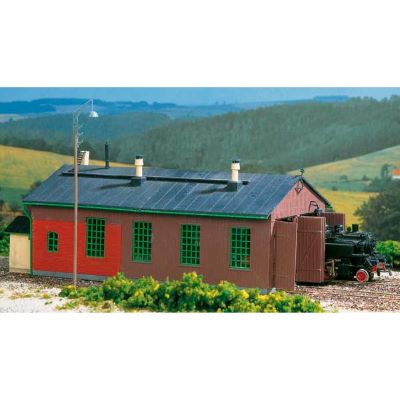
From a small branch-line engine shed to an extensive roundhouse: locomotive sheds give stabled engines a believable workplace and make maintenance, servicing and shunting visibly part of model railway operation.
Planning and designing model railway locomotive sheds means creating an operationally understandable place for stabling, inspecting and maintaining locomotives. The shed can belong to a small branch-line station or form the centre of an extensive locomotive depot.
A locomotive shed contains one or more tracks leading directly into the building. In a rectangular shed these tracks run parallel to one another. A roundhouse instead uses radially arranged locomotive roads that are normally reached via a turntable .
The most suitable type depends on the available space, era and type of traction. A small single-road shed is ideal for a branch line. Steam-locomotive depots additionally require water, coal and sometimes sand. Diesel and electric locomotives require different servicing facilities and often more modern workshop buildings.
The most important planning dimension is the actual length of the locomotives. An attractive shed is of little use if the longest tender locomotive does not fit inside or if roadbed track raises the entrance so far that the roof, pantograph or doorway becomes an obstacle. Product dimensions, clear door height, door width and usable internal length should therefore be checked before construction begins.
Different building forms make it possible to create both compact branch-line scenes and extensive depots with numerous locomotive roads.
The most space-saving traditional solution. One track, one door and a small workshop are enough for a branch line, small shunting locomotive or heritage railway. Especially useful where layout depth is limited.
Two parallel tracks provide room for several vehicles and additional shunting movements. This type suits small locomotive depots as well as terminus stations.
Three or more parallel workshop tracks suit larger maintenance and stabling facilities. Modern diesel and electric locomotive depots are often represented using this form.
The tracks radiate towards a central turntable. This provides access to many locomotive roads in a comparatively compact arrangement. The complete site still requires considerable space because of the turntable and fan of approach tracks.
Modern halls have large doors and need sensible integration with overhead wiring. Contact wire, pantograph position and clear internal building height should all be checked together before installation.
Small industrial and field railways require only very compact structures. They work especially well in industrial areas, brickworks, mines and quarry and H0f field-railway scenes .
The longest planned vehicle determines the minimum usable internal length. Additional room should be allowed for doors, buffers, servicing and safe positioning.
This calculation is intended as a practical planning aid. The actual internal dimensions, doors, track position and technical requirements of the selected kit remain authoritative.
Tender locomotives and electric locomotives in particular can be surprisingly long or tall. Compare your planned shed with its published internal and clear door dimensions before construction.
Buildings often need to be raised when track with integrated roadbed is used. This allows the railhead, shed floor and doorway to remain at a believable relative height.
Wide cylinders, footsteps, pantographs and vehicle overhang also require space. A trial run with the largest locomotive prevents problems after the building has been fixed permanently.
Vehicles occasionally derail inside locomotive sheds. Where possible, keep the roof or rear wall removable until the building has been tested completely within the finished track arrangement.
A locomotive shed becomes especially convincing when engines are visibly serviced on their way to the building. Steam locomotives typically require coal, water, sand and sometimes ash handling. Diesel traction requires a fuel point and maintenance area, while electric locomotives are better suited to workshop tracks, inspection facilities and overhead wiring.
Load coal and make steam-locomotive servicing visible.
Typical servicing equipment from the steam-locomotive era.
Fuel supply for diesel and small shunting locomotives.
Turn locomotives and distribute them between several shed roads.
Interior and exterior lighting for workshop and night scenes.
Drivers, firemen, workshop staff and other railway employees.
Roundhouses use radially arranged locomotive roads. The angular spacing of the building must therefore match the selected turntable and its track exits. Current models use layouts such as 12° or 15°, while other systems can use different track geometry. These values must not simply be combined arbitrarily.
Märklin 72887, for example, uses locomotive roads arranged at 12° and is specified for the Märklin 74861/74862 and Trix 66861 turntables. Other roundhouses, such as Auhagen 13280, FALLER 282725, Vollmer 45754 and Pola 331750, use 15° geometry. The turntable, roundhouse and track system should therefore always be selected as one coordinated system.
For smaller locomotive depots, a manual or electric turntable can also make sense without a roundhouse. It can turn locomotives and distribute them to a small number of stabling or workshop tracks.
Compatibility tip: do not select a roundhouse purely by appearance. Check the stated locomotive-road angle, usable locomotive length and compatible turntable geometry on the product pages before permanently laying the approach tracks.
| Gauge | Scale | Typical Solution | Particular Feature |
|---|---|---|---|
| Z | 1:220 | Compact roundhouse | Five locomotive roads can fit into a surprisingly compact footprint. |
| N | 1:160 | Branch-line shed or three-road roundhouse | Large depot scenes can be created with relatively little space. |
| TT | 1:120 | Single-, two-road and roundhouse designs | Strong range for DR and other historic railway themes. |
| H0 / H0e / H0m / H0f | 1:87 | Almost every shed form | Largest selection of sheds, turntables and locomotive servicing equipment. |
| 0 / 0e / 0m | approx. 1:45 | Single-road shed or modular project | Requires considerable space but creates very strong visible detail. |
| 1 / Im | 1:32 | Small shed or individual scratch-built structure | The building itself becomes a dominant model. |
| G / II / IIm | often approx. 1:22.5 | Large rectangular shed or roundhouse | Pola and PIKO offer particularly prominent large-scale buildings. |
Measure the length, width and height of the largest intended vehicle. For electric locomotives, also consider pantographs and overhead wiring.
A parallel-track shed requires less geometric planning. With a roundhouse, the turntable and angular track spacing must be selected together.
Position the building without fixing it, drive locomotives inside and check all door areas. Only then should tracks and foundations be permanently secured.
Concrete or brick surfaces work well inside the shed, while ballast, paving and dirty working surfaces suit the exterior. Oil stains should be added selectively.
The interior remains visible through large doors and windows. Even a small number of workshop details can significantly improve the overall scene.
Wiring and LEDs are considerably easier to install while the roof and rear wall are still accessible.
Steam-locomotive sheds can show stronger soot around the roof and doors, while diesel facilities are more likely to show oil and dirt. Avoid turning every window and wall completely black.
Turntable, doors, stabling tracks and approach routes must work reliably with every intended locomotive. Only then should the surrounding scenery be completed permanently.
Two-road Frauenstein locomotive shed with movable doors and space for locomotives up to approximately 220 mm long.
View Product →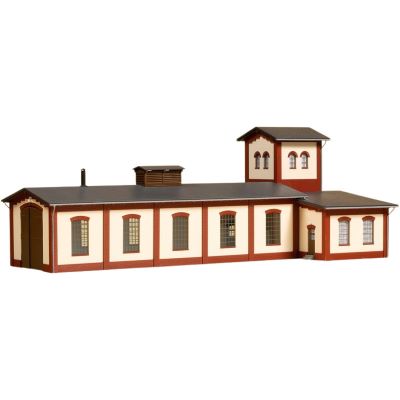
Single-road TT shed with small workshop extension for locomotives up to approximately 215 mm long.
View Product →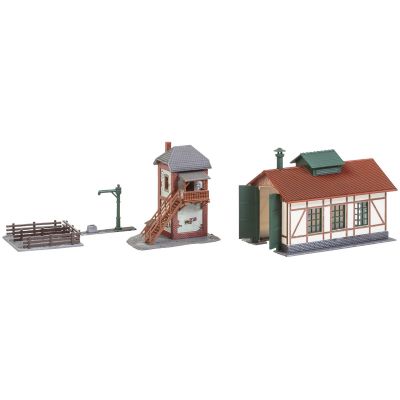
Compact set with locomotive shed, block station, water crane and a fenced coal area.
View Product →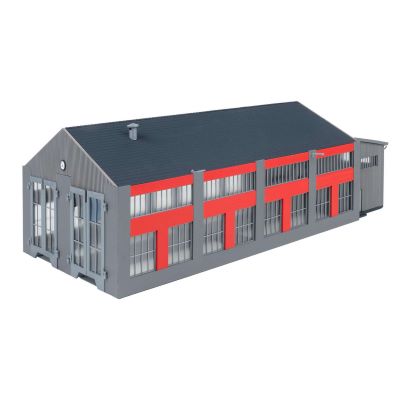
Modern two-road locomotive shed for electric locomotive, maintenance and workshop scenes.
View Product →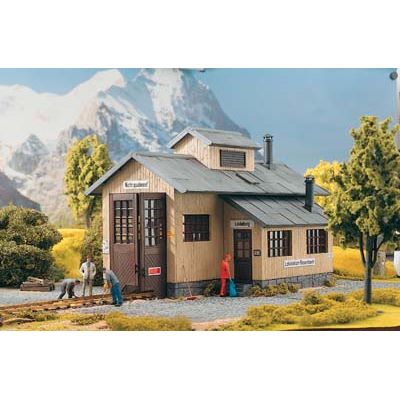
Large G-gauge locomotive shed with opening double doors and a side extension for the local locomotive management office.
View Product →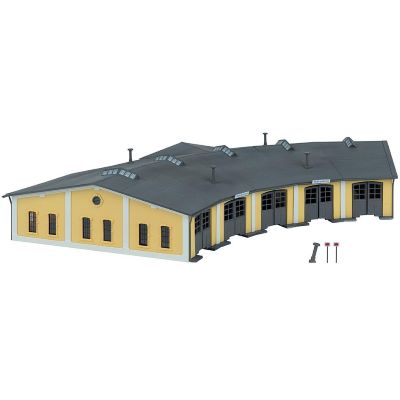
Five-road Z-gauge roundhouse with 15° track spacing for locomotives up to approximately 120 mm long.
View Product →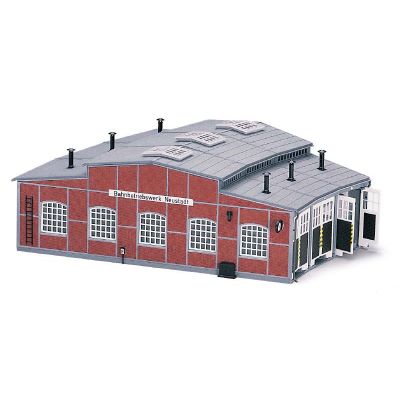
Classic three-road roundhouse for a compact N-gauge locomotive depot and turntable scene.
View Product →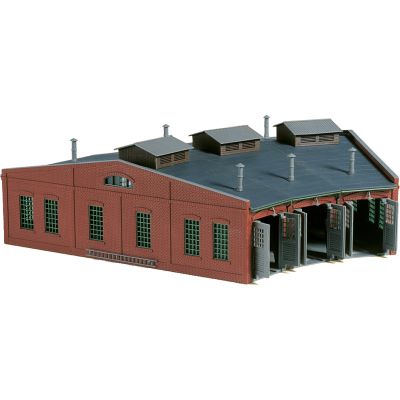
Three-road TT model with 15° track spacing for locomotives up to approximately 200 mm long.
View Product →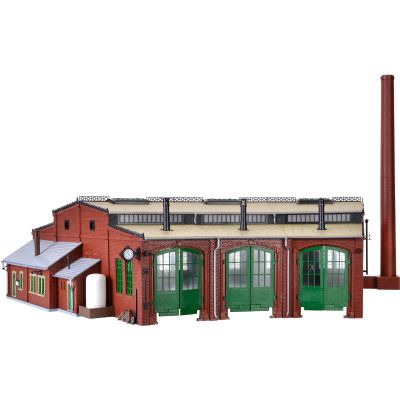
Horb depot-style roundhouse with three roads, 15° geometry and a mechanical door-closing arrangement.
View Product →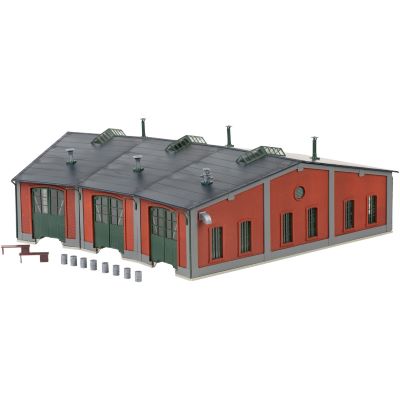
Three-road model with 12° spacing and automatically closing doors for compatible Märklin and Trix turntables.
View Product →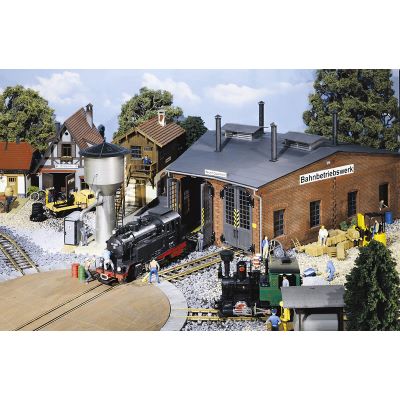
Modular garden-railway roundhouse with two locomotive roads, movable doors and a 15° entrance angle.
View Product →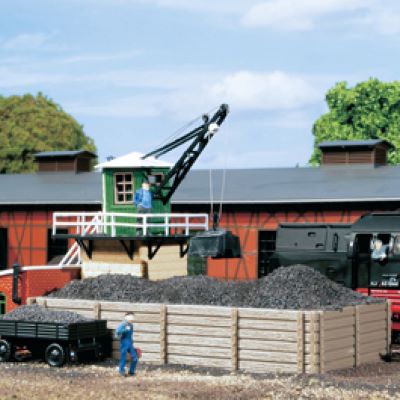
Coal bunker and manually swivelling crane for a classic steam-locomotive servicing scene.
View Product →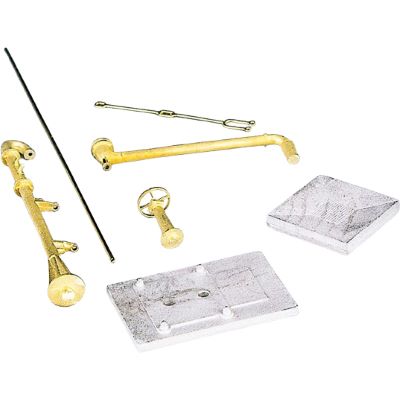
Fine brass and white-metal kit for steam-locomotive depots, stations and water-servicing scenes.
View Product →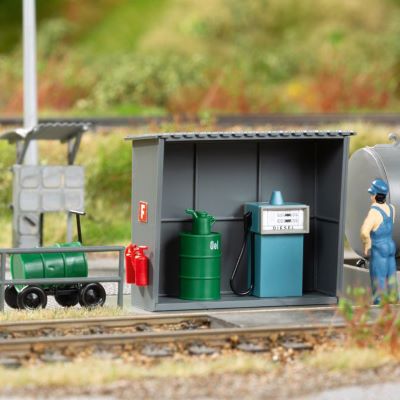
Compact fuel facility for diesel, shunting and small locomotives in depot and industrial scenes.
View Product →When this section approaches the viewport, the finder loads current English product pages from Railway Facilities Building and Turntables. Results can be filtered by product name, gauge, manufacturer and locomotive-depot area. Recognised archive, B-stock and clearance products are excluded and no availability information is displayed.
Current locomotive-depot products will be loaded when this section approaches the viewport …
Buildings and technical equipment from different manufacturers can be combined effectively within a locomotive depot. The logos lead directly to the respective English manufacturer pages at Modellbahnshop.






Roundhouse track spacing, turntable exits and locomotive lengths must work together. Checking both product groups before buying prevents incompatible track geometry later.
Tracks in a conventional rectangular locomotive shed usually run parallel. A roundhouse has locomotive roads arranged radially around a turntable.
For prototypical operation, normally yes, because the radial locomotive roads are reached via the turntable. The angular spacing of the building and turntable must be compatible.
The usable internal length must at least accommodate the longest intended locomotive. Additional reserve should be allowed for the doors, positioning and any buffer stop or workshop area.
The number describes the available locomotive roads or shed tracks. A two-road locomotive shed can accommodate two locomotives on parallel tracks.
Typical additions include a water crane, coal bunker or coaling plant, sand supply, workshop, railway staff and, at larger depots, a turntable.
A diesel fuel point, workshop, spare-parts area and stabling tracks are suitable additions. Large coal and water facilities are unnecessary for a depot used exclusively by diesel traction.
Often yes. The additional track height may require a substructure beneath the building. Check the instructions and clear door dimensions of the selected kit before installation.
LEDs or suitable building lighting are best installed during assembly so that cables can be routed invisibly through the floor or rear wall.
Z and N allow extensive depot track layouts within comparatively little space. TT provides a useful compromise, while H0 offers the widest choice of locomotive sheds, turntables and depot accessories.
Yes. Many historic locomotive sheds remained in use for decades, were converted into workshops or survived as heritage and museum buildings. The rolling stock and surroundings should make the later use visible.
Soot is especially appropriate around smoke vents, roofs and doorways of steam-locomotive sheds. Diesel and workshop areas are more likely to show oil, dust and operational dirt. Restrained weathering usually looks more convincing than completely black surfaces.
Yes. Branch-line stations, small locomotive outstations and heritage railways often need only a short shed track and a small number of servicing facilities.
Content and product links checked on . Please additionally check internal dimensions, clear door heights, angular track spacing and turntable compatibility on the respective product pages before installation.
Further detailed guides covering stations, signal boxes, track, scenery, gauges, digital technology and realistic railway operation can be found in the central Model Railway Guide.