
Passenger cars


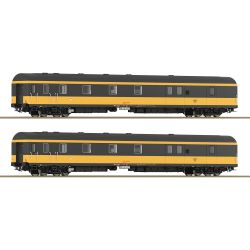




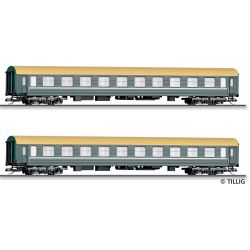
Looking for passenger cars that make your model railway more realistic, more varied and much more convincing in daily operation?
Then you are in exactly the right place: with the right passenger coaches, luggage cars, dining cars, double-decker coaches, control cars and classic express train coaches, you can create authentic passenger traffic from branch lines to prestigious long-distance trains.
What makes passenger cars so important on a model railway?
Passenger cars are among the most important rolling stock categories because they define how realistic passenger traffic feels on a layout. They shape station scenes, train formations and the overall character of a railway era.
On a model railway, coaches do much more than simply follow a locomotive. They create complete train identities, show railway-company styles, reflect historical periods and add variety through different classes, car types and train compositions.
This is exactly why the category is so important: the right coach set can turn a single locomotive into a believable regional train, express service, commuter formation or historic branch-line consist.
Why are passenger coaches so popular with model railway fans?
Many modellers appreciate passenger cars because they offer huge visual and historical variety. A layout immediately gains more life when stations, platforms and train formations are filled with matching coaches instead of only locomotives.
They are also highly flexible. Passenger coaches can be combined into short local trains, long express formations, narrow gauge sets, double-decker commuter services or prestige international trains. That makes them ideal for collectors and active operators alike.
Another major strength is that coaches make era and railway company themes much clearer. A DB express coach, a DR double-decker car or an RhB narrow gauge coach each creates a very different atmosphere on the layout.
Which products belong to the passenger cars category?
The category includes a very broad mix of passenger wagons, luggage wagons, dining wagons, mail wagons, double-decker coaches, sleeping cars and control cars. This makes it one of the most versatile rolling-stock areas in the whole hobby.
Visible examples show classic DR and DB express coaches, Halberstadt centre-entry cars, Mitropa dining cars, ÖBB mail coach sets, narrow gauge coach types from Technomodell and Tillig, as well as LGB G scale passenger cars and observation cars. That mix makes the category useful for everything from compact local layouts to highly detailed historical train sets.
Because the range includes both single cars and multi-car sets, the category supports simple fleet expansion as well as complete ready-made train concepts.
Which brands are especially important in passenger cars?
The category is especially strong because it combines many leading wagon manufacturers across a very wide prototype range. Particularly visible brands include Brawa, Piko, Tillig, Roco, Bemo, Märklin, Minitrix, Arnold, Lenz, LGB, Fleischmann and Technomodell.
Brawa and Piko are especially important in H0, while Tillig plays a major role in TT and also supports H0 and narrow gauge themes. Roco is highly relevant for H0 and TT passenger stock, and Bemo and Technomodell are especially valuable for narrow gauge enthusiasts.
Märklin, Minitrix, Arnold and Fleischmann are especially useful for H0 and N, while LGB and Lenz support large-scale and gauge 0 passenger traffic. This broad brand structure is a major strength because it allows very focused prototype collecting.
Brand overview for passenger cars
Which gauges are especially relevant for passenger cars?
H0 is by far the strongest gauge in the category and offers the widest selection of coach types, railway companies and eras. N and TT are also highly important, especially for modellers who want longer trains or compact layouts.
The category also includes strong support for G, H0e, H0m, 0, TTe and Z. That makes it useful not only for standard mainline layouts but also for narrow gauge, garden railway and specialist historical projects.
This broad gauge structure is one of the major strengths of the category because passenger traffic is relevant in almost every scale and railway style.
Which railway companies and eras are especially common in passenger cars?
The category shows particularly strong representation for DB, DR, DB AG and DRG, with many additional railway companies such as ÖBB, SBB, RhB, PKP, CSD, CD, NS, SNCF and Private Railways.
Era coverage is especially strong in Era IV, followed by Era III and Era VI, with substantial support for Era V and earlier historical periods as well. That makes the category useful for both classic post-war formations and very modern passenger traffic.
This broad historical coverage makes it easy to build coherent train sets for specific regions, time periods and railway-company themes.
Which types of passenger cars are especially useful?
Passenger wagons are the core of the category, but many layouts benefit even more when they also include luggage wagons, dining cars, control cars and double-decker coaches. These car types help train formations look more authentic and operationally meaningful.
A luggage coach can make a branch-line or classic passenger train look more complete. A dining car adds prestige to long-distance traffic. A control car is especially useful for modern commuter and regional sets, while double-decker coaches are ideal for DR, DB AG and other dense passenger-traffic themes.
That means the best coach choice often depends less on price and more on how clearly it supports the story of the train.
Which passenger cars are especially good for beginners?
For beginners, the most practical starting points are usually standard passenger wagons, double-decker coach sets and clearly themed regional or express coaches in H0, N or TT. These are easy to understand, easy to combine and immediately useful in many train formations.
A two-car or three-car formation is often a very good starting point because it creates a complete train feeling without requiring a huge layout. Coaches from DB, DR or DB AG themes are often especially beginner-friendly because they match many common locomotives.
If you want fast visible value, one well-matched coach set behind a fitting locomotive is often one of the best ways to make a layout look more realistic immediately.
Which layouts are passenger cars best suited for?
Passenger cars are ideal for station layouts, regional routes, branch lines, mainline traffic, commuter systems and narrow gauge operations. They are especially important wherever a layout should show believable everyday railway service rather than only occasional train movement.
Short branch lines benefit from compact coach formations and luggage cars, while larger layouts can support express trains, dining cars and full double-decker sets. Narrow gauge layouts gain a lot of charm from specialist passenger cars with strong local identity.
This makes passenger coaches one of the most useful categories for building a layout with real traffic character.
Typical uses for passenger cars
What should you look for when buying passenger cars?
When buying passenger coaches, you should pay special attention to gauge, railway company, era, coach type, brand and the kind of train formation you want to build. These points matter because passenger stock works best when the full consist feels coherent.
It is especially important to ask whether the coach should support a branch-line train, an express formation, a commuter set or a narrow gauge concept. That determines whether you need standard passenger cars, double-deckers, dining cars, control wagons or luggage coaches.
A careful choice usually creates a much stronger train scene than buying random attractive coaches. The best passenger cars are the ones that fit your locomotive, your layout and your railway story.
Passenger cars buy and make your train formations more realistic
Whether you need passenger coaches, luggage wagons, dining cars, double-decker coaches or control cars from brands such as Brawa, Piko, Tillig, Roco, Bemo or Märklin, the right products from the passenger cars category give your layout more life, more realism and much stronger train identity.
By choosing carefully according to gauge, era, railway company, coach type and train concept, you will find exactly the passenger cars that suit your project. That means better-looking formations, more believable passenger traffic and lasting enjoyment on your model railway.