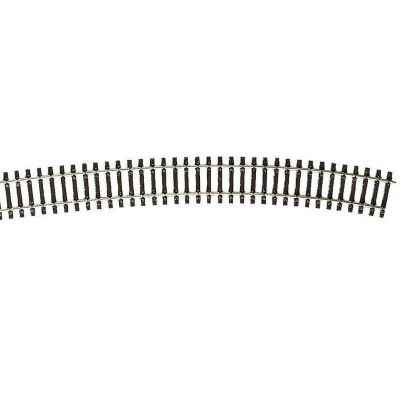


Realistic Code 83 Profile
The 2.1-millimetre profile is lower and more prototypical than traditional Code 100 track.


An illustrated overview of the ROCO LINE track without roadbed verified at Modellbahnshop: standard straights, diagonal and compensation track, 920-millimetre flexible track, radii R2 to R10, standard, curved and slip turnouts, crossings, turnout drives, rail joiners, buffer stops and complete layout track sets.
Verified range as of:
ROCO LINE without roadbed is an H0 two-rail track system with a 2.1-millimetre nickel-silver rail profile. The rails and wooden sleepers do not include a permanently moulded ballast body.
The system belongs to H0 gauge at a scale of 1:87 and has a model track gauge of 16.5 millimetres. It can be used on analogue or digital two-rail layouts.
Standard straight G1 is 230 millimetres long. Half and quarter straights, a diagonal straight and the 920-millimetre G4 straight complement the length grid.
The 920-millimetre F4 flexible track permits freely selected radii, transition curves and individually cut track sections.
Because the track has no roadbed, sound insulation, ballast colour, track-bed width, trackside paths and embankments can be designed to match the represented prototype.
The 2.1-millimetre profile is lower and more prototypical than traditional Code 100 track.
The long F4 track permits smooth transition curves and flowing track alignments.
The height, colour and width of the track bed can be adapted to a main line, branch line or station.
Twelve 30-degree curves or twenty-four 15-degree curves form a complete circle. R9 and R10 complement the geometry of the 15-degree turnouts.
| Geometry | Radius or Length | Angle | Product | Typical Application |
|---|---|---|---|---|
| G1 | 230 mm | – | 42410 | Standard straight and basic grid |
| DG1 | 119 mm | Diagonal | 42411 | Diagonal connection in turnout formations |
| G½ | 115 mm | – | 42412 | Half standard straight |
| G¼ | 57.5 mm | – | 42413 | Short length compensation |
| G4 / F4 | 920 mm | Straight or flexible | 42406, 42400 | Long routes and freely shaped track |
| R2 | 358 mm | 30° | 42422 | Compact inner circle |
| R3 | 419.6 mm | 30° or 7.5° | 42423, 42409 | Second parallel circle and partial curve |
| R4 | 481.2 mm | 30° | 42424 | Visible routes |
| R5 | 542.8 mm | 30° | 42425 | Generous outer parallel circle |
| R6 | 604.4 mm | 30° | 42426 | Long vehicles and main lines |
| R9 | 826.4 mm | 15° | 42427 | Slender partial curve |
| R10 | 888 mm | 15° | 42428 | Reverse curve for 15-degree turnouts |
| W15 | 230 mm / radius 873.5 mm | 15° | 42442, 42443 | Stations and sidings |
| W10 | 345 mm / radius 1,946 mm | 10° | 42490, 42491 | Slender station approach |
| Curved Turnout | Inner and outer R2 curves | 30° | 42466, 42467 | Junction within a curved route |
A level route, sound insulation and a properly constructed ballast bed remain necessary.
Side-mounted manual and electric drives as well as underfloor drive 10030 are available.
Transition joiners 42612 connect the 2.1-millimetre profile to track with a 2.5-millimetre profile.
Every card links directly to its product page at modellbahnshop.de. Search terms can include “42400”, “G4”, “R9”, “Wl10”, “curved turnout”, “underfloor drive”, “transition joiners” or “Martinstadt”.
Flexible track, profile transitions, turnout drives, power feeds and subsequent ballasting should be planned together before the track is permanently secured.
Flexible track and large radii permit smooth, prototypical track alignments.
Turnouts with angles of 10 and 15 degrees permit compact or particularly slender routes.
Precise straights and individually cut flexible track make defined module transitions easier.
Check the minimum radius of the longest locomotives, coaches and multiple units.
The route and sound insulation must be level, free from twisting and aligned precisely.
Power feeds, isolation points and underfloor drives should be marked before the track is secured.
Test every route before applying ballast and adhesive.
Cut and secure flexible track without tension. Use ballast particularly sparingly around frogs, tie bars and turnout drives.
Answers about track gauge, rail profile, straights, flexible track, radii, turnouts, drives, profile transitions and layout track sets.
The track has a gauge of 16.5 millimetres and belongs to H0 gauge at a scale of 1:87.
The nickel-silver profile is 2.1 millimetres high and approximately corresponds to Code 83.
No. The ballast bed is constructed separately on a prepared route.
Product 42410 is 230 millimetres long.
Product 42412 is 115 millimetres long and product 42413 is 57.5 millimetres long.
F4 flexible track is 920 millimetres long.
The overview covers R2 with a radius of 358 millimetres through to R10 with a radius of 888 millimetres.
Twelve 30-degree curved track sections form a complete circle.
Products 42442 and 42443 are 230 millimetres long, have a diverging angle of 15 degrees and an approximate diverging radius of 873.5 millimetres.
Products 42490 and 42491 are 345 millimetres long, have a diverging angle of 10 degrees and a radius of 1,946 millimetres.
Products 40295 and 40296 are electric drives. Products 40297 and 40298 are manual drives.
Yes. Product 10030 can be installed horizontally or vertically beneath the layout.
Transition joiners 42612 compensate for the change from a 2.5-millimetre to a 2.1-millimetre rail profile.
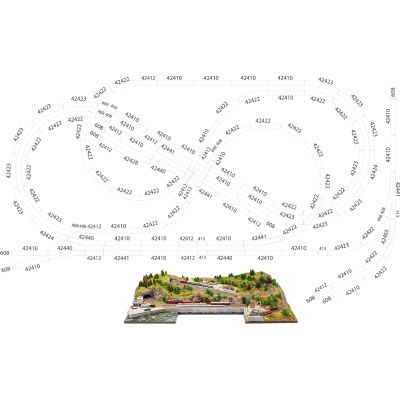
The overview includes the Andreastal, Martinstadt and Theisensee track sets.
No. The product cards exclusively contain ROCO LINE track without roadbed from the 424xx product family and matching accessories.
Plan radii, turnout drives, the substructure, power feeds and maintenance access together.