Small Village Petrol Station
A few pumps, a compact sales building and a small footprint make this ideal for country roads, villages, station roads and smaller layouts.


From a small 1950s roadside filling station with an attendant to a modern petrol station with shop, car wash and EV charging: petrol stations bring road traffic, vehicles and recognisable everyday life to towns, villages and industrial districts.
Designing model railway petrol stations gives road traffic a clear destination. Cars no longer simply move from one side of the layout to the other: they can refuel, park, visit a garage or use a car wash. Even a small area of roadway therefore gains an immediately understandable function.
Petrol stations are also buildings that can establish the period of a scene very quickly. A small filling station with only a few pumps and a workshop tells a very different story from a modern site with a large canopy, shop, price sign, car wash and charging points for electric vehicles.
In earlier post-war decades, attendant service, vehicle care and repair workshops formed a stronger part of the petrol-station scene. Self-service later became increasingly common, while shops, car washing and other services became more prominent. Contemporary layouts can combine conventional fuel pumps with charging infrastructure.
A suitable location is usually beside an easily accessible road. Village and small-town petrol stations can be compact. Large modern sites need wider entrances and exits as well as sufficient room for several vehicles. The Build Model Railway Roads guide helps integrate the forecourt and access roads convincingly.
A few pumps, a compact sales building and a small footprint make this ideal for country roads, villages, station roads and smaller layouts.
A repair bay, tyre service and vehicle maintenance turn the site into a small motor business. This is especially suitable for scenes representing Eras II to IV.
Several filling positions, a large protective canopy, sales room and broad forecourt suit town edges and heavily used main roads.
Minol branding, period East German vehicles and relatively functional architecture create a distinctive Era III and Era IV road scene.
Refuelling and vehicle care form a complete service centre. Separate access to the wash area can make the traffic flow especially convincing.
Charging points and modern canopies suit contemporary road and commercial scenes and add a current mobility theme alongside conventional petrol stations.
A petrol station should not look like a building placed directly against the roadway. A dedicated forecourt is what makes the site appear genuinely usable.
Position several typical cars or lorries before fixing the scene. Sufficient manoeuvring space must remain between the road, fuel pumps and buildings.
A larger petrol station looks especially convincing with separate entrance and exit points. A small historic station can work with one broad shared access point.
Signs, brand logos and price displays should be positioned where they would be clearly visible from the road. This significantly improves the spatial credibility of the scene.
If a car wash, repair garage or air-and-water point is included, treat it as a separate functional part of the forecourt rather than squeezing it between the pumps.
Space-saving tip: on a small layout, a compact petrol station beside a road is enough. The pumps can stand parallel to the roadway while the garage or shop is represented as a partially modelled background building.
| Era | Typical Petrol-Station Scene | Suitable Details |
|---|---|---|
| II | Small station, few pumps and a garage | Early cars, attendant, oil cans, tyres and simple signage. |
| III | ARAL, BP, Esso and Minol roadside stations | Attendant service, garages, compact cars, motorcycles and prominent brand advertising. |
| IV | Self-service becomes increasingly common | Larger canopies, more filling positions, car washes and denser road traffic. |
| V | Larger shop, prominent price display and broader service offer | Modern cars, delivery traffic, car washing and larger retail areas. |
| VI | Fuel, shop, car wash and charging infrastructure | Electric cars, charging points, modern lighting and contemporary signage. |
Branding is a particularly strong period indicator at a petrol station. A historic ARAL, BP or Esso site looks most coherent with road vehicles and advertising from the same period unless a deliberate later reuse is being represented. Conversely, an older filling-station building can survive in a modern scene as a garage, classic-car business or other commercial use.
Historic petrol stations were often closely connected with maintenance and repair. Models such as the large FALLER BP petrol station, the illuminated Kibri ARAL station and Auhagen 12227 are therefore particularly useful because they combine fuel pumps with workshop or service buildings.
A car with its bonnet open, tyre stacks, workshop staff and a few suitable spare parts work well in front of a garage. Avoid filling the area with random objects: clear space in front of the doors is operationally more important than extra decoration.
Modern scenes can add a car wash or self-service wash station . This creates a complete service area at a town edge or on a commercial site. A separate lane to the wash bay looks especially convincing because it avoids crossing the main fuel-pump area.
In Era VI, roadside energy infrastructure is no longer limited to petrol and diesel. Charging points can be modelled independently or as part of a larger petrol-station site. FALLER 130153 represents a covered electric charging station with several charging points and can also be integrated with Car System road traffic.
Charging bays should look like real parking spaces. An electric vehicle normally remains in the space longer than a car using a conventional fuel pump, so separating the charging area from through traffic creates a more believable layout.
A contemporary scene can combine conventional pumps, EV charging, a shop and vehicle washing on the same site. This mixture is often more convincing than depicting an entire transport environment based on only one propulsion technology.
| Gauge | Scale | Current Situation | Recommendation |
|---|---|---|---|
| Z | 1:220 | No dedicated Z petrol-station range is visible in the current Infrastructure Building category | Combine a compact scratch-built or background solution with suitable Z road vehicles. |
| N | 1:160 | FALLER BP petrol station and other compact infrastructure | Particularly suitable for broader road networks and compact town-edge scenes. |
| TT / TTm / TTe | 1:120 | Petrol-station models from Auhagen, Busch, igra and Loewe | Very useful for East German, historic and later-period road scenes. |
| H0 / H0m / H0e | 1:87 | Broadest current petrol-station and service-building choice | Combine garages, car washes, road vehicles and charging points in detailed scenes. |
| 0 / 0e | approx. 1:45 | Mainly specialist accessories and scratch-building | Model individual pumps or a compact historic roadside station. |
| 1 / Im | 1:32 | Mainly individual accessories and custom projects | Build a petrol-station facade or garage scene as a focused individual model. |
| G / IIm | often approx. 1:22.5 | Large Pola petrol station with workshop | Allow a generous forecourt and sufficient room for large road vehicles. |
Coordinate ARAL, BP, Esso, Minol or modern JET architecture with road vehicles from the appropriate period.
Place several vehicles on the forecourt and check that the pumps, shop and garage remain easily accessible.
The petrol-station forecourt should remain visibly distinct from pavements, planted areas and neighbouring plots.
Use traffic lines, parking spaces and EV charging bays where they clarify movement, without adding more markings than the scene needs.
Interior details behind large windows create considerable visual depth, especially when the building is illuminated.
Petrol stations make excellent evening scenes. Concentrate the lighting around functional areas rather than illuminating the complete surroundings uniformly.
One vehicle can be refuelling, another waiting and a third can stand beside the garage, wash bay or charging point.
Main vehicle routes and the area in front of a garage can show greater wear than pavements, planted margins and quieter parts of the site.
Petrol stations, EV charging stations, car washes and other road-service buildings.
Cars, vans, lorries and other vehicles for petrol-station scenes.
Tank farms and technical installations for fuel supply and industrial scenes.
Advertising, workshop details and additional equipment for service scenes.
Street, building and yard lighting for evening and night scenes.
Combine a petrol station with workshops, warehouses and industrial road traffic.
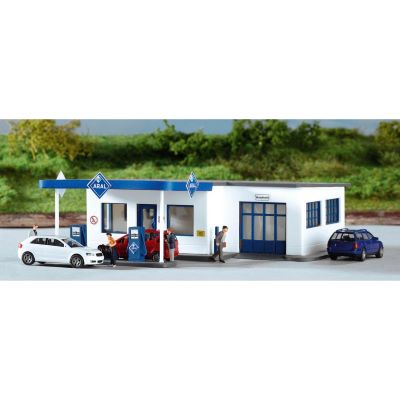
Compact ARAL filling station for village, country-road and small-town scenes.
View Product →
Large historic ensemble with sales room, fuel pumps and an integrated car-repair workshop.
View Product →
Classic service-station architecture with illuminated sales area, repair workshop, ARAL sign and pump canopy.
View Product →
Distinctive 1950s-style filling station with flexible building elements and fuel pumps.
View Product →
Historic repair business with a later petrol-station extension, ideal for period roadside and workshop scenes.
View Product →
Compact filling station for country roads, villages and town-edge scenes.
View Product →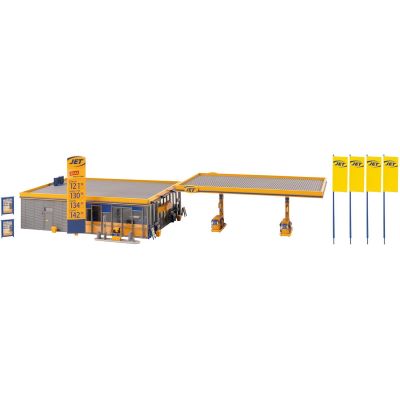
Modern JET filling station with partly glazed shop, fuel island, large canopy and extensive forecourt details.
View Product →
Compact service ensemble with covered shop area, fuel pumps and a separate car-wash building.
View Product →
Modern covered charging installation for contemporary urban and road scenes, also suitable for Car System integration.
View Product →
Modern vehicle-care building as an effective addition to a petrol station or contemporary commercial area.
View Product →
Compact Minol station for East German road scenes with period-appropriate TT vehicles.
View Product →
Petrol station based on a prototype in Pockau, with post-1990 modernisation details including a price sign and car wash.
View Product →
Compact retro station with flat roof and two fuel pumps, combining laser-cut and 3D-printed components.
View Product →
Compact 1950s-style station with the characteristic round pump canopy and BP signage for 1:160 layouts.
View Product →
Large nostalgic roadside station with workshop and covered filling area for garden railways and spacious indoor layouts.
View Product →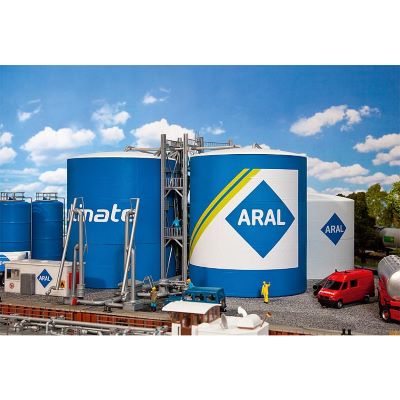
Technical fuel-storage complex with cylindrical tanks, platforms and pipework for industrial and fuel-supply scenes.
View Product →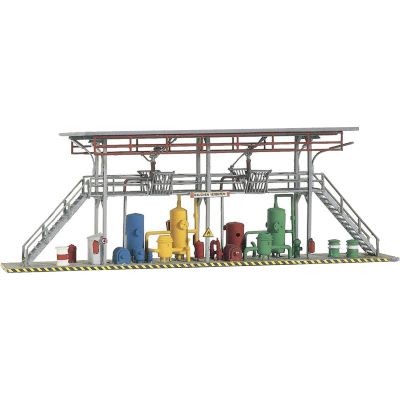
Pumps, pipelines and a raised observation platform for an operational tanker-loading and fuel-handling scene.
View Product →When this section approaches the viewport, the finder checks current English shop pages for infrastructure buildings, fuel storage, building accessories, road vehicles and lighting. Recognised archive, B-stock and clearance products are excluded. Prices, delivery times and availability are deliberately not displayed.
Current petrol-station products will be loaded when this section approaches the viewport …
Different manufacturers cover different periods and scales. The choice ranges from compact historic filling stations to illuminated service buildings, modern EV charging and large garden-railway petrol stations.






A historic Esso or BP station works especially well with period cars. A Minol petrol station belongs naturally in a suitable East German scene, while modern JET architecture and EV charging require contemporary road vehicles.
Suitable locations include a main road, village or town edge, station surroundings and commercial areas. The important point is a believable entrance from the road.
Small ARAL, BP or Esso stations with a garage, attendant and road vehicles from the 1950s and 1960s work particularly well.
A Minol petrol station combined with Trabant, Wartburg, Barkas, IFA or other period road vehicles creates a clearly recognisable East German scene.
This depends strongly on the model. In addition to the building footprint, sufficient room is needed for entering, refuelling, turning and, where applicable, a garage or car wash.
Yes. Smaller historic stations were often positioned close to the road. The model should nevertheless include a clearly recognisable vehicle area in front of the pumps.
Cars, motorcycles, vans, buses and lorries can all be suitable, depending on the size of the site. Matching the vehicle period to the architecture and branding is particularly important.
The shop, garage and fuel canopy are especially effective lighting areas. Light should be concentrated around the service functions rather than illuminating the complete surroundings uniformly.
Yes. It can remain in operation, be modernised or survive as a garage, classic-car business, café or another commercial use.
Give the car wash its own access route and enough space before and after the building. This keeps crossing traffic away from the main fuel-pump area.
Charging points work well as separate parking bays towards the edge of the site. This visibly separates through traffic, conventional refuelling and longer charging stops.
H0 currently has the broadest choice. Models are also represented in H0/TT, TT, N and G, while scratch-building and accessories are useful alternatives for other scales.
Different vehicle activities, clear traffic routes, suitable signage, restrained operating wear and surroundings that match the era make the greatest difference.
Content, English shop destinations and fixed product links checked on . Please additionally verify individual footprints, scale assignments and technical product details on the respective product pages.
Further detailed guides covering roads, vehicles, industry, buildings, railway facilities, scenery, gauges and layout planning can be found in the central Model Railway Guide.