
Fixed Track for Precise Geometry
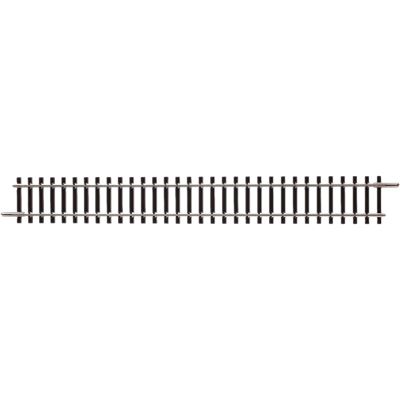
Straights, short compensation pieces and defined curves simplify the planning of parallel circles, stations, turnout formations and hidden yards.


The complete illustrated overview of Tillig TT model track: straights, curves, flexible track, sleeper strips, rail profiles, connection and functional track, turnouts, crossings, drives, accessories, multipacks and complete layout track sets.
Range reviewed:
Tillig TT track without roadbed is known as the TT model-track system. The track has no permanently moulded ballast body. The rail profiles and sleepers are laid directly on a prepared track bed. Cork, sound insulation, ballast, trackside paths and embankments can therefore be designed to match the represented prototype.
The system belongs to the TT nominal size at a scale of 1:120. The model track gauge is 12 millimetres. The nickel-silver rail profiles are 2.07 millimetres high. The track uses the usual two-rail principle and can generally be used for analogue or digital train operation.
Model track is especially suitable for permanent home layouts, modules, sectional layouts, stations, hidden yards, branch lines and industrial connections. Fixed straights and curves simplify precisely repeatable geometry. Flexible track, by contrast, permits transition curves, free radii and flowing route alignments.
Wooden, concrete and steel sleepers permit different track appearances. Wooden sleepers suit many historical and modern layouts. Concrete sleepers often identify modernised main lines. Steel sleepers are suitable for distinctive older or regional track sections.
The system also includes connection track, isolation points, contact track, uncoupling track, crossings, several turnout geometries, individual rail profiles, sleeper strips, turnout drives and complete track packages. The range therefore extends from a small station to an extensive multi-track layout.
Straights, short compensation pieces and defined curves simplify the planning of parallel circles, stations, turnout formations and hidden yards.
Flexible track permits smooth transition curves, freely selected radii and alignments that are less strictly tied to a fixed grid.
The height, colour, width and weathering of the track formation can be adapted individually to a station, main line, branch line or industrial connection.
Tillig combines fixed curves with angles of 30, 15 and 7.5 degrees. Twelve 30-degree curves, 24 15-degree curves or 48 7.5-degree curves each form a complete circle. The technically possible radius should always be compared with the required minimum radius of the locomotives and vehicles being used.
| Geometry | Radius | Angle | Track Sections per Circle | Typical Application |
|---|---|---|---|---|
| R01 | 267 mm | 30° | 12 sections | Exceptionally compact alignment; check vehicle specifications carefully |
| R04 | 267 mm | 7.5° | 48 sections | Short compensation section for the smallest fixed radius |
| R11 | 310 mm | 30° | 12 sections | Compact inner circle and smaller TT layouts |
| R12 | 310 mm | 15° | 24 sections | Partial curve and geometric compensation |
| R14 | 310 mm | 7.5° | 48 sections | Fine angle correction within the R11 system |
| R21 | 353 mm | 30° | 12 sections | General-purpose outer parallel circle |
| R22 | 353 mm | 15° | 24 sections | Partial curve and connection to turnout geometry |
| R24 | 353 mm | 7.5° | 48 sections | Short compensation section within the R21 system |
| R31 | 396 mm | 30° | 12 sections | More generous visible routes and longer vehicles |
| R32 | 396 mm | 15° | 24 sections | Large partial curve and station approach |
| Flexible Track | Individual | Freely planned | According to the plan | Transition curves and individually flowing routes |
TT standard gauge and H0m metre gauge both use a 12-millimetre model track gauge. TT represents standard gauge at a scale of 1:120, while H0m represents metre gauge at 1:87.
Different connection products are available for a prefabricated power feed. Analogue connection track 83143 and digital connection track 83149 must be selected according to their intended operating method.
A level and torsion-resistant track bed remains necessary. Sound insulation, track fixing, functional testing and final ballasting can then follow as required.
Every item receives its own product card containing the catalogue number, exact description, permanently assigned main image and direct product link. The search accepts entries such as “83125”, “flexible track”, “concrete sleepers”, “EW2”, “uncoupling track”, “Saubach” or “MBSET10068”.
The advantages of model track are especially apparent when the track plan, substructure, turnout drives, power feeds and later landscaping are planned together. A careful test phase prevents faults in difficult-to-reach areas from becoming apparent only after ballasting.
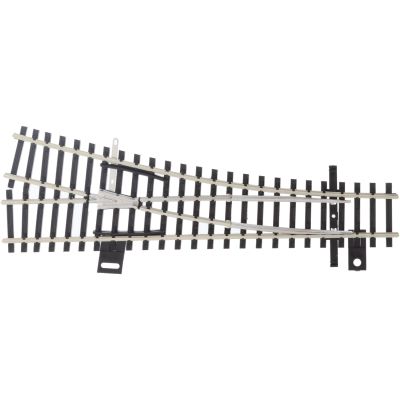
Fixed straights, compensation pieces, EW1 to EW3 turnouts, curved turnouts, crossings and double slips permit compact or generous station approaches.
Flexible track and larger radii create flowing routes. The selected sleeper type also determines the historical and regional character.
Concealed track must also be reliable, accessible and supplied with sufficient power. Maintenance openings are more important than an additional storage track which cannot later be reached.
Check the minimum radius of the longest locomotives and vehicles. Visible routes benefit from larger radii and smooth transition curves.
The track bed, insulation and centre line must be level and accurately prepared. Unevenness must not be corrected by forcing the track into position.
Power feeds, isolation points, feedback sections and turnout drives should be fully marked before the track is fixed permanently.
Test every route using different vehicles. The track should be fixed and ballasted permanently only after reliable operation has been achieved.
Flexible track should be cut cleanly to length using suitable tools and fixed without tension. Adhesive and ballast must be used especially sparingly around point blades, frogs, throw bars and drives.
These answers help with radii, flexible track, connection products, turnouts, sleeper types, transitions, multipacks and complete layout track sets.
The rail profiles and sleepers have no integrated ballast bed. The track is laid on a prepared track bed and then insulated, fixed, weathered and ballasted as required.
Yes. The track can be used for analogue or digital operation. Connection track 83149 is intended for a prefabricated digital power feed. Connection track 83143 is designed for analogue operation.
The principal fixed radii are 267, 310, 353 and 396 millimetres. Depending on the radius, curves with angles of 30, 15 or 7.5 degrees are available.
Twelve pieces form a circle when using 30-degree curves. Twenty-four pieces are required at 15 degrees and 48 pieces at 7.5 degrees.
Products 83125 and 83495 have wooden sleepers. Product 83134 represents concrete sleepers and 83136 steel sleepers. Different route types and modernisation states can therefore be represented.
EW1 is intended for more compact track plans. EW2 and EW3 permit longer and more slender routes. EW3 has the smaller branch angle of twelve degrees.
The drive for many individual turnouts is selected separately to suit the installation. Manual drives, side-mounted electric drives and motorised under-baseboard drive 86112 are available.
Transition track 83132 is intended for connecting the former standard-track system to model track. Differences in rail height should not be corrected by forcibly bending the track.
They create electrically separated sections, for example switchable storage tracks, block sections or feedback areas. Depending on the product, one or both rails are isolated.
Check rails increase the lateral guidance of wheelsets on bridges, tight sections or technically demanding areas. Products 83190 to 83194 permit double-sided and single-sided versions.
Multipacks are useful when larger quantities of the same item are required for long routes, complete circles or several identical turnouts.
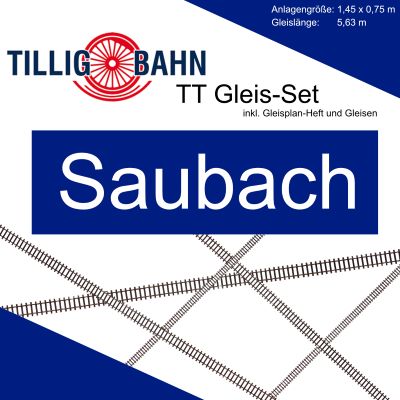
The sets combine model-track products for a particular layout design. The main image shows the associated track plan. Buildings, vehicles and scenery are included only when this is stated expressly on the product page.
Further guidance about gauges, layout planning, digital operation, wiring, landscaping, maintenance and rolling-stock selection is available on the central guide page.