
Era II
Early brand lettering, individual petrol pumps and small workshops suit the first motorised road scenes.
Suitable Addition
Two-axle tank wagons, delivery vans and simple advertising boards.

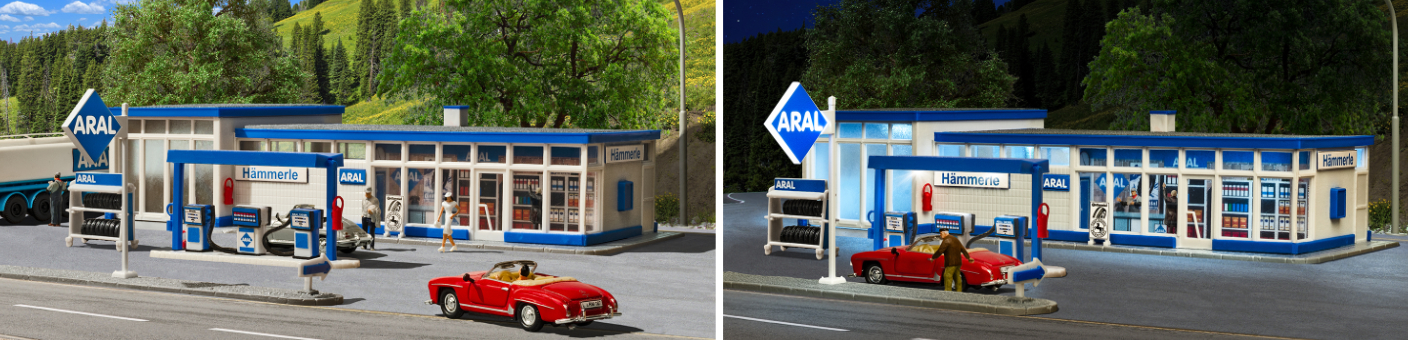
An ARAL petrol station connects road traffic, workshop operation, fuel supply and the railway in one versatile model scene. Discover classic and modern H0 petrol stations, illuminated price displays, fuel depots, CarMotion road tankers and ARAL tank wagons in H0 and N.
A petrol station consists of more than a building and fuel pumps. The canopy, sales room, price sign, workshop, oil cabinet, advertising signs, lighting, entrance and exit, and suitable vehicles work together to create a convincing scene. Larger layouts can also include a car-wash area, fuel depot, delivery entrance or a dedicated stopping area for lorries.
Low petrol-station buildings with only a few pumps and an attached workshop suit historic layouts. They can be combined with classic cars, small delivery vans and traditional road tankers. Modern stations feature larger canopies, clearly visible price displays, a shop area and, where appropriate, rapid-charging points.
The connection between road and rail provides particular variety. An ARAL tank wagon carries fuel to a depot or an industrial siding. A road tanker then distributes it to the petrol station. This creates an understandable transport chain linking shunting operation, road traffic and building design.
For moving road traffic, the Viessmann CarMotion products are particularly suitable. Static tankers, cars, workshop staff and customers provide a compact alternative without additional road-control technology.
The existing themed images illustrate the transition from everyday petrol-station operation through road logistics to rail-based fuel transport.
Early brand lettering, individual petrol pumps and small workshops suit the first motorised road scenes.
Two-axle tank wagons, delivery vans and simple advertising boards.
Flat-roofed buildings, a small number of pumps and an attached workshop represent the economic-boom years of the 1950s and 1960s.
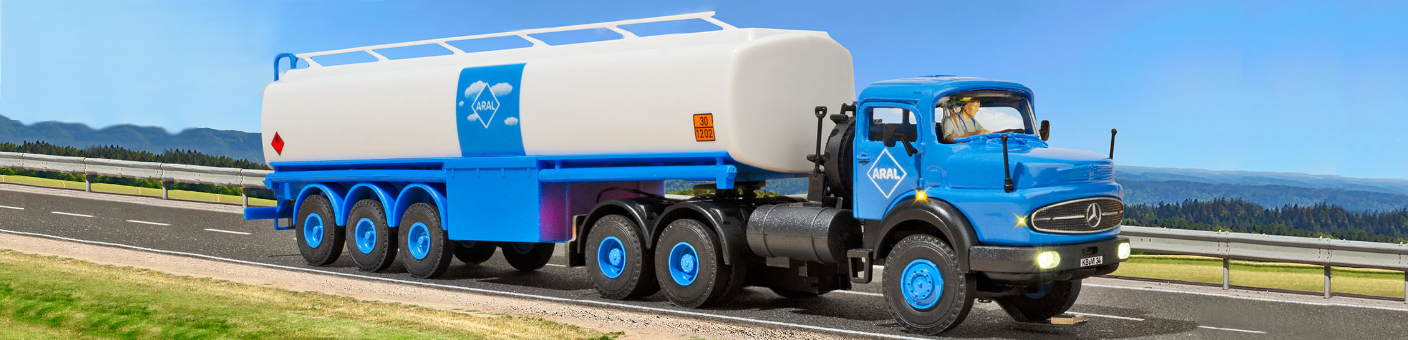
Classic cars, round-bonnet lorries, an oil cabinet and traditional tank wagons.
Larger canopies, additional pump positions and clearly visible price signs suit the growth in road traffic.
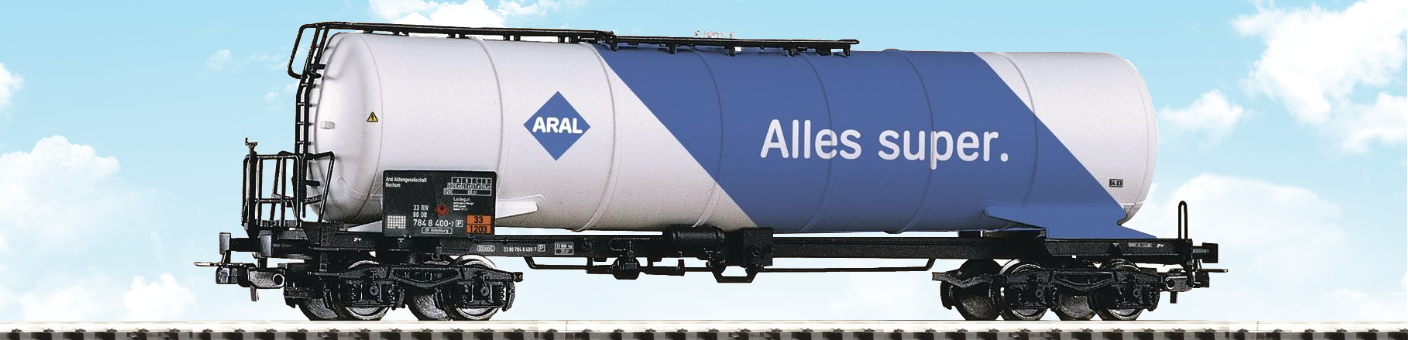
Saloons, vans, road tankers and Uerdingen tank wagons.
Modern forecourt canopies, shop areas and illuminated displays characterise scenes from the 1990s and early 2000s.
An Actros road tanker, articulated tank wagons and an industrial estate.
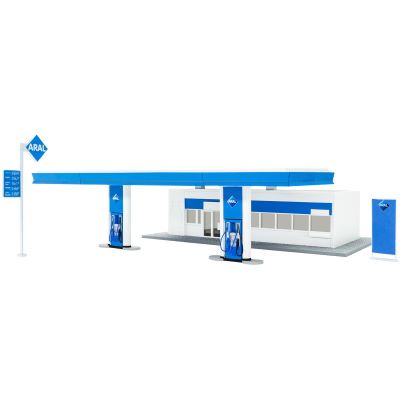
A shop, digital price display, modern lighting and charging infrastructure create a present-day mobility site.
Electric cars, rapid chargers and current road vehicles.
In later eras, a historic petrol station can serve as a classic-car workshop, museum or restored commercial building.
Deliberately combine weathered signs with more modern vehicles.
The shop, till, canopy, petrol pumps, advertising sign and price display form the immediately recognisable centre.
Town, suburb, country road and industrial estate.
A vehicle lift, tyres, oil cabinet and welder particularly complement historic petrol stations.
Classic cars, roadside assistance and small repair scenes.
A tanker explains how the underground storage tanks are replenished and brings activity to the rear delivery entrance.
CarMotion, a static model or a haulage-company scene.
Storage tanks, pipelines, walkways and office containers suit an industrial siding and a larger fuel-distribution facility.
Freight yard, harbour, refinery and industrial railway.
Historic two-axle wagons, Uerdingen lightweight wagons and modern articulated tank wagons represent different transport eras.
Local freight train, block train or individual delivery.
A modern petrol station can combine conventional pump positions and electric chargers in one mobility theme.
Era VI, current cars and modern lighting.
Coordinate the architecture, vehicles, logo design and lighting.
Include the building, canopy, advertising sign and complete entrance and exit.
Cars and road tankers must be able to pass without unrealistic turning movements.
Check the interior, pumps and lettering before permanently gluing the parts together.
Fit LEDs, the price display and cable routes so that they remain accessible.
Give customers, staff and workshop employees a clearly recognisable task.
Add a road tanker or tank wagon to explain where the fuel comes from.
Test the lighting, Car System route and access to all technical components.
| Gauge | Typical ARAL Products | Suitable Scene | Planning Note |
|---|---|---|---|
| H0 · 1:87 | Petrol stations, fuel depots, price displays, road tankers and tank wagons | Town, country road, industrial estate and industrial siding | The widest selection and numerous functional options |
| TT · 1:120 | Individual freight wagons, road vehicles and universal accessories | Compact town and industrial scene | Do not combine H0 buildings with TT vehicles |
| N · 1:160 | ARAL tank-wagon sets and cleaning wagons | Long fuel train and compact depot | Where necessary, create the buildings from neutral N-gauge kits |
| Z · 1:220 | Occasional historic tank and advertising wagons | Small local freight trains and discreet industrial sidings | Use only products currently listed in the range |
| 0, 1 and G | Rare large-scale models, scratch-building and universal equipment | Diorama, collector’s display or large garden-railway setting | A individually built petrol station is often the most practical solution |
H0 petrol stations require H0 cars and H0 figures. An N-gauge tank wagon belongs in an N-gauge freight train. The brand design connects the products thematically, but does not replace checking the scale.
This fixed selection remains visible even when the CMS does not permit dynamic product loading.
Spacious H0 kit for a suburban or industrial-estate scene.
View Product →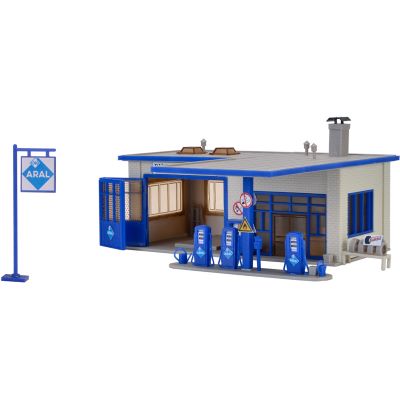
Petrol station with workshop for the 1950s and 1960s.
View Product →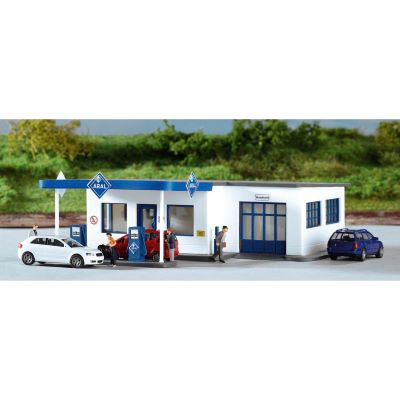
Space-saving station for a small town or country road.
View Product →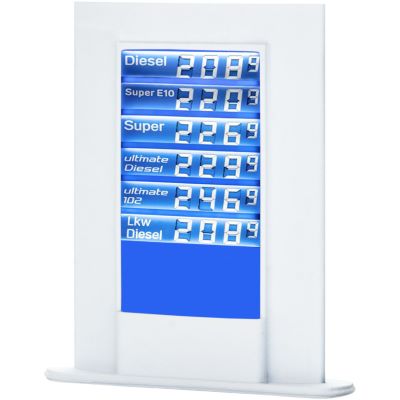
Illuminated detail for a modern H0 petrol station.
View Product →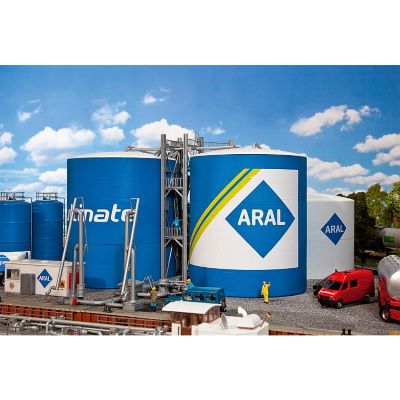
Storage tanks, pipes and walkways for an industrial siding.
View Product →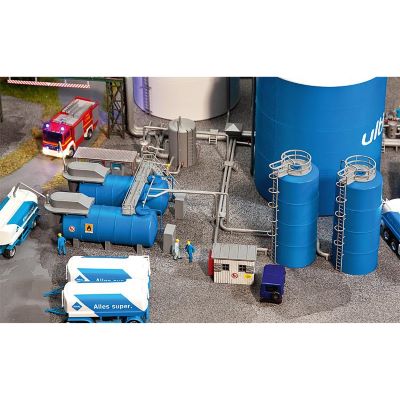
Fuel storage for industry, a railway siding and loading scenes.
View Product →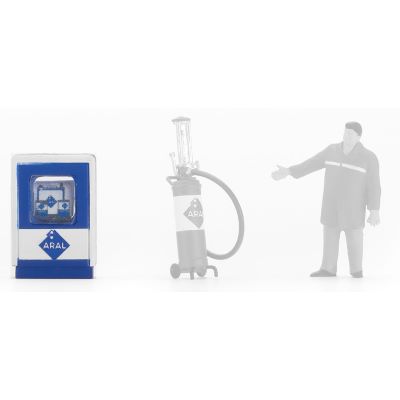
Finely detailed equipment for a historic petrol station.
View Product →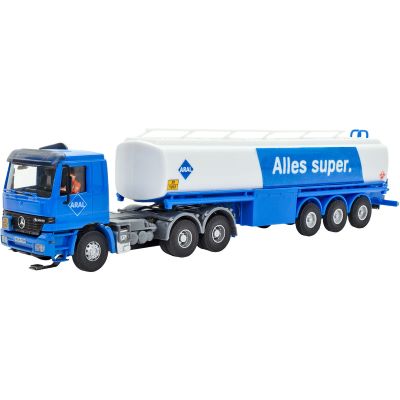
Modern moving road tanker for an H0 model road.
View Product →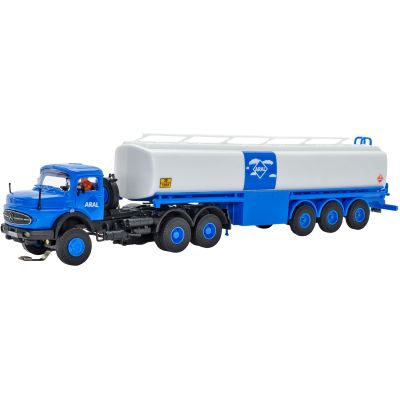
Moving road tanker for classic road and delivery scenes.
View Product →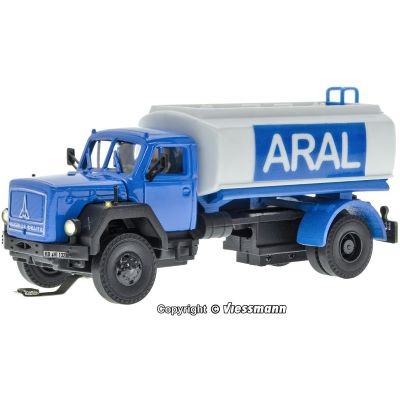
Compact functional model for historic delivery runs.
View Product →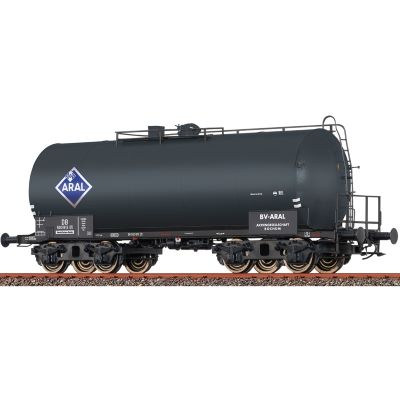
Four-axle ARAL wagon for DB freight trains in Era III.
View Product →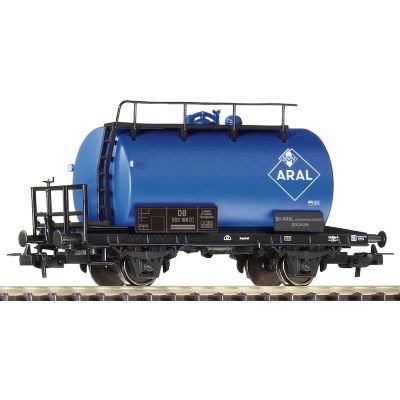
Compact two-axle wagon for local freight and collector trains.
View Product →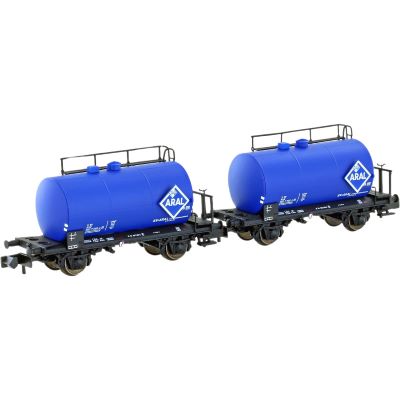
Uerdingen DB tank wagons for Era IV.
View Product →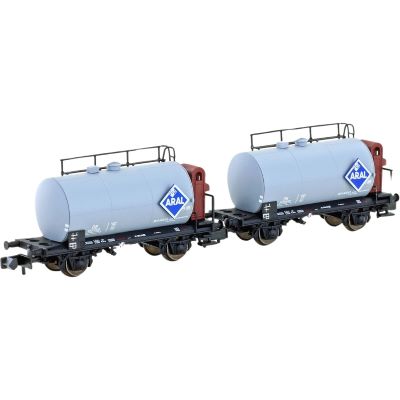
Two ARAL tank wagons for Era III freight trains.
View Product →The product browser searches Infrastructure Buildings, Viessmann Car System and Freight Cars. It includes only matching products and removes duplicate product numbers.
The large Freight Cars category contains many other liveries. The browser includes products from this category only when the product card expressly contains an ARAL reference.
Load more pages or remove one of the local filters.
Each logo links directly to the corresponding manufacturer page at Modellbahnshop.









Learn about moving road tankers, magnetic tape and traffic control.
Open CarMotionCompare road construction, guide wire, junctions and moving vehicles.
Open Car SystemCombine the petrol station, vehicles and freight wagons within a coherent period.
Open the Era GuideAdd roads, buildings, figures, lighting and commercial areas.
Open Layout DesignAssemble tank wagons, local freight trains and fuel traffic.
Open Freight CarsIntegrate a fuel depot, industrial siding and freight loading area.
Open Railway ConstructionLearn about gauges, vehicles, buildings and layout planning.
Open the OverviewExplore every knowledge area from planning and technology to scenery and maintenance.
Open the Main GuideH0 includes classic and modern petrol-station kits, some with a workshop, LED lighting or an electronic price display.
Flat-roofed buildings with a small workshop are particularly suitable for eras III and IV. They can also be used in later eras as a restored retro property.
In addition to the kit dimensions, include the canopy, advertising sign, entrances, parking spaces and the turning area required by a road tanker.
Yes. The building, pump canopy and advertising sign can be equipped with LEDs. Some products already include lighting or an electronic price display.
Classic cars, small vans, round-bonnet road tankers and workshop vehicles support a scene from the 1950s to the 1970s.
A large canopy, shop, illuminated price sign, current cars and charging points characterise a present-day layout.
Viessmann offers CarMotion road tankers and articulated tank vehicles for use on a suitable magnetically guided H0 road.
N-gauge products include historic tank-wagon sets and individual rail-cleaning wagons with ARAL lettering.
Storage tanks, pipelines, walkways, pumps, office containers, loading areas and, where appropriate, an industrial siding are the most important elements.
A tank-wagon train supplies the fuel depot. Road tankers then distribute the fuel to the petrol station and other customers.
Customers, till staff, mechanics, road-tanker drivers and pedestrians make the purpose of each area immediately clear.
Light tyre and oil marks, dirt around the workshop and subtle weathering along the canopy edges look more realistic than heavy, uniform dirt across the entire model.
Combine the petrol station, workshop, road tanker, tank wagons, figures and lighting to form an understandable transport and everyday scene.