
DCC
A manufacturer-independent protocol used across many gauges. It is especially common on two-rail layouts, but DCC itself is not restricted to two-rail operation.

Drive decoders, sound decoders, function decoders, DCC, mfx, RailCom, Next18, PluX22, 21MTC or classic NEM plugs: find out which digital decoder suits your locomotive, gauge, command station and required functions.
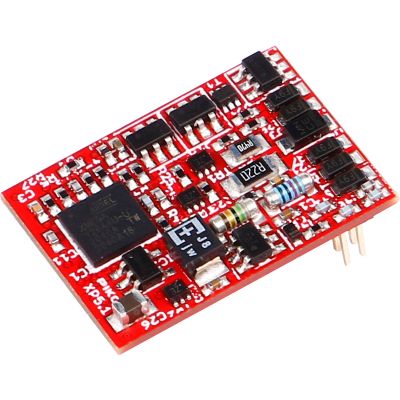
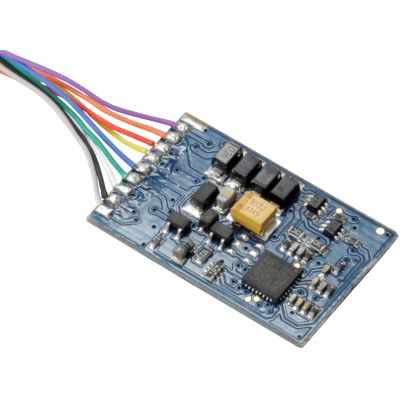
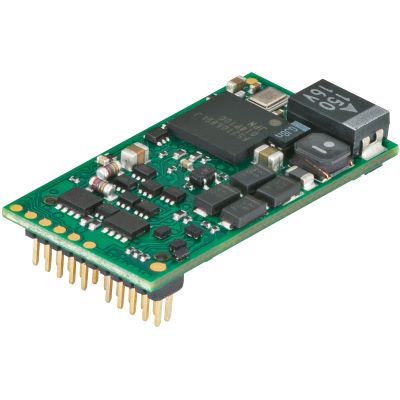
A digital decoder is a small electronic component that receives commands from the digital command station and converts them into specific vehicle or layout functions. In a locomotive it controls the motor, direction, speed, lighting and, depending on the model, sound, couplings, smoke generators or other special functions.
Without a decoder, an analogue locomotive cannot be given its own address and controlled individually on a digital layout. With a decoder, several vehicles can stand on the same powered track while still being driven, braked and controlled independently. This is one of the fundamental advantages of digital model railway operation.
A good decoder enables precise slow running, smooth acceleration and braking and individually switchable lighting. Sound decoders add vehicle-specific sounds. Function decoders can switch coach lighting, tail lights or couplings. Digital technology should make operation more controllable and realistic rather than unnecessarily complicated.
Even an excellent decoder is unsuitable if its interface, motor-current rating, digital protocol or dimensions do not match the model. Start with four questions: Which gauge do I use? Which command station do I use? Which interface is fitted in the vehicle? And do I also want sound?
Motor current, interface, installation dimensions, digital protocol, number of function outputs and any available loudspeaker space should all be checked before purchasing.
| Decoder Type | Task | Typical Application |
|---|---|---|
| Drive Decoder | motor, address, driving characteristics, lighting and basic functions | locomotives without sound |
| Sound Decoder | drive decoder plus loudspeaker and sound control | steam, diesel and electric locomotives and multiple units |
| Function Decoder | lights, tail lights, couplings and effects without motor control | control coaches, passenger coaches and tail-end coaches |
| Turnout Decoder | digital control of turnout drives | stations, hidden yards and route control |
| Switch Decoder | switches consumers, relays, lamps and signals | lighting and layout accessories |
| Servo Decoder | controls slow movements via servos | semaphore signals, barriers, gates and water cranes |
A drive decoder has a motor output and controls locomotive movement. A function decoder normally does not need motor control and is therefore especially suitable for coaches. Passenger coaches and control coaches can use one to switch interior lighting, tail lights and further functions digitally. Reliable current pickup, possibly a stay-alive capacitor and realistic brightness remain important.
A manufacturer-independent protocol used across many gauges. It is especially common on two-rail layouts, but DCC itself is not restricted to two-rail operation.
Closely associated with the Märklin digital environment. Compatible decoders can register conveniently with suitable command stations and make functions available automatically.
Mainly relevant to older Märklin digital systems. Multi-protocol decoders can help keep existing vehicles usable when several digital formats are present.
Multi-protocol decoders understand several digital languages, offering flexibility with different command stations or mixed vehicle fleets. The actual protocol must nevertheless be supported by the command station. Track system and digital data format are separate subjects: DCC, for example, does not automatically mean H0 two-rail.
RailCom provides return communication in compatible DCC systems. A suitable decoder can send information such as its address or certain decoder values back to the command station or detectors. RailCom is not essential for a simple digital layout, but anyone planning PC control, diagnostics or automation later should consider compatibility early.
| Interface | Standard | Typical Application | Check Carefully |
|---|---|---|---|
| Next18 | NEM 662 | N, TT, H0e and compact H0 models | decoder height and loudspeaker space |
| PluX12 / 16 / 22 | NEM 658 | TT and modern H0 locomotives | pin count and function outputs |
| 21MTC | NEM 660 | many H0 vehicles | PCB and output assignment |
| NEM 651 | 6-pin | N, TT and older compact models | installation orientation |
| NEM 652 | 8-pin | many classic H0 locomotives | available space and additional functions |
| Wired Connection | no plug connector | older vehicles and custom conversions | motor isolation and wiring |
PluX22 and 21MTC are different systems. If you are unsure, check the operating instructions or the vehicle PCB unambiguously before inserting a decoder.
Sound decoders combine motor control and digital functions with sounds such as steam exhaust, diesel start-up, fans, horns, whistles and braking. Steam locomotives, diesel locomotives, shunters and multiple units can benefit particularly strongly. Sound also requires additional space for a loudspeaker and resonance chamber, making the loudspeaker almost as important as the decoder itself.
CVs are decoder configuration values. They are used to set items such as the address, starting voltage, acceleration, braking delay, maximum speed, volume and lighting functions. Beginners usually need only a few basic values at first. Advanced users can adjust motor control, lighting logic, sound parameters and function mapping.
Function mapping assigns function keys to specific outputs or operating sequences. Cab lighting, shunting mode, tail lights or couplings can therefore be configured logically for your own operating style.
| Gauge | Typical Decoder Technology | Common Connections | Particularly Important |
|---|---|---|---|
| Z | nano and micro decoders | wires / special PCB | extremely limited installation space and heat management |
| N | compact DCC and sound decoders | Next18, NEM 651 | decoder and loudspeaker dimensions |
| TT / TTe | compact decoders | Next18, PluX12, PluX16, NEM 651 | PCB position and installation height |
| H0 DC | DCC / multi-protocol / sound | PluX22, 21MTC, Next18, NEM 652 | motor current and vehicle PCB |
| H0 AC | mfx, Motorola, DCC | 21MTC, PluX22, system PCBs | centre-contact version and pickup shoe |
| H0e / H0m / H0f | compact DCC decoders | Next18, wires, compact plug-in systems | very restricted locomotive bodies |
| 0 / 0e | higher-output drive and sound decoders | wires / screw terminals | higher motor currents |
| 1 / II | large-scale decoders with sound | wires / system PCBs | power reserve and loudspeakers |
| G / IIm | high-current and large-scale decoders | wires / screw terminals | outdoor operation and high electrical loads |
A smaller decoder is not automatically a better decoder. Its size and electrical load capacity must suit the vehicle. An N-gauge locomotive has very different requirements from a heavy garden railway locomotive with several motors, smoke and sound.
Wheels, current pickup, motor and gearbox should already work reliably in analogue operation.
Check the instructions and PCB. Never choose a decoder plug only by its appearance.
Remove the dummy plug or, on older vehicles, isolate and wire the motor and lighting professionally.
Check address, motor operation, lighting and functions before using the locomotive normally.
With modern locomotives that have a clearly identified and suitable interface, installation is often straightforward. Professional conversion is usually safer with old, valuable, very small or technically unusual models. Short circuits, non-isolated motor connections, incorrectly inserted decoders or pinched wires can damage the electronics.
Common problems include the wrong interface, insufficient current rating, unchecked motor connections, insufficient installation space and unsuitable loudspeakers. Test older vehicles in analogue mode before conversion and document the decoder type, address, important CV values and installation date afterwards.
Determines available installation space, physical size and often the required current capacity.
Next18, PluX, 21MTC and NEM plugs must match the vehicle unambiguously.
Decoder and command station need at least one digital language in common.
Sound, lighting, couplings and additional outputs determine the required equipment.
Important characteristics include smooth motor control, sufficient current reserve, reliable programming, suitable function outputs and compatibility with the command station. Sound decoders also require good sound quality, a suitable loudspeaker connection and appropriate sound projects. For layout operators, reliability and adjustability are often more important than the longest possible list of functions.
The cost depends on manufacturer, decoder type, interface, sound, power rating and function range. A simple drive decoder is generally less expensive than a sound decoder with loudspeaker. The technically correct and reliable solution should be more important than the lowest price.
Established brands include ESU, ZIMO, PIKO, Uhlenbrock, Tams, Lenz, Döhler & Haass, Viessmann, Fleischmann, TILLIG and Märklin. The decisive factor remains the specific technical version that matches the locomotive and digital system.








The finder searches locomotive decoders, sound decoders and decoder accessories. Each current English product page is checked again before display. Clearly archived items and products without a suitable large shop image are deliberately excluded. Product cards do not show prices, stock levels, delivery times or availability information.
Current decoders will be checked when this section approaches the viewport.
Professional conversion is particularly useful for older locomotives, models without an interface, sound conversions, very small vehicles or valuable collector models. Several vehicles can also be configured consistently with regard to decoder type, addresses, lighting, sound and driving characteristics.
Your personal contact for digitising and repairing model railways. Available Monday, Wednesday and Friday from 08:30–15:30, Tuesday and Thursday from 08:30–18:00, and on the 1st and 3rd Saturday of each month from 08:00–13:00.
Clean wheels, reliable current pickup and clean track remain important in digital operation. Poor contact can cause especially noticeable interruptions with sound decoders. Document the decoder type, address, important CV values and installation date. This makes later maintenance, troubleshooting and reprogramming considerably easier.
A digital decoder receives commands from the command station and uses them to control the motor, lighting, driving characteristics and, depending on the decoder, sound and additional functions.
Check the gauge, interface, digital protocol, motor current, installation space and required functions. Only when these points are compatible should the decoder be selected.
Both are digital protocols. DCC is widely used across manufacturers. mfx is closely associated with the Märklin digital environment and allows convenient automatic registration with compatible equipment.
A multi-protocol decoder supports several digital data formats and therefore offers additional flexibility with mixed vehicle fleets or different command stations.
Common interfaces include Next18, PluX12, PluX16, PluX22, 21MTC, NEM 651 and NEM 652. Older vehicles may also be hard-wired directly.
A sound decoder is required when vehicle-specific sounds are wanted in addition to motor and lighting control. Sufficient space for both decoder and loudspeaker must also be available.
CVs are decoder configuration values used to set items such as address, acceleration, braking delay, maximum speed, lighting and sound.
RailCom is not essential for basic digital operation. It can, however, be useful for feedback, diagnostics, PC control and future automation.
Often yes when a locomotive has a clearly identified and suitable plug-in interface. Professional help is usually safer for older, valuable, very small or complex vehicles.
Yes. Function decoders can digitally switch interior lighting, tail lights, couplings and further functions in control coaches, passenger coaches and tail-end coaches.
Established suppliers include ESU, ZIMO, PIKO, Uhlenbrock, Tams, Lenz, Döhler & Haass, Viessmann, Fleischmann, TILLIG and Märklin. The technically correct version is more important than the brand name alone.
The price depends on decoder type, manufacturer, interface, power rating, sound and function range. Drive decoders are generally less expensive than extensive sound decoders.
Current prices for drive-decoder installation, sound conversions, soldering work, BEMO conversions and repairs are listed on the dedicated Modellbahnshop service price page.
Further information about digital command stations, interfaces, programming, layout control, sound, feedback and digitisation is available in the main model railway guide.