Generous Radii
Large curves support smooth running and provide long locomotives and coaches with sufficient lateral clearance.


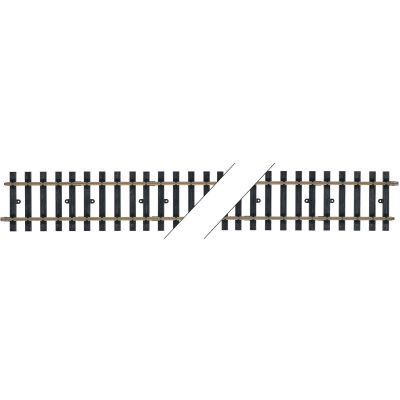
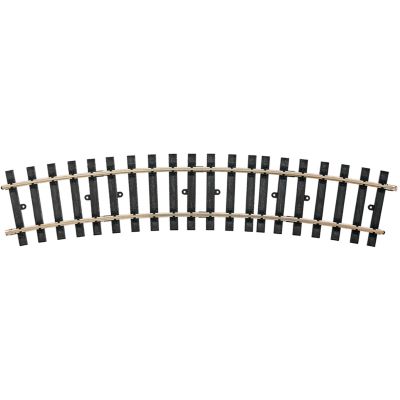
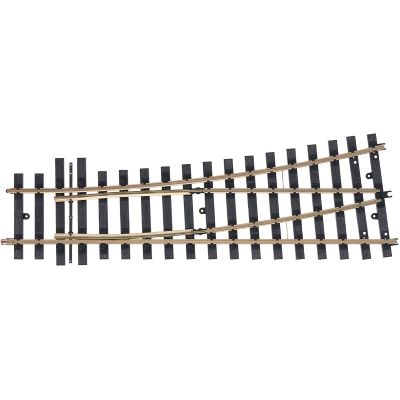
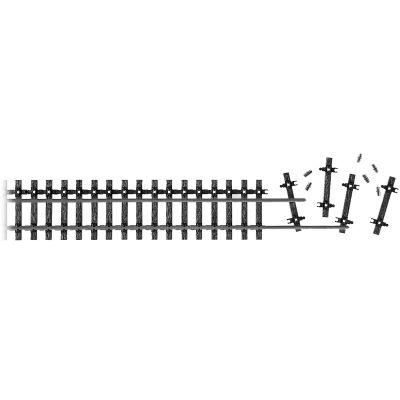
The illustrated overview of the Märklin Gauge 1 track system: short and long straights, diagonal track, fixed curves with radii from 1,020 to 2,461 millimetres, turnouts, curved turnouts, a three-way turnout, wooden- and concrete-sleeper track construction kits, rail joiners and connection accessories.
Range reviewed:
Märklin Gauge 1 track is a 45-millimetre two-rail track system for models at a scale of 1:32. The large rail profiles and sleepers are designed for heavy locomotives, long coaches and permanently reliable operation.
The track has no permanently moulded ballast roadbed. It is installed on a prepared route and can be detailed individually with sound insulation, scale ballast, trackside paths and embankments.
Straight track from 59.5 to 900 millimetres permits the construction of stations, storage areas and long routes. Two 152.2-millimetre diagonal track sections provide the geometric connection between parallel tracks.
The current curved-track range starts with a radius of 1,020 millimetres and extends to 2,461 millimetres. This makes it possible to plan both compact Gauge 1 layouts and generous main lines for long vehicles.
Track construction kits with wooden or concrete sleepers supplement the fixed track. Turnouts with integrated electric control, curved turnouts and a three-way turnout permit extensive stations and shunting areas.
Large curves support smooth running and provide long locomotives and coaches with sufficient lateral clearance.
Track construction kits permit different track appearances and particularly individual detailing.
Current turnouts can combine a drive, decoder and illuminated turnout lantern within the system.
Sixteen 22.5-degree curves, twenty-four 15-degree curves or thirty-six 10-degree curves form a complete circle. Earlier 30-degree track requires twelve sections per circle.
| Radius | Product | Angle | Circle Requires | Range Guidance |
|---|---|---|---|---|
| 600 mm | 5922 | 30° | 12 sections | Earlier compact geometry; check the vehicle radius |
| 760.8 mm | 59230 | 30° | 12 sections | Earlier parallel-circle geometry |
| 1,020 mm | 59035 | 22.5° | 16 sections | Compact, currently listed standard radius |
| 1,176 mm | 59072 | 22.5° | 16 sections | Second current parallel radius |
| 1,394 mm | 59073 | 22.5° | 16 sections | Generous visible routes |
| 1,394 mm | 59075 | 15° | 24 sections | Fine angle division and turnout connection |
| 1,550 mm | 59074, 59076 | 15° or 22.5° | 24 or 16 sections | Outer parallel circle and curved-turnout geometry |
| 1,715 mm | 59077 | 22.5° | 16 sections | Long vehicles and large layouts |
| 2,321 mm | 59078 | 10° | 36 sections | Radius range matching the long turnouts |
| 2,461 mm | 59071 | 10° | 36 sections | Largest currently listed fixed radius |
Not every long locomotive or coach is designed for earlier radii of 600 or 760.8 millimetres.
The track radius must be doubled and supplemented by the track width, vehicle overhang and a safe distance from the edge.
Straight track, curved turnouts and reverse curves should be planned as connected geometry so that parallel tracks close precisely.
Every item receives its own product card with a catalogue number, precise description, permanently assigned main image and direct link. Search terms can include “59061”, “1,394”, “curved turnout”, “concrete sleeper”, “rail joiner” or “59096”.
Large vehicles generate greater forces and require more lateral clearance than smaller scales. The substructure, radii, turnouts, power feeds and maintenance access should therefore be planned together.
Long straights and large radii are suitable for representative stations, main lines and motive-power depots.
Defined straight sections and connection dimensions simplify the construction of transportable or expandable layout sections.
Turnouts, the three-way turnout and short straights permit varied operation in a limited area despite the large vehicles.
Check the minimum radius, vehicle length and lateral overhang of the largest models.
The route and module transitions must permanently support the high weight of the vehicles.
Power feeds, isolation points, decoders and turnout connections should be installed before ballasting.
Test every route with long and heavy vehicles before the track is fixed permanently.
A circle with a radius of 1,020 millimetres already requires a diameter of more than two metres. The track width, vehicle overhang and a safe distance from the edge must also be considered.
The following answers provide guidance about scale, track gauge, minimum radius, two-rail operation, turnouts, track construction kits and layout planning.
Märklin Gauge 1 uses a scale of 1:32.
The model track gauge is 45 millimetres.
No. The ballast bed and any sound insulation are constructed separately when the layout is built.
Yes. The two-rail track can be operated with analogue control or a suitable digital Gauge 1 control system.
Product 59035 has a radius of 1,020 millimetres and an angle of 22.5 degrees. Sixteen track sections form a complete circle.
Product 59071 has a radius of 2,461 millimetres and an angle of 10 degrees.
Sixteen track sections with an angle of 22.5 degrees form a complete circle.
Thirty-six curves with an angle of 10 degrees are required for a complete circle.
The current overview ranges from 59.5 to 900 millimetres. Two 152.2-millimetre diagonal track sections are also available.
Product 5998 is a track construction kit with wooden sleepers. Product 59989 represents track with concrete sleepers.
The right- and left-hand turnouts are 600 millimetres long and use a radius of 2,321 millimetres with a diverging angle of 10 degrees.
The curved turnouts connect the radius ranges of 1,394 and 1,550 millimetres within a curved route.
Insulated rail joiners separate electrical track sections, for example for block sections, feedback detection or separate power districts.
Only after all turnouts, power feeds and routes have been tested reliably with different vehicles.
Plan radii, turnouts, the substructure, power feeds and maintenance access together before the track is fixed and ballasted permanently.