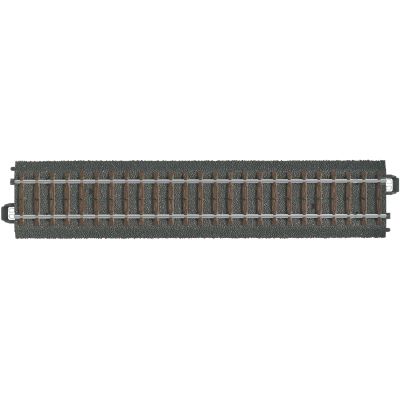
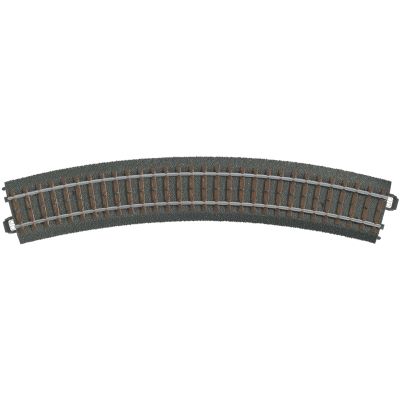

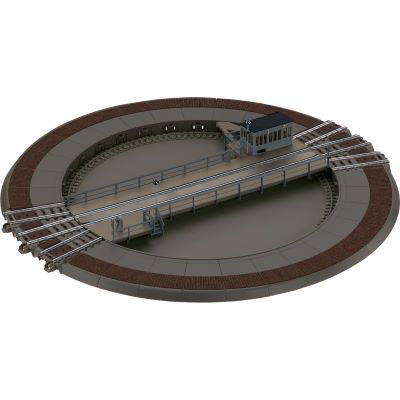
Stable Click Connection
The locking connection aligns the track mechanically while connecting the running rails and centre conductor.


The complete illustrated overview of Märklin C Track: short and long straights, R1 to R5 curves, reverse curves, contact track, transition track, buffer stops, uncoupling track, turnouts, crossings, accessories, multipacks and the digital C Track turntable.
Range reviewed:
Märklin C Track is an H0 track system with an integrated plastic ballast roadbed. Rails, sleepers, centre conductor and roadbed form a dimensionally stable track element. The concealed click connection provides both the mechanical and electrical connection.
The system belongs to H0 gauge at a scale of 1:87. The track gauge is 16.5 millimetres. The two running rails form the common return conductor, while the stud contacts in the centre carry the second pole of the Märklin three-rail system.
The integrated roadbed simplifies rapid assembly and dismantling while also permitting permanent layout installation. Space remains beneath the roadbed for connection cables, turnout drives and digital turnout decoders.
Straight track in graduated lengths and numerous fixed curve angles support precisely calculated geometry. Radii R1 to R5 permit compact circles and multi-track routes. Slender turnouts additionally use a large reverse curve with a radius of 1,114.6 millimetres.
Transition track connects C Track with the earlier M Track or the more flexible K Track. Contact track, uncoupling track, buffer stops, crossings and the digital turntable supplement the basic system.
The locking connection aligns the track mechanically while connecting the running rails and centre conductor.
The solid roadbed provides a defined track height and permits a stable temporary or permanent layout.
Turnout drives, decoders and electrical connections can be installed largely out of sight beneath the track body.
Twelve curves with an angle of 30 degrees form a complete circle. Partial curves measuring 15, 7.5 or 5.7 degrees provide geometric compensation and connections to turnouts and crossings.
| Geometry | Radius | Products | Angle | Typical Application |
|---|---|---|---|---|
| R1 | 360 mm | 24107, 24115, 24130 | 7.5°, 15° and 30° | Compact inner circle and small H0 layouts |
| R2 | 437.5 mm | 24206, 24207, 24215, 24224, 24230 | 5.7°, 7.5°, 15°, 24.3° and 30° | Standard outer circle and standard turnout geometry |
| R3 | 515 mm | 24315, 24330 | 15° and 30° | Larger visible routes and parallel circles |
| R4 | 579.3 mm | 24430 | 30° | More generous routes with 64.3 mm spacing from R3 |
| R5 | 643.6 mm | 24530 | 30° | Wide outer circle and long vehicles |
| Slender Reverse Curve | 1,114.6 mm | 24912 | 12.1° | Reverse curve for slender turnouts and wide curves |
| Standard Turnout | 437.5 mm | 24611, 24612 | 24.3° | Compact stations and sidings |
| Slender Turnout | 1,114.6 mm | 24711, 24712 | 12.1° | More prototypical station approaches and main lines |
R1 is technically compact. Long passenger coaches, express locomotives and multiple units run more smoothly and look more prototypical on R3 to R5.
Radii R1 and R2 are separated by 77.5 millimetres. A spacing of 64.3 millimetres is frequently used around slender turnouts.
Product 24922 connects C Track and K Track. Product 24951 is intended for the transition from C Track to the earlier M Track.
Every item receives its own product card with a catalogue number, precise description, permanently assigned main image and direct shop link. Search terms can include “24188”, “R3”, “contact track”, “slender turnout”, “buffer stop”, “74491” or “74862”.
The robust geometry simplifies layout construction. Radii, turnouts, power feeds, feedback sections and digital components should nevertheless be planned together and tested before landscaping begins.
The click connection is suitable for floor railways, test circles, seasonal layouts and track plans that are altered regularly.
The track can be screwed down and integrated into the scenery using colour, additional ballast and landscaped roadbed edges.
Turnout drives, installation decoders, contact track and isolated centre-conductor sections support automated and digitally controlled operating sequences.
Check the minimum radius of the longest locomotives, coaches and multiple units.
Use short straights, partial curves and suitable reverse curves instead of connecting track under tension.
Power feeds, feedback sections, drives and decoders should be installed before the track is fixed permanently.
Test every route and switching function before the track is ballasted or becomes difficult to access.
Electric drive 74491 can be installed largely out of sight beneath standard C Track turnouts. The switching movement, wiring and accessibility must be checked before the track is fixed permanently.
The following answers provide guidance about track gauge, the centre conductor, radii, turnout drives, transition track, feedback and layout construction.
C Track is an H0 track system with an integrated ballast roadbed, concealed click connection and Märklin centre conductor.
The model track gauge is 16.5 millimetres. H0 gauge uses a scale of 1:87.
Yes. The track can be operated with analogue control or Märklin Digital. Digital control units are connected using a suitable connection set.
R1 has a radius of 360 millimetres, R2 437.5 millimetres, R3 515 millimetres, R4 579.3 millimetres and R5 643.6 millimetres.
Twelve curved track sections with an angle of 30 degrees form a complete circle.
Product 24188 is 188.3 millimetres long. Product 24172 supplements the geometry with a length of 171.7 millimetres.
The standard Märklin C Track range uses fixed track elements. Product 24922 can be used to change to Märklin K Track for freely curved routes.
Standard turnouts 24611 and 24612 have a diverging angle of 24.3 degrees. Slender turnouts 24711 and 24712 use 12.1 degrees and a considerably larger radius.
Standard and slender C Track turnouts can be fitted with suitable electric drives. Product 74491 is intended for many standard turnouts.
Both products are contact track. The locomotive pickup shoe creates a momentary contact that can trigger signals, turnouts or other functions.
Transition track 24922 provides the geometric and electrical connection between C Track and K Track.
Product 24951 is intended for the transition to the earlier Märklin M Track.
It separates the centre conductor between two track sections, for example for separate power circuits or switchable sections.
Yes. The roadbed edges in particular can be treated with colour and integrated using additional ballast. Moving turnout parts must remain free.
Plan radii, turnouts, power feeds, feedback sections and maintenance access together before fixing the track permanently.