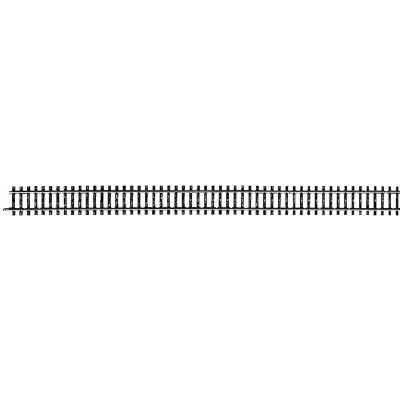
Flexible Track for Individual Radii
The long track can be cut to create individual curves, transition curves and special lengths.


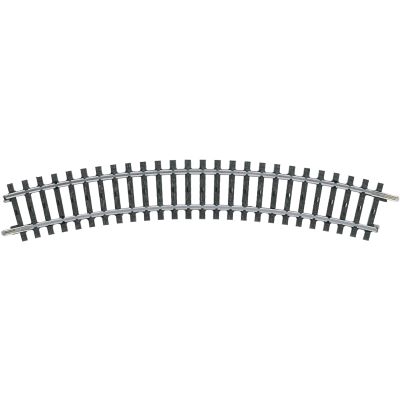
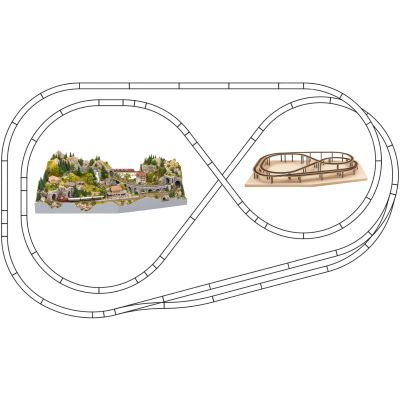
The illustrated overview of Märklin K Track: short and long straights, 900-millimetre flexible track, fixed curves, reverse curves, contact and transition track, standard and slender turnouts, curved turnouts, a three-way turnout, an electric turnout drive and complete layout track packages.
Range reviewed:
Märklin K Track is an H0 centre-conductor track system without a permanently moulded ballast roadbed. It combines finely engraved sleepers, full-profile rails and discreet stud contacts positioned between the sleepers.
The system belongs to H0 gauge at a scale of 1:87. The track gauge is 16.5 millimetres. Both running rails form the common return conductor, while the vehicle pickup shoe contacts the centre conductor.
Because no fixed roadbed body is present, the height, width, colour and weathering of the ballast bed can be designed individually. K Track is therefore especially suitable for permanent layouts, modules, stations and prototypical route sections.
The 900-millimetre flexible track permits individual radii, transition curves and flowing routes. Fixed straights and curves simplify precise station layouts, hidden yards and defined parallel routes.
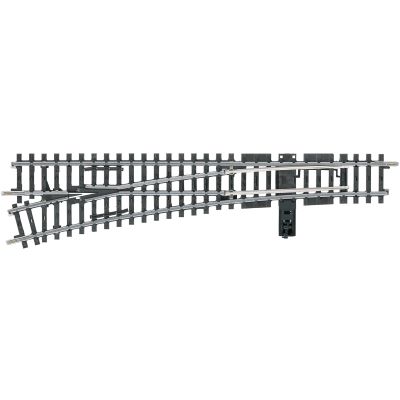
Standard and slender turnouts, curved turnouts and a symmetrical three-way turnout permit different routes. The electric turnout drive can be installed at the side or largely out of sight using an underfloor conversion set.
The long track can be cut to create individual curves, transition curves and special lengths.
Sound insulation, ballast colour, trackside paths, drainage and weathering can be designed to suit the represented prototype.
Suitable electric drives can be installed beneath the layout board using an underfloor conversion set.
K Track combines a compact industrial curve with several larger radius families. Twelve 30-degree curves, twenty-four 15-degree curves or forty-eight 7.5-degree curves form a complete circle.
| Geometry | Radius | Products | Angle | Typical Application |
|---|---|---|---|---|
| Industrial Curve | 295.4 mm | 2210 | 45° | Very compact track alignment; not suitable for every long vehicle |
| 222x Radius Family | 360 mm | 2221, 2223, 2224 | 30°, 15° and 7.5° | Compact inner circle and smaller H0 layouts |
| 223x Radius Family | 424.6 mm | 2231, 2232, 2233, 2234 | 30°, 22.5°, 15° and 7.5° | Outer circle and standard turnout geometry |
| Large-Radius Curve 2241 | 553.9 mm | 2241 | 30° | Larger visible routes; no longer regularly listed in the shop |
| Large-Radius Curve 2251 | 618.5 mm | 2251 | 30° | Generous visible routes and long vehicles |
| Slender Turnout | 902.4 mm | 22715, 22716 | 14° 26′ | Prototypical station approaches and main lines |
| Flexible Track | Individual | 2205 | Freely planned | Transition curves and freely flowing routes |
The 295.4-millimetre industrial curve is particularly compact. Long coaches, multiple units and large locomotives frequently require larger radii.
The rails and centre conductor must be cut cleanly. At cut joints, 7595 connecting and contact clips provide the appropriate connection.
Product 2291 connects K Track and M Track. The transition between K Track and C Track is created using C Track transition section 24922.
Every product receives its own card with a catalogue number, precise description, permanently assigned main image and direct shop link. Search terms can include “2205”, “flexible track”, “424.6”, “contact track”, “slender turnout”, “75491” or “Andreastal”.
The strengths of K Track are particularly apparent when flexible track, the substructure, power feeds, turnout drives and subsequent ballasting are planned together.
Flexible track, transition curves and slender turnouts permit flowing and prototypical route alignments.
Short straights, standard turnouts, curved turnouts and slender turnouts permit compact or generous station layouts.
Fixed geometric sections simplify reliable construction. Turnouts and track connections must remain accessible.
Check the minimum radius of the longest locomotives, coaches and multiple units.
The route and sound insulation must be level. Flexible track must not be fixed while under tension.
Power feeds, centre-conductor isolation points, feedback sections and underfloor drives should be prepared before ballasting.
Test every route with different vehicles before the track is permanently detailed.
Flexible track 2205 should be shortened cleanly using suitable tools and connected using 7595 contact clips. Drive 75491 can be installed with underfloor conversion set 7548 beneath a layout board measuring 8 to 25 millimetres thick.
The following answers provide guidance about the roadbed, centre conductor, flexible track, radii, transitions, turnout drives and digital operation.
K Track is an H0 centre-conductor track system with full-profile rails and finely engraved sleepers without an integrated ballast roadbed.
The model track gauge is 16.5 millimetres. H0 gauge uses a scale of 1:87.
Yes. The track can be operated with analogue control or Märklin Digital. The power feed must suit the control system being used.
No. Sound insulation, the ballast bed and trackside detailing are constructed separately when the layout is built.
The flexible track is 900 millimetres long and can be used for individual radii, transition curves and special lengths.
The rail profiles and centre conductor are shortened cleanly using suitable tools. Appropriate contact and connecting clips are fitted at the cut joint.
The system geometry includes radii of 295.4, 360, 424.6, 553.9 and 618.5 millimetres. Slender turnouts have a radius of 902.4 millimetres.
No. Its radius of 295.4 millimetres is very compact. The minimum radius of the relevant vehicle must be checked beforehand.
Product 2200 is 180 millimetres long. Shorter and longer straights supplement the geometry.
Transition track 2291 is intended to connect K Track to the earlier Märklin M Track.
The transition is created using C Track product 24922, which provides the geometric and electrical connection to K Track.
According to the supplied source text, this track contains a suppression capacitor and is not intended for digital or Delta operation.
The vehicle pickup shoe creates a momentary contact that can trigger signals, turnouts or other electrical functions.
Slender turnouts 22715 and 22716 have a radius of 902.4 millimetres and a diverging angle of 14 degrees 26 minutes.
Suitable K Track turnouts can be equipped with electric turnout drive 75491.
Yes. Underfloor conversion set 7548 permits installation beneath the layout board.
Plan radii, turnouts, the substructure, power feeds and maintenance access together before K Track is fixed and ballasted permanently.