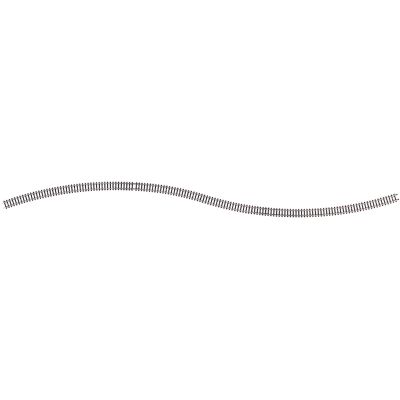
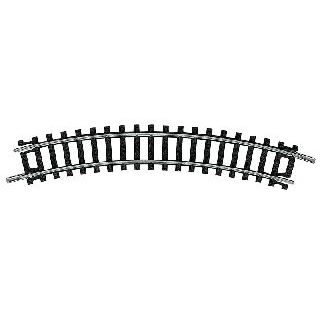
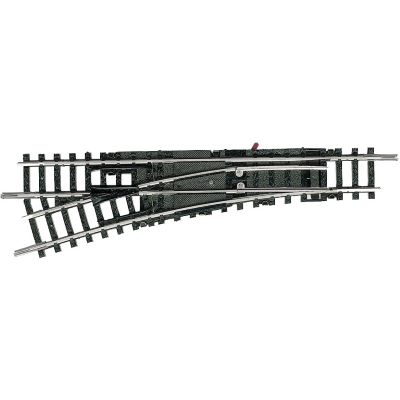
Classic Code 80 Track
Extensive geometry with straights, radii, flexible track, functional track and turnouts.


The illustrated overview of the Minitrix track products clearly assigned at Modellbahnshop: classic straights, flexible track, variable track, R1 to R6 radii, functional track, standard and curved turnouts, modern Code 60 concrete sleeper track, accessories and complete layout track sets.
Verified as of:
Classic Minitrix track is an N gauge two-rail track system without an integrated ballast roadbed. It offers fixed straights, numerous radii, 730-millimetre flexible track, adjustable variable track, functional track and different turnout designs.
A more modern Code 60 track system with grey concrete sleepers is also available. This system represents modern main lines and uses a lower rail profile.
Both systems belong to N gauge at a scale of 1:160 and have a model track gauge of 9 millimetres. The ballast bed and sound insulation are constructed separately.
Transition track 14590 connects the Code 60 concrete sleeper track to the classic Code 80 system. Historical station areas and modernised routes can therefore be combined on the same layout.
Flexible track is available for freely planned curves. Fixed track makes it easier to create geometrically precise circles, parallel routes, stations and hidden yards.
Extensive geometry with straights, radii, flexible track, functional track and turnouts.
A lower rail profile and concrete sleeper appearance for modern main and high-speed routes.
Both profile families offer 730-millimetre flexible track for individual track alignments.
Twelve 30-degree curves or twenty-four 15-degree curves form a complete circle. Partial curves with angles of 24, 7.5 or 6 degrees provide geometric compensation.
| Geometry | Radius | Angle | Example Products | Typical Application |
|---|---|---|---|---|
| R1 | 194.6 mm | 30°, 24° or 6° | 14912, 14914, 14916 | Compact inner circle |
| R2 | 228.2 mm | 30°, 24° or 6° | 14922, 14924, 14926 | Outer parallel circle |
| R2a | 261.8 mm | 30°, 15° or 7.5° | 14910, 14911, 14919 | Intermediate radius and finer parallel alignment |
| R2b | 295.4 mm | 15° or 7.5° | 14921, 14929 | Transition to larger radii |
| R3 | 329 mm | 15° | 14917 | Visible route |
| R4 | 362.6 mm | 15° | 14927 | Standard turnouts and a larger parallel circle |
| R5 | 492.6 mm | 15° | 14918 | Generous main line |
| R6 | 526.2 mm | 15° | 14928 | Large outer circle |
| Flexible Track | Individual | Freely planned | 14901, 14501 | Transition curves and freely flowing routes |
Long passenger coaches and large locomotives run more smoothly on R3 to R6 or flexible-track radii.
Transition track 14590 is intended for changing between Code 60 and Code 80.
A level route, sound insulation and secure track fixing remain necessary.
Every product card links directly to the relevant product page at modellbahnshop.de. Search terms can include “14901”, “R2a”, “variable track”, “curved turnout”, “Code 60”, “buffer stop”, “connection terminal” or “Albula Railway”.
The substructure, rail height, flexible track, turnouts, power feeds and subsequent ballasting should be planned together and tested completely before final detailing.
Code 80 wooden sleeper track is suitable for many historical and modern layout themes.
Code 60 concrete sleeper track represents modernised routes and stations.
Flexible track permits smooth transition curves, individual radii and flowing routes.
Check the minimum radius of the longest locomotives and coaches.
Even small irregularities can cause contact problems or derailments in N gauge.
Code 60 and Code 80 must be connected at the same railhead height and supplied with sufficient power.
Test every turnout and route before final detailing.
Vehicles with particularly deep wheel flanges should be test-run before the lower Code 60 profile is installed throughout the layout.
Answers about track gauge, flexible track, radii, Code 60, Code 80, functional track, turnouts, accessories and track sets.
Minitrix belongs to N gauge at a scale of 1:160.
The model track gauge is 9 millimetres.
No. The classic and Code 60 track products listed here are supplied without a ballast roadbed.
Product 14901 is 730 millimetres long.
Product 14501 with concrete sleepers is also 730 millimetres long.
It can be adjusted between 86.5 and 120 millimetres and compensates for small gaps in a track plan.
The overview ranges from R1 at 194.6 millimetres to R6 at 526.2 millimetres.
Code 60 identifies the lower rail profile used by the modern concrete sleeper track.
Transition track 14590 is intended to create a level connection between the two systems.
Product 14954 is the left-hand turnout and product 14955 is the right-hand turnout with R4 geometry.
Product 14956 branches to the left and product 14957 branches to the right within the R1 and R2 radius families.
Yes. Product 14538 is the left-hand Code 60 turnout and product 14539 is the right-hand turnout, both with a 15-degree diverging angle.
Products 14934 and 14935 are available for classic turnouts, while products 14534 and 14535 are intended for concrete sleeper turnouts.
It separates electrical track sections from one another.
The overview includes the verified sets for NOCH Easy-Track Mittelberg and the Albula Railway.
Only after every route, turnout, transition and power feed has been tested successfully.
Plan radii, rail transitions, turnouts, power feeds and maintenance access together.