Loading Siding
Freight wagons are positioned here for loading and unloading. At a small station, one short siding can support several different freight-handling tasks.


Freight wagons on the railway side, lorries or horse-drawn vehicles on the road side, with a loading platform and warehouse between them: a goods shed makes local freight traffic visible and creates varied shunting tasks.
A goods shed — also known regionally as a freight shed, goods warehouse or loading shed — was primarily used for the temporary storage of general cargo while goods were transferred between railway and road transport. This explains its typical functional division: freight wagons are handled on the railway side, while horse-drawn vehicles, delivery vans or lorries use the road side.
Anyone wishing to design a model railway goods shed should make this flow of goods visible. Large sliding doors, loading platforms, crates, sacks, pallets, hand carts, staff and vehicles together create an understandable transhipment scene. A building without a loading siding and road access can otherwise quickly look like an ordinary warehouse.
Goods sheds were particularly suitable for general cargo. Coal, gravel, ballast and other bulk commodities were more often handled at open loading areas, loading roads or specialised facilities. A model railway station can therefore include several distinct freight-handling areas next to one another.
The subject is especially suitable for Era II , Era III and early Era IV . In later eras, a former goods shed can be represented as closed, converted or used for another purpose.
Only a few clearly recognisable functional areas are required to create convincing local freight operation.
Freight wagons are positioned here for loading and unloading. At a small station, one short siding can support several different freight-handling tasks.
The platform creates an approximately level transfer between the freight wagon and storage area. Large doors are logically placed directly beside the unloading positions.
General cargo is sorted and stored temporarily. Open doors provide views of crates, sacks, barrels and pallets.
On the opposite side of the building, horse-drawn vehicles, delivery vans or lorries take over goods for local distribution.
Open freight wagons can be reached directly by road vehicles without using the shed. Cranes, machinery and larger loads are also suitable for this area.
The signal box, station building, access road and freight siding visually connect the goods facility with the rest of the railway station.
A clear flow of goods makes the shed operationally interesting and also helps determine where vehicles, staff and accessories should be positioned.
Operating idea: place a covered freight wagon beside the shed in the morning and collect it again later. Even this simple task creates believable transfer and shunting operation on a small model railway.
A classic arrangement places the goods shed beside the station building at a small railway station. The loading siding runs along one side of the shed and public road access reaches the other. Larger goods sheds can form independent buildings with several doors and much longer loading platforms.
Platform height is particularly important. The transition to the freight wagon should look plausible. When track with integrated roadbed is used, a substructure beneath the building may therefore be required. Several current Auhagen goods-shed kits specifically mention compensating for the additional track height in this way.
Position a typical freight wagon beside the building as a test. Fix the goods shed permanently only after the wagon and doors align convincingly.
The road and yard should not end directly at the loading platform. Even a small manoeuvring area makes the scene considerably more believable.
Timber, vehicles, machinery and larger loads can be handled outdoors beside the goods shed.
Test the locomotive, wagons and complete turnout route before permanently constructing the surrounding scenery.
| Era | Typical Character | Suitable Scene |
|---|---|---|
| I | Timber structures and early freight handling | Horse-drawn carts, sacks, crates and short freight wagons. |
| II | Strong individual-wagon freight traffic | DRG branch-line station with loading siding and loading road. |
| III | Classic peak period for local freight handling | Köf, V 60, steam locomotives, small lorries and general cargo. |
| IV | Transition towards more modern logistics | Remaining local freight traffic or the beginning of repurposing and closure. |
| V–VI | Traditional freight facilities often altered or decommissioned | Former goods shed used as storage, commercial premises, workshop or museum building. |
The building is selected primarily according to scale. An H0 goods shed can therefore also suit an H0e or H0m station if track alignment and loading-platform height are adjusted correctly.
| Gauge | Scale | Suitable Implementation |
|---|---|---|
| Z | 1:220 | Compact goods shed with a comparatively long loading siding on a very small footprint. |
| N / Nm | 1:160 | Larger freight facility with a longer loading road while retaining modest space requirements. |
| TT / TTm / TTe | 1:120 | Strong balance between visible building detail and available shunting space. |
| H0 / H0m / H0e / H0f | 1:87 | Widest choice of buildings, figures, road vehicles and freight accessories. |
| S | approx. 1:64 | Specialist and scratch-built projects with strong visible detail. |
| 0 / 0e | approx. 1:45 | Shunting modules with large goods sheds and visible interiors. |
| 1 / Im | 1:32 | Large individual buildings and highly detailed loading scenes. |
| G / IIm | often approx. 1:22.5 | Robust large-scale freight facilities for indoor and garden railways. |
This ensures that rolling stock, signage, road traffic and architecture form a consistent scene.
Test it with the longest intended freight wagons before installing the building permanently.
Track with integrated roadbed may require an additional substructure beneath the goods shed.
Horse-drawn vehicles or lorries need a believable route to the road-side loading platform.
Freight should be concentrated around doors, loading platforms and inside the warehouse rather than scattered randomly.
Warehouse workers, drivers and railway staff should have visible tasks that explain why they are positioned there.
Dust, timber wear and other signs of use belong primarily on surfaces that experience regular traffic and handling.
A specific wagon movement turns the goods shed into a genuine operating destination instead of just another building.
The range extends from compact branch-line goods sheds to large freight halls. Additional categories provide loading accessories, road vehicles, freight wagons, figures and lighting.
Goods sheds, stations, loading ramps and other railway buildings.
Crates, pallets, containers and small warehouse details.
Suitable wagons for local goods trains and transfer workings.
Lorries, vans and delivery vehicles for the road-side loading area.
Warehouse workers, railway staff and drivers for freight scenes.
Yard, railway and building lighting for evening operation.
Large loading building with platforms on the railway and road sides, movable doors and included small accessories.
View Product →
Historic timber goods shed with loading platforms on both sides, sliding doors and roof lights.
View Product →
Space-saving timber loading building for branch lines, compact stations and small modules.
View Product →
Compact goods shed with a traditional covered loading platform for general-cargo scenes.
View Product →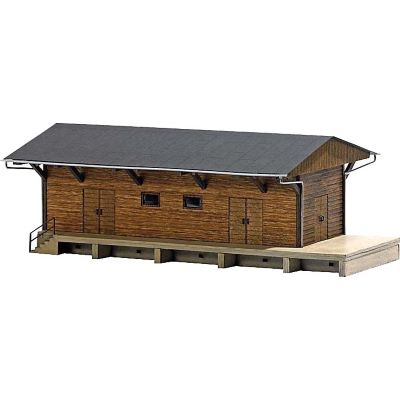
Historic timber goods shed with loading platform, movable-style gates and real-wood detailing.
View Product →
Larger goods building with loading ramps, sliding gates and detailed real-wood components for historic freight scenes.
View Product →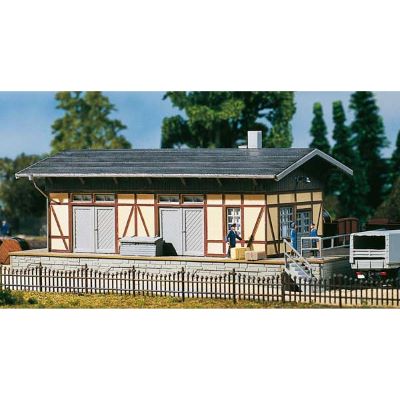
Half-timbered building with four large doors and loading platforms on both the road and railway sides.
View Product →
Historic TT loading building with movable gates, side extension and a compact footprint for station scenes.
View Product →
Half-timbered building with timber cladding and loading platforms on both the track and road sides.
View Product →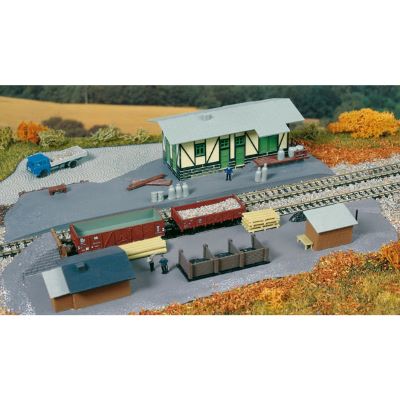
Complete loading scene with goods shed, platform, ramp, loading road and additional freight accessories.
View Product →
Compact loading building with ramp and side entrance, designed to complement Auhagen's N-gauge Krakow station scene.
View Product →
Longer goods hall for more extensive general-cargo handling at an N-gauge freight station.
View Product →
Open-style goods shed with a covered railway siding and visible loading area.
View Product →
Compact Z-gauge goods shed with open loading platform and wide hall doors.
View Product →
Large detailed Gauge 0 goods shed with real-wood doors, ramps and architectural components.
View Product →
Large-scale goods shed with timber loading ramps, double doors and a functional rolling door for larger freight.
View Product →When this section approaches the viewport, the finder loads current English products from Railway Facilities Building, Building Accessories, Freight Cars, Cars and Lights. Recognised archive, B-stock and clearance products are excluded. Prices, delivery status and availability are deliberately not reproduced on these cards.
Current products will be loaded when this section approaches the viewport …
Buildings and loading accessories from different manufacturers can be combined effectively. Scale, era and loading-platform height matter more than using one brand throughout the scene.





A goods shed becomes especially interesting operationally when short local freight trains and changing wagons serve it. The Freight Cars category provides suitable rolling stock for many eras and model railway gauges.
Goods sheds were mainly used to transfer, sort and temporarily store general cargo moving between railway and road transport.
A goods shed is a storage and transhipment building. A loading road allows road vehicles to reach freight wagons directly at an open loading siding.
Covered goods wagons are especially typical, depending on the period represented. Other wagons used for general cargo and wagon-load traffic can also be appropriate.
Era II, Era III and early Era IV provide especially strong settings for traditional general-cargo and local freight traffic.
It should visually align with the wagon floor. Track with integrated roadbed may require a substructure beneath the building to compensate for the additional height.
Depending on the era, suitable vehicles include horse-drawn carts, delivery vans, flatbed lorries, box vans and other local transport vehicles.
Yes. A short siding, compact goods shed and small road access area are already sufficient to create a complete shunting task.
Group crates, sacks, pallets, hand carts, staff and signs of use close to doors, platforms and the immediate warehouse area.
Yes. The building can be represented as disused or converted into storage, commercial premises, a workshop, museum or another purpose.
Current models are available in gauges including Z, N, TT, H0, 0 and G. Other scales can be represented using specialist models or scratch-built structures.
Content and product links checked on . Please additionally check dimensions, gauge assignment and loading-platform heights on the respective product pages.
Further guides covering stations, freight cars, signal boxes, gauges, track planning, scenery and layout construction can be found in the central Model Railway Guide.