Solid Brass Rail Profiles
The solid rail profiles provide a large contact area and good electrical conductivity. Outdoors, the railheads should be inspected regularly and cleaned gently when necessary.

From a complete R3 circle and a single siding to a station and passing loop, this overview presents all four PIKO garden-railway track sets at Modellbahnshop and explains radii, straights, turnouts, power connections and outdoor installation.
Content reviewed:
A PIKO garden-railway track set combines geometrically coordinated track for a particular purpose. The starter circle creates a complete R3 running circuit. Sets 35300, 35301 and 35302 add a station, siding or passing opportunity to an existing route.
PIKO G Track has a track gauge of 45 millimetres. Its solid rail profiles are made from a conductive brass alloy. The sleepers are manufactured from durable plastic for indoor and outdoor use. The track has no moulded ballast roadbed, allowing the substructure and ballast to be designed to suit the layout.
The designation Gauge G does not describe one single, unchanging model scale. Garden railways use 45-millimetre track to represent different prototype track gauges and slightly different scales. The common IIm classification uses a scale of 1:22.5, while PIKO vehicles may have different proportions depending on the prototype.
All four sets contain only track material and the accessories expressly specified. A locomotive, wagons, controller, digital command station, buildings and scenery are not automatically included.
Calculate the required space correctly: The track-centre diameter is smaller than the actual area required by the layout. Vehicle width, curve overhang, edge clearance, planting and a safety margin must also be considered.
The range follows a clear geometry consisting of different straights, fixed radii, turnouts and transition components. The sets can therefore be expanded later using individual track sections.
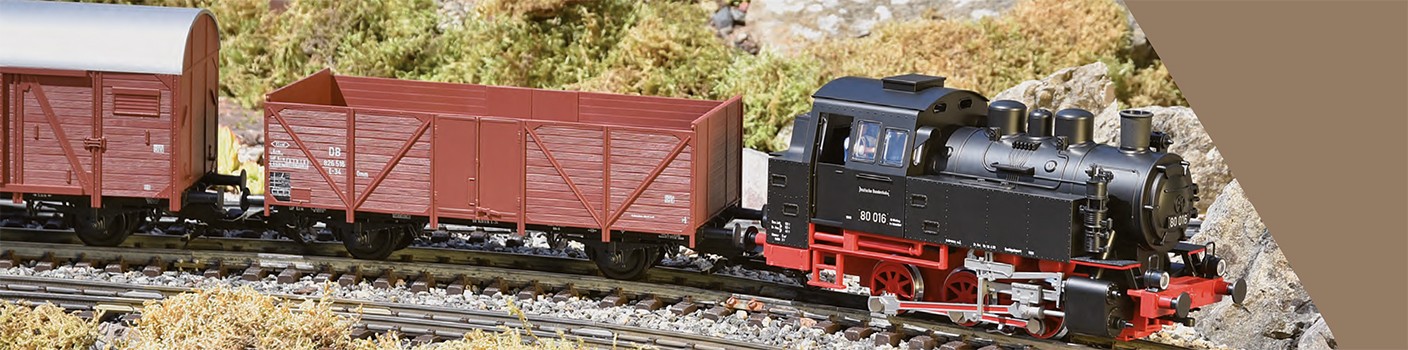
The solid rail profiles provide a large contact area and good electrical conductivity. Outdoors, the railheads should be inspected regularly and cleaned gently when necessary.
The sleepers are made from impact-resistant HDPE plastic. Their structure and spacing resemble wooden-sleeper track, while the open construction can be ballasted individually.
The R1 turnouts included in the sets can initially be operated manually and later fitted with a suitable electric PIKO turnout drive.
PIKO, LGB and other garden-railway vehicles frequently use the same 45-millimetre track gauge. Before combining them, check the minimum radius, wheel flanges, coupling height, electrical system, vehicle width and proportional appearance.
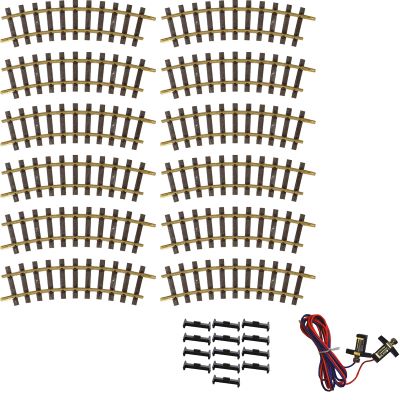
The Modellbahnshop starter circle combines twelve R3 curves with a connection terminal and track clips. It is the simplest way to construct a closed PIKO Gauge G running route.
Catalogue numbers 35300 to 35302 add typical operating locations to an existing Gauge G route. They use straights from the G320 and G280 families together with manually operated R1 turnouts.
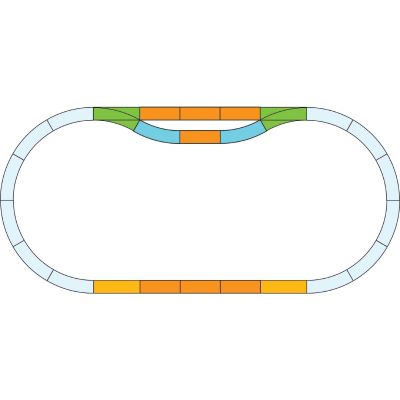
One left- and one right-hand turnout lead to a long parallel track. Two R1 curves and nine straights complete the station extension.
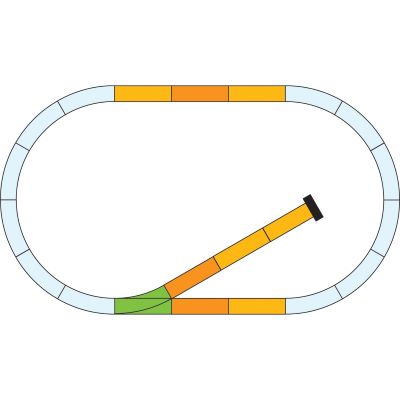
A left-hand turnout leads to a terminal siding completed by the included buffer stop. The set is suitable for storage, loading or shunting duties.
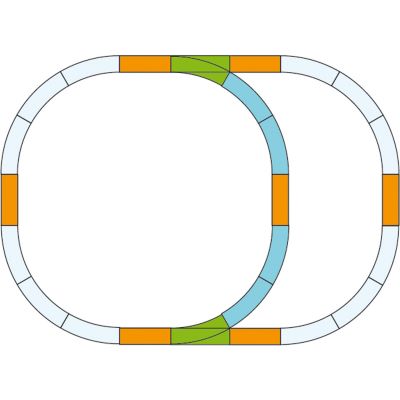
Two turnouts and four R1 curves create an offset parallel route. Trains can pass, overtake or be stored temporarily.
| PIKO Track Set | Main Purpose | Important Track Components | Space Requirement |
|---|---|---|---|
| Starter Circle | Closed running circuit | 12 × R3, connection terminal and track clips | Track-centre diameter approximately 184 cm; add edge clearance |
| PIKO 35300 Station | Long parallel station track | 2 turnouts, 2 R1 curves and 9 straights | Minimum construction area 300 × 150 cm |
| PIKO 35301 Buffer Stop | Storage, loading or shunting siding | 1 turnout, 8 straights and buffer stop | Minimum construction area 245 × 150 cm |
| PIKO 35302 Passing Loop | Train crossings and overtaking | 2 turnouts, 4 R1 curves and 7 straights | Minimum construction area 252 × 180 cm |
The sets can be adapted to the available garden using individual Gauge G tracks , garden-railway turnouts and track accessories .
G320 is approximately 321.5 millimetres long and G280 approximately 278.5 millimetres. Both lengths complete the geometry beyond turnouts and form station tracks.
G160, G140 and G95, together with longer track measuring 600, 920 or 1,200 millimetres, allow the route to be adapted to a terrace, flower bed or property boundary.
R1 has a radius of 600 millimetres. The R1 turnouts and curves included in the sets permit space-saving branches but are not ideal for every long vehicle.
R3 has a radius of 921.54 millimetres. Twelve 30-degree curves create the starter-set circle with a track-centre diameter of approximately 1.84 metres.
R5 has a radius of 1,243.08 millimetres. Even larger curves and turnouts improve the appearance of long passenger coaches and large locomotives.
Turnouts 35220 and 35221 connect a G320 straight to a 30-degree R1 branch. They are supplied for manual operation.
A suitable drive permits turnouts to be operated from a protected control position or through an appropriate digital control system.
Metal joiners align the rail profiles and conduct current. Track clips prevent loosely laid sections from pulling apart during operation.
A permanently reliable outdoor layout requires more than weather-resistant track material. The substructure, drainage, power supply and regular inspections determine whether trains operate safely.
Define narrow sections, paths, flower beds and maintenance access first. The longest train determines the station and siding lengths.
Test the intended locomotives and wagons on R1, R3 and the turnouts before installing the track permanently.
A compacted, water-permeable base reduces settlement and prevents standing water around the track.
Check every connection, curve overhang and turnout position before fixing ballast or edging stones.
Long routes benefit from additional wiring. Protect the connections and keep the controller and command station dry.
Remove leaves, soil and plants, clean the railheads and inspect the joiners and turnout mechanisms.
The R3 starter circle creates the simplest complete running route.
PIKO 35301 adds a completed terminal siding.
PIKO 35300 provides a long parallel station track.
PIKO 35302 creates an overtaking and crossing opportunity.
Further guidance is available in the Garden Railway Guide , under Plan a Model Railway and on the PIKO SmartControl WLAN topic page.
The four track sets are intended exclusively for 45-millimetre track. The prototype track gauge represented by a particular vehicle also depends on its scale and the individual model.
| Model Size | Typical Scale | Model Track Gauge | Classification |
|---|---|---|---|
| Gauge G / IIm | Frequently 1:22.5 | 45 mm | Metre gauge and other narrow-gauge railways; principal application of the track sets |
| PIKO Gauge G | Model-dependent, frequently around 1:25 | 45 mm | Garden-railway models with proportions adapted to the individual prototype |
| Gauge 1 | 1:32 | 45 mm | Standard gauge using the same model track gauge but a separate model-railway world |
| Gauge II | 1:22.5 | 64 mm | Standard gauge at a scale of 1:22.5 |
| Gauge IIe | 1:22.5 | 32 mm | Narrow gauge representing a prototype track gauge of approximately 750 mm |
| Gauge IIi / IIf | 1:22.5 | 22.5 mm | Industrial, field and exceptionally narrow railways |
The Model Railway Gauge Comparison explains scale, model track gauge and space requirements in greater detail. The decisive factor is always the combination of track gauge, vehicle dimensions and intended prototype.
These answers help with space requirements, outdoor operation, compatibility, power supplies and later expansion.
This overview contains four current sets: the Modellbahnshop R3 starter circle and the PIKO extensions 35300 Station, 35301 with Buffer Stop and 35302 Passing Loop.
No. The set contains twelve R3 curved tracks, a connection terminal with cable and 14 track clips. Vehicles, a controller and power supply are selected separately.
The radius is 921.54 millimetres, producing a track-centre diameter of approximately 1.84 metres. Vehicle overhang and safety clearance increase the actual area required.
PIKO 35301 contains a left-hand turnout, eight straights and a buffer stop. It creates a terminal siding for storage, goods loading or shunting.
PIKO 35300 creates a long station track using G320 and G280 straights. PIKO 35302 uses additional R1 curves to create a more compact, offset passing route.
The track is designed for indoor and outdoor use. A permanent layout nevertheless requires a stable, well-drained substructure, regular cleaning and inspection of the connections.
Both normally use a 45-millimetre track gauge. Transitions are often possible, but the joiners, rail profiles, radii, wheelsets, couplings and electrical systems must be checked for the specific installation.
Yes. The track is not restricted to one operating method. The controller or digital command station, vehicles, decoders and wiring determine the control system.
Yes. The manually operated PIKO Gauge G turnouts can be fitted with a suitable electric turnout drive and controlled using compatible switches or decoders.
Additional feeds are sensible on long routes because numerous rail joints and large distances can cause voltage losses. Outdoor electrical connections should be protected appropriately.

Explore individual straights, broad radii, turnouts, rail joiners, buffer stops, garden-railway vehicles and digital technology for further expansion of your Gauge G layout.