
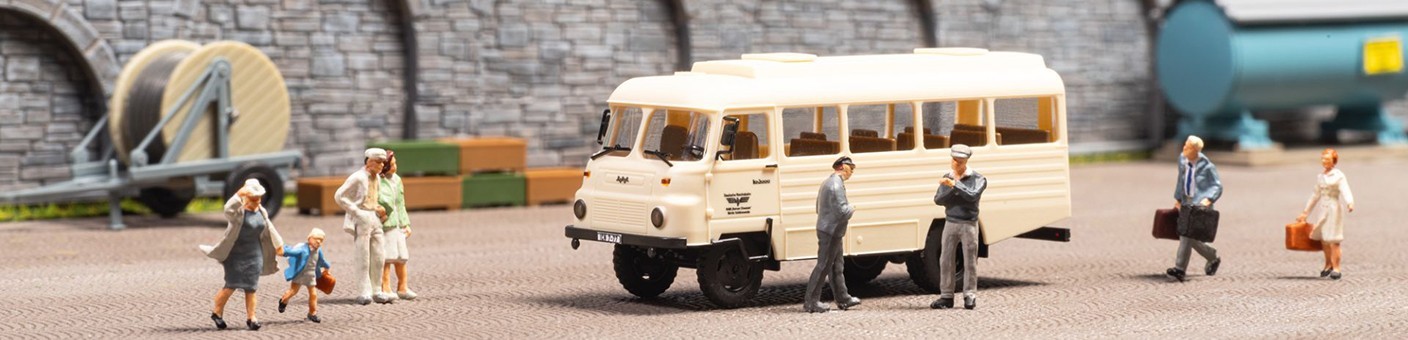
Robur LO and LD - history, models and conclusion
Robur was an important commercial vehicle brand in the GDR, known for its robust and versatile trucks. The vehicles were produced in the VEB Robur factories in Zittau and were widely used both in Germany and abroad. Today, Robur trucks are not only popular with classic car fans, but are also available as models in various scales for model railroads.
History of the Robur factories
Foundation and development of the LO and LD
The origins of Robur-Werke date back to 1888, when Gustav Hiller founded a company in Zittau to manufacture textile machines. The company later began producing bicycles under the name "Phänomen-Rover". Motorcycles were produced from 1900 and the "Phänomobil" three-wheeled vehicle from 1905. Production of four-wheeled cars and trucks began in the 1920s.
After the Second World War
After the war, Phänomen-Werke was expropriated and transformed into VEB Robur-Werke Zittau. Production concentrated on light trucks with air-cooled engines. In 1957, the brand name "Robur" was introduced, derived from the Latin word for strength. The new logo symbolized a crankshaft.
Robur models at a glance
Phenomenon Granit 30K / Robur Garant 30K
The Granit 30K, later renamed Garant 30K, was a 2-ton truck with an air-cooled petrol engine. It was produced from 1953 and was available in various versions, including a platform truck, panel van, minibus, ambulance and fire engine. The all-wheel drive version Garant 30K A was particularly suitable for off-road use.
Robur LO/LD 2500 and 1800 A
From 1961, the Robur LO 2500 with a payload of 2.5 tons was introduced, followed by the all-wheel-drive Robur LO 1800 A. The vehicles were equipped with air-cooled petrol or diesel engines and were available in various body variants.
Robur LO/LD 3000 and 2002 A
The Robur LO 3000 and Robur LO 2002 A models were produced from 1973 and offered a payload of 3 tons. They were equipped with improved Robur engines and more modern cabs. The all-wheel drive versions were used particularly by the NVA and in rural regions.
Model overview
| Robur model | Year of construction | Engine capacity | Payload | Special features |
|---|---|---|---|---|
| Granit 30K / Garant 30K | 1953-1961 | Petrol/diesel | 2,0 t | Versatile superstructures |
| Robur LO 2500 | 1961-1968 | Petrol | 2,5 t | Front link design |
| Robur LD 2500 | 1964-1968 | Diesel | 2,5 t | Diesel version of the LO 2500 |
| Robur LO 1800 A | 1961-1968 | Petrol | 1,8 t | All-wheel drive |
| Robur LO 3000 | 1973-1985 | Otto | 3,0 t | Modernized driver's cab |
| Robur LD 3000 | 1982-1985 | Diesel | 3,0 t | Diesel version of the LO 3000 |
Robur models in TT and H0 in the model railroad shop

Types of use of the Robur LO vehicles - versatility in the GDR
The Robur brand trucks were known for their extraordinary versatility. Vehicles from the LO and LD series could be found in almost every area of everyday life in the GDR and beyond - whether in the civilian sector, in the army or in specialized services. The numerous body variants turned Robur vehicles into all-rounders on wheels.
Robur LO as a fire engine
Many fire departments in the GDR - whether in cities, in the countryside or in industrial plants - relied on the robustness and compactness of Robur vehicles. They were used in different variants:
- Robur LO TLF - water tender with water tank and pump
- Robur LO KLF - small fire-fighting vehicle for volunteer fire departments
- Robur LO DL - turntable ladder vehicles on Robur chassis
- Robur LO MTF - crew transport vehicles for emergency services
- Robur LO LF 8 - fire-fighting group vehicles for local fire brigades
Robur LO in the rescue service
Robur trucks were also ubiquitous in the GDR health service. They were frequently used as ambulances with high-roof bodies or box bodies:
- Robur LO RTW - ambulance with stretcher and emergency equipment
- Robur LO emergency doctor vehicle - staffed with medical personnel
- Robur LO blood donor vehicle - sometimes even with a mobile laboratory station
Robur LO as bus and transporter
Many variants of the Robur LO 3000 and its predecessors were also used as buses - both for scheduled services and for factory transport or as minibuses:
- Robur LO KOM - bus with rows of seats for up to 20 people
- Robur Bus school bus - with safety equipment for children
- Robur Bus company bus - for factory transport, e.g. in combines
Robur LO with the National People's Army (NVA)
Countless Robur vehicles were used in the NVA (as well as by the border troops and the civil defense service). Their off-road capability and compact design made them the ideal companion for military operations:
- Robur LO radio vehicles - with antenna system and command technology
- Robur LO ambulances - with medical equipment
- Robur LO vehicles with LAK superstructure - easily detachable case for command posts, kitchen, workshop or warehouse
- Robur LO all-wheel drive transporter - for troop movements off-road
LO special superstructures and civilian applications
Robur trucks were also the basis for many special vehicles in everyday civilian life:
- Robur LO postal vehicles - mobile letter distribution and parcel delivery
- Robur LO television transmission vehicle - with parabolic mirror and technology
- Robur LO police - team vehicles, crime scene vehicles, radio control vehicles
- Robur LO travel agency bus - rolling travel agency, e.g. for GDR travel organizations
- Robur LO workshop van - for electrical companies, locksmiths or combines
- Robur LO snack vehicles and sales vans - market sales, e.g. for bakery or butchery chains
- Robur LO library buses - mobile city libraries based on Robur
Robur LO used abroad and exported
The GDR exported numerous Robur vehicles - primarily to socialist brother states, Africa and the Middle East. There they were mostly used as four-wheel drive transporters or fire engines, for example
- in Algeria - as military and ambulance vehicles
- in Vietnam - for postal and police services
- in Mozambique and Angola - as mobile training or laboratory vehicles
Robur LO in everyday life: business, agriculture and trade
Robur vehicles were indispensable in the GDR economy - whether as construction site vehicles, delivery vans or in LPGs and VEGs (agricultural or state-owned goods):
- Construction site vehicles - flatbeds with tarpaulin, tool box
- Water and sewage technology - e.g. as hose carts
- Tankers - for milk, heating oil or chemicals
- Milk collectors - with refrigerated bodies for dairies
This enormous variety of superstructures and applications makes Robur a unique vehicle brand that not only played a central role in the GDR, but is also an authentic addition to model railway layouts from a wide range of eras.
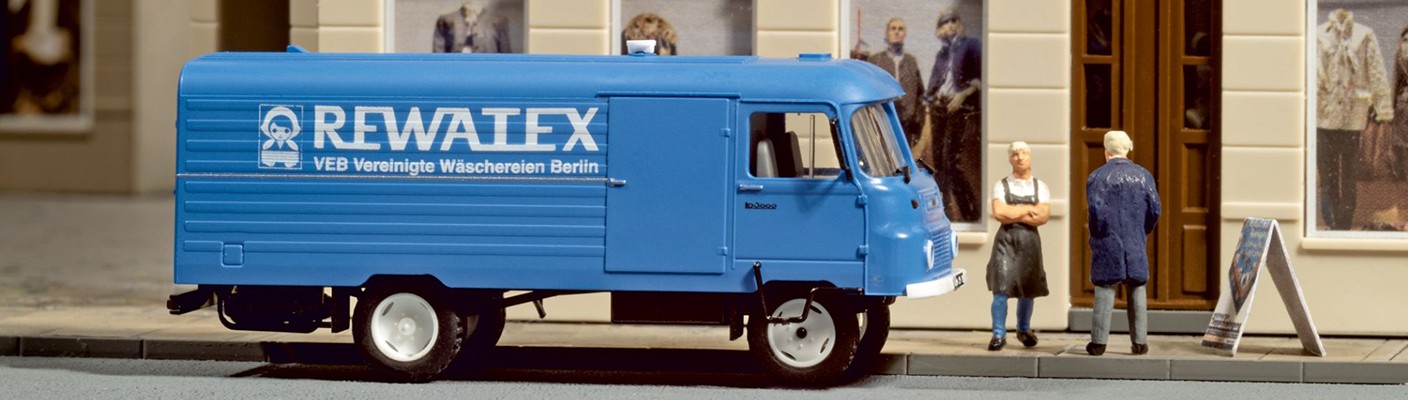
Robur models for the model railroad
Manufacturers and scales
Robur trucks are very popular with model builders and model railroaders. Various manufacturers offer models in different scales:
- Busch: H0 (1:87), e.g. Robur Garant K 30 panel van.
- Espewe: H0 (1:87), e.g. Robur LO 2500.
- Brekina: H0 (1:87), e.g. Robur Garant PP 1953.
- Minicar:TT (1:120) e.g. Robur Bus
- Tillig: TT (1:120), e.g. Robur LO 1801 platform/plane.
Use on model railroads
Robur models are ideal for creating GDR scenarios on model railroad layouts. They can be used as transport vehicles, fire engines, ambulances or buses and lend authenticity to the layout.
Conclusion
Robur trucks are an important part of GDR vehicle history. The robust and versatile vehicles were used in many areas and are popular with collectors and model builders alike today. With a variety of models in different scales, Robur vehicles can be realistically represented on model railroad layouts.