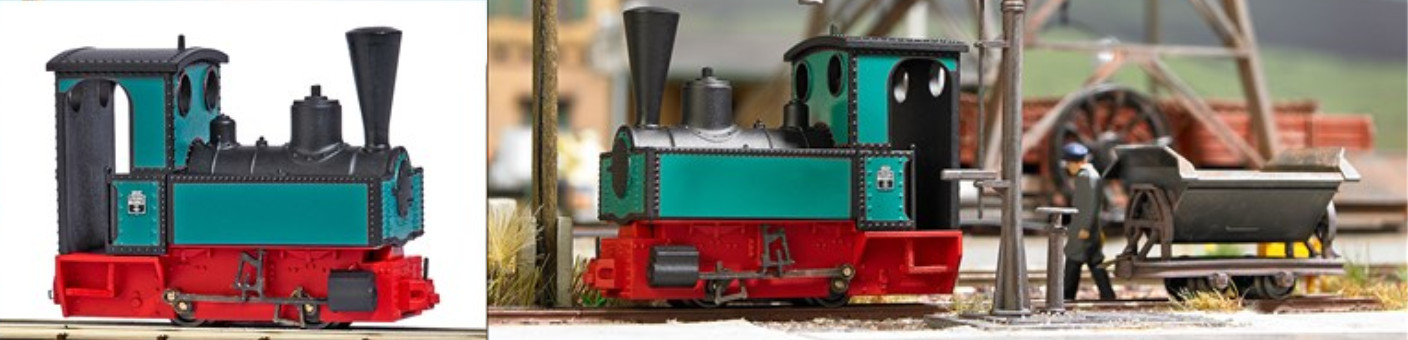
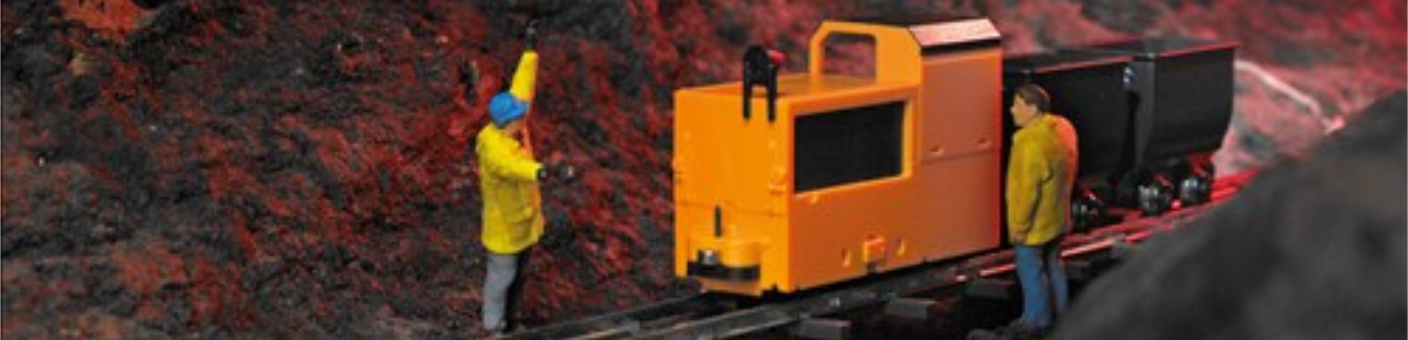
1:87 Scale
The same scale as standard H0 for buildings, figures, vehicles and scenery.

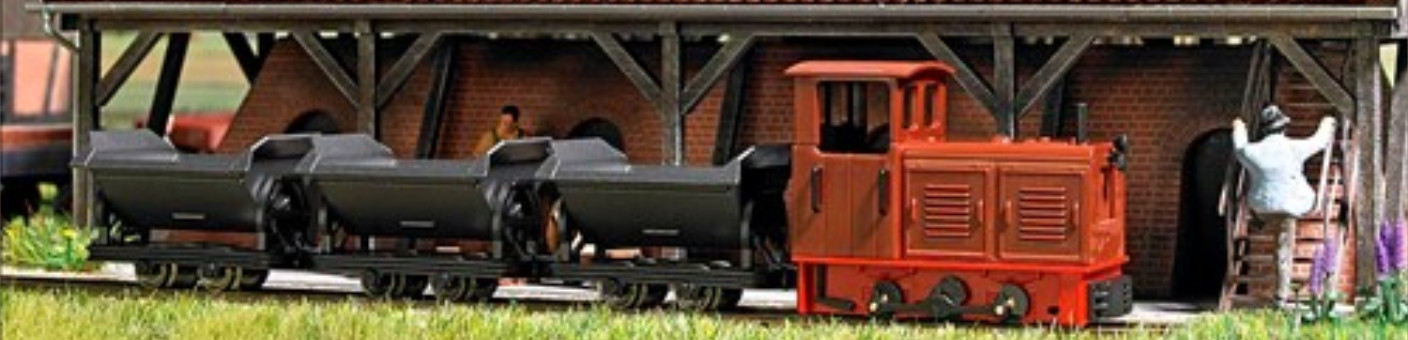
H0f combines the familiar 1:87 scale of H0 with extremely narrow 6.5 mm model track. Build brickworks, peat railways, mine railways, forest lines, quarries and compact industrial railways with locomotives, tipper wagons and realistic material-handling operations.
H0f Gauge Model Railway: Field Railways in 1:87 describes small field, mine, works and industrial railways built to the same scale as conventional H0 .
Buildings, figures, road vehicles and scenery therefore have the same proportions as on an H0 standard-gauge layout. The major difference is the extremely narrow 6.5 mm model track gauge.
The letter “f” is commonly used in the German-speaking model railway world for Feldbahn, meaning a field or light industrial railway. In the international NEM classification, this gauge group is designated H0i.
It represents prototype gauges from approximately 400 mm to below 650 mm. Prototype railways with 500 or 600 mm track gauge are particularly characteristic examples.
These railways were not designed for long-distance passenger trains. Their purpose was practical transport: clay, peat, timber, ore, coal, stone, construction materials, tools and other goods were moved over relatively short distances.
This makes H0f particularly attractive for small layouts. Even a compact diorama can tell a complete operating story: loading, transport, unloading and shunting can all take place within only a small area.
The same scale as standard H0 for buildings, figures, vehicles and scenery.
Extremely narrow model track representing small prototype industrial railways.
German field-railway terminology and the corresponding NEM industrial-railway gauge group.
Ideal for small dioramas, modules and industrial additions to larger H0 layouts.
Busch forms the core of the operational H0f system, while Technomodell provides additional narrow-gauge track and specialist components. Buildings, figures and scenery can be supplemented with ordinary H0 accessories.


Starter sets, locomotives, tippers, wagons, track, turnouts and field railway buildings.
Narrow-gauge rolling stock, specialist track and components for individual railway construction.
Coordinated introductory sets with vehicles, track and suitable control equipment.
Track components for many model railway systems, including H0f field railway products.
All of these model sizes use a scale of 1:87, but they represent different prototype track gauges. Vehicles therefore cannot automatically operate on another variant's track.
| Designation | Scale | Model Track | Prototype Group | Typical Themes |
|---|---|---|---|---|
| H0 | 1:87 | 16.5 mm | Standard gauge | Main lines, branch lines and long-distance railways |
| H0m | 1:87 | 12 mm | 850 to below 1,250 mm | Metre-gauge and mountain railways |
| H0e | 1:87 | 9 mm | 650 to below 850 mm | 750 and 760 mm narrow-gauge railways |
| H0f / H0i | 1:87 | 6.5 mm | 400 to below 650 mm | Field, mine and industrial railways |
| H0p | 1:87 | 4.5 mm | 300 to below 400 mm | Small park and specialist railways |
H0f and Z Gauge both use a nominal model track gauge of 6.5 mm, but the scales are completely different: H0f uses 1:87 and Z uses 1:220.
Track profiles, integrated magnetic components, electrical systems and approved power supplies can also differ. Never assume technical compatibility simply because the rail spacing is the same.
Compare scale, track gauge, available space and typical applications before choosing a system.
An H0f field railway is most convincing when every journey has an obvious transport purpose. Even only a few pieces of track can tell a complete operational story.
Tipper wagons carry clay from the pit to the works. A kiln, conveyor and narrow factory entrances provide a convincing industrial background.
A mine locomotive, crew vehicles and mine wagons can connect a tunnel portal, winding installation, workshop and material storage area.
Stake wagons carry logs to the timber yard. A forest road, stacks of timber and a small locomotive shed are enough to create a complete operating point.
Lightweight wagons carry cut peat across flat track to storage, loading facilities or a processing plant. Grasses, wet ground and timber walkways create the setting.
Tipper wagons move stone between the quarry, crusher and loading facility. Dust, exposed rock and conveyor installations define the scene.
Tippers, crane wagons and work vehicles can supply a factory, tunnel construction project, major building site or municipal works yard.
A peat railway needs different colours and loads from a brickworks or mine railway. The clearer the operating theme, the more convincing the complete H0f scene becomes.
This checked selection covers the initial operating system, additional rolling stock, track, turnouts and a locomotive shed. The cards use direct English product pages and fixed MBS image paths.
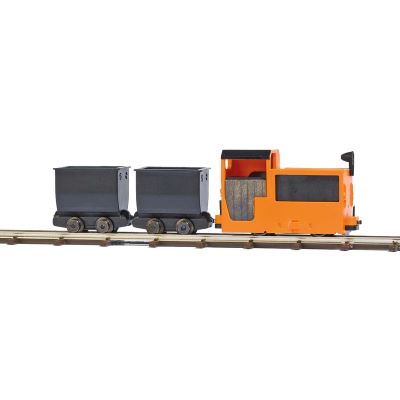
B 360 mine locomotive, two mine wagons, track and suitable battery control equipment.
View Product →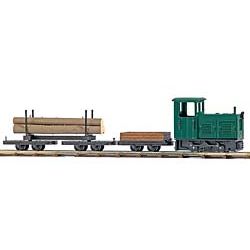
Compact introduction to timber transport with LKM Ns2f locomotive, wagons and R115 track oval.
View Product →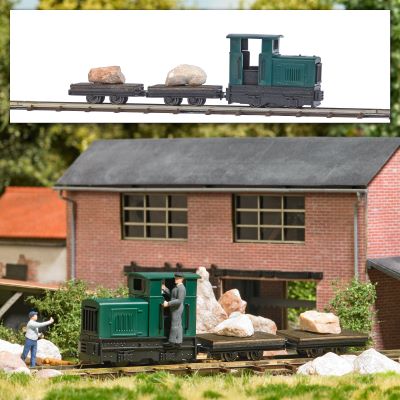
Gmeinder 15/18 diesel locomotive, two stone-loaded transport wagons, track and matching control equipment.
View Product →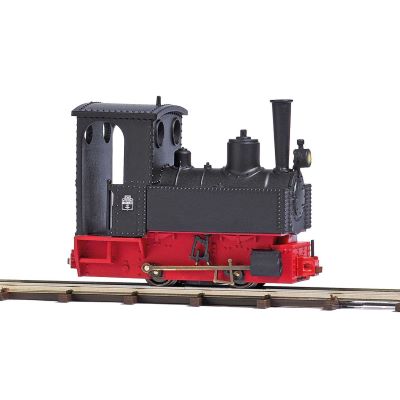
Compact historical steam locomotive for early industrial, brickworks and field railway scenes.
View Product →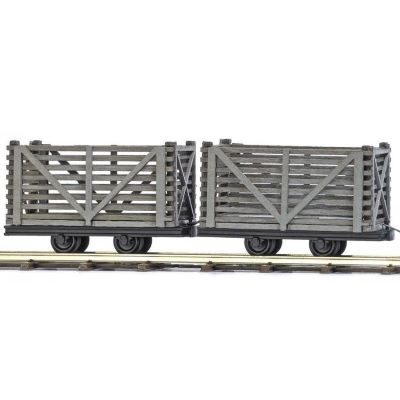
Two field railway wagons for moorland, peat extraction and material-transport scenes.
View Product →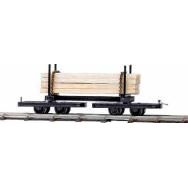
Long timber transport wagon with stakes, metal securing chains and a real-wood load.
View Product →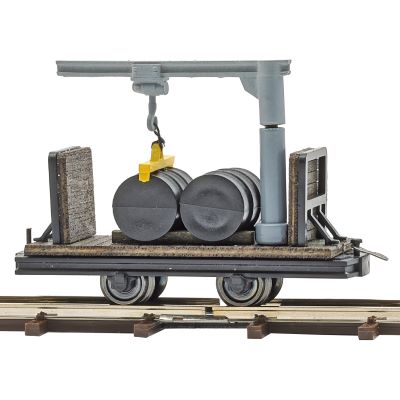
Work vehicle for loading, workshop, maintenance and industrial railway scenes.
View Product →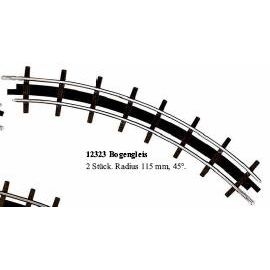
Very tight 115 mm radius for compact field railway circuits and small industrial layouts.
View Product →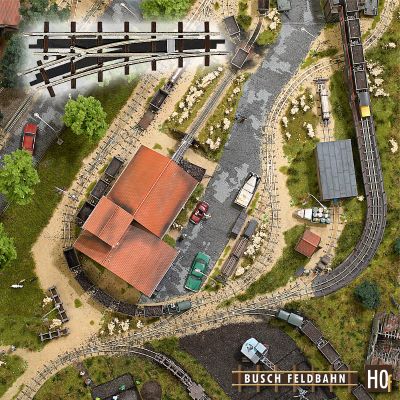
Adds loading sidings, passing tracks and operational shunting possibilities to an H0f layout.
View Product →
Compact shelter for a field railway locomotive, workshop or small industrial operating point.
View Product →Starter sets create the operational foundation. Wagons define what the railway transports, while turnouts, loading facilities and buildings turn a simple circuit into a small works railway with a real purpose.
The Busch field railway track combines 6.5 mm gauge with integrated metal strips. Magnets in compatible locomotives increase contact pressure and support electrical pickup, slow running and tractive effort.
| Track Component | Dimensions | Typical Application | Planning Note |
|---|---|---|---|
| Busch 12301 Straight | 33.3 mm | Short adjustment section | Useful for compact track connections. |
| Busch 12303 Straight | 66.6 mm | Loading or storage track | Suitable for small operating points. |
| Busch 12305 Straight | 133.2 mm | Main route and loading track | Reduces unnecessary rail joints. |
| Busch 12306 Feeder Track | 133.2 mm | Power feed | Connect only an approved compatible controller. |
| Busch 12323 Curved Track | R115 · 45° | Very compact circuits | Test every vehicle before adding scenery. |
| Busch 12332 Curved Track | R175 · 22.5° | Smoother route alignment | Prefer the larger radius when sufficient space is available. |
| Busch 12341 / 12342 | R175 · left / right | Branch and shunting track | Provide access for the drive and later maintenance. |
| Technomodell 56606 | 1 metre model track | Individual track construction | Check compatibility with the chosen vehicle system. |
Z Gauge and H0f share the same nominal track gauge but differ in scale, track construction and technical requirements. Busch's field railway system uses integrated metal strips that interact with magnets in compatible locomotives.
Many Busch starter sets are intended for battery operation or a 3 V DC power supply. Use only the power supply approved in the instructions for the exact locomotive, starter set or controller.
The number of tracks is less important than a clearly understandable task. The source of the load, the transport route and the destination should already be recognisable in the first draft.
Choose timber, peat, clay, ore, stone or factory materials as a believable load that explains why the railway exists.
Turnouts, tunnels and unloading areas must remain accessible for cleaning, maintenance and vehicle recovery.
R115 saves the most space. R175 creates a calmer and visually more generous route wherever the available area allows it.
A mine entrance, timber yard, crusher or factory hall gives every journey a clear operating purpose.
Test locomotives, wagons, turnouts and the approved power supply in both directions before ballasting or permanently adding scenery.
H0 buildings, figures, trees and road vehicles share the same 1:87 scale and can therefore be integrated naturally with an H0f field railway.
Small locomotives react particularly strongly to dust, paint mist, adhesive residue and dirty railheads. Track and wheels should therefore be kept clean and treated carefully.
Begin with short trains and expand the transport task first. Additional wagons, one turnout and a loading point usually create more operating interest than a second closed circuit.
Digital conversion is possible but remains a specialist project. Motor voltage, current consumption, decoder dimensions and heat development must all suit the exact vehicle.
A standard H0 controller or digital track output must not be connected without checking the product specification first. The locomotive, starter-set and controller instructions are authoritative.
The same nominal rail spacing does not guarantee electrical or mechanical compatibility.
One clear transport route usually looks more believable than an overcrowded track plan.
Short locomotive-and-wagon formations better represent the character of a field railway.
Turnouts and concealed track must remain reachable for cleaning and vehicle recovery.
The most important differences, applications and technical fundamentals explained clearly.
H0 indicates the 1:87 scale. The letter “f” is used in the German-speaking model railway world for a field railway. H0f vehicles operate on 6.5 mm model track.
Both describe the same basic prototype gauge group. H0i is the NEM designation for industrial and works railways, while H0f is commonly used in Germany as the more intuitive field-railway designation.
The gauge group represents prototype track gauges from approximately 400 mm to below 650 mm. Railways with 500 and 600 mm prototype track gauges are particularly common subjects.
H0e uses 9 mm model track and generally represents prototype gauges between 650 and below 850 mm, including many 750 and 760 mm narrow-gauge railways. H0f uses 6.5 mm track for even narrower field and industrial railways.
No. Both use a nominal 6.5 mm model track gauge, but H0f uses a scale of 1:87 while Z uses 1:220. Track construction and power-supply requirements can also be different.
Yes. H0 and H0f both use the 1:87 scale. Buildings, figures, road vehicles, plants and many scenery products can therefore be combined naturally.
A simple Busch R115 track oval requires approximately 375 × 250 mm. Additional area should be allowed for turnouts, loading points, landscape and good maintenance access.
Digital conversions are possible but remain specialist projects. Motor voltage, current consumption, decoder dimensions and heat development must be matched precisely to the vehicle.
Choose according to the desired theme: mine railway, forest railway, quarry, freight transport or passenger operation. The included track and matching controller are particularly important for a reliable introduction.
The nominal track gauge may be the same, but rail profile, connectors, electrical construction and the magnetic support used by the Busch system must be checked before combining components.
H0f models contain small and delicate components. Always follow the age and safety information for the exact product. Many Busch H0f products in the current shop specify a recommended age of 14 years.
Keep rails and wheels clean, use short trains, avoid abrupt gradient changes and operate every vehicle only with the approved power supply.
Choose a starter set, define a clear transport task and then expand the route step by step with wagons, turnouts, loading facilities and scenery. H0f is most convincing when the small railway does not simply run – it visibly works.
English links, H0f classification, product pages and image paths checked: 15 August 2026.