Modellbahn Keks
Welcome!
Our cookies offer you a fast, relaxed and full-featured shopping experience. Some are necessary to operate the website and its functions. Others help us to improve our services. If you agree to this, simply consent to the use of cookies for preferences, statistics and marketing by clicking on "OK". Alternatively, you can deactivate individual cookies under "Customise cookies" or all cookies, except those required for the function of our website, under "Reject all".
NOCH winter scenery with snow, ice and snow-covered trees for a model railway
Snow · Ice · Winter Forest · Winter Scenes

Create Winter Scenery on a Model Railway

Powder snow, drifted paths, bare deciduous trees, snow-covered firs, frozen water and everyday winter scenes create an exceptionally clear and atmospheric model railway landscape.

Snow Is Only One Layer of a Winter Landscape

What Makes Realistic Winter Scenery on a Model Railway?

Creating winter scenery on a model railway does not mean simply covering the entire layout completely in white. Natural transitions are what make snow convincing. Open meadows may have a continuous layer of snow, while grass, earth, ballast or scree can still remain visible on steep slopes, beneath trees, beside roads and along railway tracks.

The point in the season is therefore important. The first period of frost looks completely different from a deeply snow-covered midwinter landscape. With light snow, grass tufts, stones and paths remain clearly visible through the white surface. After heavy snowfall, the terrain becomes softer and even walls and roofs develop clearly recognisable snow layers.

Deciduous trees often have bare or only very sparsely foliated canopies in winter. Conifers remain green and, after snowfall, carry irregular white deposits on branches and twigs. This creates an important contrast. Ready-made coniferous trees and snow-covered firs can be mixed effectively with barer winter trees.

The railway itself also changes the visual effect. Rail heads should remain visible and operationally reliable. Snow may lie between sleepers, but turnout blades, electrical contacts and moving components must not be glued together with scenery material. On a railway embankment , wind-exposed areas may show less snow than hollows and protected areas around the foot of the slope.

Not Every Winter Has to Be Deeply Snow-Covered

Three Winter Scenes for Different Layout Atmospheres

Before adding snow, decide whether you want to represent the first snowfall, classic midwinter or a thaw. Snow, vegetation and roads can then be coordinated logically.

First Snow

Meadows and roofs show the first white areas while paths, forest floors and sunny places remain clearly visible. Beige winter grasses project through the thin snow layer. This scene is especially suitable when part of an existing autumn landscape is to remain visible.

Deep Midwinter

Snow visually connects meadows, embankments, roofs and forests into one calm overall scene. Snowdrifts and cleared traffic routes nevertheless provide structure. Dark tree trunks, tunnel portals, buildings and rails become particularly strong contrasts.

Thaw

Irregular remains of snow, dark damp roads and visible ground create an especially realistic transition scene. Snow piles remain longer beside roads and in shaded areas while sunny surfaces are already clear again.

Connect Landscape, Railway and Everyday Life

Typical Winter Scenes for a Model Railway

The season is especially convincing when snow is not treated only as scenery material but creates specific situations around the railway, roads, villages and natural landscape.

Snow-Covered Station

Snow on platform roofs, thin layers between lightly used tracks and cleared platforms create a strong railway scene. Areas immediately beside the platform edge should remain clean and clearly structured.

Winter Forest

Snow-covered spruces and firs are combined with bare deciduous trees. Dark earth can remain visible in selected areas of the forest floor. Different tree heights prevent a white group of trees from appearing like a continuous decorative wall.

Mountain Railway

Snow deposits emphasise rocks, retaining walls, tunnels and viaducts. Uneven snow distribution looks especially convincing: horizontal projections carry more snow than steep rock surfaces.

Cleared Village Road

The road and pavement can be partly clear while snow piles remain at the edges. Tyre tracks, parked vehicles and winter-maintenance figures tell a considerably more believable story than a completely untouched white road.

Frozen Pond

A winter water surface can be created with ice effects and snow around its edges. Ice skaters or bare bank vegetation add further seasonal detail.

Winter Sports in the Mountains

Skiers, sledges, children in the snow and hikers can bring even a small hillside to life. The scene works particularly well when paths, terrain gradient and figure positions visibly correspond.

Design tip: snow reacts very strongly to light. Pure white should therefore not stand completely alone everywhere. Slightly blue-grey shadows, grey roads, dark tree trunks and visible ground give white surfaces much more depth.

Build the Snow Layer from the Ground Up

How to Create a Believable Snow Cover in Miniature

1

Prepare the Winter Ground

Base Colour
Never apply snow to unfinished scenery

Earth, rocks, grass, paths and buildings should be completely finished first. Snow is added as the final landscape layer. Natural areas then remain visible when the white covering is intentionally thin or irregular.

2

Add Winter Grass Before the Snow

Vegetation
Beige blades provide scale and visual depth

Short winter fibres can be added to meadows, slopes and edge areas. Only their tips may remain visible once the snow is applied. These small interruptions make a thin snow cover far more convincing.

3

Shape the Snow Base

Snow Paste
Do not make drifts and snow piles equally high everywhere

Shapeable snow paste works well beside roads, on roofs, on embankments and for compact snow piles. It can create small variations in height before finer snow flakes form the visible surface.

4

Apply Fine Powder Snow

Surface
Fine flakes create the soft appearance of fresh snow

Snow flakes or snow powder should be fixed according to the instructions supplied by the manufacturer. Work on the landscape in sections and use several thin applications rather than one single coarse layer.

5

Add Tracks to Soft Snow

Everyday Life
Tyres, footprints and clearing tell the winter story

Snow paste can be used to create tyre and foot tracks. A path does not need to be cleared completely. Central wheel tracks, snow at the sides and occasional dark areas create a much more lively surface.

6

Use Ice Selectively

Details
Icicles and smooth frozen surfaces should remain special accents

Icicles suit roof edges, rocky projections and suitable structures. Frozen water requires a different surface effect from loose snow. These materials should therefore not merge into one undifferentiated white mass.

Snow Works from Z Gauge to Garden Railways

Design Winter Landscapes to Match the Gauge

Snow, snow paste and many ice effects can generally be used across different scales. Winter trees, figures, vehicles and visible tracks must nevertheless match the respective model scale.

Gauge / Scale Suitable Winter Effect Pay Particular Attention To
Z · 1:220 Large snow areas and compact mountain scenery Use extremely fine snow and minimal visible tracks.
N / Nm · approx. 1:160 Broad winter landscapes and long mountain railway routes Use small snow-covered firs and finely textured surfaces.
TT · 1:120 Balanced combination of village, railway and landscape Add TT winter figures and suitably proportioned trees.
H0 / H0e / H0m / H0f · 1:87 Highly detailed snow, ice and leisure scenes Take advantage of the large choice of figures, trees and winter accessories.
0 / 0e / 0m · approx. 1:45 Strong close-up effect with detailed tracks and footprints The snow surface requires especially fine microtexture.
1 · 1:32 Large individual scenes and detailed winter trees Refine branches, snow deposits and ground transitions carefully.
G / II / IIm Large winter and Christmas scenes Check the weather resistance of materials used outdoors.
From Winter Grass to the Final Ice Detail

Build Winter Scenery in Eight Steps

Step 1 · Define the Winter Stage

Select the Amount of Snow and Weather Conditions

Decide between first snow, deep midwinter and thaw conditions. This determines how much ground remains visible and whether roads, roofs and trees are covered completely or only partially.

Step 2 · Complete the Landscape

Finish Rocks, Ground and Buildings Before Adding Snow

Snow is the final weather layer. Tunnels, walls, embankments, paths and houses must already be fully designed. Only then can believable exposed areas and snow deposits of different thicknesses be created.

Step 3 · Prepare the Vegetation

Position Bare Trees and Winter Grass

Add winter trees and muted grass fibres before applying snow. Arrange snow-covered firs in groups with different tree heights to create a natural forest edge.

Step 4 · Apply the Snow Base

Use Snow Paste Only Where Volume Is Required

Snow piles beside roads, drifts and thick roof deposits can be modelled with paste. Large flat landscape areas do not require a heavy layer everywhere.

Step 5 · Add Fine Snow

Use Powder and Flakes for a Soft Surface

Spread the fine material over prepared areas. Work in a controlled way and follow the processing instructions supplied with the selected snow and adhesive products.

Step 6 · Work on Traffic Areas

Make Cleared Areas and Tracks Visible

Roads, squares and platforms receive tyre, foot or clearing tracks. Snow piles remain at plausible edges. This turns a static snow surface into a recognisable everyday winter situation.

Step 7 · Add Ice and Glitter

Use Frosty Details in a Controlled Way

Snow glitter can enliven selected surfaces. Icicles provide small focal points beneath roofs and projections. Restrained use usually looks more natural than applying the same sparkling effect everywhere.

Step 8 · Check Railway Operation

Inspect Tracks, Turnouts and Electrical Pick-Up Completely

Remove loose scenery material from rail heads, turnout blades and moving parts. Then perform a complete test run with long and sensitive vehicles before adding any final details.

Never Sacrifice Operational Reliability for Snow

Adhesives, pastes and loose flakes must not interfere with turnout mechanisms, contacts, couplings or rail surfaces. Build the visible winter landscape around the technical components and keep critical areas accessible for maintenance.

Select Winter Materials According to Their Function

Products for Snow, Ice, Winter Forests and Winter Scenes

A complete winter landscape combines fine snow materials, shapeable pastes, muted vegetation, winter trees and figures. The following categories lead directly to the current English Modellbahnshop ranges.

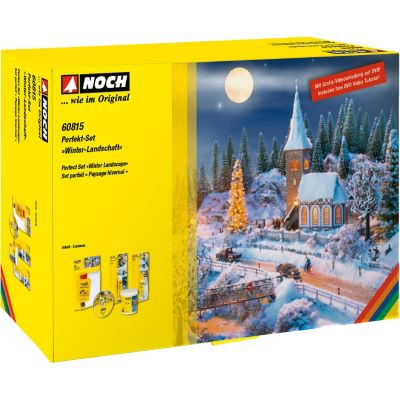
NOCH 60815 Perfect Set Winter Landscape with snow and ice effects
NOCH · All Gauges · Complete Set

NOCH 60815 Winter Landscape

Snow, ice effects and icicles for creating a complete winter landscape.

View Product →
NOCH 07065 Snowflakes Starter Set for model railway winter scenery
NOCH · All Gauges · Snow

NOCH 07065 Snowflakes Starter Set

Snow flakes, snow adhesive and spray bottle for creating fine snow covers.

View Product →
NOCH 08760 fine snowflakes 75 g for winter model railway scenery
NOCH · All Gauges · Powder Snow

NOCH 08760 Snowflakes

Very fine special fibres for soft, freshly fallen-looking snow surfaces.

View Product →
NOCH 08752 snow paste 250 ml for model railway winter scenery
NOCH · All Gauges · Snow Paste

NOCH 08752 Snow Paste

Shapeable snow layer for terrain, roofs and detailed winter scenes.

View Product →
Auhagen 77032 snow powder with glitter 500 ml for winter scenery
Auhagen · All Gauges · Snow

Auhagen 77032 Snow Powder

Pure-white material for powder snow and modelled snowdrifts.

View Product →
HEKI 3343 snow glitter powder 250 g for model railway winter scenery
HEKI · All Gauges · Snow Glitter

HEKI 3343 Snow Glitter

Sparkling surface effect for roofs, fir trees and snow-covered landscape areas.

View Product →
Busch 7172 crystal snow paste 150 ml for model railway winter scenes
Busch · All Gauges · Snow Paste

Busch 7172 Crystal Snow Paste

Shapeable paste suitable for tyre tracks, animal tracks and footprints.

View Product →
FALLER 170200 winter grass fibres 2 to 3 mm for frosty model railway scenery
FALLER · All Gauges · Winter Grass

FALLER 170200 Winter Grass

Subtle short fibres for frosty meadows and visible blades projecting through snow.

View Product →
NOCH 25075 set of seven snow-covered winter trees
NOCH · H0/TT · Winter Trees

NOCH 25075 Winter Trees

Seven snow-covered trees for parks, woodland groups and winter villages.

View Product →
NOCH 26928 set of ten snow-covered fir trees from 5 to 14 cm
NOCH · H0/TT · Snow-Covered Firs

NOCH 26928 Snow-Covered Fir Trees

Ten fir trees in different heights for forests, mountains and layout backgrounds.

View Product →
Busch 6566 set of twenty snow-covered fir trees for N gauge
Busch · N · Snow-Covered Firs

Busch 6566 Snow-Covered Fir Trees

Twenty small snow-covered trees for compact N-gauge winter forests.

View Product →
HEKI 2101 winter forest with ten deciduous and coniferous trees
HEKI · H0 · Winter Forest

HEKI 2101 Winter Forest

Different deciduous and coniferous trees for a complete winter tree group.

View Product →
NOCH 08756 clear icicle material 30 ml for winter scenery
NOCH · All Gauges · Ice

NOCH 08756 Icicles

Crystal-clear curing material for roofs, projections and detailed winter scenes.

View Product →
NOCH 15928 H0 Winter Work figures and accessories
NOCH · H0 · Figures

NOCH 15928 Winter Work

Six figures with accessories for snow clearing and winter working scenes.

View Product →
Current Winter Products Directly from the Online Shop

Filter Winter Products and Load More Dynamically

When this section approaches the viewport, the finder loads additional products from current winter, scenery and leisure categories. Results can be filtered by search term, gauge, manufacturer, winter scene and product group. Detected archived products are excluded and no availability information is displayed.

Current winter products will be loaded when this section approaches the viewport …

Manufacturer Worlds at Modellbahnshop

Brands for Snow, Ice and Winter Landscapes

Snow materials, trees and figures from several manufacturers can be combined effectively. Different textures prevent large winter surfaces from appearing too uniform.

Create Winter and Christmas Together or Separately

A realistic winter layout does not require Christmas decoration. For a festive seasonal scene, snow, winter woodland and figures can additionally be combined with Christmas markets, illuminated trees and market stalls.

Open Winter & Christmas
Frequently Asked Questions About Snow Scenery

Questions About Winter on a Model Railway

These answers cover snow materials, railway tracks, winter trees, gauges, ice and converting an existing landscape to winter.

Which Material Is Suitable for Model Railway Snow?

Special snow flakes or snow powder are suitable for fine powder snow. Shapeable snow pastes work better for snow piles, drifts, roofs and tracks. Both techniques can be combined.

How Can Model Railway Snow Look Especially Realistic?

Snow should have different depths. Grass, earth or the underlying surface can remain visible beneath trees, on steep slopes and along heavily used paths. Fine flakes as the final surface layer create a softer appearance.

Can Snow Be Placed Between Model Railway Tracks?

Yes. Snow can visually lie between and beside the tracks. Rail heads, turnout blades, electrical contacts and moving components must nevertheless remain clean and operational. Loose fibres must not enter drive mechanisms.

Which Trees Suit a Winter Landscape?

Bare deciduous trees and snow-covered conifers create a convincing combination. Different tree heights and species look more natural than a forest consisting entirely of identical snow-covered fir trees.

How Do You Create a Snow-Covered Road?

Cleared wheel tracks and snow piles at the sides look especially convincing. Tyre tracks and footprints can be pressed into shapeable snow paste. Parts of the original road surface can remain visible.

How Do You Create a Frozen Water Surface?

First complete the entire water bed and surrounding scenery. Transparent or crystalline effects can then create the appearance of ice, while snow is concentrated particularly around banks and irregular edges.

Can an Autumn Layout Be Converted into a Winter Layout?

Yes. Autumn ground, beige grass fibres and bare trees provide an excellent base. Add snow irregularly at first and gradually increase the coverage until the intended winter stage is reached.

Is Snow Material Suitable for Every Model Railway Gauge?

Many powders, flakes and pastes are suitable for several or all gauges. Figures, trees and visible tracks are scale-dependent. In Z and N, all visible structures need to appear correspondingly finer.

How Do You Prevent an Entirely White Winter Layout from Looking Boring?

Use dark tree trunks, rocks, buildings, visible ballast, winter grass and cleared traffic routes as contrasts. Irregular snow depths and different surface textures create spatial depth.

Does a Winter Landscape Automatically Have to Be Christmassy?

No. Snow, winter woodland, ice and winter maintenance create a complete landscape in their own right. Christmas markets, illuminated trees and festive decoration can be added separately as an optional theme.

Content updated on . For processing, drying times and product safety, the information supplied by the respective manufacturer and on each individual product page remains authoritative.

Discover More Model Railway Landscapes and Building Projects

The central guide connects seasonal scenery with meadows, forests, mountains, water, railway embankments, gauges, layout planning, rolling stock and model railway technology.

Open the Model Railway Guide