Bghw and Bghwe
Four-axle second-class passenger coaches with two bogies and a prototype length of 18.7 metres. They are the main subject of this page.

The four-axle Reko (rebuilt) coaches from Halberstadt shaped Deutsche Reichsbahn passenger services for decades. Discover their history, typical variants, suitable train formations and models for your DR layout. Use our train length calculator to plan the space required for your train.

After the Second World War, the Deutsche Reichsbahn had to renew its ageing fleet of passenger coaches. The reconstruction programme enabled extensive modernisation: usable existing components were combined with new designs to produce vehicles better suited to the passenger services of the time. Following the two- and three-axle Reko coaches, the four-axle family emerged in the 1960s from the Halberstadt railway repair works (RAW).
With new coach bodies and improved fittings, the four-axle vehicles were suitable for a wide range of services. Progressively fewer reused components went into the later production batches. In Era IV, green Reko coaches were a familiar sight on many routes. As newer passenger coaches were introduced, they increasingly moved into local and semi-fast services.
Vehicles from this family were still in service in the early 1990s. One example, the Bghw built in 1968 and now belonging to the Thüringer Eisenbahnverein, was taken into the DB AG fleet in 1994 as type 522. Documented individual vehicles like this help match coach lettering and model variants to a particular period.
For railway modellers, this history is especially interesting: a train of Bghw coaches conveys not only a characteristic livery but also a particular period in railway history. When modelling scenes from Saxony, Thuringia, Brandenburg or Mecklenburg, these coaches can form the basis of a convincing operating scene.
The four-axle design clearly distinguishes this coach from shorter Reko coaches with fixed axles. Its bogies, window arrangement, end entrances and enclosed gangways define its silhouette. The documented type features Görlitz V bogies and rubber-bellows gangways. The reproduced handrails, lettering, bench seats and roof details are also of interest to railway modellers.
The capital B identifies a second-class coach. The additional e denotes electric heating in the relevant historical designation system. The remaining classification letters must be read in the context of the lettering system in use at the time. Bghw and Bghwe are closely related variants of the same family, but the letter sequence alone does not establish every equipment detail.
When buying a model, compare the specific type, era and running number. The heating system of the prototype must also be distinguished from the electrical interior lighting of a model coach.

| Feature | Specification |
|---|---|
| Manufacturers | RAW Halberstadt |
| Gauge | 1,435 mm |
| Length over buffers | 18,700 mm |
| Coach body width | 2,900 mm |
| Height above rail level | 3,930 mm |
| Service weight | 30 t |
| Seats | 64 plus two folding seats |
| Maximum speed | 120 km/h |
| Heating | Steam and electric |
Sources for the prototype data: vehicle documentation of the Thüringer Eisenbahnverein, Deutsches Wagen-Archiv, Reisezugwagen, volume 2. The figures refer to the documented vehicle; other versions may differ.
The collective term Reko coach describes several vehicle families. Not every model bearing this name represents a four-axle Bghwe. For a historically convincing train, it is worth distinguishing the following types:
Four-axle second-class passenger coaches with two bogies and a prototype length of 18.7 metres. They are the main subject of this page.
Related coaches of the BDghw family combine passenger seating with a baggage compartment. They can add both operational and visual variety to a passenger train.
Baage, Bage and related two- or three-axle designs belong to a different reconstruction programme. They should not be confused with the four-axle Bghw.
Rebuilt passenger coaches also ran on Saxon narrow-gauge routes. These H0e models represent different prototypes with their own dimensions.
PIKO also produces models of standard-gauge DR passenger coaches for garden railways. The actual model length is what matters, not a single assumed scale for G gauge.
The DR also operated Modernisierungswagen. This separate vehicle family offers further opportunities to recreate mixed passenger trains.
To recreate a particular train, start with a prototype photograph and check the windows, doors, number of axles, lettering and coach order. Green livery alone is not a reliable distinguishing feature.
At a prototype length of 18.7 metres, these coaches are relatively short compared with many modern passenger coaches. This is useful for compact layouts. The following calculated figures show the space needed for true-to-scale models. Actual model lengths may differ.
| Gauge | Scale | Length |
|---|---|---|
| H0 | 1:87 | 215 mm |
| TT | 1:120 | 156 mm |
| N | 1:160 | 117 mm |
| 0 | 1:45 | 416 mm |
| G | Depends on the model | PIKO 37650: 650 mm |
H0 is suitable for detailed vehicles and a wide variety of DR themes. TT offers a good compromise between visible details and train length. In N gauge, longer trains can be accommodated in smaller areas. 0 gauge and garden railways need more space but make many coach details clearly visible. The table does not imply that a Bghw is currently available in every gauge.
In addition to coach length, consider your track radii, usable station tracks and intended shunting operations. For example, four TT coaches alone have a calculated length of around 623 millimetres. The locomotive and stopping allowance must be added. Our gauge comparison provides further guidance for your decision.
Explore manufacturers
Explore the brands offering four-axle Bghw coaches, related Reko coaches and suitable locomotives. The logos take you directly to each manufacturer's range at Modellbahnshop.



This Era IV Bghw is 155 millimetres long. It has interior fittings and is prepared for lighting kit 08866. It is a suitable basis for a DR passenger train.
MBS187134 – view modelOver the years, many DR coach models have been produced with different running numbers. Pay attention to the type, bogies and lettering; earlier production runs are not necessarily still in the current range.
Explore the BRAWA brand pageThe documented version is 416 millimetres long and has sprung buffers. Its large size makes this coach especially appealing for a detailed station scene.
MBS176908 – view model (German)The four-axle Reko coach in DR livery is 650 millimetres long. Allow enough space on your garden railway for coach overhang, stopping points and the complete train.
MBS149559 – view modelThese H0 sets feature short Reko coaches and complementary baggage or goods vehicles. They offer an alternative for other Reichsbahn train themes, but are not four-axle Bghwe formations.
MBS180853 – view set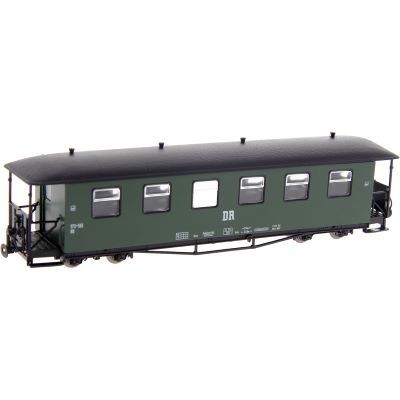
This 148-millimetre coach represents a different, narrow-gauge DR prototype. The precise design is especially important when recreating Saxon narrow-gauge scenes.
MBS992440 – view modelThe examples illustrate different vehicle concepts. Check each linked product page for the contents, system and intended accessories. For a uniform Bghw train, select four-axle vehicles in the same gauge.
When planning a Reichsbahn train, first establish the year of operation. Late Era III still features older locomotive designations; Era IV offers many combinations with DR diesel and electric locomotives using the newer numbering system. Transitional versions with more recent lettering are interesting for early Era V. A present-day heritage train, however, follows the actual historic vehicle fleet of its operator.
The following combinations are ideas for your model railway, not documented historical train formations. Adapt them to your chosen route, train length and year.
Two to four Bghw coaches behind a DR diesel locomotive of the V100 family make a compact passenger train theme. A combined passenger and baggage coach can complement the formation.
A V180 or Class 118 with several Bghw coaches is an idea for a passenger train on a suitable main or branch line.
This locomotive with several four-axle Reko coaches offers a train idea for the later Reichsbahn years. Choose appropriate coach lettering.
A Class 65.10 with green Reko coaches can represent a historic passenger train. Make sure the models belong to a compatible period.
A DR Class 242 is an idea for an electrified route. Consider the region represented and the type of overhead line.
Preserved historic vehicles can also run on modern layouts. Photographs of a particular special train are especially useful when recreating an actual prototype.
On a small layout, the train need not be as long as the prototype. What matters is a coherent operating sequence: arrival, stop, running round if necessary, and departure. An additional baggage van should not occupy the only usable siding. At a terminus, therefore, allow space for the locomotive to run round. On a through route, the visual effect of the passing train may take priority.
Select a scale and the number of coaches. You can replace the assumed coach length with the actual model length at any time. Add the locomotive length and your own track allowance. The calculation helps you plan platforms and hidden storage yards.
The selection distinguishes four-axle Bghw/Bghwe, short standard-gauge Reko coaches and narrow-gauge vehicles. Search by name, manufacturer's item number, MBS item number or recorded EAN. Use the filters to narrow down the products already listed. You can search further shop pages at the touch of a button.
Selected Reko coaches and related models
Tillig 16628 TT Bghw passenger coach, DR, Era IV
MBS item number: MBS187134
Gauge: TT
Length: 155 mm
EAN: 4012501166280
Lenz 41180-05 Bghwe Reko coach, DR, Era IV (German product page)
MBS item number: MBS176908
Gauge: 0
Length: 416 mm
PIKO 37650 second-class Reko coach, DR, Era IV
MBS item number: MBS149559
Gauge: G
Length: 650 mm
Roco 6200009 H0 set of 3 Reko coaches, DR, Era IV #1
MBS item number: MBS180853
Gauge: H0
Roco 6200010 H0 set of 3 Reko coaches, DR, Era IV #2
MBS item number: MBS180854
Gauge: H0
Length: 417 mm (set)
EAN: 9005033062354
PIKO 53021 Baage Reko coach, DR, Era IV
MBS item number: MBS102258
Gauge: H0
Technomodell 52440 Reko passenger coach with original roof, DR, Era IV
MBS item number: MBS992440
Gauge: H0e
Length: 148 mm
EAN: 4255650022995
The product pages contain the current product information.
An illuminated Reko coach train looks particularly effective in a station during evening operations. First establish whether the desired lighting is already fitted or can only be retrofitted. For a retrofit kit, power collection, permissible operating voltage, installation space and the specific coach variant are important. Even, subdued lighting usually looks more convincing than an excessively bright interior.
When using coaches from different manufacturers, it is worth testing the complete train. A standardised coupler pocket makes it easier to change couplings but does not guarantee identical spacing between coaches. On H0 centre-rail layouts, suitable wheelsets and power collection compatible with the layout must also be considered. Test the train in both directions on tight curves and through pointwork.
A convincing DR scene does not need a large number of individual objects. A small platform, a station building appropriate to the period, suitable signals and a few figures already create a convincing setting. Choose the main motif first and leave space for the moving train. In this way, a short formation can become the centrepiece of a complete layout.
A four-axle Deutsche Reichsbahn passenger coach from the Halberstadt Reko coach family. It is a typical vehicle for passenger train themes of late Era III and Era IV.
Baage denotes a shorter two-axle Reko coach. Bghw and Bghwe, by contrast, have two bogies and four axles.
With a prototype length of 18.7 metres, the scale calculation gives approximately 215 mm in H0, 156 mm in TT and 117 mm in N. The actual length is given in the specific product description.
Examples include Classes 110, 112, 118 and 119, as well as suitable DR steam and electric locomotives. The operating year and route determine the specific combination.
That depends on the model. Some coaches can be fitted with lighting later; others already have it installed. Check the contents of the specific product.
Even two to four coaches can make a convincing model train. For longer trains, the usable track length is crucial.
Preserved historic coaches make an interesting subject for a heritage or special train. For a specific prototype, compare photographs of the train from the relevant period.
Discover suitable locomotives, buildings and guides for your own Reichsbahn world.
Interested in Reichsbahn models and historic passenger trains? Choose the WhatsApp channel for your gauge to receive relevant model railway updates.
WhatsApp: your gauge, your channel
New products and relevant model railway updates by gauge: open a channel and follow it on WhatsApp.
Choose the WhatsApp channels that suit you. If you model in several gauges, you can follow several channels.