Fleischmann Piccolo
Track and textured ballast roadbed form a single unit. The 9100-series geometry supports quick assembly and can still be enhanced at the sides with additional ballast and colouring.

From the Thierstein layout measuring only 93 × 50 centimetres, through the seven Hohenstein construction stages, to the 48.24-metre Raschhagen track route: this overview presents every layout-specific set, the B1–E1 extensions and the Easy-Track packages.
N gauge is produced at a scale of 1:160. Standard gauge is represented by a model track gauge of 9 millimetres. This permits long passenger and freight trains, multi-track stations and interwoven routes to be represented within a considerably smaller area than in H0 or TT.
A Fleischmann track set combines the track required for a defined purpose. It may form a complete layout, an individual construction stage, an extension for a starter-set oval or the appropriate track package for a NOCH route-construction kit. Straights, radii, turnouts and compensation tracks therefore do not have to be found individually within a long parts list.
Most products in this overview are layout sets using Fleischmann piccolo track with integrated roadbed. Their place names identify specific track plans. The Hohenstein sets divide a larger plan into seven construction stages and an additional hidden yard. B1 to E1, by contrast, extend the basic configuration used in many starter sets.
Easy-Track also provides a choice between piccolo with moulded ballast roadbed and a Fleischmann track system from the 222xx family without roadbed. Both systems belong to N gauge but use different lengths, radii and installation heights.
Important: A track set contains the track components listed on the relevant product page. Locomotives, coaches, wagons, buildings, scenery, controllers, route-construction kits and turnout drives are included only when they are expressly listed as part of the set.
Most of the listed sets use the familiar Fleischmann piccolo track system. Four Easy-Track packages also demonstrate how the same route plan can be built either with piccolo or with a system without moulded roadbed.
Track and textured ballast roadbed form a single unit. The 9100-series geometry supports quick assembly and can still be enhanced at the sides with additional ballast and colouring.
The 222xx track is laid on a separately selected base. Roadbed height, ballast colour and transitions into the surrounding scenery can therefore be designed entirely individually.
Both track families use a two-rail system. The power supply, vehicles, decoders, command station, wiring and feedback equipment determine whether operation is analogue or digital.
| Feature | Piccolo with Roadbed | Track Without Roadbed |
|---|---|---|
| Product Family | Primarily 9100 to 9184 | Primarily 222xx |
| Basic Straight Length | 9101 at 111 mm; 9100 at 222 mm | 22203 at 104.2 mm; 22202 at 312.6 mm |
| Small Radii | R1 192 mm; R2 225.6 mm | R1 194.6 mm; R2 228.2 mm |
| Turnout Geometry | Standard, curved and double-slip turnouts | 15° turnouts measuring 112.6 mm with an R5 branch |
| Scenic Treatment | A complete roadbed appearance immediately after assembly | The base and ballast are selected separately |
| Use in This Overview | Layout sets, Hohenstein, B1–E1 and two Easy-Track sets | Two Easy-Track track packages |
Plan a system transition carefully: A shared track gauge of 9 millimetres does not mean that the two systems can be connected directly. Track length, joiners, rail profile, roadbed height and geometry must be matched precisely at the transition point.
The place names identify different operating ideas and base areas. In addition to the external dimensions, the track length helps indicate the scope of each project. Hidden-yard and branch-line variants expand their respective basic plans.
Space-saving circuits and station solutions for a cabinet, shelf, table or first permanent N gauge layout.
An exceptionally compact introduction with a circuit and additional track connections.
View Thierstein
Several running routes and storage possibilities within a width of only one metre.
View Eibingen
A short layout shape with a dense and varied route arrangement.
View Altstadt
A clear continuous route with an inner track connection.
View Hohenwiehl
Parallel routes and turnouts create a surprising amount of operation.
View KreuzthalLonger routes, station tracks, concealed sections and turnout-intensive variants for more ambitious N gauge projects.
Several interwoven running routes on a narrow base area.
View Schwarzach
Expands the Schwarzach concept with a longer diverging route.
View expansion variant
An interwoven route arrangement for a compact mountain landscape.
View Bergün
Several levels and running routes create a total of 27.60 metres of track.
View Frönden
An elongated plan with a station, continuous route and diverging tracks.
View Vitzenburg
Adds concealed storage and train-changing possibilities to the visible plan.
View hidden-yard set
Curved and double-slip turnouts create a variety of routes.
View Rottenbach
A station, long running routes and numerous turnouts within a width of 1.90 metres.
View FalkenauLong routes, large groups of tracks and extensive operation for permanently constructed layouts.
33.18 metres of track within a base area of two by one metre.
View Wutzingen
An extensive station and interwoven route for varied operation.
View Freiberg
Several running routes and station tracks provide a total route length of 31.86 metres.
View Gaarden
The longest track arrangement in the overview on a narrow base area.
View Raschhagen
A generous layout shape for scenery, a station and long visible route sections.
View AnklamHohenstein is designed for construction in stages. The set illustrations state a total layout area of 1.65 × 0.85 metres and a track length of 23.82 metres for the fully developed plan. These overall figures do not describe the contents of an individual stage.

Begins the gradual implementation of the Hohenstein track plan.
View Stage 1
Continues the modular layout plan after the first section.
View Stage 2
The third track-construction section coordinated with the complete plan.
View Stage 3
Expands the layout with the fourth intended track section.
View Stage 4
Continues the advanced expansion of the Hohenstein plan.
View Stage 5
The penultimate regular construction section of the visible track plan.
View Stage 6
The seventh regular track section in the staged layout project.
View Stage 7
An expansion set for a concealed storage area associated with the seventh stage.
View hidden yardBefore beginning with a later stage, check the corresponding product page. The stages form parts of one shared expansion concept and must not be confused with independent complete layout sets.
The four official extension packages build on the minimum configuration of a Fleischmann starter set using roadbed track. They expand the running route, station and storage possibilities in clear stages.
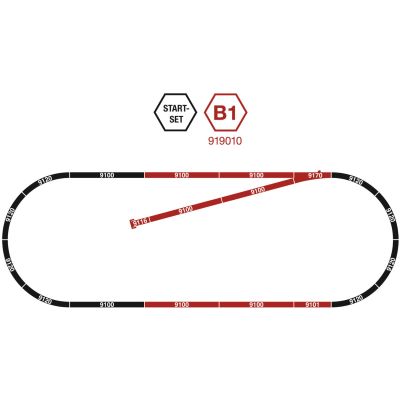
Six long straights, one standard straight, one left-hand turnout and one buffer-stop track expand the starter layout.
View B1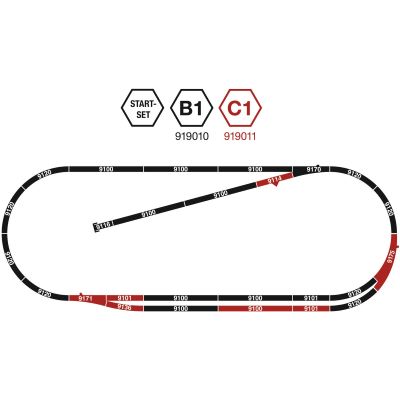
Adds further straight sections, a standard turnout, a curved turnout and an uncoupling track.
View C1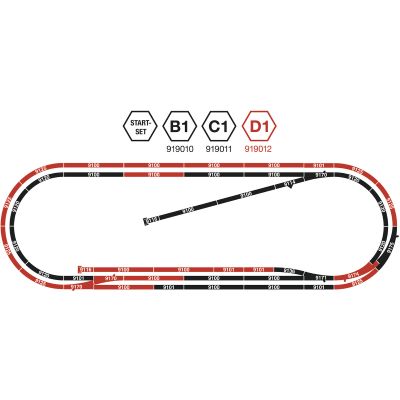
Expands the starter-set plan with straights, curves, turnout connections and an additional route.
View D1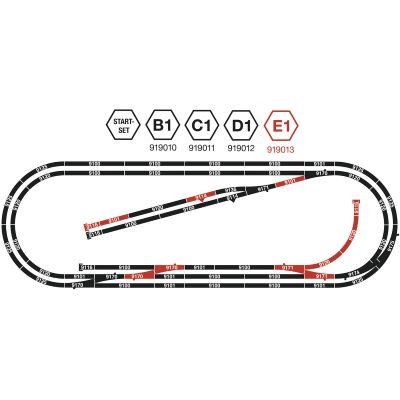
Four standard turnouts, an uncoupling track, curves and two buffer-stop tracks create a larger group of sidings.
View E1Mittelberg and the Albula Railway each have two suitable track combinations: piccolo with integrated roadbed and Fleischmann track without roadbed. The corresponding NOCH route-construction kit is a separate product.
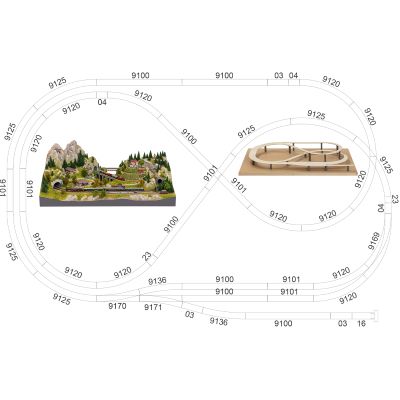
A coordinated 9100-series track package for the compact Mittelberg Easy-Track route plan.
View track package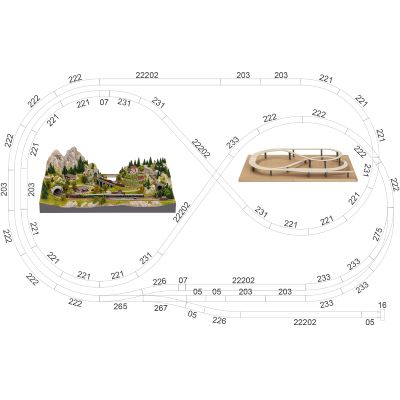
A track combination permitting free choice of base, ballast colour and roadbed design.
View track package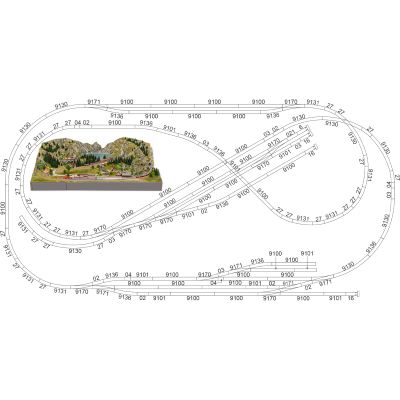
An extensive roadbed-track package for the station, hidden yard and mountain route.
View track package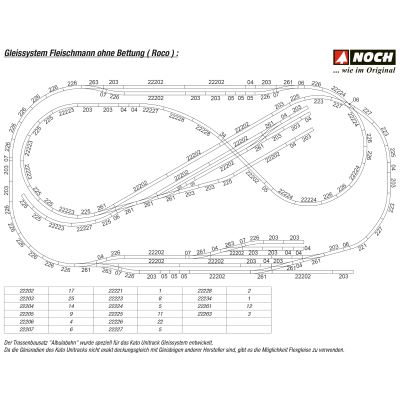
Separate track geometry with 15-degree turnouts for an individually ballasted Alpine layout.
View track packageThe corresponding substructures are available as NOCH 53700 Mittelberg and NOCH 53705 Albula Railway . The track package and route-construction kit are separate products.
The catalogue numbers follow a recurring system. Understanding the most important components makes parts lists easier to read, permits a plan to be altered and allows individual tracks , turnouts or track accessories to be added later.
9101 is 111 millimetres long. At 222 millimetres, 9100 is twice the length. Both form long routes and the basic geometry of many layout sets.
9102 measures 57.5 millimetres, 9103 measures 55.5 millimetres and 9104 measures 27.75 millimetres. These small differences close gaps beside turnouts and within complex groups of tracks.
The adjustable 9110 compensates for lengths between 83 and 111 millimetres. 9114 uncouples vehicles, while 9116 terminates a siding using a fixed buffer stop.
R1 has a radius of 192 millimetres, R2 225.6 millimetres, R3 396.4 millimetres and R4 430 millimetres. Larger radii give long vehicles a smoother appearance.
The 111-millimetre 15-degree turnouts divide the route to the left or right. Suitable reverse curves return the route to parallel track geometry.
A curved turnout begins the branch within the curve. A second running route or station curve can therefore begin within a short layout length.
The double slip combines crossing and turnout functions. It saves space at station approaches but requires especially accurate installation and reliable electrical pickup.
Manual turnouts can be fitted with suitable drives. Additional power feeds reduce voltage losses, while insulated sections separate detection, storage or power districts.
On a permanent layout, the sides of the piccolo ballast base can be enhanced using suitable track bedding and ballast . Moving turnout blades, operating mechanisms and electrical contacts must remain unobstructed.
External dimensions and track length are only the beginning. The longest vehicles, access to concealed track, usable station lengths and intended operating method determine which layout will remain suitable in the long term.
Include operating aisles, cable access and maintenance openings in addition to the actual layout area.
Choose piccolo for quick roadbed-based construction or 222xx track for completely individual ballasting.
The minimum radius stated for each vehicle remains decisive, even when a smaller track plan appears attractive.
The station, hidden yard and storage sidings must accommodate the complete intended train lengths.
Define power feeds, switchable tracks, feedback and turnout drives before ballasting.
Lay the track loosely first and test every locomotive and long coach in both directions.
Thierstein begins at only 0.93 × 0.50 metres.
Hohenstein divides the complete project into seven stages.
B1 to E1 build on the basic piccolo configuration.
Raschhagen provides 48.24 metres of track on a narrow base area.
Further guidance is available in Plan a Model Railway , the Track Planning category and the Model Railway Calculators .
The listed Fleischmann sets are intended for standard-gauge N vehicles. The same distance between the rails in another model size does not mean that vehicles, buildings, radii and track plans are proportionally compatible.
| Model Size | Scale | Model Track Gauge | Relationship to Fleischmann N |
|---|---|---|---|
| N | 1:160 | 9 mm | Standard gauge; intended for these 34 Fleischmann track sets. |
| Nm | 1:160 | 6.5 mm | Metre gauge at N scale using separate narrow-gauge track. |
| TTm | 1:120 | 9 mm | The same distance between the rails but a larger scale and different loading gauge. |
| H0e | 1:87 | 9 mm | H0 narrow gauge; vehicles and structures are considerably larger than in N. |
| Z | 1:220 | 6.5 mm | Standard gauge at a smaller scale and not equivalent to N or Nm. |
The model railway gauge comparison and the guide Which Model Railway Gauge Is Right? explain space requirements, scales and possible applications in greater detail.
These answers help with space requirements, roadbed, construction stages, starter-set expansion and digital operation.
The overview contains 34 products: 18 place-based layout and expansion variants, eight Hohenstein sets, four B1 to E1 extension sets and four Easy-Track track packages.
Thierstein has the smallest stated base area at 0.93 × 0.50 metres. The plan contains 4.62 metres of track.
Raschhagen reaches 48.24 metres of track within a base area of 2.20 × 0.85 metres.
Piccolo identifies Fleischmann N track with a moulded ballast base. Rails, sleepers and roadbed form a stable unit which can be laid quickly.
Yes. The two-rail track can be used with a suitable analogue or digital power supply. Digital operation requires compatible decoders in the vehicles and a suitable command station.
Piccolo has integrated roadbed and uses 9100-series geometry. The 222xx track is laid without roadbed and uses different basic lengths, radii and turnout dimensions.
They expand the minimum configuration of a Fleischmann starter set. Depending on the package, they add running routes, turnouts, station tracks, an uncoupling track or additional sidings.
The stages belong to one shared track plan constructed gradually. The stated dimensions of 1.65 × 0.85 metres and 23.82 metres of track refer to the complete project.
The Fleischmann products provide the appropriate combination of track. The NOCH Mittelberg and Albula Railway route-construction kits are separate products.
The distance between the rails is also 9 millimetres. Scale, vehicle width, coupling height, loading gauge and layout geometry differ considerably, so automatic system compatibility does not exist.
Only the components expressly listed on the relevant product page belong to the set. Vehicles, buildings, scenery, controllers and electric drives must otherwise be selected separately.
One power feed is often insufficient for long routes. Additional connections should be planned according to track length, electrically isolated sections, turnout formations and feedback equipment.

Explore individual straights, radii, turnouts, track accessories, locomotives, coaches, wagons and digital technology for further expansion of your N gauge layout.