
FS Ferrovie dello Stato – Italian State Railways in All Gauges
FS as a Mediterranean Railway Prototype for Model Railways
FS stands for Ferrovie dello Stato Italiane, the Italian State Railways. For model railway enthusiasts, this theme is especially appealing because Italian railways have a very distinctive atmosphere. Sunny stations, long passenger trains, heavy freight wagons, elegant express locomotives, modern high-speed multiple units, diesel locomotives for branch lines and historic museum vehicles can be combined into highly varied layout scenes. FS was founded in 1905 and developed into one of Italy’s most important transport providers. On model railways, the spectrum ranges from historic Era II and Era III vehicles to modern Era VI trains such as the ETR 610, XMPR livery and international traffic.
An FS layout differs clearly from DB, DR, ÖBB or ČD themes. Colours, coach and wagon types, station styles and landscapes have a Southern European character. Typical elements include bright station buildings, platforms in Mediterranean surroundings, overhead line equipment with Italian character, long express trains, freight wagons for industry, steel, mineral oil and agriculture, as well as modern multiple units for international traffic. The combination of mountains, coast and city is especially attractive: a layout can represent an Italian main line, a branch line in Tuscany, a freight yard in northern Italy, a museum line or a cross-border express train.
At Modellbahnshop, you will find FS models mainly in H0, N and 0 gauge. There are also individual specialist themes in TT, Z, H0e, Gauge 1 and G. Important manufacturers for FS models include PIKO, Roco, Fleischmann, Rivarossi, Arnold, Lenz and other European brands. Particularly suitable are electric locomotives, diesel locomotives, passenger coaches, freight train models and international coaches and wagons for cross-border connections.
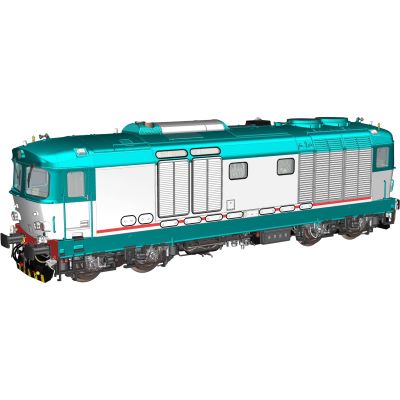
FS in Model Form: Modern Diesel Power in Italian Livery
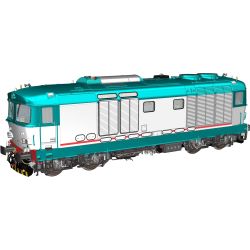
The PIKO 22028 H0 diesel locomotive D.445 XMPR is an ideal model for modern Italian branch lines and non-electrified main lines. The D.445 is suitable for passenger trains, regional trains and freight trains. Thanks to its XMPR colour scheme, it immediately looks typically Italian and is excellent for Era VI scenes with modern station equipment, colour-light signals and international coaches and wagons.
What Does FS Mean on a Model Railway?
On model railway items, FS refers to the Italian state railway Ferrovie dello Stato or Ferrovie dello Stato Italiane. Depending on the era, the models can look very different. In early eras, steam locomotives, brown freight wagons, classic passenger coaches and historic lettering dominate. In Eras III and IV, grigio-ardesia passenger coaches, brown freight wagons, powerful electric locomotives and diesel locomotives are central. Eras V and VI show modern XMPR livery, Trenitalia references, international high-speed trains, container traffic and current freight wagons.
For a coherent FS layout, the choice of era is especially important. A historic passenger coach from Eras II–III fits steam locomotive and post-war scenes. A D.445 in XMPR livery, by contrast, clearly belongs to modern periods. An ETR 610 stands for international long-distance traffic and modern high-speed operation. Freight wagons such as telescopic hood wagons, sliding-roof wagons, stake wagons, tank wagons or Eaos wagons can be integrated very well into mixed European freight trains.
Typical FS Vehicles in Model Form
Typical FS models include Italian steam locomotives such as Gr. 685 or Gr. 460, diesel locomotives such as D.445, UIC-X passenger coaches, historic passenger coaches, modern multiple units such as the ETR 610 and numerous freight wagons. Wagons for steel, mineral oil, bulk goods and general cargo traffic are especially important. Italian FS trains can also be combined very well with DB, ÖBB, SBB, SNCF or international coaches and wagons, because many prototypes ran in cross-border traffic.
Typical FS Eras
- Eras II–III: historic passenger coaches, steam locomotives, early post-war trains, brown freight wagons and classic stations.
- Era IV: grigio-ardesia passenger coaches, UIC-X coaches, Tms and telescopic hood wagons, international traffic and powerful electric locomotives.
- Era V: modernisation, new colour schemes, Eaos wagons, stake wagons, international freight trains and the transition to Trenitalia.
- Era VI: XMPR livery, modern multiple units, ETR 610, D.445 in current appearance and international long-distance traffic.
Important Selection Tip
FS looks especially believable when vehicles, landscape and type of operation fit together. An Italian branch line with D.445 needs different coaches, wagons and buildings from a modern long-distance corridor with ETR 610. A historic freight yard with tank wagons and covered wagons should be designed differently from a modern main line with steel wagons and container trains.
FS in All Major Gauges
Z Gauge – FS as a Specialist Theme in 1:220 Scale
Z gauge is a specialist theme for FS. The range is smaller than in H0 or N, but the scale is well suited to long routes, mountain railways and compact Italian layouts. Italian motifs with tunnels, bridges, coastal sections and long passenger trains can be represented very effectively in Z gauge on limited space.
Anyone planning FS in Z gauge can use international coaches and wagons, European passenger trains and scenic design to create Italian flair. Basic products for this small scale can be found in the Märklin section. FS specialist models are not very common in Z, but as a complement for international layouts, Alpine routes and Southern European motifs, the gauge remains interesting.
N Gauge – Long FS Trains in Limited Space
N gauge in 1:160 scale is particularly attractive for FS because Italian express trains, international long-distance trains and freight trains often need to appear long. In N, generous routes, hidden yards, long platforms and multi-part multiple units can be represented much more space-efficiently than in H0. This makes N gauge very suitable for layouts with Alpine crossings, northern Italy, international passenger traffic or modern main lines.
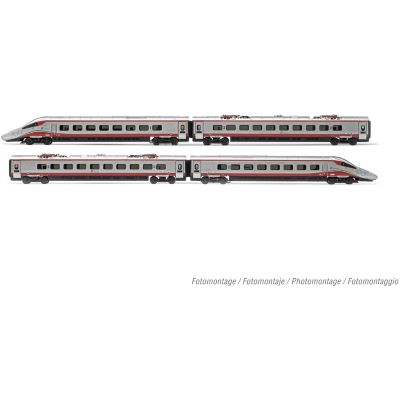
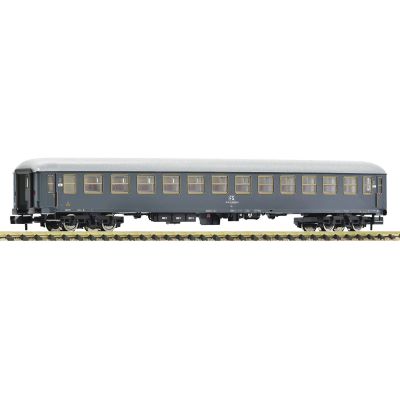
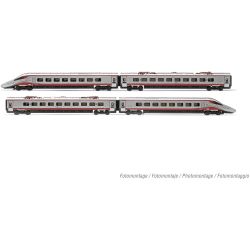
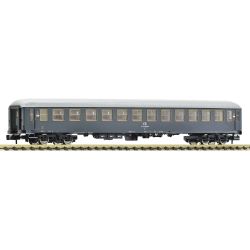
A strong N gauge model is the Arnold HN2577 N four-piece multiple unit set ETR 610 “ECE Milano – Frankfurt”, FS, Era VI. This train is perfect for modern international connections. For Era IV, the Fleischmann 863962 N UIC-X 2nd class passenger coach, FS, Era IV and the matching Fleischmann 863961 N UIC-X 2nd class passenger coach, FS, Era IV are suitable. For freight traffic, the Fleischmann 6660002 N flat wagon with stakes Rgmms, FS, Era V and the Arnold HN6573 N two-piece set of covered freight wagons Gs, FS, Era III are very suitable.
Why N Gauge Fits FS Well
FS layouts benefit from long trains in N gauge. An ETR 610, an express train with UIC-X coaches or a freight train with flat wagons and covered wagons looks longer and more realistic. International routes to Germany, Austria or Switzerland can be represented especially well in N gauge.
TT Gauge – FS as an International Complementary Theme
TT gauge in 1:120 scale is more of a specialist and complementary theme for FS. The range is smaller than in H0 or N, but TT can be interesting for international freight trains, European wagon movements and southern layout motifs. The scale offers a good mix of detail and space saving. Anyone who already owns a TT layout with a DR, DB, ÖBB or ČD theme can use FS wagons as an international complement.
TT scenes with transit traffic, harbour sidings or goods yards are particularly sensible. Italian wagons can run in mixed European trains, for example with German, Austrian, Czech or Swiss vehicles. This creates believable international freight traffic without requiring the whole layout to be exclusively Italian.
H0 Gauge – the Most Important FS Gauge in 1:87 Scale
H0 is the central gauge for FS fans who value a wide selection and visible detail. In 1:87 scale, Italian locomotives, coaches and wagons are shown especially well. Roof equipment, vents, bogies, lettering, pantographs, handrails and colour separations are clearly visible. H0 is suitable for Italian branch lines, main lines, stations, freight facilities, industrial sidings and museum trains.
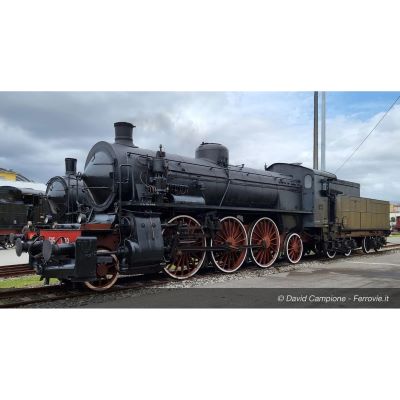
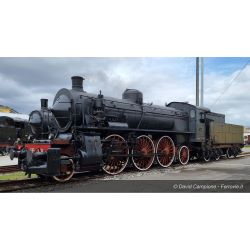
For modern diesel routes, the PIKO 22028 H0 diesel locomotive D.445 XMPR, FS, Era VI, DC sound is a very suitable model. For historic and museum scenes, the Rivarossi HR2916 H0 steam locomotive Gr. 685, 2nd series, FS, Eras V–VI is a good choice. For older passenger trains, the Roco 6200094 H0 passenger coach Cz, 3rd class, FS, Eras II–III provides a fitting addition.
Historic FS Motifs in H0
The Gr. 685 is an ideal eye-catcher for museum trains, special services and Italian nostalgic scenes. Combined with historic passenger coaches, station buildings, a water crane, small platforms and Mediterranean scenery, it creates a very atmospheric H0 layout.
H0 Freight Traffic of the FS
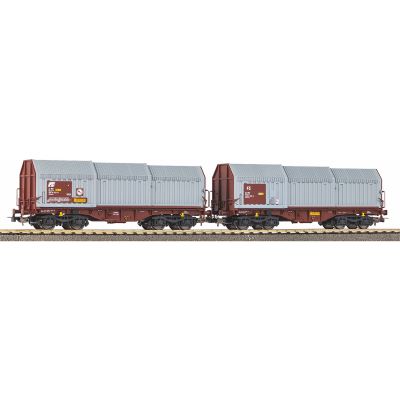
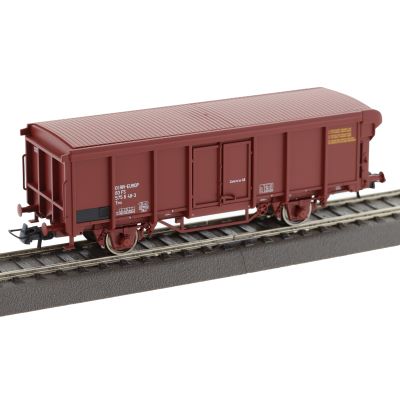
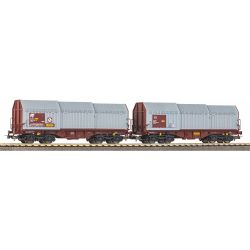
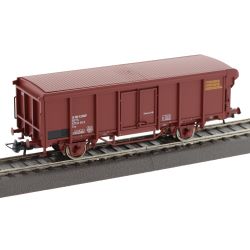
FS freight traffic is especially versatile in model form. Steel, bulk goods, mineral oil, general cargo and ordinary wagonload traffic can be represented with different wagon types. The PIKO 58794 H0 tank wagon “ESSO”, FS, Era IV fits mineral oil traffic and industrial sidings. The PIKO 58295 H0 two-piece set of telescopic hood wagons, FS, Era IV is suitable for steel and coil traffic. The Roco 6600082 H0 two-piece set of Tms sliding-roof wagons, FS, Era IV brings classic covered bulk or weather-protected transport to the layout. The PIKO 58492 H0 high-sided wagon Eaos, FS, Era V is a good wagon for mixed freight trains.
H0e and H0m – Narrow Gauge as a Complement
In model form, FS is mainly a standard-gauge theme. H0e and H0m are therefore not classic core gauges for FS. Nevertheless, narrow gauge can be very attractive as a complement, for example as a local museum railway, industrial railway, harbour railway or branch line beside an Italian standard-gauge route. Italian narrow-gauge and local railway motifs can be freely interpreted with suitable rolling stock and Mediterranean scenery.
Anyone who wants to integrate narrow gauge will find suitable basics under narrow-gauge railways. A small transfer station where standard-gauge freight wagons and narrow-gauge operating points meet looks especially attractive.
0 Gauge – FS with Strong Detail Impact
0 gauge in 1:45 scale is a special collector and shunting theme for FS. The range is smaller than in H0, but individual wagons look very present due to their size. Doors, buffers, axle boxes, lettering and side walls are clearly visible. For short freight trains, shunting modules and display cases, 0 gauge is very attractive.
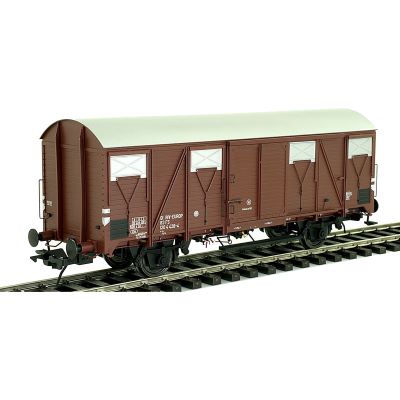
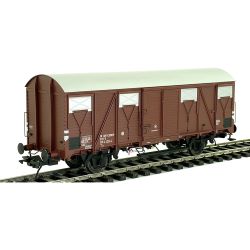
A suitable example is the Lenz 42246-08 0 gauge K4 freight wagon, FS, Era IV. Such wagons are suitable for international freight trains, small stations, goods sheds and high-quality collections. A matching K4 freight wagon in Era III lettering can also be used for historic European freight motifs.
FS in 0 Gauge
0 gauge is ideal when a few vehicles are intended to create a strong impression. An FS freight wagon, a loading track, a small warehouse and Mediterranean details are already enough to create Italian freight traffic atmosphere in a large scale.
Gauge 1 and G Gauge – FS as a Specialist and Large-Scale Theme
Gauge 1 and G gauge are more specialist areas for FS. The range is significantly smaller than in H0 or N, but the impact of large models is enormous. An Italian locomotive, freight wagon or passenger coach in Gauge 1 can convince as a high-quality collector model. In G gauge, free Mediterranean garden railway motifs can be created: harbour, coast, vineyards, tunnels and bridges fit very well with Italian scenery.
Anyone who prefers large gauges will find suitable basics under garden railway. FS specialist models are rarer there, but international freight wagons and free Italian motifs can be a very attractive complement.
Suitable FS Models at Modellbahnshop
Which FS Trains Fit Together?
Modern Regional and Branch-Line Train
A modern FS train with D.445 fits very well on non-electrified routes. The locomotive can haul short passenger trains, regional coaches or mixed freight trains. Suitable layout motifs include small stations, a loading track, a tunnel, Mediterranean scenery and bright buildings. The XMPR livery combines the classic diesel locomotive prototype with a modern Era VI appearance.
International Long-Distance Traffic with ETR 610
The ETR 610 is suitable for modern international main lines. Such a train runs believably between Italy, Switzerland and Germany. On a layout, overhead lines, long platforms, modern signals, tunnel portals and larger radii fit well with it. In N gauge, the multiple unit can be used very effectively on compact surfaces without appearing too short.
Historic or Museum FS Train
The Gr. 685 is suitable for museum trains and historic scenes. Combined with older passenger coaches, small stations and classic equipment, it creates a nostalgic Italian layout. Special services on modern layouts are also possible: a historic steam locomotive can haul an excursion train while modern vehicles operate on the main line.
Typical FS Train Formations
- D.445 XMPR with short regional coaches or a mixed freight train.
- ETR 610 as the international express train “Milano – Frankfurt”.
- Gr. 685 with historic passenger coaches for special and museum train operation.
- FS UIC-X coaches as a classic Era IV passenger train.
- Telescopic hood wagons and sliding-roof wagons for steel and industrial traffic.
- “ESSO” tank wagon with further freight wagons for mineral oil traffic.
- 0 gauge K4 freight wagon as an international shunting or collector wagon.
Designing an FS Layout
An FS layout lives from its Italian surroundings. Bright buildings, terracotta roofs, cypresses, rocks, walls, tunnels, small platforms, overhead lines and Mediterranean colours immediately create a fitting image. Anyone representing northern Italy can include Alpine foothills, bridges, tunnels and international trains. Anyone who prefers central or southern Italy can work with dry vegetation, small stations, warm colours and rural branch lines.
Freight traffic is also very important. Italian freight wagons can run in international trains and fit steelworks, harbour facilities, mineral oil depots, scrap yards, building materials dealers or industrial sidings. FS wagons can be combined particularly well with DB, ÖBB, SBB or SNCF wagons. This makes a layout feel lively and European.
Italian Station
An Italian station can be designed with a bright station building, long platforms, platform canopies, a loading track and overhead lines. UIC-X coaches and classic freight wagons fit Era IV, while modern multiple units and XMPR vehicles fit Era VI.
FS Freight Yard
A freight yard with FS wagons offers plenty of operation. Telescopic hood wagons bring steel, sliding-roof wagons protect sensitive cargo, tank wagons deliver mineral oil, and Eaos wagons transport scrap or bulk goods. Just a few tracks are enough for varied shunting.
Coast, Mountains and Tunnel Route
FS fits perfectly with routes that have scenic impact. A coastal line with tunnel portals, a mountain railway with bridges or a northern Italian main line with overhead equipment are ideal motifs. In N gauge, long routes can look especially generous, while H0 shows more vehicle detail.
Gauge Comparison for FS Models
| Gauge | Scale | Strength for FS Layouts | Typical FS Themes |
|---|---|---|---|
| Z | 1:220 | Very space-saving, FS as a specialist theme | Coastal routes, Alpine crossings, international trains |
| N | 1:160 | Long passenger and freight trains in limited space | ETR 610, UIC-X coaches, flat wagons, covered freight wagons |
| TT | 1:120 | International complementary theme | Transit traffic, mixed freight trains, European wagon movements |
| H0 | 1:87 | Largest selection and best detail effect | D.445, Gr. 685, tank wagons, telescopic hood wagons, sliding-roof wagons |
| H0e / H0m | 1:87 narrow gauge | Complementary theme | Local railway, harbour railway, museum railway, industrial siding |
| 0 | 1:45 | Strong detail impact | K4 freight wagon, shunting modules, collector wagons, goods shed |
| 1 | 1:32 | Premium and specialist scale | Individual models, display cases, large Italian locomotive and wagon models |
| G | approx. 1:22.5 to 1:29 | Free large-scale and garden railway theme | Mediterranean garden railway, harbour, coast, international freight trains |
Frequently Asked Questions about FS Models
What does FS mean in model railways?
FS stands for Ferrovie dello Stato, the Italian State Railways. In the model railway sector, FS refers to Italian locomotives, multiple units, passenger coaches and freight wagons from different eras.
Which gauge is best for FS?
H0 offers the largest selection and the best detail effect. N is excellent for long international trains and modern multiple units such as the ETR 610. 0 gauge is interesting for large freight wagons and collector models. TT, Z, Gauge 1 and G are more specialist areas.
Which FS era is especially popular?
Era IV with classic UIC-X coaches and freight wagons, Era V with international freight traffic and Era VI with XMPR vehicles, D.445 and modern multiple units are popular. Fans of historic steam locomotives often choose museum and special train themes.
Which FS locomotives are typical?
Typical examples include steam locomotives such as Gr. 685 or Gr. 460, diesel locomotives such as D.445 and modern multiple units such as ETR 610. Depending on the era, numerous Italian electric locomotives and international train services can also be added.
Which coaches and wagons fit an FS layout?
UIC-X passenger coaches, historic passenger coaches, telescopic hood wagons, sliding-roof wagons, tank wagons, Eaos wagons, stake wagons, covered freight wagons and international passenger or freight vehicles fit FS layouts.
Can FS be combined with DB, ÖBB or SBB?
Yes, FS is very suitable for international layouts. Passenger trains and freight trains ran and still run across borders. Routes over the Alps, international express trains and mixed freight trains with wagons from different railway administrations are especially believable.
Is FS more of a passenger or freight train theme?
Both are possible. FS offers elegant passenger trains, modern multiple units, regional traffic and many freight wagons. A layout becomes especially versatile when passenger traffic, a freight yard and international wagon movements are combined.
How do I design a realistic FS layout?
A realistic FS layout is created through suitable vehicles, Italian buildings, overhead line equipment, warm landscape colours, tunnels, bridges, cypresses, walls and believable train formations. A clear era and a distinct layout motif are important.
Conclusion: FS Brings Italian Railway Atmosphere to the Model Railway
FS is a particularly versatile and atmospheric model railway theme. Ferrovie dello Stato combines historic steam locomotive tradition, classic passenger coaches, modern diesel locomotives, international multiple units and varied freight traffic. This makes FS suitable for very different layouts: Mediterranean branch line, northern Italian main line, international long-distance traffic, freight yard, industrial siding or museum train.
In H0, details and Italian vehicle shapes are shown especially well. N is ideal for long passenger trains, ETR 610 and international express trains in limited space. 0 gauge creates strong visual impact with only a few wagons. TT, Z, Gauge 1 and G remain specialist areas, but can be very attractive for international additions, collections or free Italian motifs.
Anyone planning an FS layout should first define gauge, era and type of operation. Locomotives, coaches, wagons, tracks, buildings and accessories can then be selected in a targeted way. Whether D.445 in XMPR livery, ETR 610 “Milano – Frankfurt”, Gr. 685 as a museum steam locomotive or FS freight wagons in international traffic – the Italian State Railways bring Southern European model railway variety and unmistakable flair to every layout.