Shunting Board on a Shelf or Sideboard
Two to four tracks are sufficient for wagon delivery, locomotive run-around movements and changing shunting tasks.

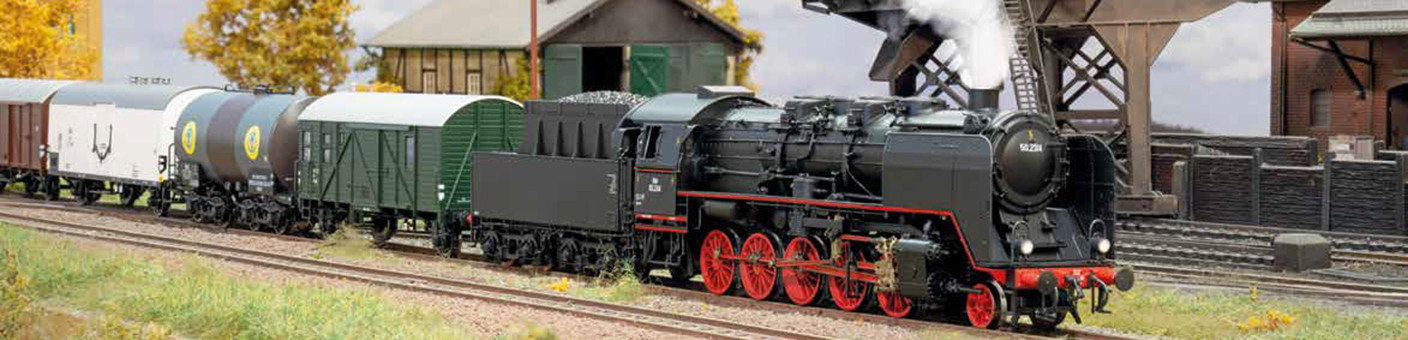
A convincing model railway does not require a large room. A clear operating concept, the appropriate gauge, realistic train lengths and a few carefully selected turnouts create varied railway operation on a shelf, table, segment or portable base.
The most important step is not automatically selecting the smallest possible gauge. A suitable operating concept with a few well-used tracks is more important.
A compact model railway can represent a branch line, terminus, industrial siding, tramway, harbour railway or pure shunting layout. These themes do not require a long continuous route, but still provide varied train and shunting movements.
Modellers who want to watch trains travel over longer routes frequently choose N gauge or Z gauge . For clearly visible vehicles with moderate space requirements, TT gauge provides a useful compromise.
H0 requires larger radii, but it works extremely well as a narrow shunting, shelf or sectional layout. One station track, a run-around loop and an industrial siding can already support a complete operating sequence.
Do not measure only the free floor area. Shelves, cupboard tops, wall sections, alcoves and the area below a bed can also be used. A transportable sectional layout can be stored safely after use.
Two to four tracks are sufficient for wagon delivery, locomotive run-around movements and changing shunting tasks.
A small station, one siding and short trains create believable operation within a manageable area.
Several lightweight sections can be connected for operation and stored separately afterwards.
The finder combines the available area, preferred type of operation, desired model size, train length and intended method of assembly.
Not every small layout requires a closed circuit. Narrow, transportable and modular forms often use the available room more effectively.
A narrow point-to-point route is suitable for a station, industrial siding or tramway.
A few turnouts and short tracks create changing delivery, sorting and locomotive run-around tasks.
Individual landscape sections are built, connected and stored separately.
A lightweight, shallow layout can be folded upwards or stored inside a cupboard after operation.
A low structure can be moved below a bed, table or sloping roof.
Z and N gauges in particular permit a complete circuit within a compact transportable form.
Smaller nominal sizes reduce the required radius and train length. Larger scales work best in limited space when used for shunting and point-to-point concepts.
| Gauge and Variants | Typical Scale | Suitable Small Layout | Particular Strength | Important Considerations |
|---|---|---|---|---|
| Z and Zm | 1:220 | Case, table or display-cabinet layout | Maximum space saving | Delicate handling, good lighting and track maintenance |
| N and Variants | 1:160 | Compact circuit or branch line | Longer trains within a small area | Accessibility and clean track |
| TT and Variants | 1:120 | Branch line, shelf or sectional layout | Good visibility with moderate space requirements | Check the track system and vehicle range |
| H0 and Variants | 1:87 | Shunting board, terminus or industrial siding | Large selection and easy handling | Avoid excessively long vehicles and tight curves |
| 00 and S | Approximately 1:76 and 1:64 | Short shunting or branch-line layout | Clearly visible models | Country- and manufacturer-specific standards |
| 0 and Variants | Usually 1:45 | Narrow shunting or shelf layout | Large details and intensive operation | Vehicle length and a stable supporting structure |
| 1 and G | 1:32 and 1:22.5 | Short presentation or shunting track | Very strong visual impact | Weight, radius and storage |
The track plan must accommodate the longest intended combination of locomotive and rolling stock. Every turnout should have a clearly defined operational purpose.
Short branch-line trains, railcars, shunting locomotives and freight wagons appear more convincing in a confined area than long express trains.
A train consisting of a locomotive and two to four vehicles can already support timetable, shunting and industrial operations. A terminus requires a main track, a run-around loop and, optionally, a freight siding.
An industrial connection may require only two or three turnouts. Established concepts such as an Inglenook or Timesaver are useful for a pure shunting layout.
Avoid unnecessary reverse curves immediately after turnouts. Include a safe distance from the layout edge and use larger visible radii than the technical minimum wherever possible.
Each step reduces unnecessary space requirements and prevents later rebuilding.
Include walls, shelves, alcoves and the intended storage area.
Choose continuous running, branch-line operation or shunting.
Compare model size, curve radius and achievable train length.
Measure the locomotive, vehicles, couplings and a safety margin.
Retain only turnouts that have a clear operational purpose.
Test every route with the locomotives and vehicles to be used.
Consider transportation, folding mechanisms and protected storage.
Use a backdrop, low-relief buildings and staggered scenery.
Technical and visual planning mistakes are especially noticeable when every centimetre of the layout is visible and important.
The scenery disappears and the usable track lengths become too short.
Excessive overhang and tight curves look unrealistic and can reduce operational reliability.
A siding or industrial connection frequently creates more varied operation.
Mobile sections require dry, protected and clearly planned storage.
The technical minimum radius is not always visually or operationally suitable.
Rear tracks and scenery remain difficult to reach and maintain.
An open fiddle yard requires less technology, height and maintenance access.
A backdrop significantly increases the perceived depth of a narrow layout.
The examples cover Z, N and TT gauges. Product cards do not make any statement about current availability. The base area, minimum radius and package contents on the individual product page remain decisive.
Both nominal sizes permit complete circuits within manageable table and shelf areas.
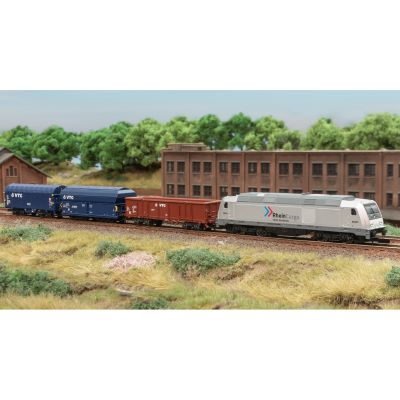
Modern diesel locomotive, three freight wagons, track oval, controller, power supply and rerailer.
Open Product Details →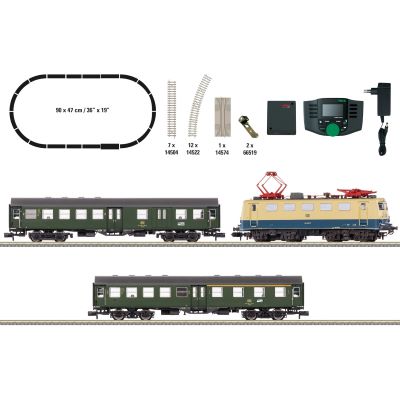
Digital train, Mobile Station and a track oval requiring a base area of approximately 90 × 47 centimetres.
Open Product Details →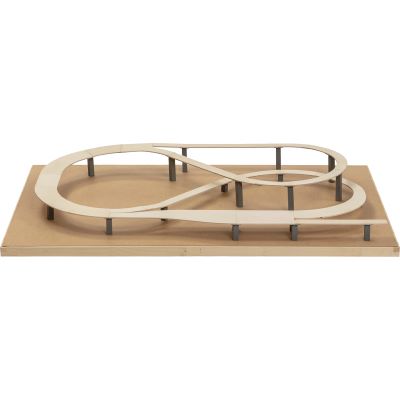
Preplanned N-gauge route kit with a passing loop and siding within a compact base area.
Open Product Details →TT provides larger and more visible models than N while requiring considerably less space than many comparable H0 projects.
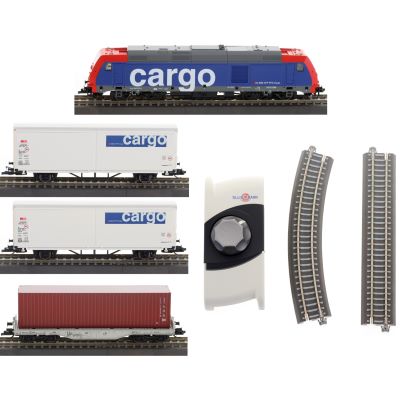
Locomotive, three freight wagons, controller, rerailer, uncoupling tool and TT roadbed-track oval.
Open Product Details →
Select prepared terrain, route kits and portable projects according to gauge and available base area.
Open the Category →These answers cover gauge selection, track plans, layout forms, train lengths, digital control and protected storage.
Z and N gauges permit complete circuits within particularly small areas. TT provides a balanced middle ground. H0 is especially suitable for shunting and sectional layouts when space is limited.
A shunting board can fit on a narrow shelf. For a closed circuit, the required area depends on the selected track system and the curve radii being used.
No. A terminus, industrial siding or shunting layout often provides more varied operation on a narrow area than a tightly curved circuit.
N gauge permits longer trains and more route length. TT offers larger and more visible vehicles while still requiring less room than H0.
Yes. A narrow H0 shelf layout is suitable for a terminus, shunting operation, an industrial siding or a tramway. A continuous circuit is not required.
Short branch-line, railcar and freight formations appear believable. The station and sidings must accommodate the longest intended train completely.
A fiddle yard is an open, usually unscenicked area where trains are assembled, exchanged or stored. On a small layout it often replaces a technically complex hidden yard.
Background scenes, low-relief buildings, angled roads, concealed layout ends and different terrain heights create visual depth.
Yes, especially when several locomotives should move independently on shunting and storage tracks. Analogue operation is also sufficient for a single train.
Sections should be kept dry, protected from dust and preferably upright or in suitable shelving. Vehicles should be removed before the layout is transported.
A small station, industrial siding, urban edge or branch-line halt requires less space than a major station. A few completely finished scenes appear calmer and more convincing.
A turnout with a siding or industrial connection usually expands operation more effectively than another locomotive without an additional route.
Explore gauges, track systems, radii, layout planning, digital technology and scenery in the central model railway guide.
Editorially reviewed and updated on 30 July 2026. The base area, minimum radius, package contents and technical information on the individual product page remain decisive.