Modellbahn Keks
Welcome!
Our cookies offer you a fast, relaxed and full-featured shopping experience. Some are necessary to operate the website and its functions. Others help us to improve our services. If you agree to this, simply consent to the use of cookies for preferences, statistics and marketing by clicking on "OK". Alternatively, you can deactivate individual cookies under "Customise cookies" or all cookies, except those required for the function of our website, under "Reject all".
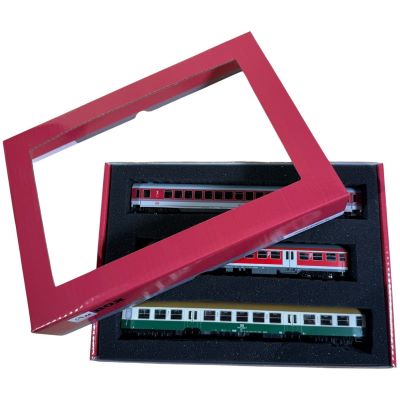
Clear Roco presentation box protecting an H0 model railway vehicle during storage and display
Protection begins before the models are put away

Store Model Railways Correctly | Protect Vehicles & Layout

Protect locomotives, coaches, wagons, accessories and complete layouts from dust, moisture, direct sunlight and mechanical damage. This guide explains suitable storage conditions, boxes, showcases and long-term storage routines from Z gauge to garden railways.

Protection begins before storage

How Should a Model Railway Be Stored Correctly?

Sensitive models should not be left unprotected in a basement cardboard box, on a sunny windowsill or stacked loosely in a drawer. Model locomotives and rolling stock have delicate handrails, pantographs, couplings, buffers, pipes, separately fitted details, printed surfaces and, in many cases, sensitive electronics.

Good storage protects these details as well as wheels, gears, running gear and bodies. The ideal location is dry, clean and subject to as little temperature fluctuation as possible.

Direct sunlight should be avoided because intensive UV exposure and heat can affect paintwork, plastics and printing over time. Permanently damp basements, severe temperature fluctuations and locations immediately beside radiators are also unsuitable.

Even robust garden railway vehicles should be brought into a dry, protected location when they will not be used for an extended period.

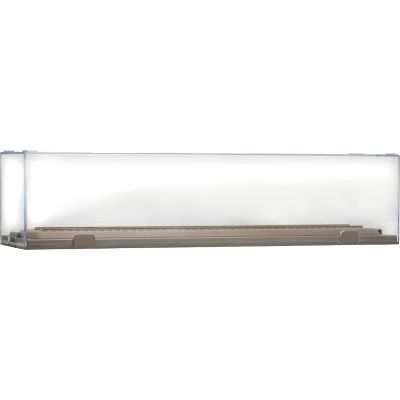
Individual collector models can be stored and displayed in showcases, presentation boxes and collector cases . Larger vehicle collections can be organised systematically in original packaging or padded storage boxes. Compact layouts can benefit from model railway cases, while permanent layouts primarily need effective dust protection.

Seven points for safe storage

Protect Model Railways from Dust, Moisture and Damage

1

Store Models in a Dry and Clean Environment

Select the Room
Avoid Moisture and Condensation

A hobby room, living area or dry storage room is generally more suitable than a damp basement. Models should not be repeatedly exposed to condensation, high humidity or abrupt climatic changes.

2

Avoid Direct Sunlight

Check the Location
Be Careful with Window Positions

A showcase protects against dust but does not automatically protect against sunlight. Collector models should therefore not remain in strong direct sunlight. Painted surfaces, plastics and fine printing particularly benefit from a protected location.

3

Cushion Models Without Applying Pressure

Mechanical Protection
Keep Delicate Parts Free

Foam and shaped inserts should hold the model safely without compressing pantographs, handrails, antennas, mirrors or couplings. The vehicle should neither slide around loosely nor remain under permanent mechanical tension.

4

Keep the Original Packaging

Organisation and Identification
Document the Article Number

Original packaging is often designed specifically for a particular vehicle. Keep inserts, accessory bags, instructions and additional couplings together. Article number, class and running number make later identification considerably easier.

5

Reduce Dust Consistently

Showcase or Cover
Less Cleaning Work

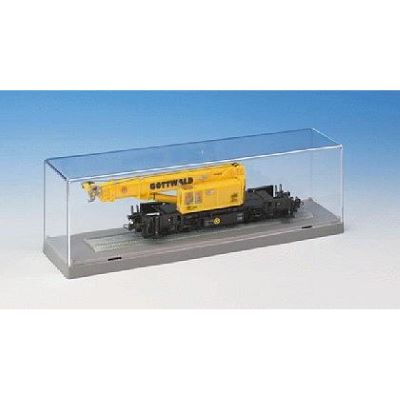
Vehicles left standing openly collect dust on roofs, running gear and in fine recesses. Closed presentation boxes and showcases considerably reduce this exposure and are therefore especially practical for collector models that remain visible.

6

Disconnect Electrical Equipment

Longer Operating Breaks
Do Not Leave Power Supplies Connected Permanently

When a layout will not be used for an extended period, controllers, digital command stations and power supplies should be switched off and disconnected in accordance with their manufacturer's instructions. Cables, plugs and accessories should be labelled and stored in a dry location.

7

Document the Collection

Organise the Inventory
Find Every Model Quickly

A simple list containing manufacturer, article number, gauge, railway company, running number and storage location can save a great deal of time. For larger collections, each box or shelf compartment can additionally receive its own unique number.

Different models require different protection

Store Locomotives, Wagons and Accessories Correctly

Locomotives

Store locomotives in correctly fitting original packaging or padded boxes whenever possible. Pay particular attention to pantographs, roof equipment, handrails and side-mounted details. Remove loose dirt before a long storage period.

Maintenance with oil or grease should never follow the principle that more is better. Lubricate only where and when the manufacturer specifies it.

For further maintenance information, use the model railway maintenance and repair guide .

Passenger Coaches & Freight Wagons

Long vehicles require sufficiently large boxes so that buffers and close-coupling mechanisms are not under continuous load. Scale-length H0 passenger coaches require more internal length than short freight wagons.

Larger storage systems such as Au-BOX solutions are particularly useful when many vehicles need to be organised consistently.

Multiple Units & Train Sets

Multi-part ICE, regional or narrow-gauge multiple units should be labelled in the correct sequence. Intermediate coaches, end units, current-conducting couplings and special connecting parts should be stored together as one clearly identified set.

Model Cars & Figures

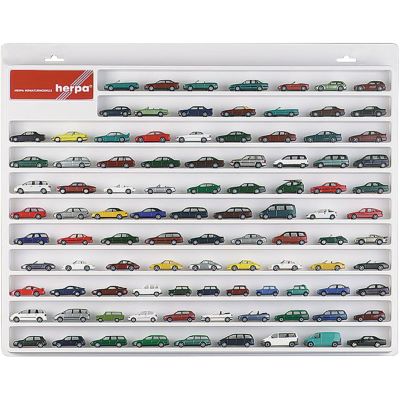
Small road vehicles can be organised effectively in shallow showcases or presentation boxes. Mirrors, antennas and fine attachments must not press against the cover.

Figures and other small parts can be stored in compartment boxes and labelled according to theme, scale or project.

Buildings & Scenery

Do not lift removable buildings by delicate gutters, antennas or chimneys. Trees and overhead-line masts require sufficient clearance above them.

For layout sections and modules, stable protective frames are often more suitable than tightly fitted plastic film.

Track & Electronics

Store unused track clean and dry. Label turnout motors, decoders, feedback modules and cables clearly. Rail joiners, screws and other loose small components belong in separate containers rather than between vehicles.

Compare storage solutions

Original Packaging, Storage Box or Showcase?

Solution Especially Suitable For Strength What to Check
Original Packaging Locomotives, coaches, wagons and multiple units Usually designed specifically for the vehicle Keep inserts, accessory parts and documentation complete.
Padded Collection Box Larger vehicle collections Consistent and space-efficient storage system The insert must not apply pressure to delicate attachments.
Presentation Box Individual models Dust protection while keeping the model visible Check the internal length, width and vehicle height.
Wall Showcase Collections and complete train formations Many models remain visible and clearly organised Secure the showcase correctly and avoid direct sunlight.
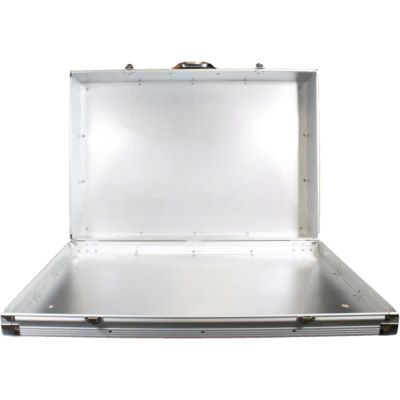
Model Railway Case Small layouts and transportable projects The complete layout remains protected together Plan sufficient internal height and secure fixation.

Showcases Combine Storage and Presentation

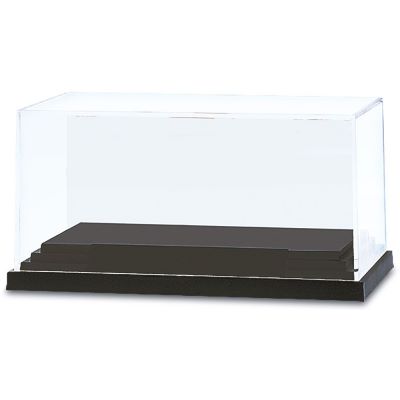
Presentation boxes, collector showcases, wall-mounted cases, transparent storage boxes and foam inserts are available for individual vehicles as well as larger collections.

View Showcases
From Z gauge to garden railways

How Much Storage Space Does Each Gauge Require?

The larger the scale, the more important stable shelving, sufficiently deep boxes and free height above the model become. The actual vehicle length also matters: a long multiple unit requires a different storage solution from a short shunting locomotive.

Gauge Typical Storage Special Consideration Guide
Z / Zm Compact boxes, showcases and model railway cases Very space-efficient but particularly delicate Z Gauge
N / Nm / Ne / Nf Original boxes and compact collection systems Protect small roof and running-gear details N Gauge
TT / TTm / TTe / TTf Shelf boxes, original packaging and showcases Good compromise between required space and handling size TT Gauge
H0 / H0e / H0m / H0f Very large selection of boxes and showcases Check internal length carefully for long passenger coaches H0 Gauge
0 / 0e Large individual boxes and stable shelving Considerably more weight and volume Gauge 0
1 Large showcases and robust individual packaging Allow for tall models and long vehicles Gauge 1
G / IIm Dry indoor room, large shelves or transport boxes Do not leave garden railway vehicles permanently unprotected outdoors G Gauge
Before an extended operating break

Store a Model Railway for Several Months or Years

1

Inspect the Collection

Preparation
Document Damage Before Storage

Check vehicles for missing buffers, loose separately fitted parts and damaged couplings. A component that is already loose can otherwise disappear unnoticed inside the packaging.

Photographs are particularly useful for larger collections and simplify identification later.

2

Clean Carefully

Maintenance
Do Not Pack Dust Away with the Model

Remove dust from bodies using a suitable soft tool and service heavily contaminated vehicles before storage. Wheels, current collectors and visible running-gear areas should also be inspected.

Suitable maintenance products can be found under oils, greases and cleaners .

3

Secure Accessory Parts

Packing
Keep Small Parts with the Correct Model

Uninstalled couplings, brake hoses, snow ploughs and other accessory parts should remain clearly labelled with their corresponding vehicle.

Small bags should not be placed loosely in large collection boxes.

4

Label Every Box Clearly

Organisation
Record Manufacturer and Article Number

External labels prevent unnecessary opening of storage boxes. For larger collections, a combination of shelf number, box number and digital inventory list is particularly effective.

5

Check the Storage Location

Room Conditions
Avoid Critical Basements and Attics

Check whether the room becomes excessively hot in summer or damp in winter. A dry and reasonably stable room climate is more important than whether the room happens to be called a basement, attic or storage room.

For larger projects, see the Model Railway in an Attic or Basement guide .

6

Plan the Return to Operation Carefully

After Storage
Inspect First, Then Run

After a long period of storage, do not immediately run vehicles at high speed. Check wheels, current collection and the visible mechanism first and then carry out a gentle test run.

Older collections can be assessed systematically with the Returning toing-to-model-railways/lp/ Model Railways guide .

Garden Railways in Winter: Store Vehicles Under Cover

Even robust G-gauge vehicles should be kept dry and protected from persistent rain, frost, dirt and intense sunlight during long periods of non-use. Depending on the track system, the rails may remain outdoors, but protected indoor storage is the safer long-term solution for vehicles and electronics.

Storage solutions at Modellbahnshop

Manufacturers for Boxes, Showcases and Model Railway Cases

Explore manufacturers offering presentation boxes, storage systems, showcases and transport solutions for model railway vehicles and collector models.

From individual models to compact layouts

Products for Safe Storage and Presentation

The appropriate storage product depends on model size and intended use. The following examples cover padded storage, individual presentation boxes, collector showcases, wall displays and complete model railway cases.

Directly from the current shop category

Filter Current Showcases and Storage Products

The English Showcases category contains the current Modellbahnshop range of presentation boxes, collector showcases, wall cases, storage boxes, foam inserts and specialised display solutions. Use the shop filters for manufacturer, gauge, price and availability.

Available Shop Filters

  • Manufacturer: Auhagen, Busch, FALLER, Herpa, Kibri, LGB, Märklin and Roco
  • Gauge: Gauge 1, universal, G, H0 and Z
  • Product type: presentation boxes, collector showcases, wall displays, storage boxes and accessories
  • Availability: use the current shop filter for the latest stock information

Open the Current Showcases Category

Product availability and prices change over time. The English category page therefore remains the authoritative destination for the current product range.

Open Current Storage Products
Frequently asked questions about storage

FAQ: Safe and Long-Term Model Railway Storage

What Is the Best Way to Store Model Railway Locomotives?

A correctly fitting original box, a well-padded model railway storage box or a closed presentation case is ideal. The vehicle should remain dry and protected from dust without placing pressure on pantographs, handrails or couplings.

Can Model Railways Be Stored in a Basement?

A dry basement with reasonably stable temperatures can be suitable. Permanently high humidity, condensation and severe temperature fluctuations are problematic. Check the actual room climate and do not store cardboard boxes directly on a potentially damp floor.

Is an Attic Suitable for Model Railway Models?

Only when temperature and humidity remain sufficiently stable. Unconverted attic spaces can become extremely hot in summer and very cold in winter. A more stable indoor environment is generally preferable for valuable vehicles.

Should Locomotives Be Stored in Their Original Packaging?

Original packaging is often a very good solution because its insert was designed for the particular model. Make sure accessory parts are correctly positioned and delicate components do not catch on the insert when the vehicle is packed.

Can Foam Damage Models During Long-Term Storage?

Use clean inserts intended for model railway storage and inspect older packaging periodically. Foam should not crumble, become sticky or place permanent pressure on sensitive painted surfaces.

How Can a Model Railway Be Protected from Dust?

Vehicles can be protected in closed showcases and boxes. A permanent layout can be covered with a sufficiently high, non-contact cover. The cover must not place pressure on trees, catenary, signals or buildings.

Can a Model Railway Showcase Stand in Direct Sunlight?

Strong direct sunlight should be avoided. A transparent showcase prevents dust but does not automatically provide complete protection from light or heat.

How Should G-Gauge Garden Railway Vehicles Be Stored in Winter?

During longer operating breaks, locomotives and wagons should be stored dry and protected from persistent rain, frost, dirt and intense sunlight even when the railway system itself is designed for robust outdoor use.

How Should a Complete Small Model Railway Layout Be Stored?

Case, sectional and compact layouts should be constructed so no scenery element is loaded during storage. A closed model railway case can provide transport protection and dust protection at the same time, especially for compact Z- and N-gauge projects.

What Should Be Done First After Several Years in Storage?

Begin with a visual inspection and cleaning. Check wheels, current collectors, moving parts and track. Then carry out a slow test run. A locomotive that has been stored for many years should not immediately be operated at full speed without inspection.

Well-Stored Models Are Ready for Operation More Quickly

Clean vehicles, suitable packaging, a dry storage location and an organised inventory protect the collection and simplify later maintenance, presentation and recommissioning.

Open the Main Guide

Content reviewed: 9 August 2026