A small village market
Two or three different stalls, a tree and a few neighbours create a peaceful focal point. A vegetable stall fits particularly well in a rural setting with a farm shop.

Market day in your miniature world
Fresh vegetables beneath a striped awning, flowers by the fountain and a conversation beside the fruit stall: a weekly market on your model railway turns an empty space into a place full of everyday life. With suitable stalls and accessories, shopping figures and a carefully planned square, you can create a scene that invites exploration even when no trains are running.
Selling goods and telling stories
A weekly market is a regular event at which different traders offer their goods. In a miniature setting, the temporary stalls are particularly interesting: they distinguish the market from a permanent shopping street. Baskets, crates, parasols and portable sales tables suggest that the square can serve other purposes outside market day.
The scene works in an old town, on a village square or beside a station. What matters is how the stalls work together, rather than how many there are. Sales counters face the customer routes, traders need space to work, and goods need somewhere to arrive. A recognisable arrangement makes the scene easy to understand.
Two or three different stalls, a tree and a few neighbours create a peaceful focal point. A vegetable stall fits particularly well in a rural setting with a farm shop.
Shop fronts frame several stalls. Different awnings, a fountain and small groups of visitors divide up the square without filling every gap.
A small market brings travellers and local residents together. Keep the station entrance clear and arrange the stalls around a separate pedestrian area.
Start by drawing buildings, roads and stall positions on paper. Cut out the footprints of your chosen models and move them around the layout. Allow room for customers in front of the displays, working space behind the stalls and vehicle access at the edge. A quick trial arrangement with figures helps you judge whether the layout makes sense.
A central aisle or a loose arrangement around a fountain provides a useful starting point. The stalls do not all have to line up perfectly. Small offsets create interesting viewing angles. Delivery vans should stay clear of dense groups of visitors unless you are specifically depicting the early morning setup.
For a worked example, assume a stall is three metres wide and two metres deep. These dimensions are a planning aid, rather than a universal standard for market stalls.
At 1:87, this gives approximately 34.5 × 23 millimetres; at 1:160, approximately 18.8 × 12.5 millimetres. Customer areas, roof overhangs and transport crates require additional space beyond the stall itself.
Always check the actual product dimensions. An overhanging parasol or an open sales side may require more room than the stall's base suggests.
For paving, footpaths and road connections, explore the categories Roads and paved areas and Building sheets, walls and films .
A varied weekly market does not need every imaginable type of product. You could start with vegetables, flowers and a food stall. Different roof colours and stall shapes help each one stand out. Similar counter heights also help the models look consistent in scale.
Filled crates and baskets add splashes of colour. Group produce by type and leave an area clear for weighing or payment.
Flowers create an eye-catching feature at the entrance to the square. Pots and bouquets of different heights add variety to otherwise fairly flat displays.
A different range of goods opens up new scenes. Waiting customers, a menu or a sales sign make the differences between stalls visible.
Specific options include the FALLER 180614 Flower and Cheese Stall , AUHAGEN 11352 Snack and Market Stalls and the NOCH Tiny-Scenes Fish Stall . Check what is included: a figure set, a fully decorated stall and a building kit each serve different purposes.
Kits, small scenes and market visitors
The following selection illustrates different approaches: a larger kit, a small sales scene, additional accessories and suitable figures. The product cards use images from the shop and are checked against their respective product pages.
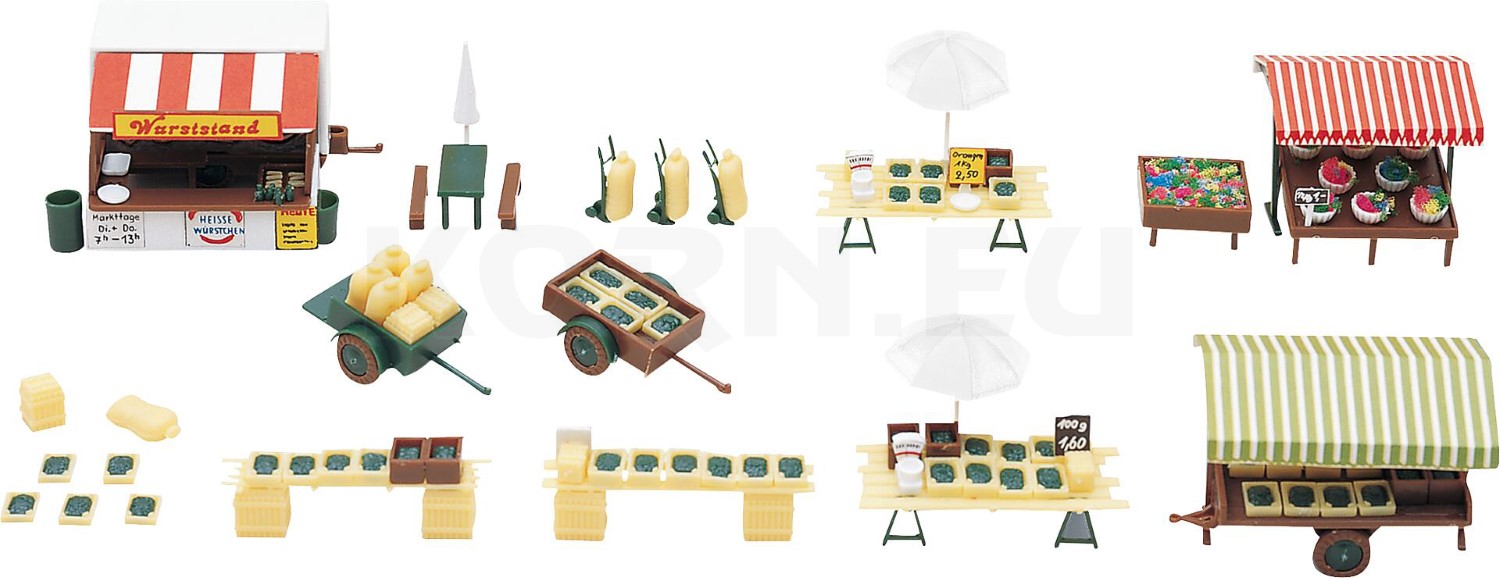
Sales stalls and accessories as the starting point for your own market.
View product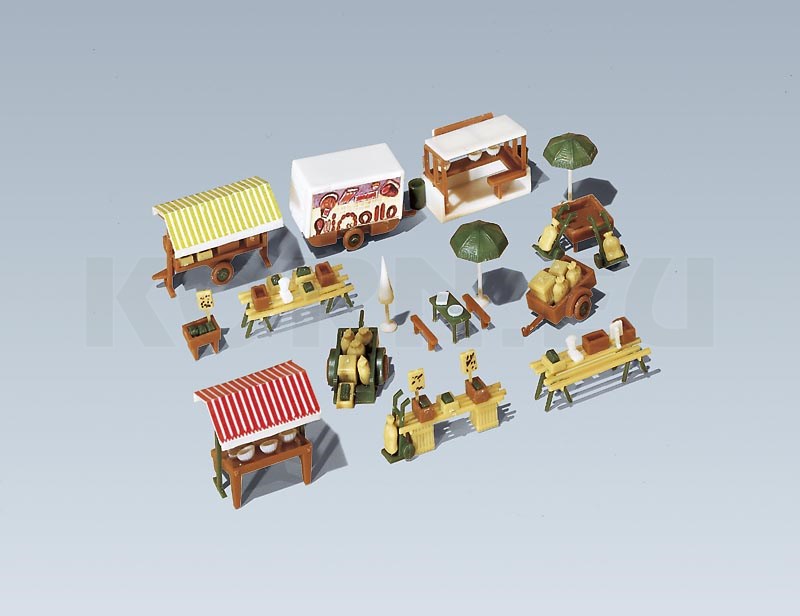
A dedicated market kit for compact N scale.
View product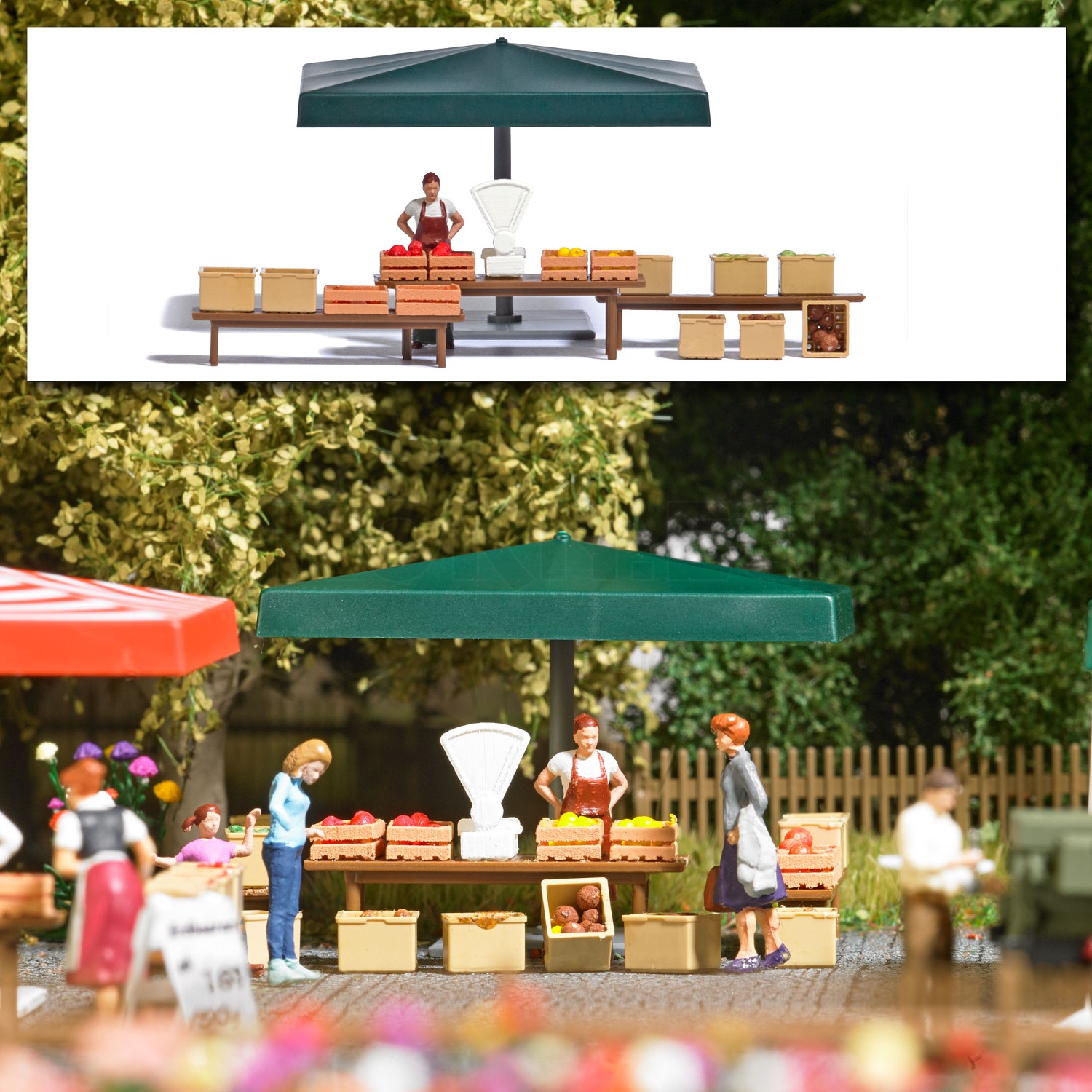
A market stall with a female vendor and small scenic details.
View product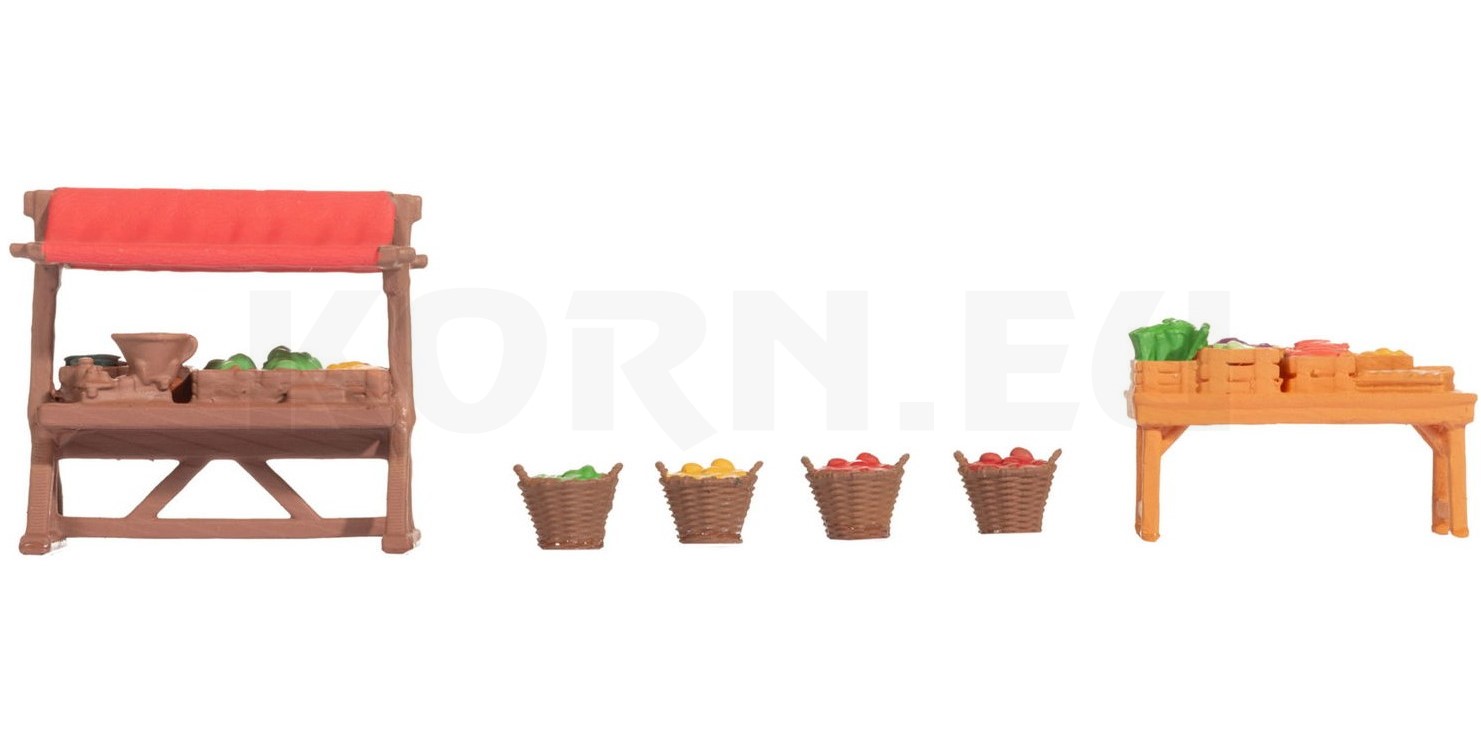
A market stall, sales table and vegetable baskets add detail to the scene.
View product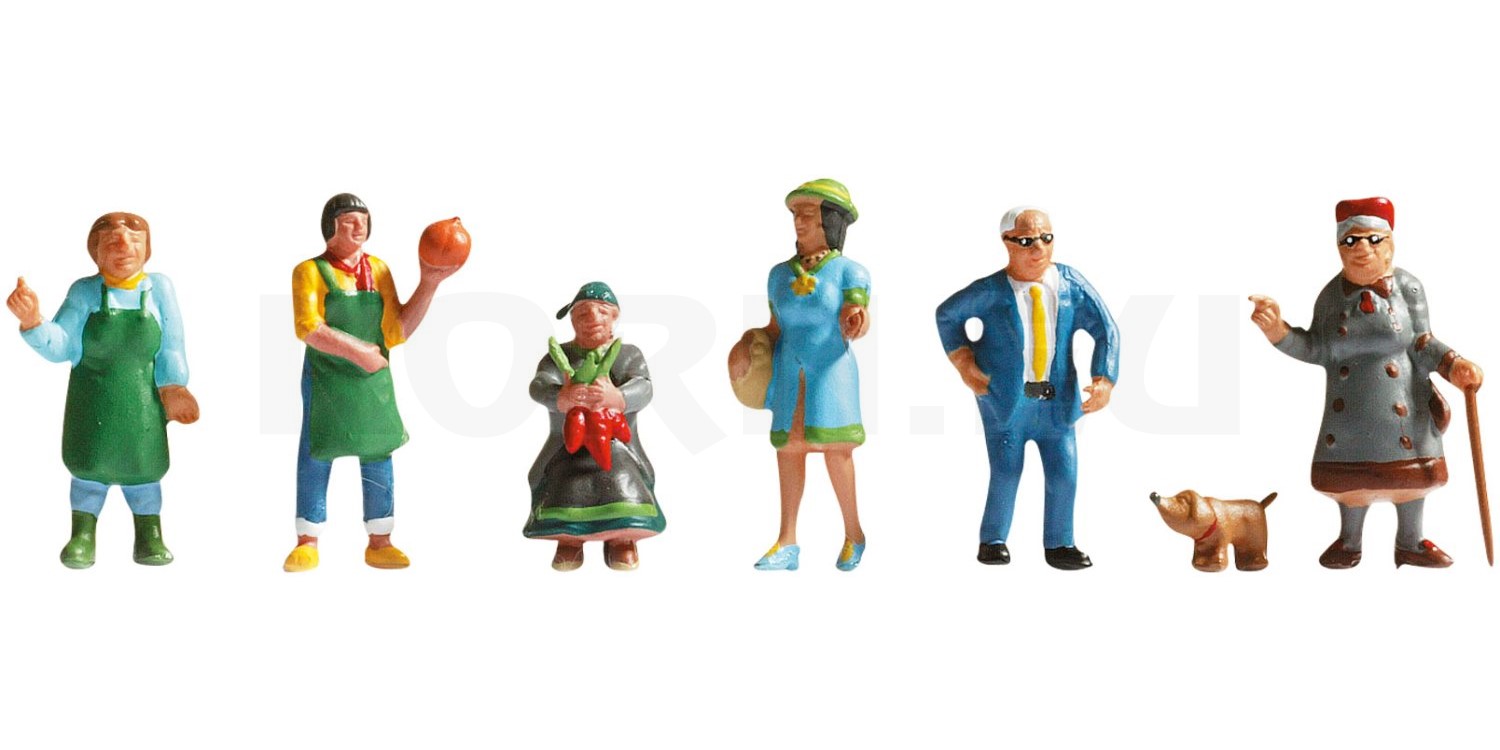
People give your sales stalls a clear purpose.
View product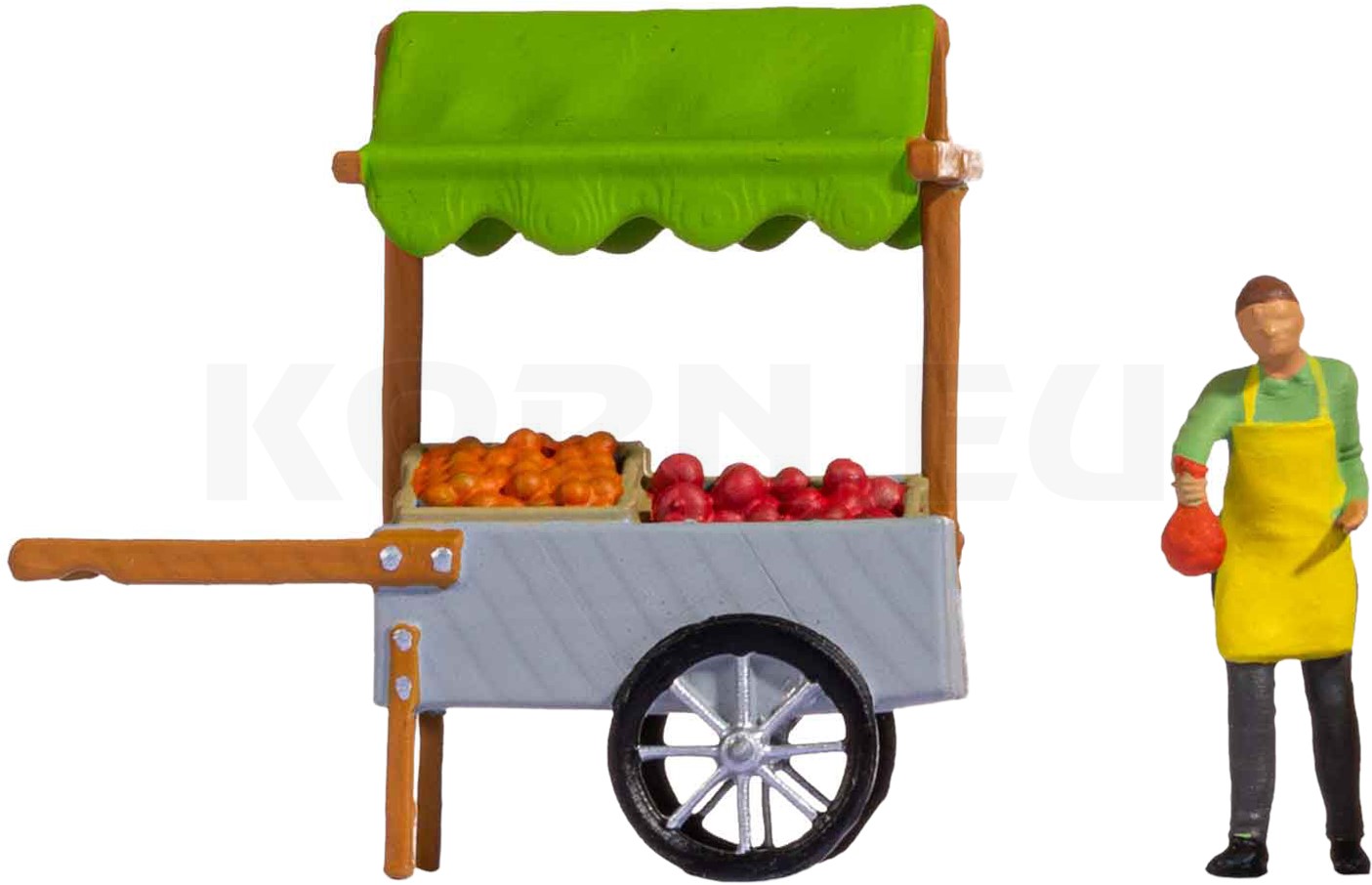
A small sales scene for a market lane or village square.
View productPosition model railway figures according to what they are doing, rather than in a regular grid. A seller looks towards the customers; a shopper stands in front of the display. Two passers-by can chat at the edge while a family is already leaving the market.
A small group might wait at a popular stall, while other stalls remain quieter. This variation in density brings the market square to life. Bags, baskets and a pushchair support the activities being depicted. When using ready-made scenes, check whether figures are already included before adding more people.
PREISER item 10056 At the Market combines market stalls and a parasol. Find more everyday characters among the leisure figures . Clothing and carried items should suit your chosen period.
Empty crates, a handcart or packaging materials can sit behind the stalls. A delivery vehicle at the edge of the square explains how the goods arrived. Choose a vehicle style and lettering that suit the trader: a modern van does not automatically belong in a historical market scene.
Bicycles, benches and litter bins are more appropriate near entrances and resting areas. The scenic accessories category offers additions for these everyday settings. Use only a few signs of clutter: a crate left nearby tells a story, while an overcrowded lane hides the models you want to show.
For buildings, figures and market stalls, model scale matters rather than track gauge. H0e, H0m and H0f layouts can therefore use H0 market accessories. The market products linked here are mainly for H0 and N; for other scales, choose suitable additions or scratch-built models individually.
| Designation | Scale | Modelling focus |
|---|---|---|
| Z | 1:220 | Clear stall shapes and a few carefully placed colour accents. |
| N / Nm | 1:160 | Complete square scenes with suitable N scale figures. |
| TT / TTe / TTm | 1:120 | Compare stall heights, figures and accessories explicitly suitable for H0/TT. |
| H0 / H0e / H0m / H0f | 1:87 | Combine market stalls, goods and visitors in the same scale. |
| 0 / 0e | Usually 1:45 here | Check the manufacturer's scale; give individual goods and signs careful attention. |
| 1 | 1:32 | Detailed individual stalls with visible interior fittings. |
| II / IIm / G | Often 1:22.5; G varies | Check the specific scale; use suitable materials for outdoor layouts. |
The same principle applies to other scales, such as 00 or S. A large parasol does not turn an H0 stall into a suitable large-scale model. Doors, working heights and human proportions remain the most useful points of comparison.
For a market day in an earlier period, simple sales tables, baskets, handcarts and period-appropriate figures can establish the character. Modern markets can feature sales trailers, current vehicles and contemporary signs. A manufacturer's era classification for a kit is a useful guide, but it does not replace comparison with your real-world reference.
The goods also suggest the time of year. Flowers can define a spring market, while fruit and vegetables take centre stage in summer. Pumpkins and autumn colours give a harvest market a different character. Avoid emphasising too many seasonal themes at once if you want one particular season to remain recognisable.
A market feels part of its surroundings when facades and paths explain its location. Combine shops and commercial buildings with residential buildings or a café. Place taller facades towards the back to keep parasols and displays visible. Where depth is limited, low-relief buildings can complete the background.
Paving joints and subtle colour variations prevent the surface from looking sterile. Allow slight differences in tone beneath parasols, along walking routes and beside drainage channels. A few street lamps and model lights are enough to begin creating an evening atmosphere. Plan cable holes before installation and follow the connection instructions supplied with each light.
Prepare a level base and mark out buildings, stall positions and paths. Then lay or model the surface. Check the effect with temporarily positioned models before attaching delicate details.
Paint kit parts before assembly wherever they will be difficult to reach later. Carefully remove moulding flash and use an adhesive suitable for the material. Test paints and glue on offcuts. Look beneath parasols and stall roofs too, because these areas are often visible from the viewer's position.
Next come the stalls, larger accessories and figures. Use adhesive sparingly on small elements. Photograph the arrangement at the model figures' eye level: hidden displays, narrow passages and mismatched proportions become easier to spot. A removable market section makes later changes and cleaning easier.
For an individual market stall, combine wooden strips, card or suitable plastic profiles. The guide to scratch-building model buildings provides a useful starting point for your own designs.
Too many stalls: Keep connected areas of open space visible. Figures facing the wrong way: Customers belong in front of the displays, traders behind them. Hidden models: Large parasols and trees should not conceal all the interesting details.
Mismatched sizes: Compare people, counters and vehicles directly alongside one another. Uniform colours: Vary individual goods and signs of wear instead of artificially dirtying the entire scene. Missing access routes: Every visible path should lead somewhere that makes sense.
Stalls · People · Goods · Surroundings
The finder loads suitable products from several shop categories. Search by name or item number, then narrow the loaded results by product group, manufacturer and scale. More models and category pages linked by the shop can be loaded in stages.
The product search starts when you reach this section.
The featured market products come from several brands. Combine them according to subject, scale and the contents you need, rather than the manufacturer's name alone. The brand pages help you find additional stalls, people and details for your own market project.
Choose a few different stalls, suitable traders and customers, and a finished ground surface. A logical arrangement matters more than a large number of models. Extra goods, vehicles and lighting can follow later.
That depends on your chosen kits and their arrangement. Add customer routes, working areas and roof overhangs to the stall dimensions. A paper trial layout is more reliable than a blanket estimate of the space required.
Yes. The FALLER 272533 linked here is a weekly market kit for N scale. Add suitable figures and paved areas in 1:160 scale.
Not as a general rule. Some items are explicitly offered for H0/TT. Even then, check the visible proportions. Figures, doors and sales counters should match the actual model scale.
No. Kits, accessory packs and small scenic sets differ in their contents. The relevant product description is what matters, rather than the decorated promotional photograph alone.
Delivery vans, sales trailers and, where appropriate, handcarts can complement the scene. Choose their period, lettering and size to suit the trader, era and layout.
The filters apply to products that have already been loaded. Load more shop pages to see further items. An empty results list does not mean that the full range contains no suitable additions.
Build the scene on a removable section and use suitable reversible fixings. This lets you change traders, stalls or the season without rebuilding the whole square.
Start with a clear idea and a few models that work well together. Different goods, believable encounters and clear paths give the weekly market its character. Find further advice on buildings, scenery, figures and layout construction in the comprehensive model railway guide .
 FALLER
 NOCH
 BUSCH
 AUHAGEN
 PREISER