Our cookies offer you a fast, relaxed and full-featured shopping experience. Some are necessary to operate the website and its functions. Others help us to improve our services. If you agree to this, simply consent to the use of cookies for preferences, statistics and marketing by clicking on "OK". Alternatively, you can deactivate individual cookies under "Customise cookies" or all cookies, except those required for the function of our website, under "Reject all".
East German vehicle history · H0 and TT · Weimarwerk
Weimarlader T170, T172 and T174 – East German construction machinery in miniature
From coal merchants to railway maintenance depots: the loaders from the state-owned VEB Weimar-Werk tell the story of working life in East Germany. Discover the differences between the generations, suitable models in H0 and TT, and ideas for realistic loading and construction scenes on your model railway.
From railway vehicle production to the Weimarlader
The history of the industrial site dates back to 1898, when Waggonfabrik Weimar AG was founded in Weimar. After the Second World War and the resumption of railway vehicle production, manufacturing shifted towards agricultural machinery and lifting equipment in the 1950s. This development gave rise to a family of self-propelled loaders used particularly in agricultural and industrial operations. From 1964, the company was known as VEB Weimar-Werk.
The T170 was the starting point of the well-known loader family. The factory chronicle records the launch of the pre-production series in 1957. By 1959, the two thousandth vehicle had been completed. The chronicle records production of the T172 from 1962, its design drawing on experience with its predecessor. Production of the T174-1 began in 1967. The T174-2 variant, with additional stabilisers, was introduced in the mid-1970s; the chronicle gives 1975 as the start of series production.
1957 · T170
Pre-production series of the early general-purpose loader.
1962 · T172
Production of the further developed loader.
1967 / 1975 · T174
Start of T174-1 production, followed later by series production of the T174-2.
The vehicles were designed for a range of tasks. Depending on their attachments, they could lift loads or handle bulk materials; later generations also carried out excavation work. This versatility of attachments makes them particularly interesting for model making. A vehicle is more than a decorative object: it explains the work taking place at a station, on a farm or in a factory.
Explore the detailed industrial history in our Weimarwerk feature. It also provides context for agricultural machinery production and later vehicle developments.
T170, T172 and T174: recognising the differences
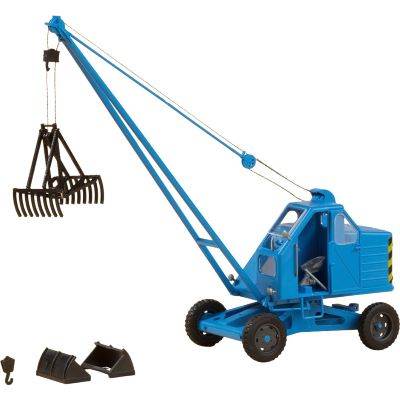
T170 – the early cable-operated loader
The T170 has a distinctive tubular boom and a cable mechanism for moving loads. This design is particularly suitable for hook and grab operations. In miniature, it can form the centre of a loading area: a lorry stands at the edge, a coal pile is waiting to be loaded, and the loader is positioned so that its grab can reach the working area depicted.
In H0, Auhagen reproduces the T170 in kit 41674, for example. According to the product description, the model measures 103 × 29 × 46 mm and can be fitted with various attachments. In TT, the grey 43683 depicts a coal merchant's loader. Its lettering is a good starting point for a small fuel depot.
T172 – further development for materials handling
The T172 introduced changes to the boom design and adjustment mechanism. Cable-operated lifting remained an essential feature, while boom adjustment was hydraulically assisted. Hooks and grabs make the loader an interesting model for many different tasks. Choose the variant according to the visible attachment and lettering, not just the type designation.
Our special TT model, Auhagen 99050 “Bahnmeisterei” (railway maintenance depot), is particularly interesting. Measuring 73 × 23 × 37 mm, the loader has a manually rotating upper structure. A small track maintenance yard with stored sleepers, materials wagons and tools makes a suitable setting. For agricultural scenes, Auhagen offers the 43692 T172 land improvement model. This kit allows different boom positions and attachments.
T174 and T174-2 – the wheeled excavator generation
With the T174, hydraulic working functions and an articulated boom became essential parts of the vehicle concept. With suitable equipment, the machines could operate both as cranes and as excavators. The later T174-2 can be identified, among other features, by its additional stabilisers. Hydraulic operation of the working equipment should not be confused with a fully hydraulic travel drive.
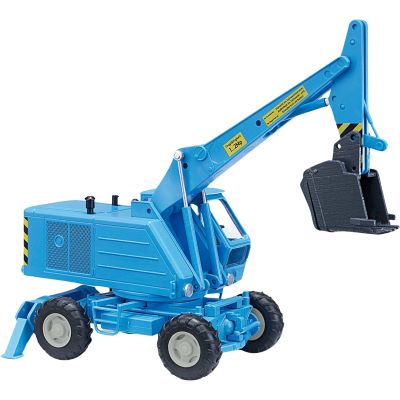
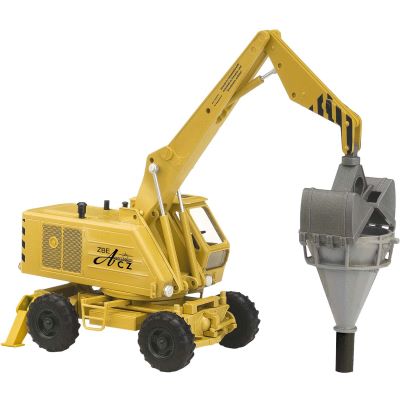
Busch offers the T174-2 in various liveries and with different attachments. Versions with a front shovel or backhoe bucket allow different types of earthmoving and loading work to be represented. The fertiliser hopper on Busch 42897 creates a distinct agricultural theme. Which parts are movable depends on the particular model.
T170: Auhagen 41674, MBS171209.T174-2 with front shovel, MBS184038.T174-2 with hopper, MBS177301.
Choosing the right era and colour
For a convincing East German scene, the period depicted is more important than including as many historic vehicles as possible. Early T170 and T172 loaders suit late Era III themes. In Era IV, older loaders and newer wheeled excavators can appear side by side. The T174-2 belongs to the period from the mid-1970s onwards, not to a layout set in 1965. Some machines remained in use after 1990 and, with appropriate lettering, suit early post-reunification scenes or historic collections.
Era III
T170, T172 and early T174-1: coal merchants, rural stations and small industrial businesses.
Era IV
T172 and T174-2: agricultural production cooperatives (LPGs), land improvement, construction combines, goods handling and works yards.
Era V and later
Older vehicles still in service, workshops, collections or historic demonstrations.
Blue, green, yellow, grey and orange are attractive model variants. Colours alone, however, do not establish that a machine belonged to a particular company. For a specific prototype, check photographs and lettering. For a freely designed diorama, a plausible combination of period, task and setting is sufficient. The guide to railway eras helps place the other vehicles in their historical context.
Discover manufacturers
Weimarlader models and accessories for historic working scenes
Auhagen and Busch are at the heart of the Weimarlader model selection. Discover suitable buildings, vehicles and accessories for your layout as well.
Six ideas for realistic Weimarlader scenes
A model looks more convincing when its surroundings explain why it is there. Decide on the work you want to depict first. Then choose buildings, attachments, loads, figures and other vehicles. The following examples are suggestions for a freely designed layout, not reconstructions of specific historical businesses.
Coal merchant at the station
An open goods wagon, a loading road, several coal storage bays and a T170 with a clamshell grab create a plausible materials-handling scene. A weighing scale, a small shed and a lorry complete the setting. Coal piles in different dark shades and dusty tyre tracks give the area texture.
Railway maintenance depot and track construction
A T172 with appropriate lettering stands beside stacks of sleepers and a materials store. Add a small equipment wagon, worker figures and a surfaced access road. Even beside a branch line, this makes an interesting railway maintenance scene in a small space.
Agriculture and LPGs
A farmyard with a machinery shed, trailers, tractors and a loader suits an agricultural business. Give the loader a recognisable task, such as working at a bulk materials store. Surfaces can look uneven and well used without filling every corner with accessories.
Agrochemical centre
A T174-2 with a fertiliser hopper provides a distinctive loading theme. A storage building, an agricultural trailer and suitable bulk material containers make the function clear. Choose the type of load according to the operation depicted and the lettering on the equipment.
Road construction and civil engineering
The T174-2 with a backhoe bucket is suitable for a small excavation. A pile of earth, barriers and a tipper lorry are enough to create a recognisable scene. The front shovel is better suited to loading and removing material from a raised working face.
Scrapyard or works yard
A wheeled excavator with a suitable grab, sorted metal parts and a workshop building create an industrial setting. On a stationary vehicle, a lowered boom and attachments set aside can suggest a break in the working day.
Another option is to transport the machine as a load on a suitable flat wagon. Check its length and width, including the tyres, the boom position and the actual loading surface. Load-securing details can complete the scene. For an operating train, also consider clearance, the ability to negotiate curves and secure attachment of the model.
Weimarlader in H0 and TT: from model to finished scene
In H0 at a scale of 1:87, small fittings, printed details and attachments are particularly easy to see. A T170 or T174 can therefore become the main feature even in a small works yard. In TT at 1:120, more space remains for the interaction of track, loading areas and roads. For Deutsche Reichsbahn layouts in particular, this scale is an attractive way to accommodate several working areas within a station.
Plan using the actual model dimensions rather than an assumed prototype length. The Auhagen 43683 T170 in TT measures 71 × 21 × 33 mm, while the T172 99050 measures approximately 73 × 23 × 37 mm. In addition to the footprint, allow room for the boom and the working area depicted. Test the arrangement with the lorry or wagon before permanently fixing roads and buildings in place.
Kit or ready-made model?
A kit allows you to adapt the boom position, accessories and details to your planned scene during assembly. Read the instructions in full, carefully remove delicate parts from the sprue and use an adhesive suitable for the material. Before gluing, check which joints are intended to remain movable. A ready-made model is particularly appealing if your focus is on layout construction rather than assembling the vehicle. Movable parts do not mean that a model is motorised.
Weathering and surroundings
Start with light, subtle weathering. Dust on the tyres and chassis, signs of use on the bucket and slightly dirty ground often look more convincing than lettering obscured by heavy weathering. Test paints on a spare piece of material first. Avoid glue and paint on joints that are intended to remain movable. Adapt the surroundings to the equipment: coal dust at a fuel depot, earth marks on a construction site and firm access roads in a works yard.
Practical tip: Start by building a small, removable loading scene. This allows you to change vehicles and attachments without damaging track or scenery. Our layout planning guide and the scenery guide provide further inspiration.
Find Weimarlader T170, T172 and T174 models at Modellbahnshop
Search the recorded model examples by manufacturer, MBS item number, manufacturer's item number, EAN, gauge and vehicle type. Additional suitable products can be added from the shop categories at the touch of a button. The selection covers part of the range, not a complete catalogue. The current information on the relevant product page is authoritative. Earlier model variants that are clearly no longer in the range are not displayed as products for purchase.
Frequently asked questions about Weimarlader models
What is a Weimarlader?
A Weimarlader is a vehicle from the Weimar-Werk family of loaders and wheeled excavators. Depending on the generation and equipment, it is used for lifting, grabbing, loading or excavating.
When were the T170 and T172 built?
The factory chronicle gives 1957 for the T170 pre-production series and 1962 for the start of T172 production. The T172 was therefore not the first loader in this family.
When was the T174-2 introduced?
The variant with additional stabilisers emerged in the mid-1970s. The factory chronicle gives 1975 as the start of series production, while contemporary technical literature describes construction from 1974.
Which gauges are particularly interesting?
The Auhagen and Busch models listed here are designed for H0 and TT. Check the specific model scale before buying.
Is the Modellbahnshop special edition motorised?
Auhagen 99050 is an accessory model with a manually rotating upper structure, not a self-propelled vehicle.
What is the difference between a front shovel and a backhoe bucket?
A backhoe bucket is particularly suitable for excavation below ground level, while a front shovel is used for removing and loading material in front of or above the machine's standing level. Position the model accordingly.
Can I load a Weimarlader onto a goods wagon?
Yes, provided the loading surface, dimensions and clearance of the model combination are suitable. Make sure the vehicle is in the correct transport position and secure it in place.
Why is the Modelltec model 14140220 missing from the product search?
The former H0 tracked coaling crane is a historical model example. Its product page is marked as no longer in the range. The search focuses on other documented model products.
Historical references: the chronicle “100 Jahre Industriestandort Weimar-Werk” (100 years of the Weimar-Werk industrial site) and Kautzleben/Kunzelmann, agrartechnik, issue 4/1981, p. 172 ff. Model specifications refer to the respective item number.
Choose the WhatsApp channels that suit you. If you model in several gauges, you can follow several WhatsApp channels.
Last seen
Product Search
searching ...
Es ist ein Fehler aufgetreten
loading ...
Cookie settings
Cookies are small piece of data sent from a website and stored on the user's computer by the user's web browser while the user is browsing. Your browser stores each message in a small file, called cookie. When you request another page from the server, your browser sends the cookie back to the server. Cookies were designed to be a reliable mechanism for websites to remember information or to record the user's browsing activity.
Necessary
More information
Technically required cookies ensure that you can view our website and navigate in our offers. Basic functions such as filling the shopping cart, login or the display and selection of products on our websites are not possible without them.
Preferences
More information
Cookies are used here to make your visit to our website as convenient as possible. Already confirmed information or personal settings will be saved during your next visit. Cookies also enable functions such as the display of recommendations or the creation and administration of wish lists. This applies to both registered users and guests without an account.
Marketing
More information
We store information about your user behavior on our website and use this data for individual offers and campaigns in the context of direct marketing and for more comfort when using our website. These cookies are used, for example, to present you with special offers on the website itself or in mailings. Furthermore, we want to make surfing on our website as attractive as possible for you. The responsibility and control for data processing lies with us.
Statistics
More information
We use cookies for statistical purposes in order to better understand your user behavior and to support you in your navigation on our offer pages. This also enables us to record your navigation on our offer pages and to use this information for the design of our services to meet your needs.




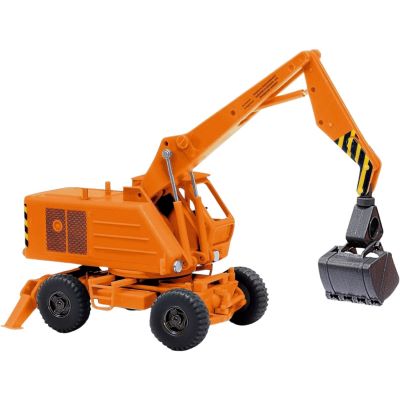 Busch 87403 TT T174-2 excavator, orange