Mountain Railways
Narrow routes can follow valleys, slopes and tight curves, making them ideal for scenery-focused mountain layouts.

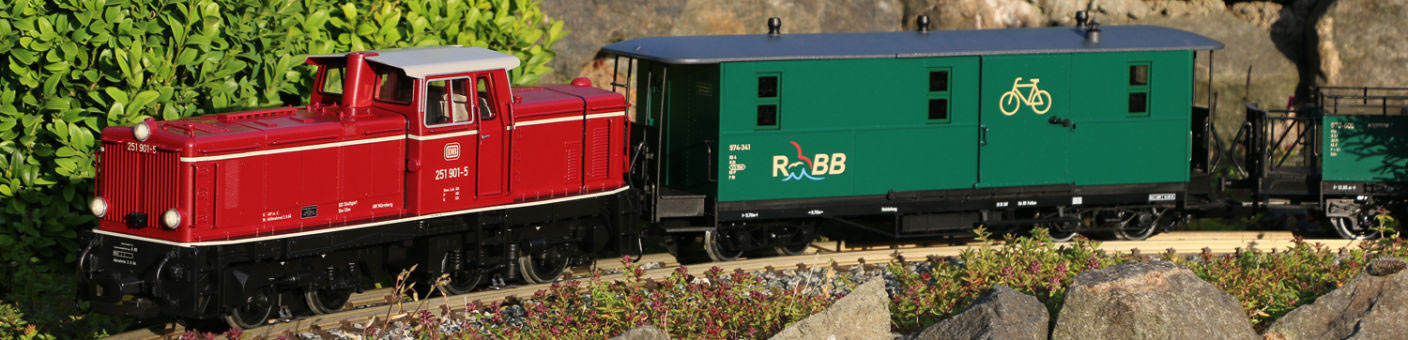
Discover the fascinating world of narrow-gauge railways: from Saxon 750 mm steam lines and metre-gauge mountain railways to compact industrial and field railways. Compare H0e, H0m and H0f, explore famous prototypes and find suitable models for historically convincing layouts.
Narrow-gauge railways use a track gauge smaller than the 1,435 mm standard gauge commonly used on main-line railways throughout Central Europe.
They were built particularly where economical railway construction was important – for example in mountainous regions, rural areas, industrial sites, mines, forests and agricultural operations.
A narrower formation can permit tighter curves, lighter infrastructure and routes that follow difficult terrain more closely. This made narrow-gauge railways especially useful where constructing a conventional standard-gauge railway would have been too expensive or technically demanding.
In Germany, narrow-gauge lines once formed an important part of many regional transport networks. Numerous routes were later closed, while others survived as public transport, tourist attractions or museum railways.
In the model railway world, narrow gauge remains popular because it combines short trains, compact operating locations, distinctive vehicles and scenery-focused railway construction.
The three particularly important variants at 1:87 scale are H0m , H0e and H0f .
Narrow routes can follow valleys, slopes and tight curves, making them ideal for scenery-focused mountain layouts.
Small stations, goods sheds and short passenger trains recreate regional transport away from the main lines.
Mines, quarries, brickworks and factories use small locomotives and specialised wagons for material transport.
Preserved steam and diesel trains make narrow gauge particularly attractive for modern museum-railway themes.
Germany used many different narrow-gauge systems. In 1:87 model form, the most important prototype groups are represented by H0f, H0e and H0m.
| Prototype Gauge | Typical Railway | Model System | Model Track Gauge |
|---|---|---|---|
| Approx. 400–<650 mm | Field, mine and industrial railways | H0f / H0i | 6.5 mm |
| Approx. 650–<850 mm | 750 and 760 mm narrow-gauge lines | H0e | 9 mm |
| Approx. 850–<1,250 mm | Metre-gauge regional and mountain railways | H0m | 12 mm |
The older version of this landing page associated the Harz Narrow-Gauge Railways with 785 mm and later listed them as 1,000 / 750 mm.
The current HSB network – including the Harzquerbahn, Selketalbahn and Brockenbahn – uses a 1,000 mm metre gauge. H0m on 12 mm model track is therefore the appropriate 1:87 model classification.
Compare scale, model track gauge, space requirements and typical railway themes before selecting a system.
Germany still offers numerous famous narrow-gauge railway themes. They range from Saxon 750 mm steam lines and the 1,000 mm Harz network to industrial railways with only 600 mm track gauge.
| Railway | Region / Route | Gauge | Suitable Model System |
|---|---|---|---|
| Fichtelberg Railway | Saxony · Cranzahl–Oberwiesenthal | 750 mm | H0e |
| Zittau Narrow-Gauge Railway | Saxony · Zittau–Oybin / Jonsdorf | 750 mm | H0e |
| Rügen Resort Railway – “Rasender Roland” | Rügen · Putbus–Binz–Sellin–Baabe–Göhren | 750 mm | H0e |
| Harz Narrow-Gauge Railways | Harz · Harzquerbahn, Selketalbahn & Brockenbahn | 1,000 mm | H0m |
| Preßnitz Valley Railway | Saxony · Steinbach–Jöhstadt | 750 mm | H0e |
| Jagst Valley Railway | Baden-Württemberg · Möckmühl–Dörzbach | 750 mm | H0e |
| Muskau Forest Railway | Saxony / Brandenburg border region · Bad Muskau | 600 mm | H0f |
| DEV Bruchhausen-Vilsen | Lower Saxony · Bruchhausen-Vilsen–Asendorf | 1,000 mm | H0m |
A clearly defined prototype makes model selection easier. Once gauge, railway company and era are known, locomotives, coaches, freight wagons, buildings, road vehicles and landscape details can all be coordinated around one railway world.
Classic railway eras can also be represented on narrow-gauge layouts. Vehicles, buildings and operating practices should be coordinated to create a convincing historical scene.
Early state and private railways, small steam locomotives, lightweight passenger coaches and simple station facilities.
State-railway traditions meet DRG operation, standardised numbering and increasingly unified vehicle fleets.
Steam, diesel railcars, freight traffic and intensive regional railway operation make this one of the most popular narrow-gauge periods.
Modernised vehicles, declining freight traffic, route closures and the transition toward tourist operation.
Museum railways, tourist steam services and modern metre-gauge trains can all be represented depending on the chosen prototype.
Water cranes, narrow-gauge stations, engine sheds, roll-wagon facilities, period road vehicles and suitable figures turn individual models into an authentic operating scene.
| Model System | Scale | Track Gauge | Main Application |
|---|---|---|---|
| H0e | 1:87 | 9 mm | 750 / 760 mm railways, especially Saxon and Austrian themes |
| H0m | 1:87 | 12 mm | Metre gauge, Harz and Swiss mountain railways |
| H0f | 1:87 | 6.5 mm | Field, mine and industrial railways |
| TTe / TTm | 1:120 | 6.5 / 9 mm depending on prototype group | Compact narrow-gauge railways in TT scale |
| Nm | 1:160 | 6.5 mm | Very compact metre-gauge layouts |
| Zm | 1:220 | 4.5 mm | Specialist miniature metre-gauge layouts |
| IIm / G | Often around 1:22.5 | 45 mm | Large-scale and garden narrow-gauge railways |
Different manufacturers specialise in different narrow-gauge themes. Bemo and Tillig cover extensive vehicle ranges, Busch provides a complete H0f field-railway system and Technomodell specialises in detailed Saxon narrow-gauge models.



| Manufacturer | Main Gauges | Current Focus |
|---|---|---|
| Bemo | H0m · H0e | RhB, MGB, MOB, Saxon narrow gauge, German and international metre-gauge railways |
| Tillig | H0e · H0m | DR narrow gauge, Harz railways, rolling stock and narrow-gauge track |
| Busch | H0f | Field railways, mine railways, tipper wagons, starter sets and H0f track |
| Technomodell | H0e · specialist narrow gauge | Saxon steam locomotives, passenger coaches, freight wagons, track and small-series models |
The following examples illustrate the different model systems. Each card uses a verified English Modellbahnshop product page and its fixed MBS product image.
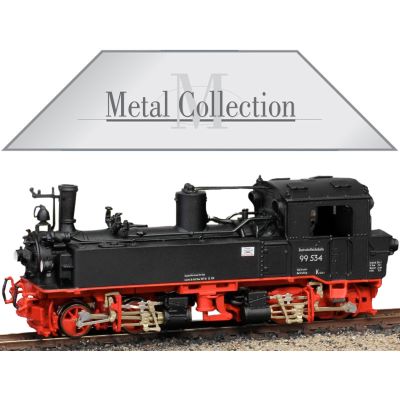
Detailed 750 mm narrow-gauge steam locomotive in 1:87 scale for classic Saxon railway themes.
View Product →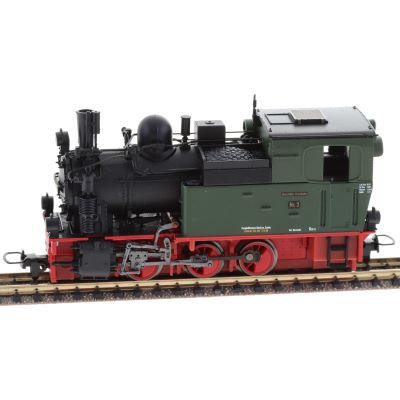
Compact H0e locomotive with 9 mm track gauge and digital interface for narrow-gauge layouts.
View Product →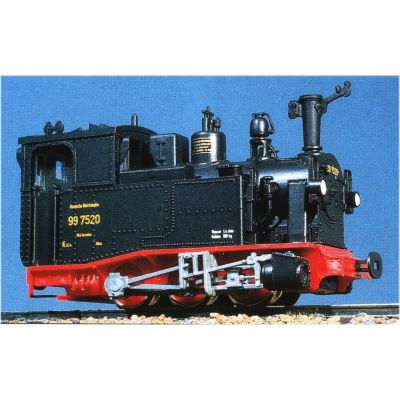
Fine H0e small-series locomotive for historical Saxon narrow-gauge railway operation.
View Product →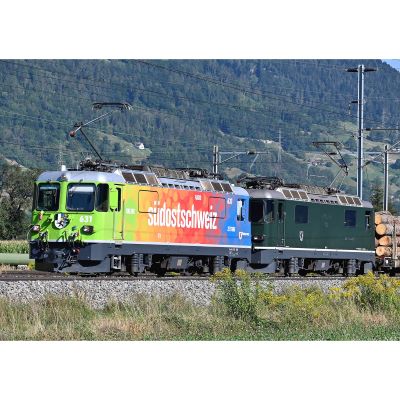
Modern metre-gauge electric locomotive for passenger and freight operation on an RhB-inspired H0m layout.
View Product →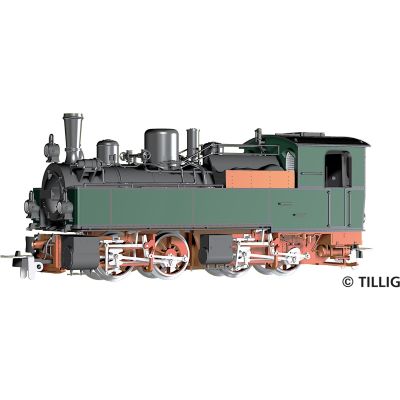
Metre-gauge steam locomotive for Harz railway, heritage and tourist-operation scenes.
View Product →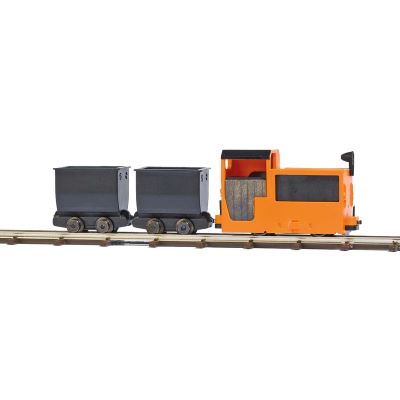
Complete compact field-railway introduction with mine locomotive, wagons, track and matching control equipment.
View Product →Use the current English shop categories to compare locomotives, passenger coaches, freight wagons, track and digital equipment by manufacturer and gauge.
Saxon steam locomotives, Harz railway models and historical narrow-gauge traction.
Regional, works, field and modern narrow-gauge diesel traction.
Electric mountain-railway locomotives, particularly for modern H0m themes.
Historic diesel railcars and modern regional narrow-gauge multiple units.
Historical, regional, panoramic and museum-railway coaches.
Tippers, transporter wagons, timber wagons and metre-gauge freight stock.
Flexible track, curves, turnouts and specialist narrow-gauge track systems.
Small stations, engine sheds, goods sheds and railway facilities for regional lines.
Narrow gauge is especially effective when the layout is built around a clear operating purpose rather than simply using the narrowest possible curves.
Decide whether the model represents a 600 mm field railway, a 750 mm Saxon line or a 1,000 mm metre-gauge railway.
Define the railway company and historical period before selecting locomotives, coaches and buildings.
A crossing station, goods shed, engine shed and one industrial siding already create varied railway operation.
Narrow track does not mean every locomotive or coach can use every tight curve. Follow the minimum radius stated for the exact vehicle.
Run complete trains in both directions over turnouts, reverse curves and gradients before fixing track permanently.
Passenger transport, timber, coal, clay, tourism or regional freight gives every train movement a believable reason.
Because H0, H0e, H0m and H0f all use a 1:87 vehicle scale, an interchange station can combine standard-gauge trains with narrow-gauge services in the same landscape.
Narrow-gauge railways form a fascinating chapter of German and European railway history.
Whether it is the Rasender Roland on Rügen, the nostalgic Zittau Narrow-Gauge Railway, steam operation in the Harz or a small field railway in the forest, these prototypes offer distinctive vehicles and highly scenery-oriented model railway themes.
For modellers with limited space but high expectations, H0e, H0m and H0f offer especially creative possibilities. Short trains, small stations and compact railway facilities leave plenty of room for landscape while still providing real passenger, freight and shunting operation.
Choose a prototype gauge and railway theme first, then build the model world around matching vehicles, track, buildings and scenery.
A narrow-gauge railway uses a track gauge smaller than standard gauge. In Central Europe, standard gauge is 1,435 mm.
All three use a scale of 1:87. H0m uses 12 mm model track, H0e uses 9 mm and H0f uses 6.5 mm.
H0e represents the NEM narrow-gauge group from approximately 650 mm to below 850 mm. The most familiar prototypes use 750 or 760 mm track gauge.
H0m represents approximately 850 mm to below 1,250 mm prototype gauge and is particularly associated with 1,000 mm metre-gauge railways.
The current HSB network uses 1,000 mm metre gauge. H0m on 12 mm track is therefore the typical 1:87 model representation.
Most well-known Saxon narrow-gauge lines use a prototype gauge of 750 mm and are therefore normally represented in H0e on 9 mm track at 1:87 scale.
H0f is commonly used for 600 mm field, mine and industrial railways at 1:87 scale.
Important current Modellbahnshop brands include Bemo, Tillig, Busch and Technomodell. Further manufacturers also offer specialist narrow-gauge locomotives, rolling stock and accessories.
Yes. Short trains and compact prototype facilities make narrow gauge particularly suitable for shelf layouts, modules, small stations and scenery-focused projects.
Yes. H0e and H0m normally use two-rail electrical systems and many models can be operated with DCC. Digital possibilities for H0f depend strongly on the individual locomotive and technical system.
From 600 mm field railways to Saxon H0e steam trains and metre-gauge H0m mountain railways, choose a clear prototype and build a compact railway world with distinctive vehicles, authentic operation and plenty of landscape.
English links, prototype gauges, manufacturer pages and selected product pages checked: 15 August 2026.