
A-Track Without Roadbed
The 552xx track is laid on cork, foam or another substructure. Ballast colour, roadbed width and weathering can be adapted completely to a station, main line or branch line.

Compare the modular Sets A to E, extensions with integrated roadbed, 22 complete layout plans, eight Hohenstein construction sections and four track packages for NOCH Easy-Track.
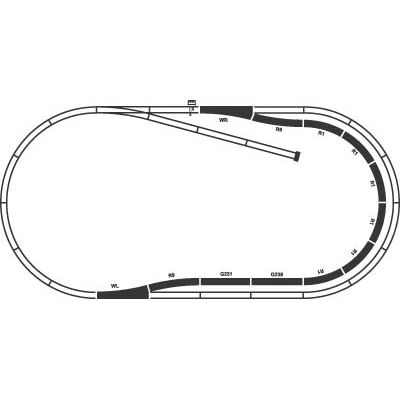
H0 gauge is produced at a scale of 1:87. Standard gauge is represented by a model track gauge of 16.5 millimetres. The vehicles are therefore large enough for clearly visible details, while complete stations and varied running routes can still fit onto typical home layouts.
PIKO A-Track is a two-rail track system. The two rail profiles are electrically separated and supply the vehicles through their wheels. With a suitable power supply, the same track layout can be operated using analogue or digital control .
A track set combines compatible straights, curves, turnouts, buffer stops or flexible track for a particular purpose. Set A forms an oval. B to E add a station, sidings, a parallel route or a shunting area. The extensive place-based layouts contain the track combination for a complete plan.
A-Track is available without roadbed and with a moulded ballast base. The version without roadbed is especially suitable for permanently ballasted layouts. Roadbed track can be assembled quickly and securely and can later be enhanced at the sides.
Check the package contents: A layout track set contains the track components listed on its product page. Vehicles, buildings, scenery, digital command stations, turnout drives and substructures are included only when they are expressly listed as part of the set.
Both versions use the same track gauge and a clearly structured system geometry. They differ primarily in installation height, catalogue numbers, fixing method and scenic treatment.
The 552xx track is laid on cork, foam or another substructure. Ballast colour, roadbed width and weathering can be adapted completely to a station, main line or branch line.
The 554xx track has a moulded ballast base. It is suitable for quick assembly, starter layouts and projects intended for gradual expansion.
Solid nickel-silver rail profiles combine good electrical conductivity with resistance to corrosion. The engraved sleepers reproduce the appearance of wooden-sleeper track.
| Feature | A-Track Without Roadbed | A-Track with Roadbed |
|---|---|---|
| Typical Catalogue Numbers | 55200 to 552xx | 55400 to 554xx |
| Installation | Substructure, fixing and ballast are planned separately | Track and moulded ballast base form one unit |
| Scenic Treatment | Maximum freedom over colour, height and track surroundings | A complete appearance immediately, with optional side detailing |
| Typical Use | Permanent layouts, flexible track and individual alignments | Starter layouts, quick assembly and modular expansion |
| Electrical Operation | H0 two rail, analogue or digital | H0 two rail, analogue or digital |
| Transition | Check height and joiners at the transition point | Taper the roadbed and align the rail heads |
A transition between the two versions is possible, but the shared track gauge alone does not solve it. The rail heads must align precisely, the height difference must be supported securely and the connection must be tested with every type of vehicle before it is fixed permanently.
Sets A to E without roadbed build systematically on one another. Extensions B and C are available for A-Track with roadbed.
From the basic oval to a station, parallel route and shunting group.

Basic oval consisting of twelve R2 curves, two G231 straights and a connection clip.
View Set A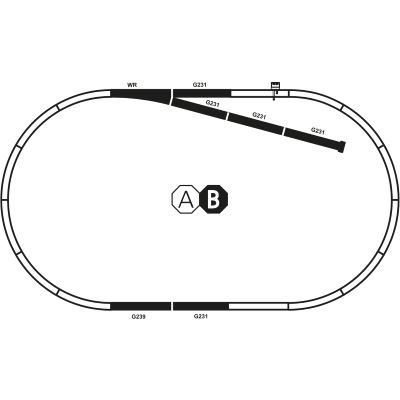
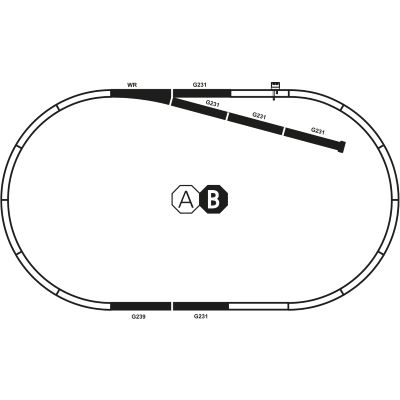
A right-hand turnout, straight track and a buffer stop add a shunting or storage siding to the oval.
View Set B
A left- and right-hand turnout, R1 and R9 curves create a parallel station track.
View Set C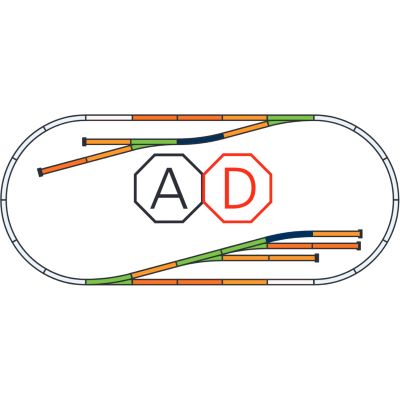
Five turnouts, 16 straights, two R9 curves and five buffer stops form a large group of sidings.
View Set D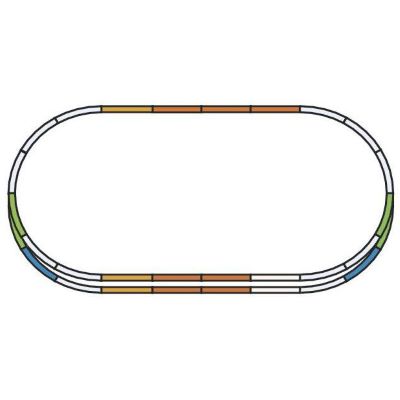
Two curved turnouts, R2 curves and ten straights add a second running route to the basic oval.
View Set EThe familiar B and C geometry with a moulded ballast base.
A right-hand turnout, straight track and a buffer-stop end section create the first siding.
View Roadbed Set B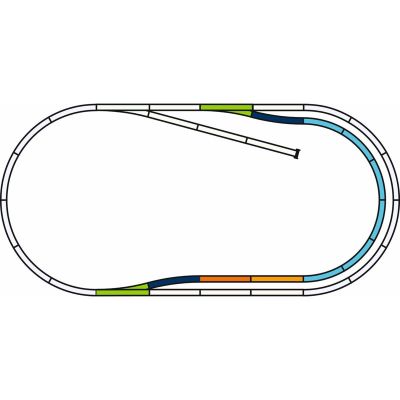
A left- and right-hand turnout, straight track and R1 and R9 curves form a station extension.
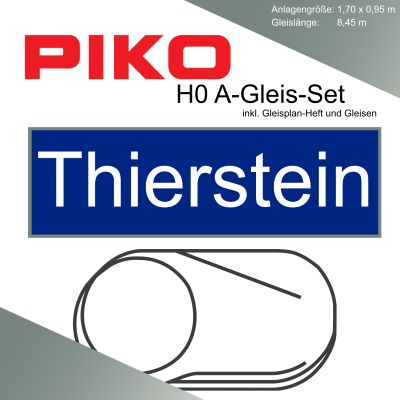
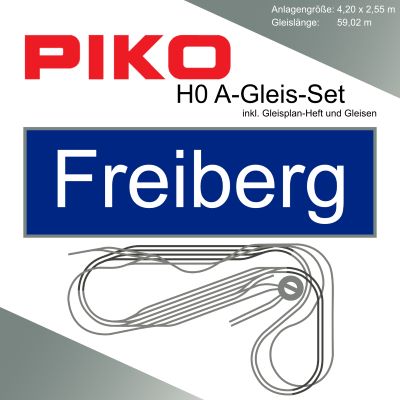
View Roadbed Set CThe place names identify specific track plans. The maximum layout dimensions and total track lengths shown in the set illustrations are stated below.
For smaller rooms, first permanent layouts and manageable station or branch-line projects.
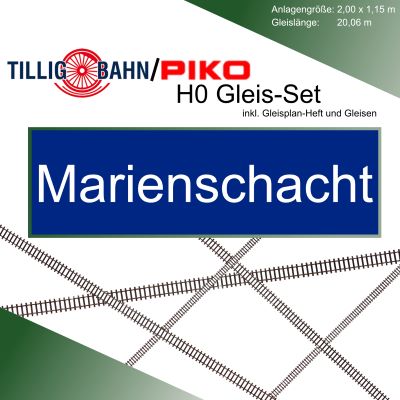
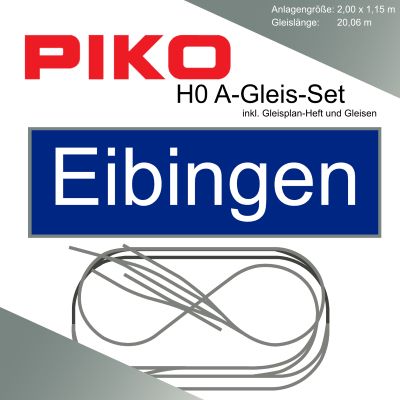
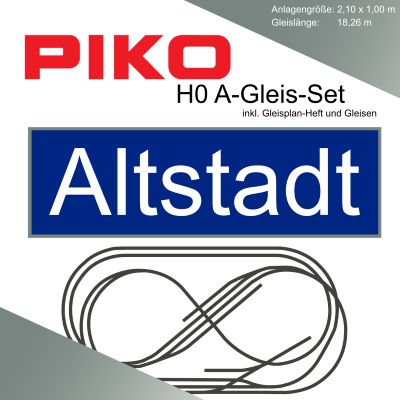
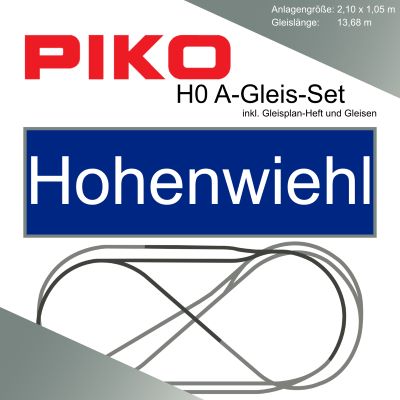
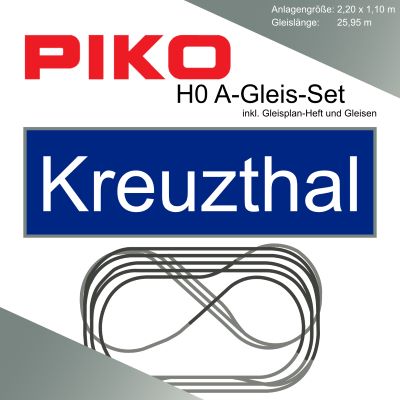
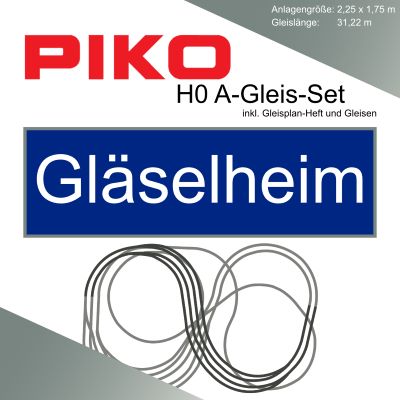
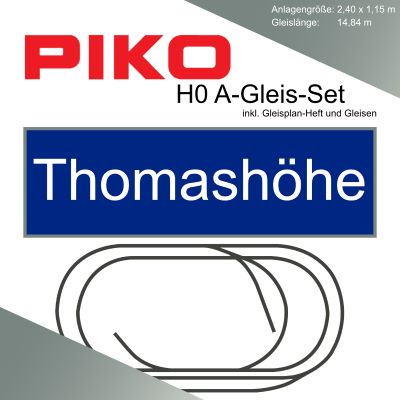
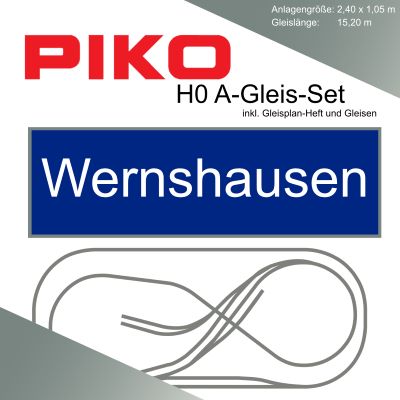
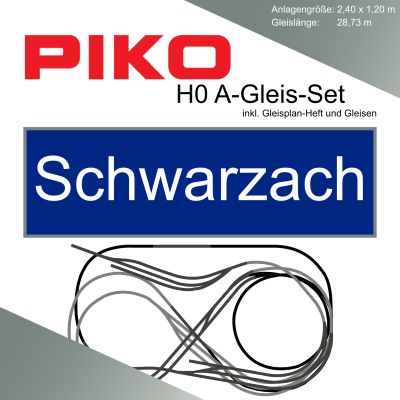
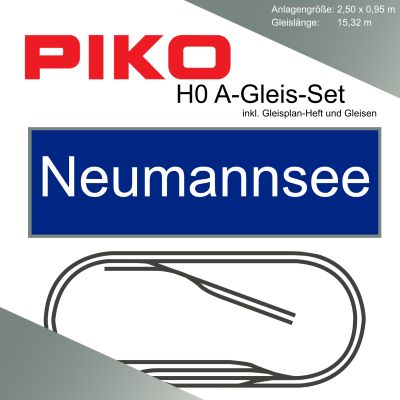
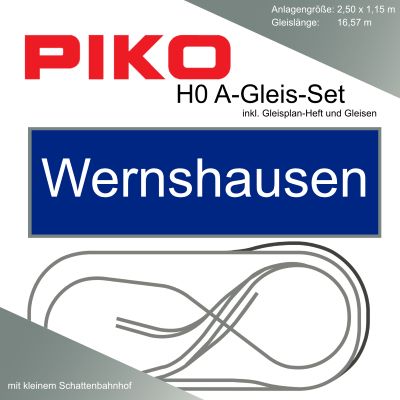
For long running routes, extensive stations, hidden areas and operationally focused model railway projects.
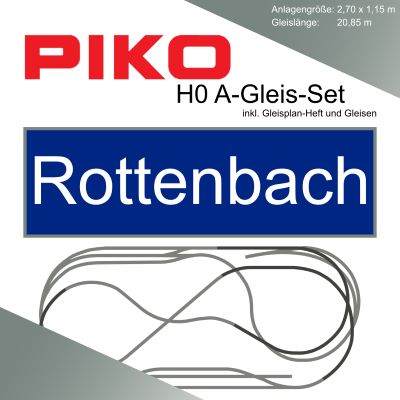
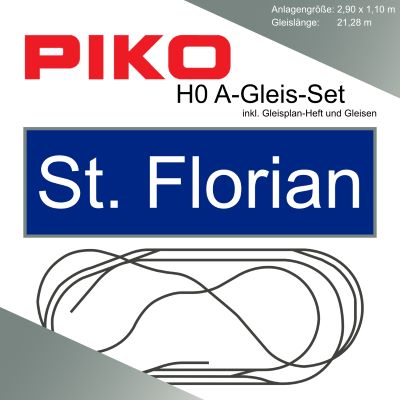
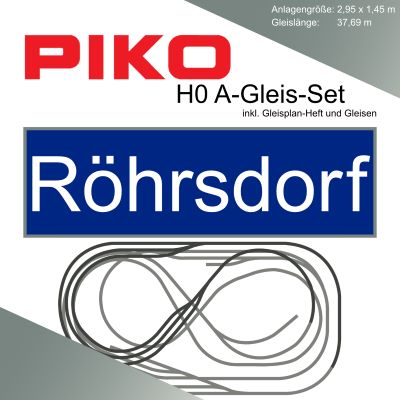
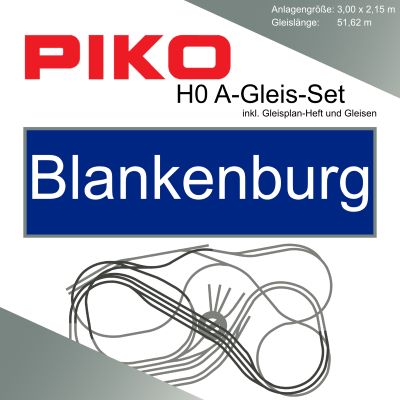
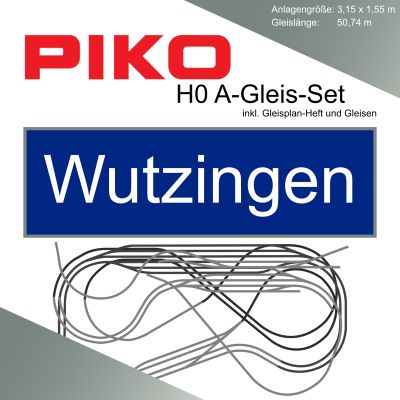
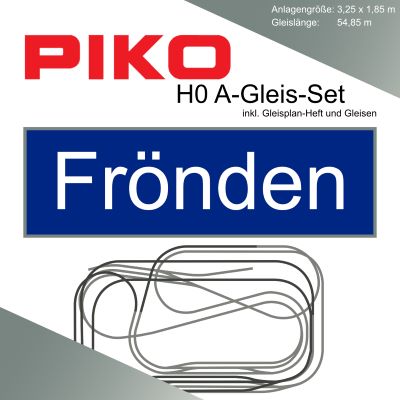
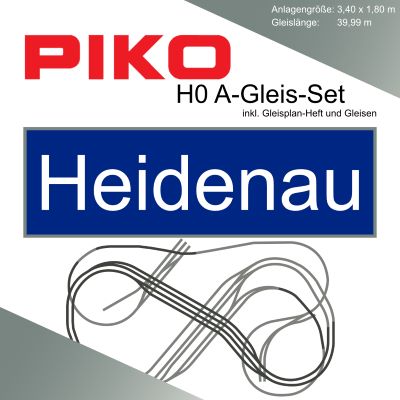
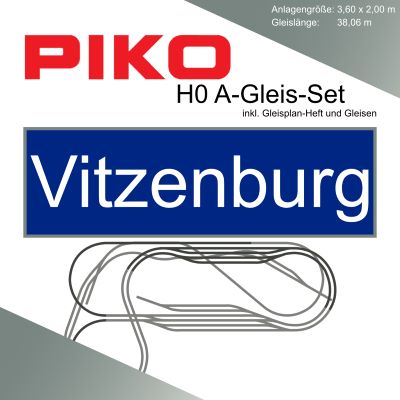
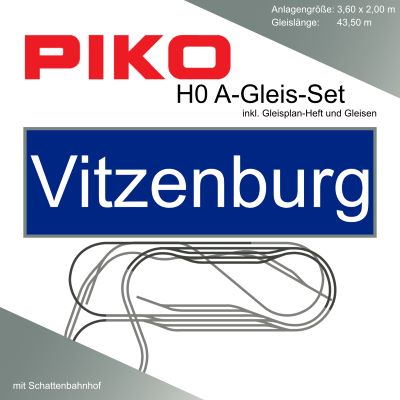
Hohenstein divides a large layout plan into coordinated sections. The dimensions of 3.10 × 1.75 metres and the 40.49 metres of track shown in the illustrations describe the fully developed project, not the contents of an individual stage.
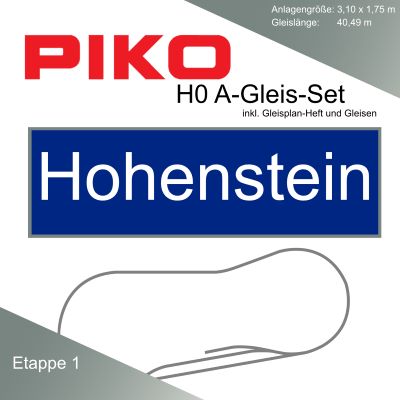
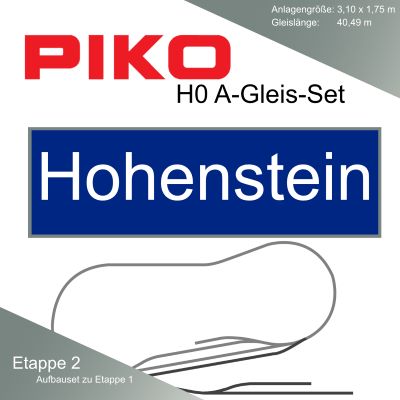
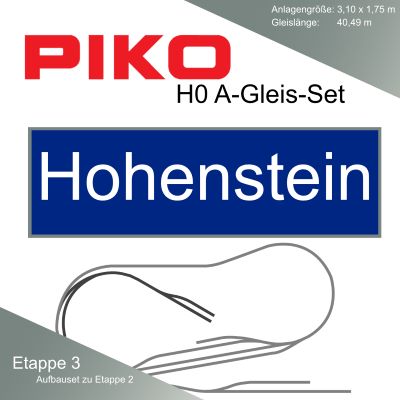
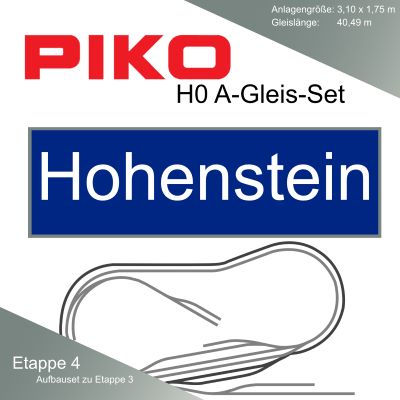
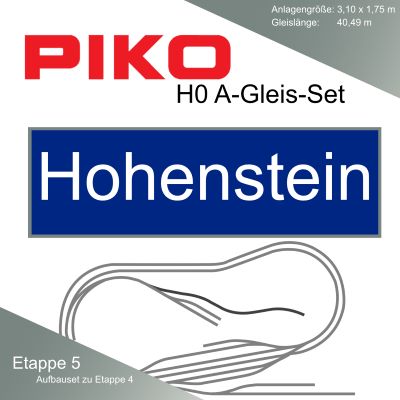
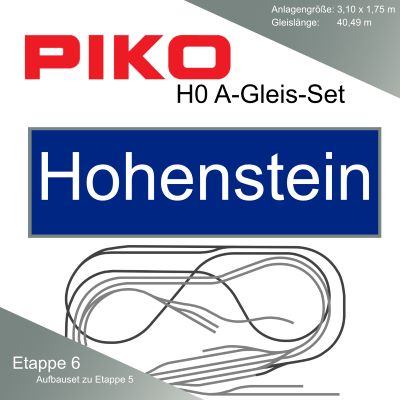
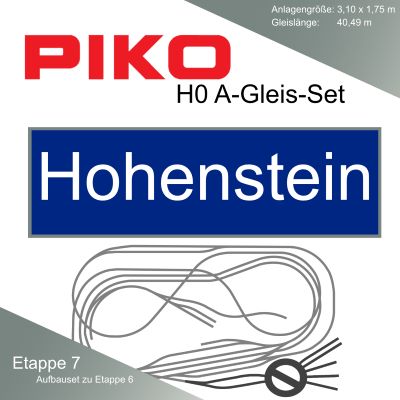
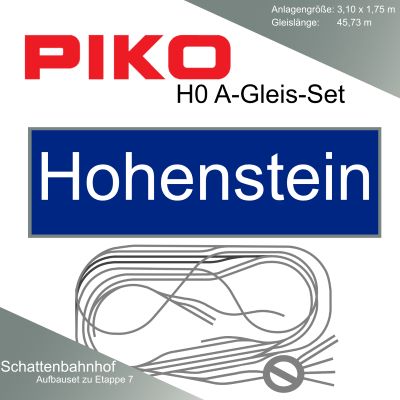
The stages are partial sets which build on one another. Anyone wishing to begin at an advanced stage should first check which earlier track sections and substructures are required.
These combinations provide the PIKO track required for the respective Easy-Track route plan. The corresponding NOCH substructure is a separate product.
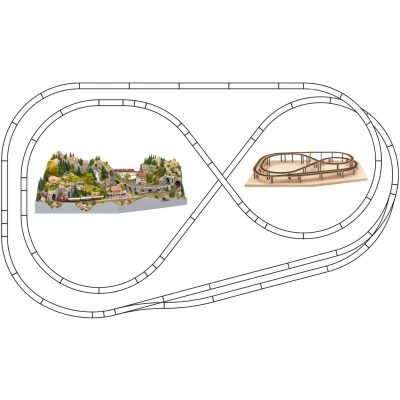
Track combination for a compact mountain layout with a station and interwoven route.
View Andreastal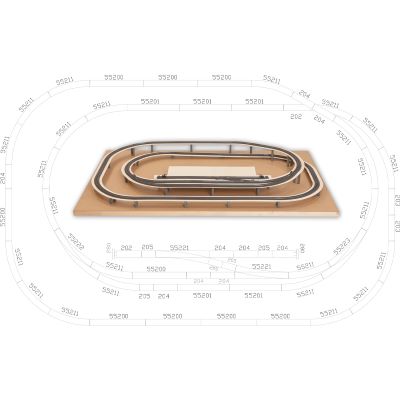
Coordinated straights, curves and turnouts for the NOCH Karlsberg route plan.
View Karlsberg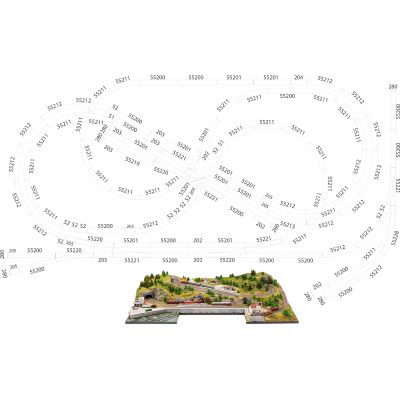
An extensive track package for a station, continuous route and urban layout scenes.
View Martinstadt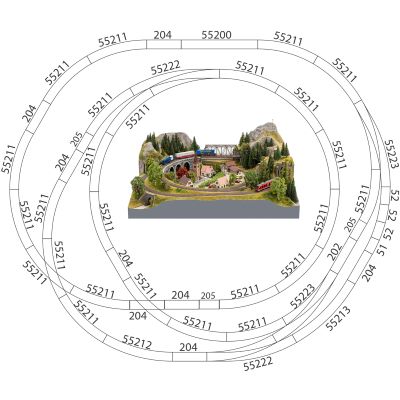
Suitable track for the compact oval-based Theisensee Easy-Track route plan.
View TheisenseeNumerous track plans can be constructed using only a few basic elements. Individual tracks , turnouts and track accessories permit later modifications.
G239 measures approximately 239 millimetres and G231 approximately 231 millimetres. The difference compensates for the geometry of turnouts, reverse curves and parallel tracks.
G119, G115, G107 and G62 close small gaps at station approaches and complex turnout formations without requiring flexible track to be cut.
The 940-millimetre flexible track is suitable for individual radii, transition curves and long routes with as few rail joints as possible.
R1 has a radius of 360 millimetres, R2 approximately 422 millimetres, R3 484 millimetres and R4 546 millimetres. Larger radii give long vehicles a smoother appearance.
R9 forms an especially broad curve with a radius of 908 millimetres. The element is used, among other purposes, to compensate for 15-degree turnout geometry.
WL and WR branch to the left or right. Curved turnouts begin the branch within a curve and therefore save valuable layout length.
Crossings allow two tracks to intersect. A double-slip turnout adds branching functions, while a three-way turnout divides the route into three directions.
Manual turnouts can be fitted with electric or underfloor drives. Connection clips, additional power feeds and isolation points support reliable operation.
The transition track connects older PIKO hollow-profile track with the current A-Track system and compensates for the different rail profiles in a controlled manner.
Different joiner widths simplify the transition to selected H0 track systems. Rail-profile and installation heights must still be checked carefully.
Buffer stops mark the end of loading, storage and shunting tracks. Sufficient braking distance for the longest vehicle should remain in front of the buffer stop.
With track without roadbed, the substructure and track bedding are selected separately. Turnout blades and operating mechanisms must remain unobstructed.
A suitable track plan considers external dimensions, vehicle radii, train lengths, maintenance access and the intended style of model railway operation.
In addition to the layout area, allow space for operation, wiring and access to concealed track.
Roadbed track supports quick system-based construction, while A-Track without roadbed permits individual ballasting.
The smallest permitted radius of the intended locomotives and long passenger coaches remains decisive.
Stations, hidden yards and storage sidings must accommodate complete trains.
Define power feeds, feedback sections, turnout drives and possible reversing loops before building the scenery.
Lay the track loosely first and test every type of vehicle in both directions.
PIKO 55300 Set A forms an oval measuring 110 × 88 centimetres.
Set C adds two turnouts and a parallel track.
Hohenstein divides the complete project into seven stages.
Freiberg contains 59.02 metres of track within 4.20 × 2.55 metres.
Further guidance is available in Plan a Model Railway , the Track Planning category and the Model Railway Calculators .
The 41 listed sets are intended for standard-gauge H0 two-rail layouts. An identical model track gauge alone does not guarantee electrical or proportional compatibility.
| Model Size | Scale | Model Track Gauge | Relationship to PIKO A-Track |
|---|---|---|---|
| H0 DC / Two Rail | 1:87 | 16.5 mm | Direct application of the listed A-Track sets |
| H0 AC / Centre Stud | 1:87 | 16.5 mm | The same track gauge, but A-Track has no centre conductor |
| H0m | 1:87 | 12 mm | Metre gauge at H0 scale using a separate track system |
| H0e | 1:87 | 9 mm | H0 narrow gauge and not interchangeable with standard-gauge H0 |
| H0f | 1:87 | 6.5 mm | Field and industrial railways using exceptionally narrow track |
| TT | 1:120 | 12 mm | A smaller scale with independent vehicles and track |
| N | 1:160 | 9 mm | Considerably more space-saving than H0 but not compatible |
| G | Frequently 1:22.5 | 45 mm | A separate PIKO garden-railway system with its own track sets |
A-Track has no centre-stud conductor and is therefore not intended for conventional H0 AC vehicles with pickup shoes unless extensive technical modifications are made. The H0 AC or H0 DC guide and the gauge comparison explain the fundamentals.
These answers help with system selection, expansion, radii, digital operation and layout planning.
The overview contains 41 H0 products: seven modular system sets, 22 complete place-based layouts, eight Hohenstein sets and four track packages for NOCH Easy-Track.
PIKO 55300 Set A forms a complete oval using R2 curves and two straights. It requires approximately 110 × 88 centimetres and can be expanded using B, C, D or E.
Set C contains one left- and one right-hand turnout, one G239 and one G231 straight, six R1 curves and two R9 curves. Together with A and B, it creates a station extension.
With standard A-Track, the substructure and ballast are designed separately. The roadbed version already has a moulded ballast base and can be assembled more quickly.
Yes. The two-rail track is not restricted to one control method. The controller or digital command station, vehicle decoders and wiring determine the operating method.
A-Track has no centre conductor. Conventional H0 AC vehicles with pickup shoes require a centre-stud track system or an extensive technical conversion.
No. R1 has a radius of 360 millimetres, but the specification for the individual vehicle remains decisive. Long coaches and large locomotives normally benefit from R2 or larger radii.
Only components expressly listed belong to the set. Many A-Track turnouts can initially be operated manually and later fitted with a suitable drive.
No. The seven stages are coordinated construction sections within one complete plan. Dimensions and total track length shown in the illustrations refer to the fully developed layout.
The PIKO products provide the appropriate combination of track. The corresponding Easy-Track substructure and additional scenery materials are separate products.
Transitions are possible but must be planned according to rail-profile height, joiner form, sleeper height and geometry. PIKO transition tracks 55207 and 55208 assist with particular system combinations.
Set B creates one siding. Set D contains five turnouts and five buffer stops for a larger shunting group. Large layouts such as Blankenburg and Freiberg provide even more operation.

Explore individual straights, radii, flexible track, turnouts, drives, vehicles and PIKO digital technology for further expansion of your H0 layout.