Preformed Terrain Layout
The terrain shape and track area are prepared, allowing the three-dimensional railway landscape to become visible quickly.

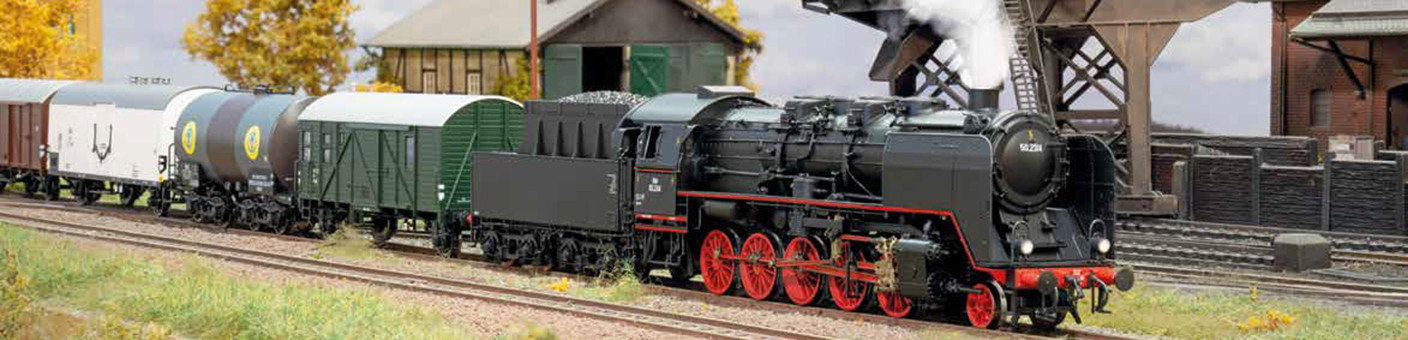
A preformed terrain layout saves construction time, an Easy-Track route kit simplifies the structural work and a full custom build adapts most precisely to the room and intended operation. This guide helps you choose the right route to your own model railway.
A preformed terrain layout is suitable for modellers who mainly want to run trains, add buildings and complete an existing landscape. Track routes, tunnels and terrain shapes are largely predetermined. This reduces structural work but limits major changes to the station and route.
With a full custom build, you determine the layout shape, curve radii, station, hidden areas, track bases and scenery yourself. This route is especially suitable for unusual room shapes, longer trains and individual operating concepts.
An Easy-Track route kit combines both approaches. Prefabricated track-base sections and supports create a proven route. The surface, buildings, roads, vegetation and complete layout theme are then designed individually.
The decision is therefore not simply between a finished product and a complete custom build. A compact route kit can be an excellent solution for beginners who want to simplify the wooden structure without giving up creative scenery construction.
Explore prepared terrain shells and route kits in the finished systems category or begin a completely individual project with model railway track-planning aids .
The terrain shape and track area are prepared, allowing the three-dimensional railway landscape to become visible quickly.
The structural track base follows a proven plan while the visible landscape and complete scenic treatment remain individual.
The room, train length, station and operating concept determine every dimension of the future model railway layout.
The finder evaluates the desired construction time, interest in practical work, available room shape, desired design freedom and previous experience.
All three routes can produce a high-quality model railway. The deciding factor is whether their limits match the intended hobby, available space and operating concept.
| Criterion | Preformed Terrain Layout | Easy-Track Route Kit | Complete Custom Build |
|---|---|---|---|
| Construction time | Low | Medium | Medium to high |
| Planning effort | Very low | Track plan included | Complete planning required |
| Design freedom | Limited | Scenery remains individual | Maximum |
| Room adaptation | Fixed external dimensions | Fixed basic shape | Individually adaptable |
| Tool requirements | Low | Basic equipment | More extensive |
| Operating concept | Largely predetermined | Track plan predetermined | Completely individual |
| Best suited for | A fast introduction | Planning certainty with individual scenery | Individual rooms and operating objectives |
The desired activity is decisive. Some modellers primarily want to operate and landscape trains, while others regard planning and structural construction as an essential part of the hobby.
Mountains, tunnels, valleys and the route are already largely shaped. A three-dimensional railway world therefore becomes visible early in the project.
Limited construction time, rectangular standard areas and short to medium-length trains.
Track-base segments and supports simplify multiple levels and gradients. The visible landscape, buildings and complete theme remain open to individual design.
Beginners who want to build but do not want to plan and cut the complete wooden structure themselves.
The station, radii, hidden areas, route and complete layout shape are designed for the intended trains and operating concept.
Unusual rooms, sectional layouts, long trains and individual shunting, timetable or main-line operating concepts.
Prepared layout products concentrate particularly on Z, N and H0. Larger gauges are more frequently realised as sectional, modular or fully custom-built layouts.
| Gauge | Typical Scale | Sensible Construction Method | Particularly Important |
|---|---|---|---|
| Z | 1:220 | Compact preformed terrain or small custom build | Clean track and safe access to every route |
| N | 1:160 | Preformed terrain, route kit or custom build | Keep hidden routes and turnouts accessible |
| TT | 1:120 | Route kit or custom build | Check the track system and vehicle range first |
| H0 | 1:87 | All three construction methods are possible | Distinguish two-rail, centre-contact and minimum radius |
| H0e and H0m | 1:87 | Compact custom or sectional layout | Match the narrow-gauge track and prototype theme |
| 0 | Usually 1:45 | Shelf, modular or sectional layout | Vehicle length and a stable supporting structure |
| 1 and G | 1:32 and 1:22.5 | Modular, room-sized or garden railway custom build | Load capacity, weather and large curve radii |
Even a prepared terrain shell requires a system check, track work, wiring and extensive test runs before the permanent scenery is completed.
Record the external dimensions, operating aisles, doorways, stairways and complete transport route.
Compare model size, curve radius and the desired train length.
Select a preformed terrain layout, Easy-Track route kit or complete custom build.
Check the exact component list, conductor system and control method.
Position the structural base so it is stable, level and accessible for maintenance.
Initially lay every route provisionally and test it with different locomotives and train lengths.
Label power feeds, turnouts, isolated sections and complete cable routes.
Permanently shape and finish the landscape only after reliable train operation has been confirmed.
Dimensions, the track component list and accessibility must be clarified before permanent terrain and scenery construction begins.
Operating aisles, layout height, reach depth and safe access are forgotten.
Track, electrical equipment, buildings and vehicles may need to be purchased separately.
The project component list must match the exact track system and conductor type.
Long trains require more traction than short train formations.
Hidden routes and turnouts require removable scenery or maintenance openings.
A small completed section provides more value than a permanently unfinished construction site.
Turnouts, transitions and hidden routes must first operate reliably with the intended trains.
Layout structures and modules must fit through doors, corridors, stairways and the intended vehicle.
The examples represent different levels of preparation. Product cards do not make any statement about current availability. Check the exact external dimensions, track system, gradients, component list and package contents on the individual product page.
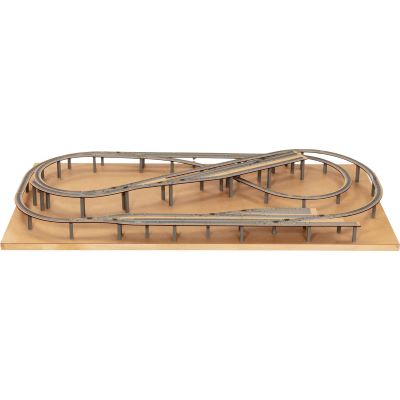
The terrain shape and route area are largely prepared. The required track system and suitable train lengths must still be checked carefully.

Compact mountain terrain prepared for KATO Unitrack and correspondingly suitable short N-gauge vehicles.
Open Product Details →
Select preformed terrain, route kits, cases and structural systems by gauge, dimensions and level of preparation.
Open the Category →The route kits define the track base and vertical development. Track, electrical equipment and the visible scenery are added according to the selected system and individual design.
A planned H0 route with station area and additional track space for storage or shunting operation.
Open Product Details →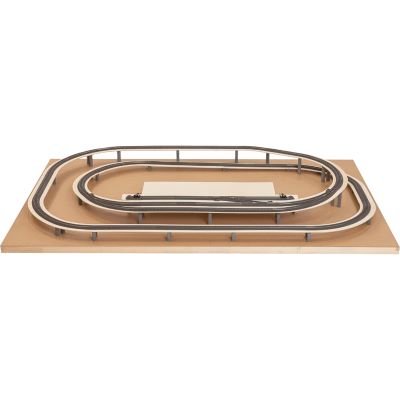
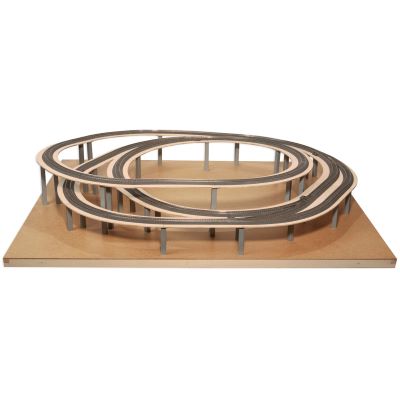
Track-base sections, supports and planning documents create a structured foundation for an individually designed layout.
Open Product Details →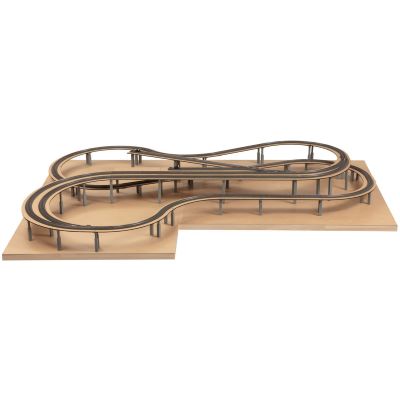
Extensive route kit with multiple levels, a long visible route, station track and several shunting possibilities.
Open Product Details →The smaller model size permits a more extensive route within the available area. Hidden areas must nevertheless remain fully accessible for cleaning and maintenance.
NOCH offers prepared terrain and route concepts. Matching track, buildings, vehicles, tools and scenery products can be added from the selected system manufacturers.
These answers cover package contents, cost, track systems, expansion options and long-term use.
A preformed layout reduces planning and structural construction. It is suitable when the external dimensions and track plan match the available room. An Easy-Track route kit offers more design freedom and is a useful middle ground for many beginners.
This depends on the individual product. The terrain and route may be prepared, while track, electrical equipment, buildings, vehicles and control equipment frequently have to be purchased separately.
With preformed terrain, the visible landscape shapes are largely present. A route kit primarily supplies track-base segments, supports and a proven track plan.
Not automatically. A custom build distributes the cost across wood, tools, track, electrical equipment and scenery. It can be economical when the project remains small and many parts are made by the modeller.
Yes. The track, wiring, digital command station and vehicles must be technically compatible. The terrain shape itself does not determine whether the railway is analogue or digital.
Z, N and H0 are particularly common. N provides extensive routes within a small area, while H0 offers larger vehicles that are easier to see and handle.
Small changes may be possible. Tunnel openings, track-base widths, gradients and terrain shapes nevertheless impose fixed limits.
Typical tools include a knife, file, screwdriver, ruler, suitable adhesive and drill. Depending on the electrical system, a soldering iron or connection terminals may also be required.
In addition to length and width, consider operating aisles, reach depth, layout height, doorway widths, stairways and the complete transport route.
Compact preformed layouts, lightweight route kits and transportable sectional layouts provide the greatest flexibility.
Turnouts, radii, gradients, transitions and hidden routes should be tested reliably with the longest intended locomotives, coaches and train formations.
Expansion with additional sections or modules is often possible. Track height, electrical supply, structural support and the transition between the two landscapes must match.
Explore gauges, track systems, layout planning, digital technology, structural construction and scenery in the central model railway guide.
Editorially reviewed and updated on 30 July 2026. The external dimensions, package contents and technical information on the individual product page remain decisive.