
Fine Rail Profile Without Roadbed
The rail profile is 1.8 millimetres high. The base, sound insulation and ballast are added to suit the particular layout project.

Explore 20 complete layout track sets, the first construction stage of Hohenstein and the 35901 extension set for the Roco TT turntable. This overview compares base dimensions, track lengths, radii and suitable applications.
TT gauge combines clearly visible detail with comparatively modest space requirements. Standard gauge is represented at a scale of 1:120 using a model track gauge of 12 millimetres.
A layout track set combines the Roco TT track required for a specific plan. Depending on the concept, this includes straight sections, R1 and R2 curves, straight turnouts, curved turnouts, double-slip turnouts and short compensation pieces. The sets avoid the need to compile an extensive parts list manually.
The place names identify different layout concepts. Thierstein begins at 1.55 × 0.85 metres. Schlegel uses a total of 50.77 metres of track within an area of 2.80 × 1.65 metres. Hohenstein is a special case: Stage 1 is supplied, while the dimensions and track length shown in the illustration describe the later complete plan.
Vehicles, buildings, scenery materials, power supplies and turnout drives are not automatically included. The package listed on the relevant product page is always authoritative.
Selection rule: Do not compare the external dimensions alone. Usable track lengths, accessibility, radii, gradients and concealed routes determine whether a plan suits the available room and intended vehicles.
Roco TT track is a two-rail system without a moulded ballast bed. It can therefore be supported, ballasted and integrated into the scenery individually.
The rail profile is 1.8 millimetres high. The base, sound insulation and ballast are added to suit the particular layout project.
The DC designation identifies the two-rail system. With a suitable power supply, the same track can be operated in analogue form or digitally using DCC.
G128 is the standard length. Shorter straights, radii and 20-degree turnouts compensate for branches and parallel tracks.
| Track Component | Dimension or Radius | Purpose Within the Track Plan |
|---|---|---|
| G44 / G60 / G64 | 44 / 60.5 / 64.3 mm | Compensate for short lengths and complete turnout formations |
| G121 / G128 | 120.96 / 128.7 mm | Compensation straight and standard system length |
| G640 Flexible Track | 640 mm | Free radii, transition curves and individual lengths |
| Radius R1 | 321 mm | Compact curves with angles of 10 or 30 degrees |
| Radius R2 | 365 mm | Outer curves with angles of 10, 20 or 30 degrees |
| WL20 / WR20 | 128.7 mm · 20° branch · 365 mm radius | Construct stations, passing tracks and branches |
| BWL / BWR | Main and branch routes use R1 at 321 mm | Position a branch economically within a curve |
For digital operation, the track is suitable for systems including the Roco Z21 and z21 . On larger layouts, multiple power feeds, detection sections and electrical isolation points should be planned before the track is permanently installed.
Grouping the sets by maximum layout width simplifies the preliminary selection. The stated track lengths refer to the illustrated plan; only Stage 1 is supplied for Hohenstein.
Small base areas with continuous routes, storage sidings and interwoven running lines.
The smallest base area in the range, with a continuous route and storage branches.
View Thierstein →
Interlocking running routes within a width of only 1.65 metres.
View Kühnhausen →
Parallel running lines with additional connections at the sides.
View Thomashöhe →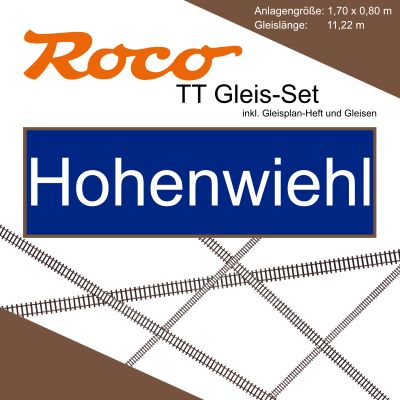
An interwoven continuous route with a compact inner group of tracks.
View Hohenwiehl →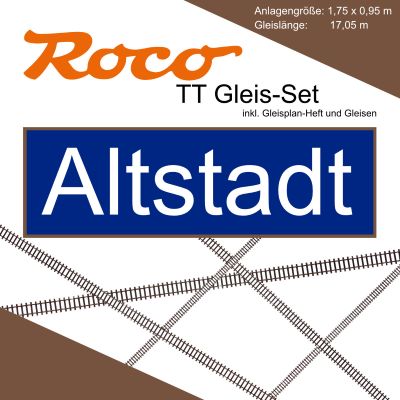
An elongated plan with several running routes and storage sidings.
View Altstadt →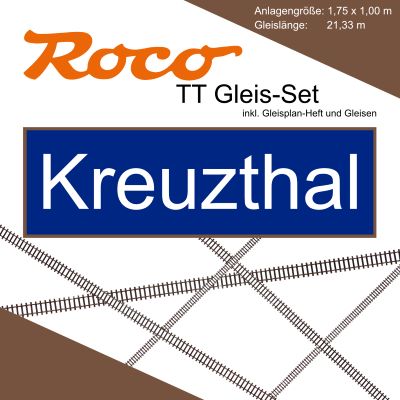
Several parallel routes and a prominent group of tracks.
View Kreuzthal →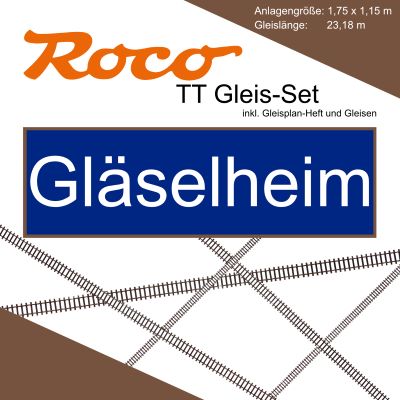
An interwoven alignment containing 23.18 metres of track.
View Gläselheim →
A narrow continuous route with several track connections at the sides.
View Neumannsee →More track, more extensive turnout formations and varied train sequences.
Densely arranged routes on a compact rectangular area.
View Schwarzach →
A manageable continuous route with an additional alignment.
View Karlsberg →
Several parallel running routes within a width of two metres.
View Mittenwald →
Interwoven routes with a total length of 27.81 metres.
View Röhrsdorf →
43.02 metres of track within an area of only 2.00 × 1.00 metres.
View Wutzingen →
An elongated continuous route with several branches.
View Rottenbach →
Structured continuous routes and sidings for changing train movements.
View St. Florian →
The first track-construction stage of a layout designed for gradual expansion.
View Hohenstein →Suitable for long routes, extensive track groups and operationally focused layouts.
A turntable and fan-shaped locomotive sidings define the track plan.
View Blankenburg →
Numerous straight and curved turnouts connect interwoven running routes.
View Heidenau →
A broad plan with several long, interlocking routes.
View Vitzenburg →
A large group of tracks and a turntable for intensive locomotive operation.
View Freiberg →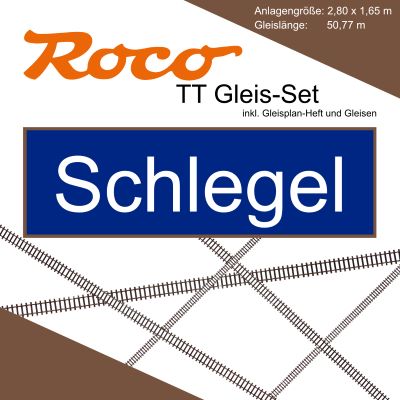
The longest track arrangement in the overview, containing 50.77 metres.
View Schlegel →Note about Hohenstein: The set offered contains Stage 1. The total track length of 28.64 metres stated in the set illustration describes the fully developed layout plan, not the first construction stage alone.
The extension set is specifically intended for the Roco 35900 turntable and is not a general extension package for a continuous track circuit.
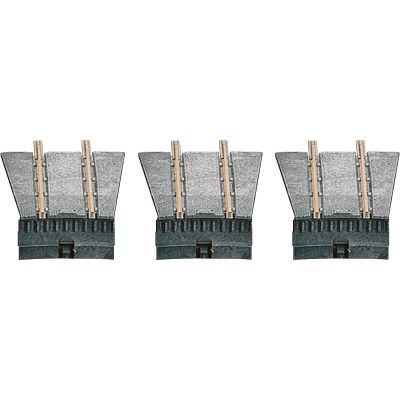
Three additional approach and departure tracks for Roco 35900.
The basic Roco 35900 TT turntable has six approach and departure tracks. Several 35901 sets can increase the total number of connections to as many as 24.
The three track pieces have roadbed designed to match the turntable and are inserted directly at its connection points. They therefore do not replace ordinary Roco TT straight tracks.
Understanding the designations makes parts lists easier to check and permits an existing layout plan to be modified using suitable track , turnouts and track accessories .
G128 is the standard straight. G44, G60, G64 and G121 close gaps and compensate geometrically for turnout connections.
The 640-millimetre flexible track permits individual lengths, generous curves and gentle transitions without numerous rail joints.
R1 curves are available with angles including 10 and 30 degrees. Twelve 30-degree sections form a complete circle.
R2 is available with angles of 10, 20 and 30 degrees and forms parallel curves as well as the branch radii of WL20 and WR20 turnouts.
The 128.7-millimetre turnouts have a 20-degree branch angle, a radius of 365 millimetres and an integrated snap mechanism.
Both routes use the R1 radius. A branch can therefore begin within a curve and save valuable layout length.
The DKW20 is 128.7 millimetres long, crosses at 20 degrees and requires two suitable drives for electrical operation.
Rail joiners align the profiles. Connection terminals supply traction current, while insulated joiners separate detection or power sections.
Since Roco TT track has no moulded roadbed, track bedding , ballast colour and installation height can be adapted individually to a station, main line or branch line.
A good track plan suits the room, the longest vehicles and the intended operation rather than merely fitting the maximum board width.
Maintenance routes, layout edges and concealed track must remain accessible.
Continuous running, stations, shunting and locomotive depots require different track plans.
The specified minimum radius of each vehicle remains binding.
Station and storage sidings must accommodate the intended trains.
Define power feeds, isolation points and occupancy detection before ballasting the track.
Test every type of vehicle before fixing the track permanently.
Thierstein requires approximately 1.55 × 0.85 metres.
Wutzingen combines 43.02 metres of track within 2.00 × 1.00 metres.
Blankenburg and Freiberg integrate a Roco TT turntable.
Schlegel reaches a total track length of 50.77 metres.
Further assistance is available in Plan a Model Railway , the Track Planning category and the Model Railway Calculators .
The same model track gauge does not automatically indicate the same track system. Scale, sleeper pattern, radii and loading gauge must also be suitable.
| Model Size | Scale | Model Track Gauge | Classification |
|---|---|---|---|
| TT | 1:120 | 12 mm | The 22 Roco products discussed here belong to standard-gauge TT layouts. |
| TTe | 1:120 | 6.5 mm | TT narrow gauge and not interchangeable with standard-gauge TT track. |
| H0m | 1:87 | 12 mm | The same distance between the rails but a larger scale and different appearance. |
| H0e | 1:87 | 9 mm | A separate H0 narrow-gauge system using dedicated Roco H0e track. |
| H0 | 1:87 | 16.5 mm | Roco Line and other H0 systems are considerably larger than TT. |
| N | 1:160 | 9 mm | Smaller than TT and intended for particularly space-saving layouts. |
The model railway gauge comparison explains space requirements and scales in greater detail. Although H0m also uses a track gauge of 12 millimetres, it is not a direct substitute for a TT layout concept.
These answers help with system selection, space planning, turnout control and later expansion of a Roco TT layout.
The overview includes 20 complete layout track sets, Hohenstein Stage 1 and the 35901 turntable extension set. A total of 22 suitable Roco TT products are presented.
Thierstein has the smallest stated base area at approximately 1.55 × 0.85 metres. It is followed by Kühnhausen, Thomashöhe and Hohenwiehl.
Schlegel reaches a track length of 50.77 metres. Wutzingen is particularly track-intensive, with 43.02 metres within an area of only 2.00 × 1.00 metres.
The product pages list the required straight tracks, curves, turnouts and compensation pieces individually. The 8050009 TT track-plan book is also included. Specialist components are included only when expressly stated.
Yes. It is a two-rail system. Analogue operation uses a suitable controller, while digital operation can use a DCC command station such as the Roco Z21 or z21.
The regular straight tracks, curves and turnouts are used without moulded ballast roadbed. Bedding material and ballast can therefore be selected individually. The turntable access tracks in set 35901 are a specialist exception.
The turnouts have a snap mechanism and can initially be operated mechanically. Electric side-mounted or underfloor drives are included only when the relevant set page expressly lists them.
R1 permits compact layouts. The product specifications must still be checked to confirm that each locomotive and wagon can negotiate the radius safely. Long vehicles and large locomotives frequently appear smoother on R2.
It adds three approach and departure tracks to the Roco 35900 TT turntable. Several extension sets can increase the turntable to a total of up to 24 track connections.
A common track gauge alone is not sufficient. Rail-profile height, connectors, roadbed height, sleeper pattern and geometry must be checked. A system transition should be aligned precisely and tested with every type of vehicle before it is fixed permanently.

Explore individual straight tracks, radii, turnouts, turntables, vehicles and digital technology for further expansion.