Modellbahn Keks
Welcome!
Our cookies offer you a fast, relaxed and full-featured shopping experience. Some are necessary to operate the website and its functions. Others help us to improve our services. If you agree to this, simply consent to the use of cookies for preferences, statistics and marketing by clicking on "OK". Alternatively, you can deactivate individual cookies under "Customise cookies" or all cookies, except those required for the function of our website, under "Reject all".
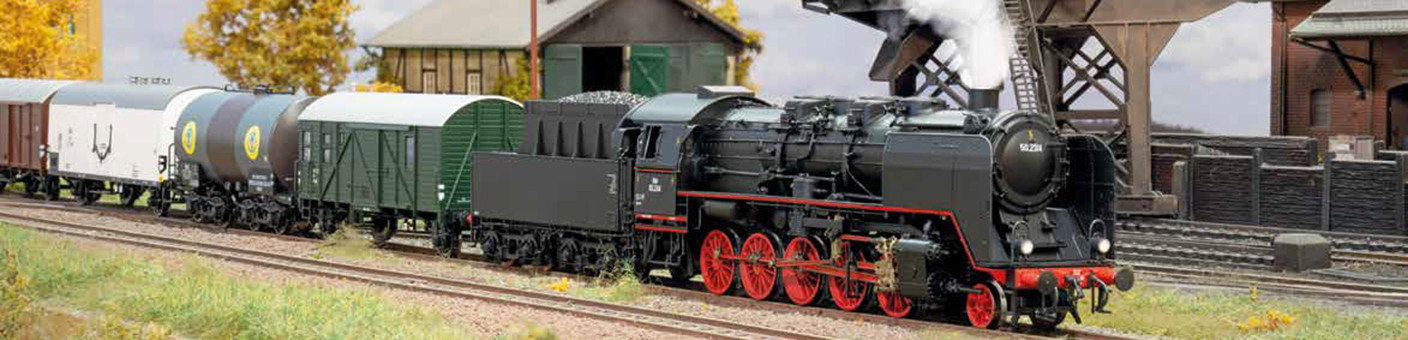
Detailed model railway layout used to compare H0 gauge and N gauge
Choose by layout goal, available space and preferred model size

H0 Gauge or N Gauge? A Direct Comparison

H0 brings locomotives, details and functions to the foreground. N gauge creates longer routes, trains and stations within the same base area. Compare scale, curve radius, technology, handling and product ranges before choosing.

The most important decision first

The Quick Answer: H0 for Presence, N for Railway Length

Choose H0 gauge when locomotives and rolling stock should be the main focus, when you want to read lettering and see separately fitted details clearly, value powerful sound or want to use an especially broad range of vehicles, track, buildings and digital technology. The larger models are generally easier to rerail, couple, maintain and convert to digital operation.

Choose N gauge when space is limited or when you want long passenger and freight trains, generous stations, double-track main lines and extensive scenery. A comparable train requires only a little over half the H0 length. This leaves more room for credible distances between a station, bridge, tunnel and town.

Neither gauge is inherently better. The deciding factor is what should provide enjoyment on the finished layout. A compact H0 terminus can be more interesting than an overcrowded N-gauge track plan. Conversely, a long express train in N often looks more convincing than a heavily shortened H0 formation on the same area.

Technical fundamentals

Scale, Radius and Base Area Compared Directly

These figures provide realistic guidance for preliminary planning. The permissible minimum radius always depends on the longest coach and the most demanding locomotive. Wider curves improve reliability and appearance in both gauges.

Comparison Point H0 Gauge N Gauge
Usual scale 1:87 1:160 in continental Europe
Standard-gauge model track 16.5 mm 9 mm
26.4-metre passenger coach approximately 30.3 cm model length approximately 16.5 cm model length
Compact curve radius frequently approximately 358 to 360 mm frequently approximately 192 mm
Simple starter oval approximately 160 × 100 cm approximately 85 × 40 to 90 × 47 cm
Typical system choice centre-contact or two-rail predominantly two-rail
Particular strength detail impact, handling and product range train length, station length and scenery depth
Typical digital technology DCC, mfx, Motorola and multi-protocol DCC and, depending on the model, mfx or multi-protocol

Calculate a Prototype Length in H0 and N

Enter the prototype length of a coach, platform or complete train. The calculator immediately shows the resulting model length in both sizes.

H0 Gauge · 1:87 30.3 cm

Greater visual impact and easier handling.

N Gauge · 1:160 16.5 cm

More usable railway length on the same base area.

Calculated using scales of 1:87 and 1:160.

Mathematically, an N-gauge model has approximately 54 per cent of the linear dimensions of an H0 model. Actual layout requirements cannot be calculated from scale alone. Track geometry, turnouts, clearances, reach and accessibility remain important.

Layout impact rather than numbers alone

What Can Actually Be Achieved on the Same Base Area?

It is not enough for a simple oval to fit on the baseboard. Consider the longest planned train, usable station tracks, accessible tunnels, realistic curves and sufficient scenery between individual operating locations.

H0 Gauge

The Vehicles Become the Main Attraction

H0 is particularly suitable for branch lines, shunting layouts, locomotive depots, industrial sidings and compact termini. Locomotives, couplings, signals, figures and buildings have a strong visual presence. Interior lighting, cab lighting, smoke, sound and moving functions can also be experienced clearly.

  • More comfortable handling during maintenance and vehicle changes
  • Exceptionally broad selection of European prototypes and accessories
  • Centre-contact and two-rail systems are available
  • Long express trains require correspondingly long platforms
N Gauge

Route, Station and Scenery Move Closer Together

N gauge shows its strengths on main lines, with long passenger trains, container trains, Alpine railways and generous stations. More coaches or wagons can be used within a given length. At the same time, room remains for bridges, open track, valleys, backscenes and credible distances between individual scenes.

  • Long formations and larger storage groups on a smaller area
  • Suitable for shelf, folding, modular and apartment layouts
  • Broad vehicle selection covering Eras I to VI
  • Accurate track construction and regular contact care are especially important

Example: 200 × 100 Centimetres

In H0, this area can credibly accommodate a compact branch line, a small through station or a shunting layout. In N, it is usually possible to include longer station tracks, more open route or a larger hidden yard. An overcrowded track plan does not automatically become prototypical simply because it is built in N. Fewer tracks with sufficient usable length are often the better solution.

Running, switching and maintenance

Understanding Power Systems, Digital Operation and Care

Gauge does not automatically determine the digital system. In H0 especially, current collection, track system and vehicle version must be coordinated before the first locomotive is bought.

Distinguish the Power Systems

Practical rule
Decide before purchasing the first vehicle

H0 is available as a centre-contact or two-rail system. Märklin C Track and K Track belong to the centre-contact world. Roco Line, PIKO A Track, Trix C Track and other systems use two-rail operation. N gauge is predominantly supplied through two separate rail poles.

Digital Operation Is Possible in Both Sizes

Several locomotives, lighting, sound, turnouts and feedback can be controlled digitally in H0 and N. PluX22, 21MTC, NEM 652 and Next18 are common in H0. Compact Next18 and NEM 651 solutions play an important role in N. The actual vehicle interface always remains decisive.

Sound and Functions Have a Different Effect

The larger H0 body provides more room for loudspeakers, power buffers and function decoders. This can improve sound volume and ease of conversion. Modern N-gauge models are also available with sound, directional lighting and additional functions, but this equipment must fit within a considerably smaller body.

Clean Track Ensures Smooth Operation

Both sizes require correctly laid track, reliable rail joiners and several power feeds. Lightweight N vehicles often react more quickly to dirty wheels or brief contact interruptions. H0 is generally more comfortable to rerail and clean, but still depends on careful track construction.

Standard gauge and narrow gauge

Do Not Confuse Standard Gauge with Model Track of a Similar Width

A designation does not describe only the distance between the rails. Scale and the prototype track gauge being represented must always be considered together. H0e and N therefore form two very different model worlds despite both using 9-mm model track.

Designation Scale Model Track Gauge Typical Representation
H0 1:87 16.5 mm European standard gauge
H0m 1:87 12 mm Metre gauge, including the Rhaetian Railway
H0n3 1:87 10.5 mm North American three-foot narrow gauge
H0e 1:87 9 mm 750, 760 and 800-mm narrow gauge
H0f / H0i 1:87 6.5 mm Field, mining and industrial railways
N usually 1:160 9 mm European standard gauge
Nm / Nn3 N scale frequently 6.5 mm Narrow metre-gauge or three-foot prototypes

Why H0e Vehicles Do Not Belong on an N-Gauge Layout

H0e and N can use the same rail spacing of 9 millimetres. H0e vehicles, buildings and figures nevertheless remain at 1:87 scale and are considerably larger than N models. Depending on rail profile and geometry, individual track components may be technically usable. Vehicles, loading gauges, platforms and scenery accessories are not interchangeable at the correct scale. British or Japanese N models can also use a different regional scale, so the individual product specification remains decisive.

Brand worlds at Modellbahnshop

Manufacturers for H0, N, Track and Digital Technology

H0 has a particularly large number of full-range manufacturers. Fleischmann, Minitrix, Arnold, PIKO and Kato form important vehicle and track worlds in N gauge. Scenery and digital manufacturers complement both model sizes.

Direct access to suitable ranges

Open Vehicles, Coaches, Wagons and Track by Gauge

These links lead directly to current Modellbahnshop categories. Vehicle lengths, interfaces, available manufacturers and track systems can therefore be compared immediately in both gauges.

Selected current shop products

Filter Featured H0 and N Models

Select a gauge, product group and manufacturer or search by product name. Every card leads directly to its English Modellbahnshop product page.

Product Selection

The category link below is adjusted to the selected gauge and product group.

Eight featured H0 and N products are shown.

Open the Complete Product Guide →
Weight your personal priorities

A Personal Decision in Four Steps

This evaluation does not replace a track plan. It indicates which gauge is more closely aligned with the available area, desired layout character, preferred handling and any models already owned.

Select Your Priorities

Complete all four fields for an indicative recommendation.

No Evaluation Yet

Select your priorities and start the decision aid.

Answers before construction begins

Frequently Asked Questions About H0 and N Gauge

These answers address common questions about getting started, space requirements, train length, digital technology, compatibility and handling.

Is H0 or N Gauge Better for Beginners?

Both gauges are suitable for beginners. H0 is often more straightforward because the vehicles are larger, rerailing is easier and the product range is particularly broad. N is ideal when space is limited and longer trains or a larger station are wanted from the beginning. A complete starter set makes a technically coordinated introduction easier in either size.

Which Gauge Really Requires Less Space?

N gauge requires considerably less base area for comparable train lengths, radii and stations. A simple N starter oval can occupy approximately 85 × 40 to 90 × 47 centimetres. A compact H0 oval is more likely to require approximately 160 × 100 centimetres. Wider radii improve the appearance in both sizes.

Which Gauge Is Better for Long Trains?

N has a clear space advantage for InterCity, ICE, Railjet, overnight and long freight trains. A prototype coach measuring 26.4 metres is approximately 16.5 centimetres long in N and approximately 30.3 centimetres in H0. Considerably more coaches therefore fit alongside the same platform in N.

Does H0 Really Offer the Larger Product Range?

H0 generally provides the more extensive selection of vehicles, track systems, buildings, figures, road vehicles and digital accessories. N nevertheless offers a broad range for German and international railways. Fleischmann, Minitrix, Arnold, PIKO and Kato cover many important N-gauge themes.

Can N Gauge Also Be Digital and Include Sound?

Yes. N-gauge locomotives are available with DCC and, depending on the model, mfx or multi-protocol decoders. Next18 is a common compact interface. Sound is also possible. The smaller installation space does, however, limit loudspeaker size, sound volume and room for additional technology.

Can H0 and N Vehicles Be Used Together?

No. Scale, vehicle size, model track gauge and track systems differ. Both sizes can be operated only on separate track as independent model worlds. H0e also uses 9-mm track, but represents larger narrow-gauge vehicles at 1:87 scale and is therefore not an N-gauge railway.

Should an Existing Märklin H0 Collection Be Abandoned?

It is usually more economical and technically simpler to continue using an existing Märklin H0 system. Track, locomotives, the digital command station and accessories already form a coordinated foundation. N can later be added as a separate diorama, module or second layout when longer routes are desired.

Which Gauge Is Better for Children or Limited Dexterity?

H0 is often easier to grip and rerail because the models, couplings and track are larger. Robust roadbed track also makes frequent assembly and dismantling easier. The manufacturer’s age recommendation, adult supervision, vehicle sensitivity and a clear control system remain decisive. Small separately fitted parts in either gauge are not toys for very young children.

From Gauge Selection to a Reliable Layout Plan

Continue with track planning, power systems, digital technology, curve radii, starter sets and layout construction. The central guide connects every planning stage with suitable subject and product worlds.

Open the Model Railway Guide
No description available.