mfx and mfx+
Compatible locomotives register automatically. Their names, functions and icons are transferred to a compatible controller.

H0 AC describes the Märklin-compatible centre-contact system at a scale of 1:87. Stud contacts supply power to the pickup shoe beneath the locomotive, while both running rails form the common return conductor. Modern layouts primarily use mfx, mfx+, Motorola and, in some cases, DCC.
Small stud contacts are positioned between the running rails. A centre pickup shoe beneath the locomotive collects power from these contacts. The wheels return the current through both outer rails. This principle technically distinguishes H0 AC from the two-rail system.
The term AC originates from the era of analogue alternating-current operation. A modern digital layout carries an encoded digital signal in the track. The important terms today are therefore centre contact, pickup shoe and digital protocol.
Märklin forms the largest part of this system. PIKO, Roco, BRAWA, ESU and other manufacturers also offer selected locomotives in AC, three-rail or centre-contact versions.
An H0 two-rail locomotive normally has no pickup shoe and cannot operate on centre-contact track without a technical conversion.
A complete digital starter set contains a locomotive, rolling stock, C Track, a track box, power supply and usually a Mobile Station. Additional mfx locomotives can then register automatically, while further electromagnetic accessories can be controlled.
An existing C Track oval can be extended gradually with turnouts, parallel tracks, station tracks and a second electrical district. Märklin K Track is also suitable for a permanently ballasted layout.
Large layouts may add a Central Station, feedback modules, boosters, turnout decoders and separate power supplies for several layout districts.
Starter sets combine C Track, digital control and suitable centre-contact vehicles.
Open Section| Track system | Construction | Strength | Particularly suitable for |
|---|---|---|---|
| Märklin C Track | Plastic roadbed with a clip connection | Quick assembly, concealed drives and robust contacts | Starter sets, floor layouts and permanent digital layouts |
| Märklin K Track | Track without fixed roadbed | Custom ballasting and flexible track | Permanent, prototype-oriented layouts |
| Märklin M Track | Historic metal-roadbed track | Large second-hand supply and nostalgic operation | Existing layouts and collector operation |
| Transition Track | Connects different Märklin track systems | Gradual conversion of an existing layout | C/K or C/M combinations |
Because both running rails normally form a common return conductor, one outer rail can be insulated in individual sections. A non-insulated AC wheelset reconnects it to the common return when the vehicle enters the section.
Compatible locomotives register automatically. Their names, functions and icons are transferred to a compatible controller.
Many command stations and multi-protocol decoders also support older Motorola vehicles and modern DCC locomotives.
A compact handheld controller for locomotives and electromagnetic accessories. A suitable track box is required for a direct connection to the track.
A large system controller for routes, feedback, track diagrams, automation, networking and extensive locomotive functions.
Contact tracks, push buttons and occupancy detectors provide information to the command station or control software.
Larger layouts are divided into separate power and short-circuit districts.
360 mm is compact; long coaches benefit from wider radii.
Size platforms and storage sidings for the longest train.
Provide several feeds and separate booster districts.
Electrically isolate contact tracks before adding ballast.
The centre conductor is separated at the district boundary. Common return connections, feedback and shared accessory supplies should be planned according to the instructions for the command station in use.
| Component | Directly usable? | Check or conversion |
|---|---|---|
| H0 DC Locomotive | Normally no | Adapt the pickup shoe, wiring, wheelsets and decoder. |
| Unlit Coach or Wagon | Often yes | Check the wheelset dimensions, turnout operation and coupling. |
| Illuminated Coach | Only with suitable current collection | Check the pickup shoe, return contact and decoder. |
| Buildings and Figures | Yes | The scale of 1:87 is identical for both systems. |
| Digital Command Station | Protocol-dependent | Compare support for mfx, Motorola and DCC. |




Selected locomotives and rolling stock for centre-contact track.
Decoders and LocoNetMulti-protocol decoders, Intellibox and diagnostic equipment.
Modules and Feedbacks88, boosters and digital layout modules.
Signals and ControlSignals, overhead line and digital switching technology.
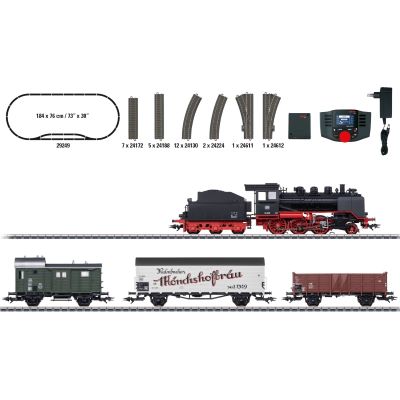
Class 24, freight wagons, C Track and a Mobile Station.
View product
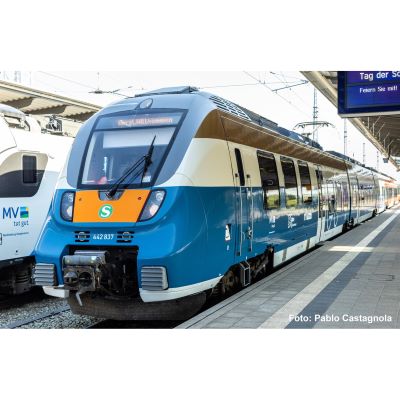
Five-part regional multiple unit with AC sound.
View product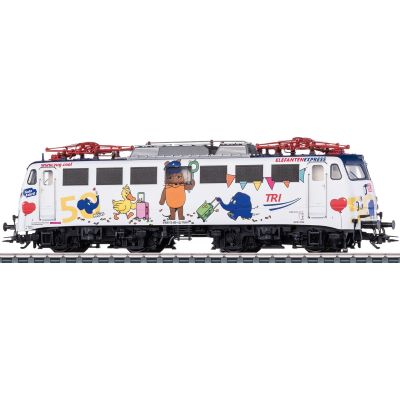
Striking TRI electric locomotive with extensive functions.
View product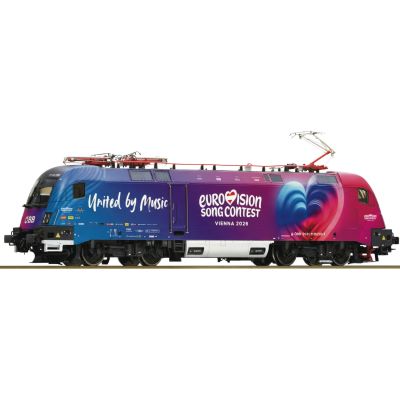
Eurovision special-livery locomotive with AC sound.
View product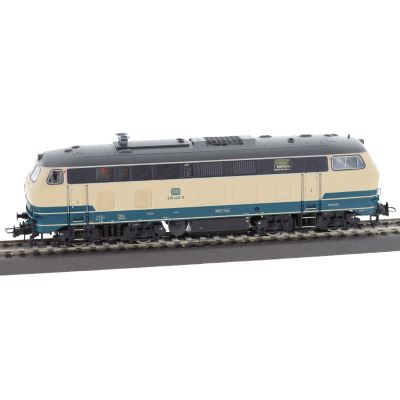
Ocean blue and beige Deutsche Bundesbahn locomotive with sound.
View product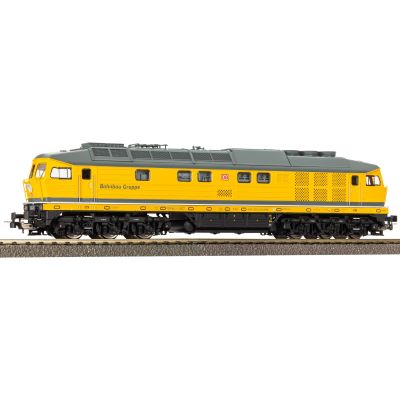
Heavy yellow engineering-train locomotive with AC sound.
View product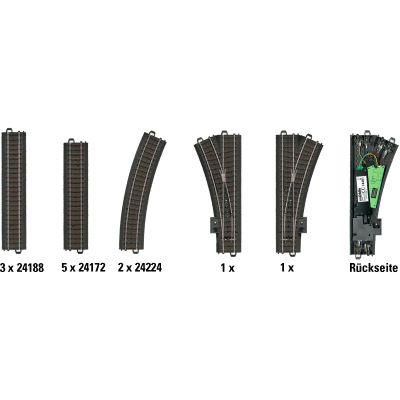
Track and two digitally equipped turnouts.
View productIn model railway retail, H0 AC normally refers to the Märklin-compatible centre-contact system. PIKO, Roco, BRAWA and ESU also offer suitable vehicles.
The term AC is historical. A digital track carries an encoded signal. The decisive features are the centre pickup shoe and the digital protocol.
Yes, provided that the command station and vehicle decoder support DCC. The locomotive still requires a centre pickup shoe.
The decoder and a compatible command station exchange the vehicle name, function icons and additional data bidirectionally.
Many vehicles operate from approximately 358 or 360 millimetres. Long passenger coaches look considerably better on wider radii.
Normally not without conversion. The centre pickup shoe, current collection, wheelsets and decoder must be adapted.
Frequently yes. Suitable AC wheelsets may be required for reliable operation through turnouts, feedback or interior lighting.
A booster is required when the power demand or layout size exceeds the output of the command station, or when separate short-circuit districts are required.
One outer running rail is insulated. An AC wheelset reconnects it to the common return conductor when entering the section and therefore produces a feedback signal.
The Mobile Station suits compact layouts. The Central Station additionally provides routes, feedback, networking and automation.
Further gauges, manufacturers, layout-building advice and digital topics are available in the central model railway guide.