Code 83 and NEM Vehicles
The rail profile is approximately 2.07 millimetres high and corresponds to Code 83. It is suitable for current H0 vehicles whose wheel flanges follow the usual NEM dimensions.

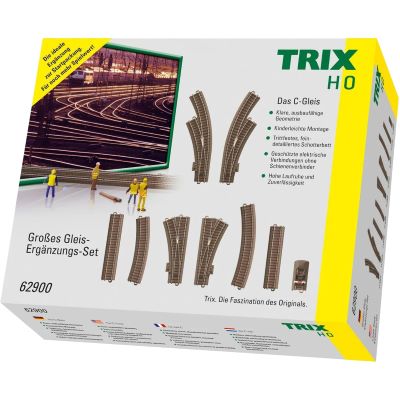
Explore the large Trix 62900 extension set and four complete C-Track packages for the NOCH Easy-Track layouts Andreastal, Karlsberg, Martinstadt and Theisensee. The guide also explains how two-rail technology, Code 83, radii, turnouts and transition tracks work together.
Trix H0 represents model railways at a scale of 1:87 using a model track gauge of 16.5 millimetres. The current H0 two-rail system uses the two electrically isolated outer rails to supply traction current. Suitable H0 DC vehicles from different manufacturers can therefore operate on the same track.
Trix C-Track was developed from the basic concept of Märklin C-Track but is electrically configured for two-rail operation. Rails, sleepers and the moulded ballast body form a stable unit. The precise click connection aligns adjoining track mechanically while also creating a reliable electrical connection.
A Trix track set combines matching straights, curves, turnouts and track ends for a particular task. Set 62900 expands starter sets with passing, storage and parallel tracks. The four Easy-Track packages, by contrast, contain the track combination for a complete predefined NOCH route plan.
The track can be operated using analogue or digital control . On a digital layout, a suitable DCC command station controls the vehicles. Turnout drives, turnout decoders, feedback modules and additional power feeds are added to suit the intended operating concept.
Check the package contents: An Easy-Track track set supplies the track listed on the relevant product page. The baseboard, NOCH route-construction kit, scenery, vehicles, controller and electric turnout drives are included only when expressly stated as part of the package.
The system combines fixed geometry with quick assembly, integrated roadbed and two-rail current distribution suitable for H0 DC layouts.
The rail profile is approximately 2.07 millimetres high and corresponds to Code 83. It is suitable for current H0 vehicles whose wheel flanges follow the usual NEM dimensions.
The plug connection holds the track securely together. Contact points beneath every track section mean that traction current does not have to be supplied through one particular feeder track.
Standard and curved turnouts have polarising metal frogs. Suitable versions can later be fitted with an electric drive, turnout lantern and digital decoder.
| Track Component | Dimension | Typical Purpose |
|---|---|---|
| Straights 62064 to 62236 | 64.3 to 236.1 mm | Construct routes and compensate for turnout connections precisely |
| Radius R1 | 360 mm | Compact curves and curved turnouts |
| Radius R2 | 437.5 mm | Regular outer curve and turnout branch |
| Radius R3 | 515 mm | Smoother curves for longer vehicles |
| Radius R4 | 579.3 mm | More generous visible routes |
| Standard Turnouts | 188.3 mm · 24.3° · R2 | Stations, passing loops and branches |
| Curved Turnouts | R1 · 30° | Begin a branch within a curve |
Trix transition track 62951 is intended for connecting the system to conventional Code 83 track without moulded roadbed. The railhead height, substructure and electrical isolation must be checked carefully before the track is fixed permanently.
The set is not a complete starter set or closed oval. It is intended for extensively expanding an existing Trix C-Track route or a compatible starter set.
The track is already matched to the geometry of the relevant route-construction kit. This avoids having to compile a long parts list individually, while the scenery, buildings and operating concept can still be designed freely.
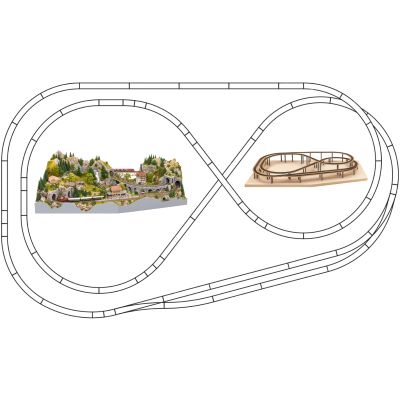
R1 and R2 curves, a standard turnout, a curved turnout and numerous straights create an interwoven multi-level route.
View Andreastal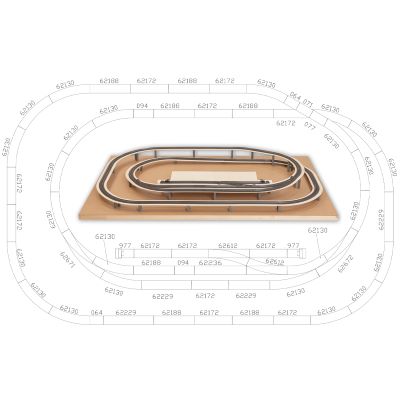
Two curved turnouts, two right-hand standard turnouts and two buffer stops permit continuous running, station operation, storage and initial shunting tasks.
View Karlsberg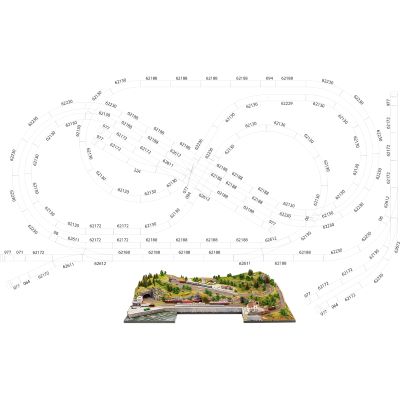
Nine standard turnouts, one curved turnout, eight buffer stops and numerous R1 and R2 tracks create a station, storage group and long running routes.
View Martinstadt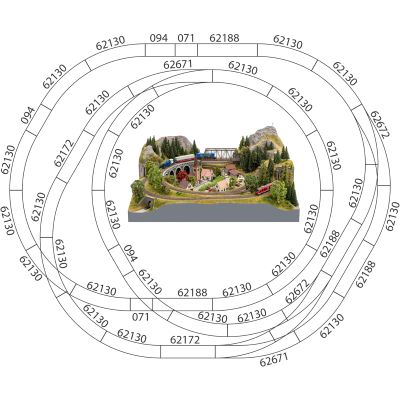
Four curved turnouts and R1 curves create a compact plan with a siding accessible from both directions and an additional storage track.
View TheisenseeNote about the Theisensee product name: The linked shop product includes the wording “without roadbed”. The individually listed 62xxx components nevertheless belong to the Trix C-Track system with its characteristic integrated ballast body.
The corresponding substructures are NOCH 53605 Andreastal , NOCH 53600 Karlsberg , NOCH 53610 Martinstadt and NOCH 53615 Theisensee .
The five sets use a manageable group of recurring straights, curves and turnouts. This makes later modifications easier using individual tracks , turnouts and track accessories .
171.7 and 188.3 millimetres together produce 360 millimetres. This combination defines long routes, station tracks and systematic compensation beyond turnouts.
Straights measuring 64.3, 70.8, 77.5 and 94.2 millimetres close small gaps and return complex turnout connections to the track grid.
The 229.3- and 236.1-millimetre straights are used within larger station geometries and in conjunction with slender turnouts or specialist curves.
Both tracks have a curve angle of 30 degrees. Twelve pieces form a complete circle. R2 creates a visibly more generous alignment than R1.
The 188.3-millimetre turnouts branch through 24.3 degrees using radius R2. Their frogs can be polarised to support reliable current pickup.
The inner and outer curves are already positioned within the curve. A siding can therefore begin without an additional straight section, saving layout length within a compact area.
The track end, measuring approximately 80.5 millimetres, is suitable for loading tracks, storage and shunting groups. Sufficient braking distance should remain before the buffer stop.
The transition track connects Trix C-Track with conventional Code 83 two-rail track. The substructure must compensate for the difference in roadbed height.
Trix C-Track does not include conventional flexible track. Anyone planning free radii or long transition curves can change to flexible Code 83 track at a suitable point using 62951. Every system transition should be tested using the longest locomotives and coaches before ballasting.
External dimensions and track quantity are not the only deciding factors. Vehicle radii, train lengths, accessibility and the planned electrical control system are equally important.
In addition to the base area, allow sufficient space for operation, cables, layout edges and maintenance access.
Set 62900 expands existing track. Easy-Track packages equip a particular complete route plan.
R1 is compact but is not ideal for every long vehicle. The specification for the individual vehicle remains binding.
Stations and storage tracks must accommodate the longest intended train completely between the turnouts and buffer stop.
Plan additional power feeds, isolation points, feedback and turnout decoders before constructing the scenery.
Connect the track loosely at first and test every route in both directions using several different vehicles.
Trix 62900 provides the largest universal extension.
Theisensee begins at approximately 125 × 105 centimetres.
Andreastal combines several levels and interwoven running routes.
Martinstadt contains a particularly large number of turnouts and terminal tracks.
Further guidance is available under Plan a Model Railway , in the Track Planning category, in the Model Railway Calculators and in the Digital Model Railways overview.
Scale, track gauge and electrical system must all be compatible. Similar brand names or identical distances between the rails are not sufficient to ensure safe compatibility.
| System | Scale | Track Gauge | Classification |
|---|---|---|---|
| Trix H0 C-Track | 1:87 | 16.5 mm | Two-rail track used by the five listed sets |
| Märklin H0 C-Track | 1:87 | 16.5 mm | Stud-contact centre conductor and a different electrical system |
| Trix Express | 1:87 | Historic H0 system | Independent three-rail technology and specialist wheelsets |
| H0m | 1:87 | 12 mm | Metre gauge using independent track |
| H0e | 1:87 | 9 mm | Narrow gauge and not interchangeable with Trix H0 C-Track |
| H0f | 1:87 | 6.5 mm | Field and industrial railways at H0 scale |
| Minitrix N Gauge | 1:160 | 9 mm | A separate, smaller product family under the Minitrix brand |
Trix C-Track and Märklin C-Track use similar dimensions for many geometric elements but are designed for different electrical systems. Mixed operation requires deliberately planned electrical isolation and appropriately equipped vehicles.
These answers help with set selection, electrical systems, radii, Easy-Track and later expansion.
The overview contains the five Trix products currently listed in the track-set category: 62900, Andreastal, Karlsberg, Martinstadt and Theisensee.
It is an H0 two-rail track system with integrated roadbed, a Code 83 profile and a stable click connection. The two outer rails are electrically isolated from one another.
No. Set 62900 is an extensive extension package for an existing starter set or C-Track layout. It contains straights, curves, turnouts and a buffer stop.
The Trix set contains the matching track combination. The precut routes, pillars and assembly documents belong to the separately linked NOCH route-construction kit.
Theisensee requires a minimum area of approximately 125 × 105 centimetres. The assembled routes themselves measure approximately 123 × 103 centimetres.
Yes. For analogue operation, it is connected to a suitable two-rail controller. A compatible DCC command station can be used for digital operation.
The geometry is similar, but the electrical current distribution differs. Märklin uses a centre conductor, while Trix uses two electrically isolated outer rails. Straightforward combined operation is therefore not intended.
Not automatically. R1 has a radius of 360 millimetres. The manufacturer's minimum-radius specification for the individual vehicle remains decisive. Long coaches and large locomotives benefit from R2 or larger radii.
Transition track 62951 is intended for conventional Code 83 track. The roadbed height, railhead level and electrical power feed must also be matched correctly.
The product name contains that wording. The 62xxx components listed on the product page nevertheless belong to the Trix C-Track system with its integrated ballast body.

Explore individual straights, radii, turnouts, track ends, H0 DC vehicles and digital technology for further expansion of your Trix layout.