
Wartburg Models for Model Railways and Dioramas
The GDR Classic from Eisenach in Model Form
The Wartburg is one of the best-known cars of the GDR and remains a symbol of East German automotive history. It was built at the traditional automobile plant in Eisenach, a location whose vehicle production history goes back to 1898. For model railway enthusiasts, the Wartburg is especially interesting because it fits credibly into many everyday scenes from Eras III, IV and early V. Whether as a family saloon in front of a prefab apartment block, a Tourist estate car at the station, a taxi outside the station building, a driving-school car in town or a Volkspolizei vehicle on duty: Wartburg models instantly bring period atmosphere to a layout.
At Modellbahnshop, you will find Wartburg models in the popular H0 and TT scales. H0 in 1:87 scale is ideal for detailed street scenes, dioramas and collector showcases. TT in 1:120 scale is especially well suited to East German layouts, as this gauge has traditionally been strongly associated with the model railway landscape in Saxony, Thuringia and Brandenburg. Manufacturers such as Herpa, Tillig and Brekina offer suitable models for collectors, layout builders and fans of historic GDR vehicles.

Why do Wartburg models fit so well on a model railway?
The Wartburg was omnipresent on the roads of the GDR. This is exactly why a Wartburg model on a model railway does not look like a decorative extra, but like a natural part of everyday layout life. It connects roads, stations, residential areas, workshops, excursion traffic and official vehicle scenes. With just a few cars, an entire scene can be placed in its correct historical period.
What is a Wartburg?
Wartburg was the brand name for passenger cars from the Eisenach automobile plant. The name refers to Wartburg Castle above the city of Eisenach and therefore combines regional identity with automotive history. While the Trabant was considered a small car, the Wartburg played the role of a larger family and mid-range car in the GDR. It offered more space, had a more substantial appearance and was also used as a company car, official vehicle, taxi, estate car and commercial variant.
From the Wartburg 311 to the Wartburg 353
The elegant Wartburg 311 and the more angular Wartburg 353 are especially well known. The Wartburg 311 stands for the flowing shapes of the 1950s and early 1960s. Coupé, cabriolet, camping and estate versions look particularly nostalgic in model form and fit perfectly into historic town scenes, excursion destinations or Era III railway stations. The Wartburg 353, by contrast, shaped the streetscape of the 1960s, 1970s and 1980s. Its clear lines, four-door saloon body and popular Tourist estate version make it the ideal vehicle for everyday GDR scenes.
Typical Wartburg Series in Model Form
- Wartburg 311: elegant classic with rounded shapes, popular as a coupé, cabriolet and camping version.
- Wartburg 353: angular everyday GDR car, available as a saloon, Tourist, taxi, driving-school car or emergency vehicle.
- Wartburg 353 Trans: practical pick-up version with platform or tarpaulin for trades and depot scenes.
- Wartburg 1.3: late development for post-reunification and transition-period scenes.
Choosing the Right Era
Wartburg 311 models fit especially well into Era III. Wartburg 353 models are ideal for Era IV and can also be used in early Era V scenes. Wartburg model cars therefore make it possible to depict a long period of East German road traffic history.
Wartburg 311 – Elegance from the Early GDR Years
The Wartburg 311 remains popular among classic-car enthusiasts because of its soft, harmonious body shape. In model form, it looks especially charming in front of a café, on a station forecourt, on a country road or beside a historic hotel. Coupé and cabriolet versions show the elegant side of vehicle production in Eisenach. The camping version also adds a touch of travel and leisure culture that feels very lively in miniature worlds.
Wartburg 311 as an H0 Model
In H0, the fine lines of the Wartburg 311 can be seen particularly well. Brekina offers several variants, including coupé, cabriolet and camping versions. These models are suitable for collectors of classic automobiles as well as for layout builders who want to bring life to their roads not only with commercial vehicles, but also with private cars. A Wartburg 311 in two-tone paintwork immediately appears refined and adds a calm, nostalgic accent.

Design Ideas with the Wartburg 311
The Wartburg 311 fits especially well with small railway stations, old-town streets, weekend cottages and excursion restaurants. With figures, road signs, trees and historic buildings, you can create a believable scene from the early post-war decades. Combined with Framo model cars or early commercial vehicles, it creates a harmonious East German vehicle fleet.
Collector Tip
Special body styles such as coupé, cabriolet or camping versions look very attractive in a display case. On a layout, they should be placed deliberately, for example in front of representative buildings, at an excursion station or on a country road.
Wartburg 353 – the Everyday Classic
The Wartburg 353 is the best-known Wartburg in the model railway sector. It was widespread as a saloon, Tourist estate car, taxi, driving-school vehicle, company car and emergency vehicle. This variety makes it especially valuable for layout building. A single model can bring life to a street scene, while several variants already tell a complete everyday story: a family drives to the station, a taxi waits for passengers, the driving school practises at an intersection and a Wartburg Trans delivers materials to the workshop.
Wartburg 353 in TT
TT enthusiasts will find several interesting Wartburg 353 models from Tillig. The orange Wartburg 353 is suitable as a typical private car. The taxi version fits perfectly in front of stations, hotels, bus terminals or town squares. The driving-school car is especially charming because it almost tells a small everyday story on its own. Such vehicles make a TT layout instantly livelier without requiring much space.
TT Scenes with Wartburg Vehicles
| Model | Scale | Ideal Area of Use |
|---|---|---|
| Tillig 08708 Wartburg 353 | TT 1:120 | Residential area, country road, car park, GDR town |
| Tillig 08706 Wartburg 353 Taxi | TT 1:120 | Station forecourt, hotel, town centre |
| Tillig 08707 Wartburg 353 Driving School | TT 1:120 | Intersection, side street, driving-school scene |
| Tillig 08695 Wartburg 353 Volkspolizei | TT 1:120 | Road check, accident scene, official building |
Combination with Other GDR Vehicles
The Wartburg 353 looks especially believable together with IFA models, Robur, Trabant, Lada, Barkas and suitable lorries. This creates a streetscape that clearly fits the Deutsche Reichsbahn, GDR towns and rural scenes.
Wartburg Tourist, Taxi and Trans
In addition to the saloon, the special Wartburg versions are particularly appealing for model railway layouts. The Wartburg Tourist is the practical estate version and fits families, tradespeople, excursionists and official services. A Tourist with a roof tent or caravan brings a holiday mood to the layout. The Wartburg Trans as a pick-up, by contrast, adds a trade and depot character. With a tarpaulin, it looks like a small delivery vehicle transporting materials, tools or general cargo.
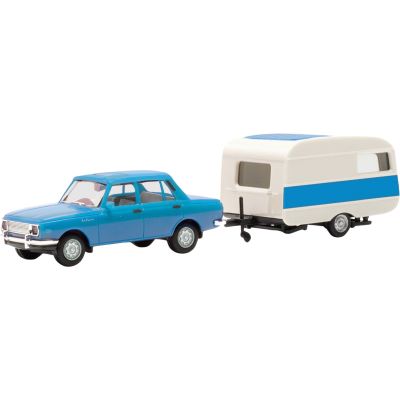
Travel Culture in Miniature
A Wartburg with Qek Junior caravan is a strong motif for a campsite, weekend property, rest area or holiday destination. Combined with figures, suitcases, bicycles and small tents, it creates a scene that is immediately easy to understand. Especially on H0 layouts, such a car-and-caravan combination can become an eye-catcher.
Wartburg Trans for Workshop and Depot
The Wartburg 353 Trans with tarpaulin is very suitable for small businesses, VEB workshops, railway station services or craft scenes. It is smaller than a lorry, but more versatile than a saloon. On the layout, it therefore fills an important gap between passenger car and commercial vehicle.
Suitable Layout Areas
Suitable areas include workshops, coal merchants, builders’ yards, goods sheds, storage yards, garage courtyards and rural village streets. Combined with a Weimar loader or small stacks of cargo, the Trans looks especially authentic.
Wartburg Models by Scale
When choosing a model, the first priority should be matching the scale to the existing layout. H0 offers many details and is suitable for close-up views. TT is more compact and especially strong for East German layouts with longer routes, stations and road areas. Both scales have their own appeal.
H0 Wartburg Models
H0 Wartburg models from Herpa and Brekina show many fine details. These include clean printing, typical body shapes, realistic colours and different versions. They fit perfectly with model cars, lorries, buses, buildings and figures in 1:87 scale. Particularly popular are the Wartburg 353 Tourist, Wartburg 353 Trans, Wartburg 311 Coupé and Wartburg 311 Cabriolet.
TT Wartburg Models
TT Wartburg models from Tillig are ideal for layouts with a GDR focus. They require little space but have a high recognition value. A small station forecourt with taxi, private car and driving-school car already looks complete with just a few vehicles. Combined with TT buildings, figures and road accessories, the result is a very coherent overall scene.
Which Colour Fits Which Scene?
- Orange and beige: typical everyday colours for private cars and urban traffic.
- White: suitable for driving schools, company cars and neutral scenes.
- Brown: ideal for taxis, Trans versions and a typical 1970s atmosphere.
- Green and white: suitable for Volkspolizei and official use.
- Red or light blue: appealing for coupé, cabriolet, excursion and collector scenes.
Detail Tip
Wartburg models look especially realistic when they are not all lined up perfectly. Slightly offset parked vehicles, a small repair scene or a taxi with waiting figures create much more life than a simple row of cars.
Selected Wartburg Models at Modellbahnshop


Using Wartburg Models Realistically
Station and Urban Traffic
A station forecourt quickly looks empty without road vehicles. With a Wartburg taxi, private car and Tourist estate, a lively transition between rail and road is created. Bus stops, porters, figures, timetables and small kiosks fit well with this. Especially in combination with DR passenger trains, the result is a very typical Era IV impression.
Residential Area and Everyday Life
In front of prefab apartment blocks, garage rows and residential houses, Wartburg, Trabant and Lada almost belong naturally in the scene. A parked Wartburg 353, a family estate car and a driving-school car at an intersection are enough to clearly identify an everyday scene.
Recommended Additions
Suitable additions include street lamps, garages, figures, bicycles, prams, small trees, waste bins and period road signs. Subtle weathering of the road surface also improves the effect.
Holiday, Camping and Excursions
Wartburg models with roof tent or Qek caravan are ideal for holiday motifs. A small campsite, rest area or excursion restaurant at the edge of a forest becomes immediately understandable with such vehicles. Combined with figures, tents, tables and bicycles, a charming scene is created that attracts attention even away from the tracks.
Authorities, Police and Service Vehicles
Wartburg vehicles were also used as service and emergency vehicles. Volkspolizei versions fit accident scenes, road checks, official buildings or barriers. For further emergency-service themes, it is worth taking a look at fire brigade model cars. There you can find complementary vehicles for rescue, emergency and plant-protection scenes.
Frequently Asked Questions about Wartburg Models
Questions and Answers for Model Railway Enthusiasts
Which Wartburg models fit a GDR model railway?
For GDR layouts, Wartburg 353 saloons, Wartburg Tourist, Wartburg taxi, driving-school cars, Volkspolizei vehicles and Wartburg Trans versions are especially suitable. For earlier scenes, Wartburg 311 coupé, cabriolet and camping versions are particularly appropriate.
Are Wartburg models available in H0?
Yes, many Wartburg models are available in H0 from Herpa and Brekina. Particularly popular are the Wartburg 311, Wartburg 353 Tourist, Wartburg 353 Trans and Wartburg 353 with caravan.
Are Wartburg models available in TT?
Yes, Tillig offers several Wartburg 353 models in TT. These include private cars, taxis, driving-school cars and Volkspolizei versions. These models are ideal for compact GDR street scenes.
Which era is right for Wartburg models?
The Wartburg 311 fits especially well into Era III. The Wartburg 353 is typical of Era IV and can also be used for early Era V scenes. The Wartburg 1.3 is suitable for late GDR and post-reunification scenes.
How do I combine Wartburg models on a layout?
A very coherent combination includes Trabant, IFA, Robur, Framo, Barkas, Lada, buses, figures and typical GDR buildings. It is important that vehicles, buildings and road accessories match each other historically.
Conclusion: Wartburg Brings Everyday GDR Life to the Model Railway
Wartburg models are small but effective witnesses of their time. They tell stories of everyday life in the GDR, holidays with a roof tent, station taxis, driving schools, official vehicles, family trips and workshop journeys. Whether H0 or TT, Wartburg 311 or Wartburg 353: these models fit perfectly into historic layouts, collections and dioramas with an East German theme.
Anyone who wants to create a believable GDR street scene should combine Wartburg models with suitable model cars, IFA vehicles, Robur models and typical buildings. This creates a lively miniature world in which road, railway, everyday life and vehicle history convincingly belong together.