Hilltop Castle
The classic model railway castle on a hill, rocky spur or slope. Its visual impact comes primarily from the height difference between the castle, railway, road and settlement below.

On a rocky spur above the valley, between woodland and vineyards or beside a historic town: castles add height, depth and an unmistakable silhouette to a model railway.
Designing model railway castles means developing the building and landscape together. Hardly any other building type is so strongly connected with its location. A hilltop castle depends on its rocky spur or ridge, a moated castle on the surrounding water, and an urban fortification on walls, gates and neighbouring buildings.
The term castle covers many very different structures. For model planning, it is particularly useful to distinguish elevated castles from lowland castles. Hilltop castles stand on summits, spurs, slopes or exposed rock. Moated castles, by contrast, are lowland fortifications whose character is defined by moats, ponds or natural waterways.
Historically, the distinction between a defensive castle and a more representative residence is not always clear-cut. For model railway scenery, however, a practical distinction can still be useful: a defensive site is emphasised with walls, gates, towers and a strategic position, while a stately residence can be surrounded by gardens, parkland, an approach road and a more cultivated landscape.
The scene does not have to represent the Middle Ages. In later railway eras, castles may appear as ruins, museums, hotels, restaurants or tourist attractions. They can therefore be combined convincingly with steam traction, post-war railway scenes, modern trains and contemporary road traffic.
The classic model railway castle on a hill, rocky spur or slope. Its visual impact comes primarily from the height difference between the castle, railway, road and settlement below.
A lowland castle whose moat or surrounding water forms part of the complete scene. Bridges, shorelines and water require additional space around the building.
Particularly flexible and comparatively space-efficient. A ruin can stand on a small rocky base, beside woodland or high above a railway line.
City walls, gates and defensive towers connect the castle theme with an old town and work especially well as a clearly defined historic edge to an urban scene.
More representative than a classic defensive fortress. Gardens, parkland, an approach road or water features can strengthen the prestigious character.
An effective transition between woodland and architecture. A hunting lodge can be presented as an excursion destination, museum, hotel or historic residence.
A castle should not simply occupy an otherwise unused corner. Its position determines whether the complete scene appears convincing.
Cut the building footprint from cardboard or place the unbuilt base on the layout. Large models such as Kibri Falkenstein need considerably more surrounding landscape than a compact ruin.
View the model from the positions from which the railway will normally be operated or observed. A clear view of the main tower or keep is often more important than maximum absolute height.
A footpath, forest road or narrow access road can connect the castle with the valley. The Model Railway Paths & Squares guide provides suitable ideas for these transitions.
A particularly effective position allows trains to pass visibly below the castle. The railway and historic building remain spatially separated while still forming one strong panorama.
A hilltop castle looks convincing when its terrain does not resemble a separate platform placed beneath the building. Rocks should emerge naturally from the slope and blend into embankments, woodland edges and paths. The Designing Model Railway Rocks guide provides suitable methods for creating the geological structure.
Woodland should not hide the complete building. Larger trees below the walls can make the slope appear steeper, while open rock faces keep the height difference visible. Castle ruins can deliberately include bushes and smaller trees reclaiming sections of the old masonry.
A moated castle uses the opposite scenic principle. Its effect comes less from height and more from the surrounding water. Shorelines, bridge and water surface should therefore be planned as one continuous scene. The Model Railway Lakes & Water guide provides suitable fundamentals for the water area.
Perspective tip: on a small layout, a compact castle positioned higher towards the backdrop can appear larger than a huge model directly at the front edge. Layered terrain, exposed rock and smaller nearby vegetation reinforce this effect.
Not every historic scene needs a complete castle. A town gate with a few wall sections can define the edge of an old town much more convincingly while requiring considerably less space. This is particularly useful on densely built H0 and N layouts.
The current Modellbahnshop castle category includes round towers, defensive towers, town gates and complete old-town wall sets. Such elements can follow a street, define a square or mark the transition between a historic centre and later suburban development.
Walls should not end without an understandable reason. Their end can disappear behind a house, merge into a rocky slope or remain visible as a deliberately broken section. A gate, by contrast, needs a road or path that genuinely passes through it.
A castle ruin is one of the most flexible historic structures for a model railway. It can stand above a gorge, inside woodland, against the backdrop or directly beside a walking route. NOCH offers hand-coloured textured rigid-foam ruins, while FALLER offers traditional construction kits with keeps and surviving wall sections.
Restraint is useful when weathering. Rain streaks, darker joints and several related stone colours are often sufficient. Vegetation naturally gathers around wall bases, cracks and flatter protected surfaces. Uniformly applied moss, by contrast, can quickly make a ruin look artificial.
On a modern layout, the ruin can also be a tourist destination. Benches, walkers, an information board and a secured access path explain why visitors and routes are present.
A historic castle does not have to stand in a purely medieval diorama. On a regular model railway representing Eras III to VI, a museum, hotel, restaurant or tourist attraction is usually a more logical interpretation.
If a medieval festival is deliberately being represented, H0 knight figures and tournament scenes can be used. Preiser offers fighting knights and mounted tournament figures, while NOCH offers an animated jousting tournament with sound. Such features work best as a clearly defined event outside a preserved castle.
For a quieter everyday scene, walkers, visitors and a small number of vehicles are enough. A restaurant, viewpoint or car park at the foot of the castle hill can explain modern excursion traffic without reducing the historic character of the building.
| Gauge | Scale | Typical Situation | Recommendation |
|---|---|---|---|
| Z | 1:220 | Specialist, background and scratch-built projects | Use compact fortifications or distant background structures. |
| N | 1:160 | Castles, moated castles, walls, defensive towers and town gates | Ideal for extensive castle landscapes with moderate space requirements. |
| TT / TTm | 1:120 | Several H0/TT structures and background models | Castle ruins and town gates work particularly well. |
| H0 / H0m / H0e | 1:87 | Broadest current specialist selection | Complete castle complexes and modular town fortifications are possible. |
| 0 / 0e | approx. 1:45 | Specialist and scratch-built projects | Prefer individual towers, wall sections or ruin scenes. |
| 1 / Im | 1:32 | Mainly individual projects | Build a strongly compressed castle section or scenic façade. |
| G / IIm | often approx. 1:22.5 | Large castle ruins and historic structures | Use generous landscape dimensions and strong height differences. |
Compare the height, length and width of the model with the available layout area.
A hilltop castle needs rock and slopes, while a moated castle requires enough room for water, shoreline and bridge.
The principal tower should remain clearly visible from at least one important viewing position.
Several related grey, brown and beige shades usually appear more natural than one uniform wall colour.
Continue the rock texture beyond the edge of the building base so that the castle hill does not appear artificially attached.
Steep access routes can be narrow, but they should remain visibly connected to the valley, public road or car park.
Smaller vegetation close to the castle and larger trees lower on the slope can strengthen the sense of perspective.
Walkers, visitors, a medieval festival or museum use gives the model an understandable purpose.
Castles, ruins, historic residences, city walls, gates and defensive towers.
Wall sheets and stone surfaces for castle hills and old towns.
Woodland, parks and mature trees around castles and historic residences.
Wooded mountain slopes and upland landscapes.
Overgrown walls, ruins and natural woodland edges.
Visitors, walkers and further figures for castle scenes.
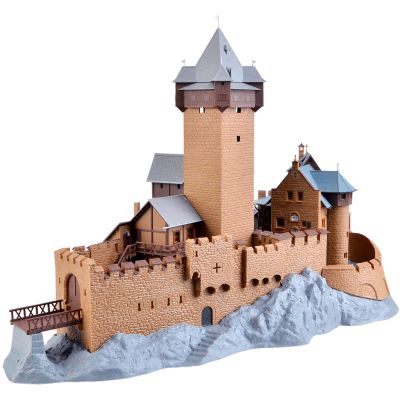
Large castle complex with towers and defensive walls for a dominant hilltop landmark.
View Product →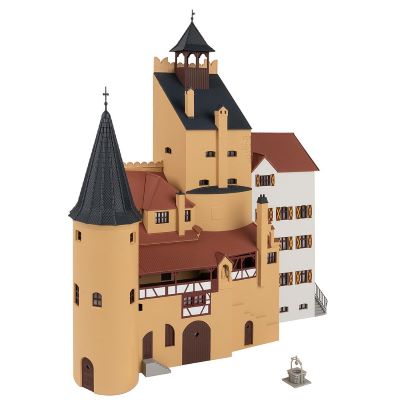
Detailed Era I castle complex with several towers and distinctive historic architecture.
View Product →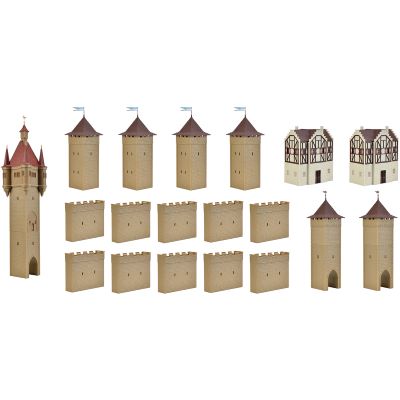
Extensive castle complex with walls, towers and integrated lighting for a complete historic scene.
View Product →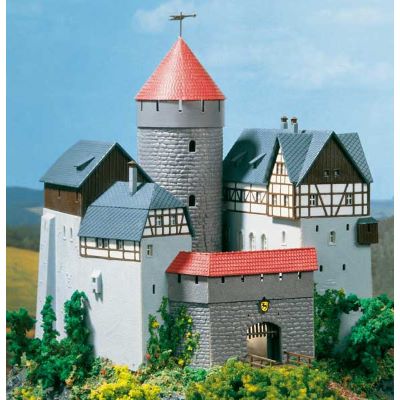
Historic castle ruin designed as a background model and also suitable for perspective use in H0, TT and N scenery.
View Product →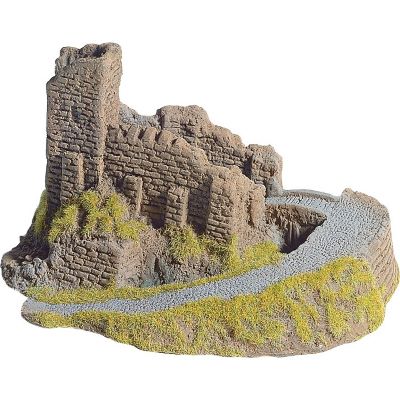
Hand-coloured textured rigid-foam ruin for rocky scenery, woodland edges and background landscapes.
View Product →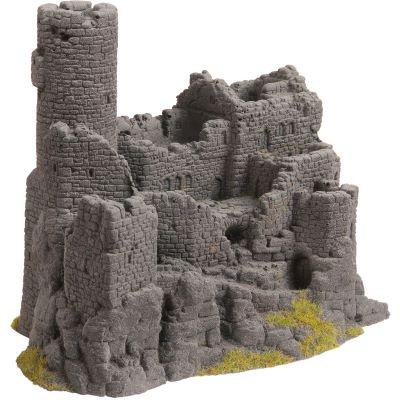
Compact hand-coloured ruin for a rocky spur, walking route or romantic landscape scene.
View Product →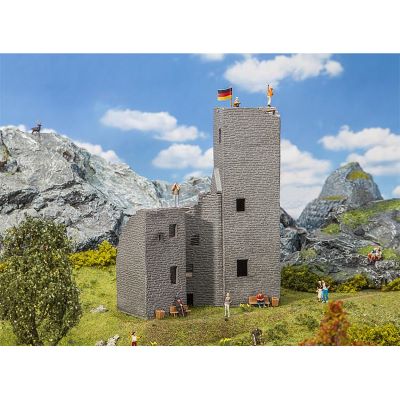
Ruined castle with keep and viewing-point character for walking and excursion scenes.
View Product →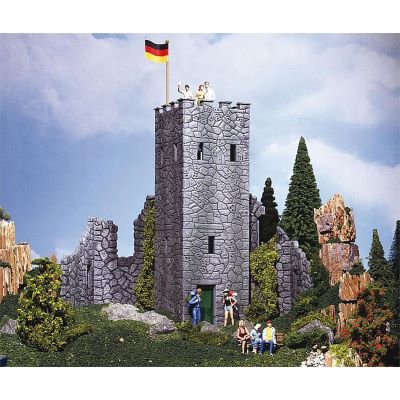
Large historic tower and wall sections for expansive garden-railway landscapes.
View Product →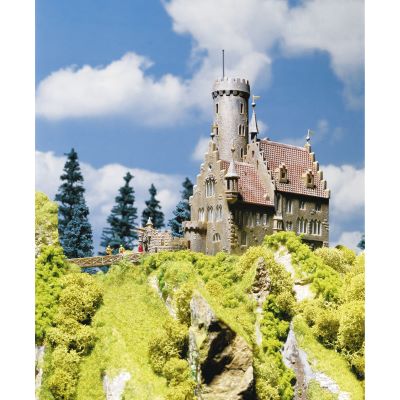
Neo-Gothic castle model supplied with a raised mountain base for a particularly prominent scenic position.
View Product →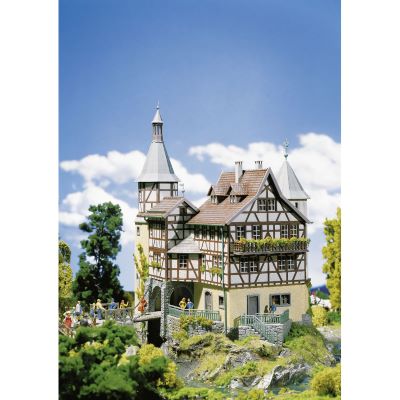
Representative hunting lodge with wooden drawbridge, suitable for a water or moat setting.
View Product →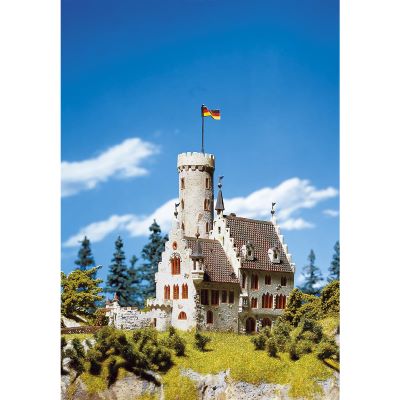
Compact N-scale castle with surrounding moat as the basis for a complete historic water scene.
View Product →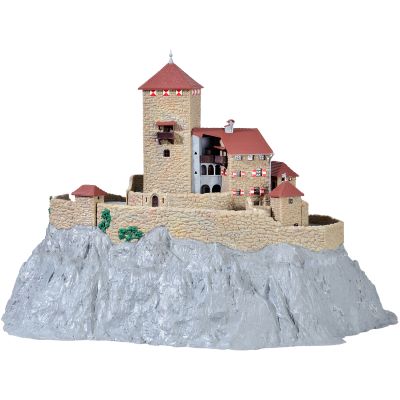
Large N-scale castle with integrated mountain scenery for an immediately recognisable elevated setting.
View Product →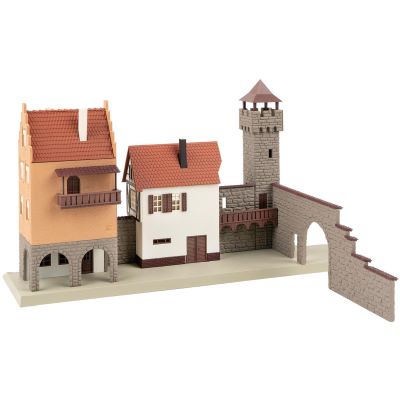
Historic wall ensemble for a fortified town edge and old-town scene.
View Product →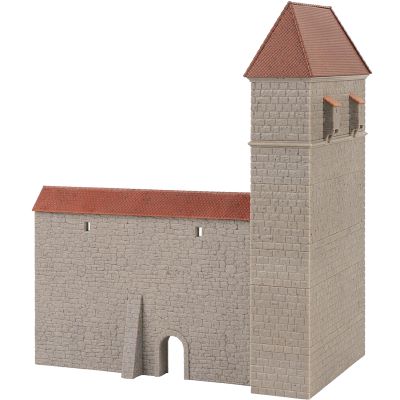
Modular old-town wall set with stairs and covered wall walk.
View Product →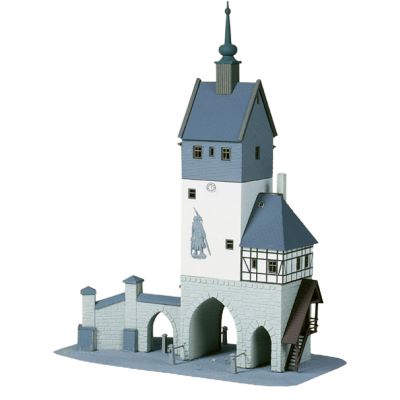
Tall historic gate tower with adjoining wall remains for a distinctive old-town entrance.
View Product →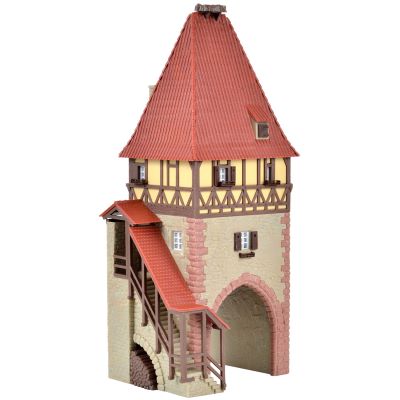
Historic gate tower for city fortifications, a castle complex or a compact old-town scene.
View Product →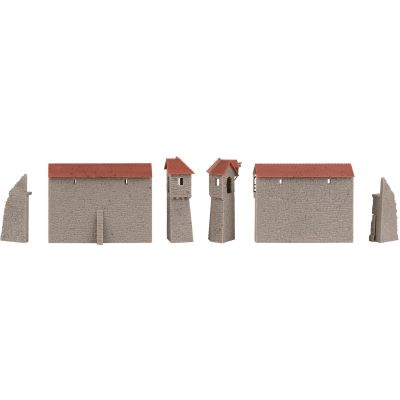
Multi-part N-scale set with towers and historic wall sections for a complete town fortification.
View Product →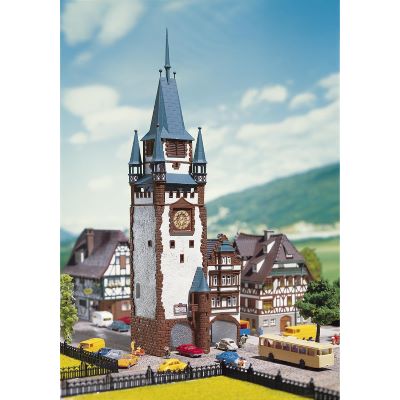
Tall and comparatively space-efficient historic gate tower for a distinctive street scene.
View Product →
Four knight figures for a castle festival, exhibition or historic diorama.
View Product →
Mounted knights for historic tournament and festival scenes.
View Product →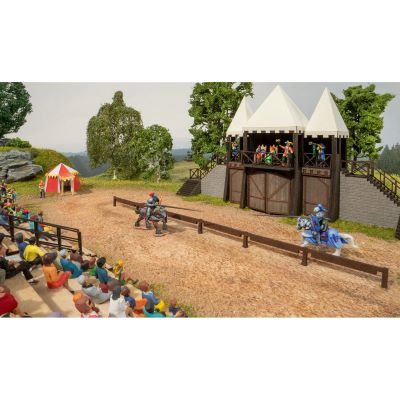
Animated tournament scene with figures, movement and sound as an unusual focal point for a castle festival.
View Product →When this section approaches the viewport, the finder checks current English shop pages for castles and fortifications together with selected figure, wall and landscape products. Recognised archive, B-stock and clearance products are excluded. Prices, delivery times and availability are deliberately not displayed.
Current castle products will be loaded when this section approaches the viewport …
Large castle complexes, compact ruins and modular town fortifications differ greatly in the space they require. Manufacturer pages are therefore particularly useful when comparing additional buildings and matching accessories.







Even the most impressive castle will not look convincing if the terrain does not suit it. Large castles need a carefully shaped hill, moated castles need a genuine water setting, and ruins need believable integration into vegetation and exposed rock.
A hilltop castle works particularly well on a mountain, rocky spur or elevated backdrop. A moated castle needs a flatter setting with water or a surrounding moat.
A hilltop castle uses its elevated topographical position. A moated castle is a lowland fortification whose character is defined by water-filled moats or natural waterways.
Historically, the terms are not always completely distinct. For model scenery, a defensive castle can be emphasised with walls and strategic positioning, while a stately residence can be presented more representatively with gardens, parkland or a formal approach.
A castle ruin, single defensive tower or town gate needs comparatively little space while still creating a strong historic effect.
Rocks, slopes and the castle base should blend together without an obvious transition. Vegetation can then be distributed irregularly across the hillside.
Use several related stone colours, darker joints and selective vegetation around wall bases and cracks rather than applying weathering uniformly.
Yes. It can be presented as a museum, hotel, restaurant, viewpoint or tourist destination.
Plan the castle, moat, bridge and shoreline as one complete scene. The water requires additional space around the building.
H0 currently offers the broadest specialist selection of complete castles, ruins, walls and towers. Models are also available in N, H0/TT and G.
An elevated background position, smaller nearby vegetation and a clear sightline towards the principal tower or keep increase the perceived size.
City walls, town gates and defensive towers provide a logical transition between the castle complex and historic streets and buildings.
Walkers and visitors suit modern scenes. Knights, tournament participants and other historic figure groups are suitable for castle festivals and themed displays.
Content, English category structure and product links checked on . Please additionally verify model dimensions, scale assignments and specific technical details on the respective product pages.
Further detailed guides covering mountains, rocks, forests, water, town scenery, buildings, gauges and layout planning can be found in the central Model Railway Guide.