Quarry Face and Extraction Area
The exposed rock face forms the visual centrepiece. Different levels, drilling marks, fractured surfaces and fresh lighter rock make it clear that material is actively being extracted here.

Quarry faces, dusty haul roads, excavators, dump trucks, field railways, crushers, conveyor belts and ballast loading combine scenery and industrial operation into an exceptionally active model railway theme.
Designing quarries on model railways means much more than placing a bare rock face beside the track. A quarry is both a working and transport environment. Stone is extracted from the quarry face, collected, transported to the processing plant, crushed, separated into different grain sizes and then stored or loaded for dispatch. This visible material flow is what makes the theme especially interesting in miniature.
Large modern prototype quarries are often worked in a series of benches. This creates several approximately horizontal working levels separated by high rock faces. Excavators, wheel loaders and heavy haul vehicles move along these benches. The same stepped terrain form works extremely well in miniature and generally looks much more believable than one single vertical wall.
After extraction, the rock is often processed using crushers, screening equipment and conveyor belts. Different grain sizes are stored separately in ballast or aggregate stockpiles. A ballast plant or processing facility immediately explains why conveyors, silos, lorries and freight wagons all meet at the same location.
From an operational point of view, a works or field railway makes the quarry especially attractive. Current H0f gauge represents very narrow field railways at 1:87 scale with a 6.5 mm model track gauge. Compact locomotives and small wagons need very little space and can transport stone from the quarry face to a crusher or transfer point. For onward transport on the main railway, standard-gauge bulk or self-unloading wagons are suitable.
Not every section has to be represented in full. Three or four clearly recognisable functional zones are often enough to tell a convincing quarry story.
The exposed rock face forms the visual centrepiece. Different levels, drilling marks, fractured surfaces and fresh lighter rock make it clear that material is actively being extracted here.
A relatively level area in front of the rock face provides space for excavators, wheel loaders and transport vehicles. Individual boulders, dust and tyre marks make its purpose clearly visible.
Coarse rock enters the crusher. Conveyor belts, screens, silos and transfer points connect the different stages of processing.
Material of different grain sizes is stored separately. Stockpiles should vary slightly in shape, height and colour instead of looking like identical cones of sand.
Short tracks with small wagons are particularly suitable for historic or compact quarry scenes. Turnouts and loading points give every movement a clear operational purpose.
Dump trucks, tipper lorries, a weighbridge and dusty works roads complement modern quarries. Roads should look wide enough for heavy vehicles to manoeuvre realistically.
Visual tip: A quarry appears more convincing when the rock face looks as though it has been cut into an existing landscape. A vegetated upper edge, exposed geological layers, bare working areas and aggregate piles should therefore have clearly different surfaces.
A prototypical quarry is easiest to plan by defining the material flow first. The positions of excavators, roads, field railway, crusher and loading facilities then follow almost automatically.
The active section can be lighter, dustier and less vegetated. Older or disused parts of the rock face may appear darker and already carry the first groups of grass and bushes.
Do not place an excavator in front of a rock wall without an accessible haul road. Dump trucks need sufficiently wide roads, while a field railway needs a loading point, route and unloading location.
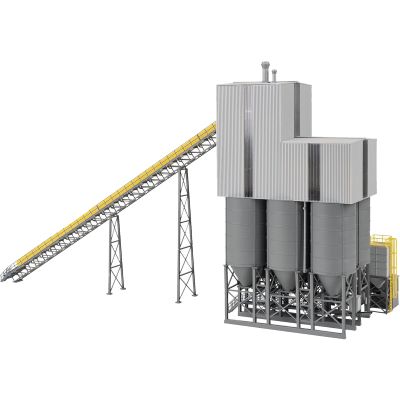
The FALLER modern ballast plant is a useful example of a clearly recognisable processing layout with production equipment, silos and conveyor technology. In H0 it requires considerable space, making it especially suitable as the main visual theme.
Self-unloading, ballast and open freight wagons create a logical connection to the main railway. The freight train now has a clear transport task instead of merely passing through the scenery.
A full-size quarry occupies an enormous area, so deliberate compression is essential on a model railway. The most convincing solution is often to show only a section: one high quarry face, two working levels, a haul road, a crusher and a loading scene. The rest of the operation can continue imaginatively beyond the edge of the layout or behind the backdrop.
A quarry is particularly effective in a corner of the layout. The rock face can connect two sides of the backdrop while visually separating a technical working area from a village, forest or station. An existing raised terrain edge can also be converted effectively into an extraction area. Basic construction techniques for these forms are covered in Build Model Railway Terrain .
Visible quarry benches should be wide enough to look functional. Large machines need turning areas and should not appear trapped directly against a vertical model edge. Low stone or earth berms beside haul roads further reinforce the appearance of heavy industrial traffic.
The rock treatment itself depends on the represented geology. Granite and other massive rocks generally appear angular and grey, while sandstone often shows visible strata and warmer beige and brown colours. A common fracture direction is especially important. Detailed techniques for casting moulds, filler, washes and dry-brushing are explained in Designing Model Railway Rocks .
A drill rig, restricted working area, loose boulders and machinery are more than sufficient to suggest an active quarry in miniature. Pyrotechnics or real explosives have no place in model railway construction.
The landscape itself can be represented in every model size. The main differences concern vehicles, field railways, conveyor equipment and the amount of space required.
| Gauge / Scale | Particular Strength | Suitable Quarry Concept |
|---|---|---|
| Z · 1:220 | Extensive scenery in very little space | Rock face with standard-gauge ballast loading and long freight trains. |
| N · 1:160 | Extensive operational area | Several benches, processing plant and a longer bulk-freight train. |
| TT / TTf · 1:120 | Good compromise between space and visible detail | GDR quarry with Weimarlader, lorries and a small works railway. |
| H0 · 1:87 | Very large choice of machinery and industrial buildings | Large excavator, crusher, ballast plant, conveyors and a main-line connection. |
| H0f · 1:87 / 6.5 mm | Extremely compact field railway | Small-wagon operation between quarry face, crusher and transfer point. |
| H0e / H0m · 1:87 | Larger narrow-gauge works railway | Longer works-railway connection between quarry and processing facility. |
| 0 / 0e · approx. 1:45 | Strong visible detail | Compact shunting diorama with loading point, small wagons and a strongly textured rock face. |
| 1 · 1:32 | Large individual models | Detailed section with loading track, one machine and a few highly detailed rock surfaces. |
| G / IIm | Natural stones and outdoor operation | Robust works railway, real pieces of rock and large outdoor scenery. |
Decide whether you want a small historic field-railway quarry, a GDR operation, a modern aggregate quarry or a more neutral industrial scene. Vehicles and buildings can then be selected consistently.
Rigid foam, open-frame supports and other lightweight substructures create the volume. Use several elevations and avoid one completely smooth vertical wall extending across the entire quarry.
Define the route from extraction to processing. Large vehicles need sufficient curve and turning space. Field-railway track should be fully test-run before ballast is permanently fixed.
Rock filler, casting moulds or carved rigid foam can create the geological layers. Fresh extraction areas may look more angular and lighter than older, weathered sections.
Larger boulders lie closer to the rock face while smaller stones spread across the working area and haul roads. Fine material visually connects the individual grain sizes.
Conveyor equipment should always have a recognisable beginning and destination. Suitable stockpiles or loading points for lorries and railway wagons belong below discharge points.
An excavator looks much more convincing when its bucket is working at a material pile and an accessible vehicle is waiting nearby. Tyre and track marks visually integrate the machines into the ground.
Active working areas are largely bare. Dust settles on machinery, roads and building bases. Grass and bushes are concentrated mainly around disused edges and above the active quarry face.
A complete quarry scene combines scenery, machinery, industrial structures, field railways and freight traffic. The following links lead directly to suitable current English Modellbahnshop ranges.
Granite, sandstone and modelling materials for active quarry faces.
Fine and coarse grain sizes for rock bases, haul roads and material piles.
Processing facilities, silos, workshops and technical industrial buildings.
Excavators, Weimarlader models, tippers and other working vehicles.
Complete H0f sets for quarry, mine and industrial railway operation.
Tippers, Multicar vehicles, working equipment and specialist vehicles for individual assembly.
Bulk-goods, self-unloading and ballast wagons for onward transport.
Tipper lorries and commercial vehicles for haul roads, weighbridges and loading yards.
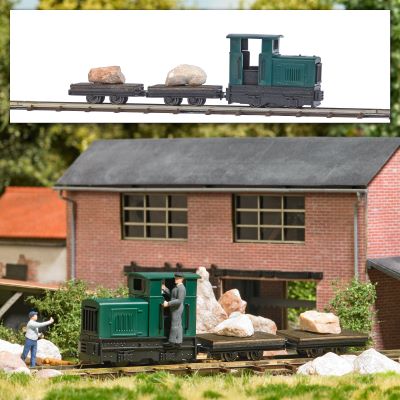
Gmeinder field-railway locomotive, stone wagons and track oval for compact quarry operation.
View Product →
Large processing facility with silos, elevator and conveyor equipment.
View Product →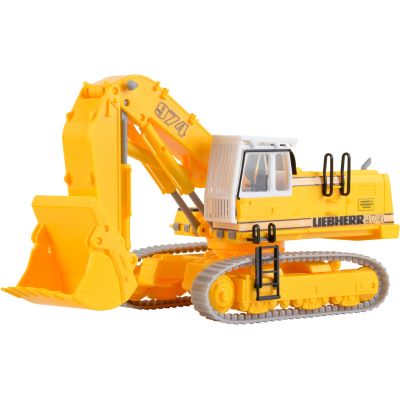
Large excavator suitable as the central working machine at the quarry face.
View Product →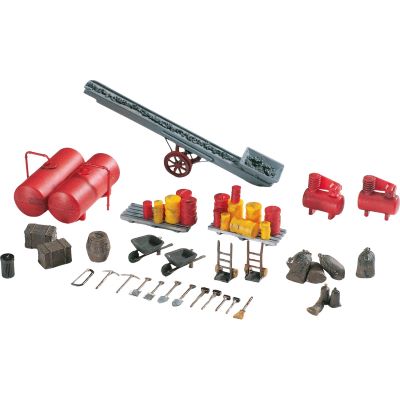
Conveyor belt and accessories for compact processing and loading scenes.
View Product →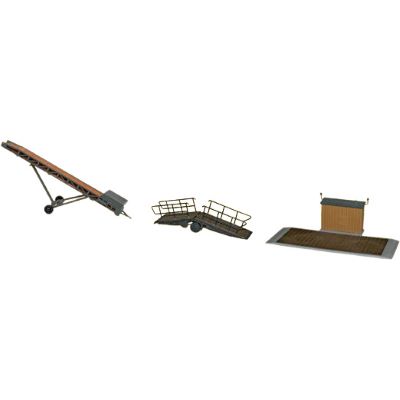
Conveyor belt, road weighbridge and loading ramp for works yards and bulk-material scenes.
View Product →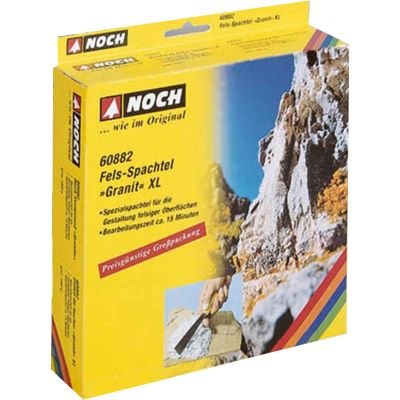
Grey structural material for massive quarry faces and fractured rock surfaces.
View Product →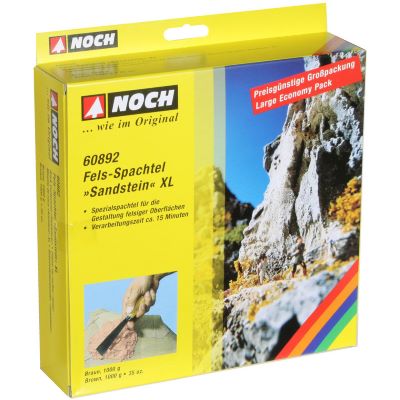
Warm rock texture for layered quarry and extraction faces.
View Product →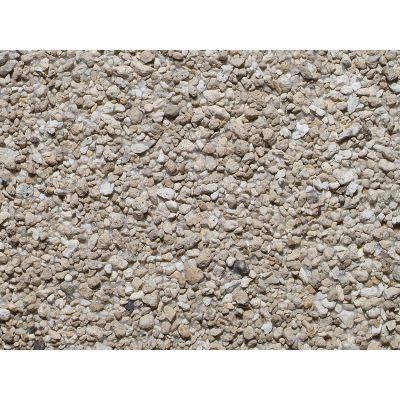
Fine stone material for the quarry face base, haul roads and smaller stockpiles.
View Product →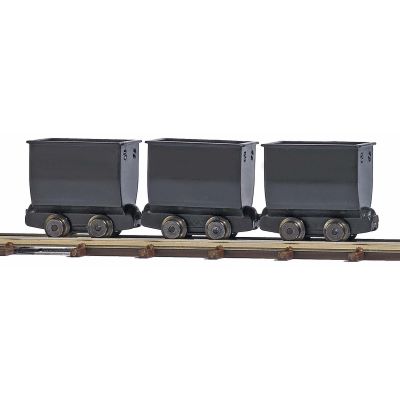
Three compact wagons for extending a field or mine railway.
View Product →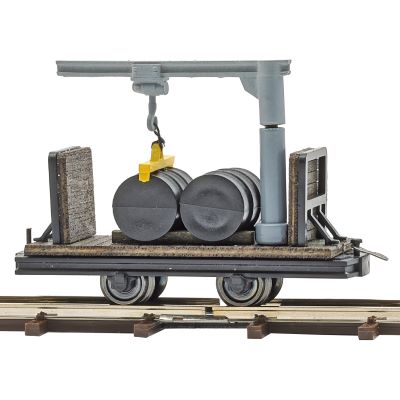
Compact working wagon for loading, maintenance and field-railway scenes.
View Product →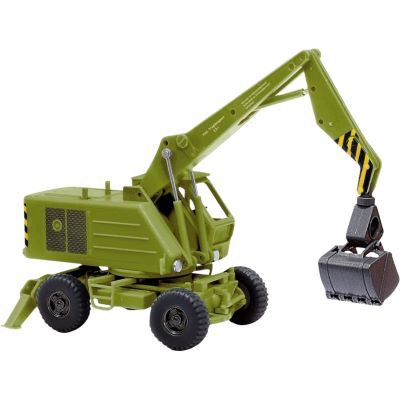
TT mobile excavator for historic industrial and quarry scenes.
View Product →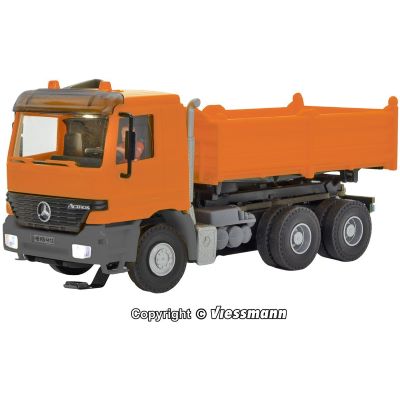
Moving H0 commercial vehicle for modern quarry haul roads and bulk-material transport.
View Product →When this section approaches the viewport, the product finder loads additional current products directly from suitable English Modellbahnshop categories. Detected archived pages are excluded. Product cards deliberately contain no stock, delivery-time or other availability information.
Current quarry products will be loaded when this section approaches the viewport …
These manufacturers complement one another particularly well: scenery materials, industrial plants, field railways and working vehicles can be combined across brands into one coherent quarry project.






Even a short field-railway circuit with one turnout, two loading points and several small wagons can create a complete operational sequence. H0 buildings, figures and road vehicles remain at the same 1:87 scenery scale.
These answers cover rock faces, gauges, machinery, conveyor equipment, field railways and bulk-freight operation.
Begin with the quarry face and several working levels. Then add haul roads, scree, machinery, processing equipment and loading facilities. A logical material route from the rock face to dispatch is more important than using the maximum possible number of individual details.
H0 offers a particularly large choice of excavators, industrial buildings and scenery materials. H0f is especially useful for compact field railways at 1:87 scale. TT and N allow larger quarry areas with lower space requirements.
H0f represents field and industrial railways at 1:87 scale using a 6.5 mm model track gauge. Small locomotives and wagons are ideal for short transport routes between the extraction area, crusher and loading point.
The colour depends on the represented type of rock. Granite-like faces can use grey and anthracite shades, while sandstone is better represented with warmer beige and brown colours. Fresh fractured surfaces may appear slightly lighter than weathered areas.
Use several grain sizes. Larger boulders lie closer to the extraction face, while smaller stones and dust dominate haul roads and storage areas. One completely uniform grain size normally looks artificial.
Typical vehicles include large excavators or wheel loaders, heavy tippers or dump trucks and smaller service vehicles. The size of the machinery must remain believable in relation to the available working and turning areas.
Loading can be represented using conveyor belts, silos, wheel loaders or direct discharge points. Material can leave the quarry by lorry, field railway or standard-gauge bulk and self-unloading wagons.
Yes. Show only a section containing a rock face, small crusher, short field-railway track and loading scene. The remaining quarry can continue conceptually behind the backdrop or beyond the edge of the layout.
Active working areas are mostly bare, dusty and heavily trafficked. Grass, bushes and trees belong mainly along upper terrain edges, older slopes and disused sections.
Depending on the era and transported material, open freight wagons, ballast wagons and self-unloading wagons are suitable for stone and aggregate traffic. A dedicated loading siding makes the connection between quarry and freight railway immediately understandable.
Content updated on . For specific product dimensions and processing instructions, the information on the respective product page remains authoritative.
Further detailed guides covering rocks, terrain forms, slopes, streets, industrial scenery, gauges, field railways and general landscape design can be found in the central Modellbahnshop guide.