Era Ia
The pioneering period of the railway. Short trains, simple stations and individually developed locomotives characterise the scene. Many early designs still show a strong British influence.

The beginnings of the railway are among the most colourful model railway themes: Prussia, Bavaria, Saxony, Württemberg and numerous smaller railway administrations developed their own locomotives, coaches, wagons, liveries and operating regulations. Discover Era I from the pioneering days of railways to the golden age of the German state railways.
Era I in model railways covers the period from 1835 to 1920 in Germany according to the commonly used NEM classification. It begins with the first public railways and ends with the transition from the individual state railway administrations to a common German national railway administration. Unlike later eras, there was not yet a unified Deutsche Reichsbahn or Deutsche Bundesbahn.
Instead, regional state and private railways defined the railway scene. Prussia, Bavaria, Saxony, Württemberg, Baden, Mecklenburg, Oldenburg and other German states developed their own vehicles and technical traditions. The state railway period is therefore considerably more colourful on a model railway than the increasingly standardised decades that followed. Green, brown, blue and other regional liveries combine with brass details, spoked wheels and finely applied lettering.
This period is especially interesting for model railway enthusiasts because even a small station with short trains can look highly convincing. Alongside prestigious express trains, branch lines, shunting operations, freight loading, industrial railways and narrow-gauge routes can all be recreated. Choosing a specific region and a more narrowly defined period creates a particularly distinctive model railway world.
The subdivision makes it easier to coordinate vehicles, buildings, lettering and road traffic more accurately. The transitions are gradual, but narrowing down the period is very useful for a prototype-oriented layout.
The pioneering period of the railway. Short trains, simple stations and individually developed locomotives characterise the scene. Many early designs still show a strong British influence.
Larger state railway networks emerge. Branch lines open up rural regions, while vehicle technology becomes increasingly systematic and railway operation grows more intensive.
The state railways reach their peak. More powerful steam locomotives, four-axle express coaches and extensive freight transport make substantial main-line scenes possible.
Technical standardisation increases. Large steam locomotives, standardised freight-wagon designs and the first electric main lines gradually lead into the subsequent Reichsbahn period.
| Period | Character | Typical Vehicles | Suitable Layout Theme |
|---|---|---|---|
| Ia | Early private and regional railways | Small steam locomotives and very short coaches and wagons | Pioneering railway, diorama or small terminus |
| Ib | Expansion and nationalisation | State railway locomotives and short passenger coaches | Rural station, local railway or freight loading |
| Ic | Golden age of the state railways | P 8, express locomotives and four-axle coaches | Main line and larger station |
| Id | Technical modernisation | Large steam locomotives and early electric locomotives | Main line, border station or electrification |
Instead of mixing vehicles from all state railways arbitrarily, a layout looks more convincing when one specific region provides the central theme. A broader overview of historic and modern railway administrations is available in the Railway Companies Overview .
Prussia offers an especially wide variety of prototypes: T 3, P 8, G 7 and numerous compartment, express and freight wagons. The extensive network makes both main lines and small branch lines suitable themes.
Bavarian state railway models stand out through elegant locomotives, regional liveries and distinctive local-railway coaches. Branch lines with short trains are particularly suitable for limited spaces.
Saxony combines standard gauge, industrial traffic and a dense network of narrow-gauge light railways. This makes it possible to combine main-line and H0e themes attractively on the same layout.
Württemberg offers compact passenger trains, distinctive steam locomotives and attractive routes through rolling landscapes. Historic narrow-gauge railways also expand the theme.
Baden, Mecklenburg, Oldenburg and other administrations add regional vehicle designs and less common model variations to a collection or historic model railway layout.
Austrian state railways, early Swiss railways and Alpine narrow-gauge lines extend the theme beyond Germany. Country-specific era boundaries may differ from the German classification.
Small tank locomotives handle shunting and branch-line duties, while tender locomotives haul passenger, express and freight trains. Well-known themes include the T 3, P 8, G 7, S 2/6 and Saxon local-railway locomotives.
Two- and three-axle compartment coaches are especially typical. Longer four-axle express coaches appear later. Luggage, mail and baggage vehicles make a historic passenger train considerably more convincing.
Covered and open wagons, livestock, tank, refrigerated and private-owner wagons form varied mixed freight trains. Shunting tasks arise at loading roads, goods sheds and factory sidings.
A small tank locomotive with three suitable passenger coaches or five to eight short freight wagons already looks highly convincing. This makes Era I attractive for compact layouts as well.
A historic train alone does not create a convincing state railway world. Buildings, roads, signals, industry and scenery should tell the same historical story.
Regional station buildings, goods sheds, water cranes, coal stages, small engine sheds and simple platforms are excellent choices. An engine shed does not have to be large and immediately creates a convincing steam-railway scene.
Dark timber, brick, natural stone and restrained warm lighting look more convincing than modern materials.
Semaphore signals, mechanical level-crossing gates, bell systems, telegraph poles and visible wire controls shape the scene. Modern colour-light signals and contemporary platform equipment should be avoided.
Horse-drawn vehicles, handcarts, bicycles and only a few early motor cars suit the road scene. Dirt tracks, unpaved roads and small villages reinforce the historic appearance.
A brewery, sawmill, brickworks, coal merchant or agricultural business creates varied shunting operations. Short industrial sidings are often more interesting than simple continuous running.
The largest selection is available in H0, although TT and H0e also offer particularly interesting state railway models. Available space, desired train length and visual detail are important when choosing. You can find more information in the comprehensive gauge comparison .
| Gauge | Strength | Typical Era I Theme | Suitable For |
|---|---|---|---|
| Z | Very low space requirements | Small historic trains | Mini layouts and collections |
| N | Long routes in a small area | Main lines and express trains | Extensive train operation |
| TT | Compact with clearly visible detail | Prussia and Saxony | Compact home layouts |
| H0 | Very large selection | Almost all state railways | Operation and collecting |
| H0e / H0m | Narrow gauge and tight curves | Saxony, Württemberg and Alpine railways | Light and mountain railways |
| 0 / 0e | High visual detail | Local railways and shunting | Modules and short trains |
| 1 / G | Large and impressive vehicles | Steam and narrow-gauge railways | Large-scale and garden railways |
Select Prussia, Bavaria, Saxony, Württemberg or an Austrian or Alpine railway theme. This automatically provides a framework for vehicles, buildings and landscape features.
Choose Ia, Ib, Ic or Id. For even greater historical precision, define a particular year. This is especially helpful when selecting lettering and train formations.
Branch line, main line, narrow gauge, shunting or express-train operation all require different track plans. Small layouts benefit especially from branch-line operation and freight sidings.
Do not buy only an attractive locomotive. Three to five matching coaches plus a luggage or mail van create a convincing overall impression more quickly than several individual locomotives without trains.
Do not mix state railway administrations without a convincing operating concept, do not combine Era I and Era II lettering without checking it, avoid modern road vehicles and colour-light signals, and do not overwhelm historic stations with excessively long trains.
The logos take you directly to the manufacturer pages at Modellbahnshop. Available gauges and particular state railway specialisations vary between brands.
Locomotives, passenger coaches and freight wagons can be filtered by gauge, state railway, manufacturer and vehicle type. The product pages are checked again when the page is opened; products that have since been archived are automatically removed from this selection.
Current products are being checked …
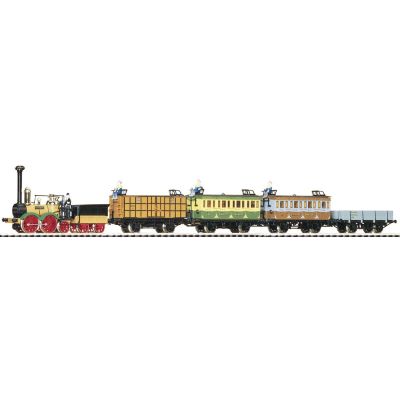
Historic train formation representing the pioneering period of German railway history.
View Product →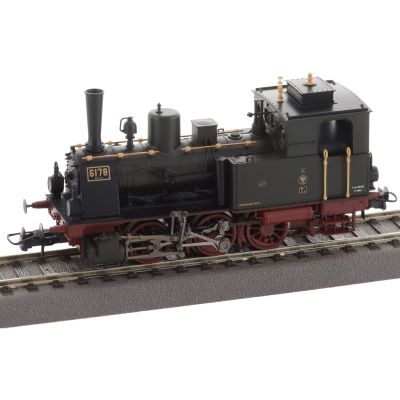
Compact tank locomotive for branch-line operation, shunting and short trains.
View Product →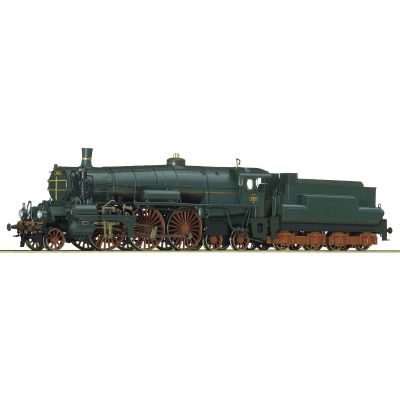
Elegant state railway express locomotive for a Württemberg main-line railway.
View Product →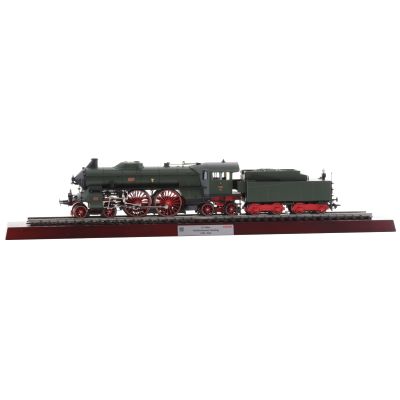
Distinctive express locomotive of the Royal Bavarian State Railways.
View Product →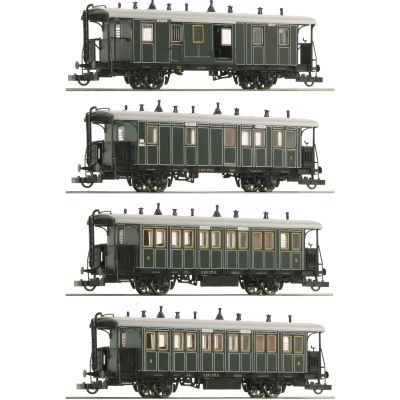
Four coaches for a compact and distinctive Bavarian branch line.
View Product →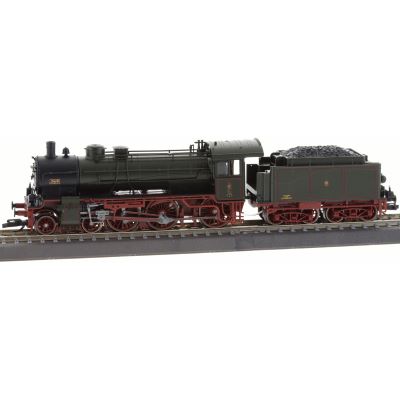
Prussian passenger locomotive for main lines and high-quality passenger trains.
View Product →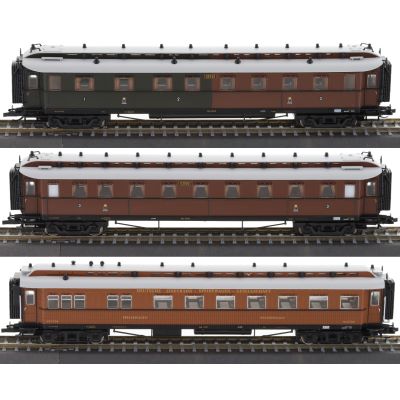
Three coaches for a prestigious state railway express train.
View Product →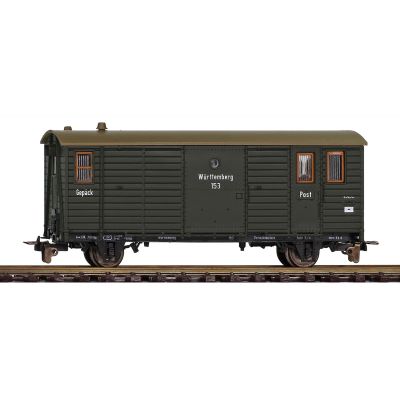
Historic vehicle for Württemberg narrow-gauge train formations.
View Product →Key answers concerning the historical period, state railways, gauges, train formations and historically appropriate layout design.
In Germany, Era I generally covers the period from 1835 to 1920 according to the commonly used NEM classification. It extends from the first public railways to the transition of the state railways into a common German national railway administration.
Germany consisted of several states with their own railway administrations. Prussia, Bavaria, Saxony, Württemberg and other states developed their own vehicles, colours, lettering and technical traditions.
H0 offers a very large selection of state railway locomotives and rolling stock. TT is especially interesting for Prussian and Saxon themes. H0e is particularly suitable for historic narrow-gauge railways.
Wagons could cross the boundaries between railway administrations and international services already existed. For a typical local or branch railway, however, a regionally consistent train formation usually looks more convincing.
Transitional situations around 1920 can be represented, although lettering and ownership markings changed. Anyone aiming for historical accuracy should check the specific operating condition of each model.
Yes. The first electrified main lines appeared during the later state railway period. Steam locomotives nevertheless remain the defining form of traction for most Era I layouts.
A tank locomotive with three short passenger coaches or a freight train with approximately five to eight wagons can already look highly convincing. This also keeps stations and sidings pleasantly compact.
Yes. The era describes the prototype being represented rather than the technical control system used by the model railway. Decoders, sound, digitally controlled turnouts and feedback equipment can operate unobtrusively in the background.
Regional station buildings, goods sheds, small engine sheds, water stations, timber-framed houses, sawmills, brickworks and agricultural buildings are particularly suitable themes.
A complete train set or a small tank locomotive with a few matching state railway coaches is a good starting point. Luggage vans, freight wagons and suitable station buildings can then be added.
The Model Railway Guide also provides information about gauges, track planning, railway companies, layout construction, rolling stock, digital technology and scenery design.