Regional Forest Types as Complete Sets
Coordinated assortments for low mountains, the Alps, coastal regions or lowlands could combine different tree heights, species and undergrowth.

Which realistic trees, rock structures, grass areas or terrain materials are still missing? This page collects wishes for HEKI new products in 2027, explains important scenery techniques and connects them with current products for H0, TT, N, Z and multi-scale model-making projects.
HEKI New Products 2027: Scenery & Model Making is not an invented preview of an annual programme that has already been published. The current manufacturer programme comprises the 2026 new products, including a renovation and decoration set, two weathered-spruce assortments and crumpled rock foils with granite and red-sandstone appearances.
Model scenery is especially convincing when more than one material is used. A natural woodland edge, for example, combines ground colour, fine scatter material, low grasses, bushes and trees of different heights. Rocks require transitions to soil, scree, plants and, where appropriate, water.
New products are therefore particularly helpful when they purposefully expand existing material families. Additional colours, matching grain sizes, new tree heights or coordinated complete sets make believable and reproducible scenery easier to create.
The following suggestions have not been announced. Interesting ideas can be saved locally in the browser and later included automatically in a personal wish message.
Coordinated assortments for low mountains, the Alps, coastal regions or lowlands could combine different tree heights, species and undergrowth.
Smaller foliage, finer trunks and compact growth forms would strengthen depth effects on N- and Z-gauge layouts.
Spring blossom, summer green, autumn colours and winter or dead vegetation could form one coordinated colour system.
Leaves, roots, tree stumps, branches, fungi and fine woodland scatter could create believable areas beneath model trees.
Matching smaller foils, scree, pigments and ground colours could conceal joints and connect rock faces to the terrain.
Base fibres, wild grass, tufts, flowers and low bushes could build a natural meadow in several coordinated stages.
Main-line, branch-line, industrial and narrow-gauge ballast assortments could differ in colour, grain and weathering.
Asphalt base colour, repairs, cracks, oil stains, markings and edge dirt could form one expandable road-finishing system.
Water material, stones, sand, mud, reeds and bank plants could create one coordinated stream and riverside scene.
Young trees, tree pits and protective guards would enliven contemporary town, station and residential areas.
Matching colour, fibres, flor and adhesive could visually renew existing areas without requiring their complete removal.
A small practice diorama could explain ground, grass, bushes, trees, rocks and colour step by step.
A natural model landscape is created from several visual layers. Trees provide height, grass and flor shape the surfaces, while rocks, ballast and roads define the visible terrain.
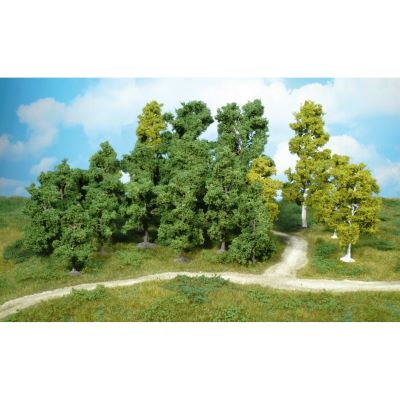
Different sizes prevent uniform forests and create convincing transitions between the foreground and background.
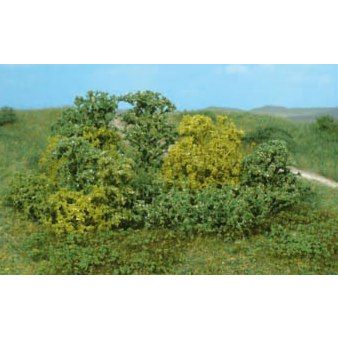
View Deciduous Trees →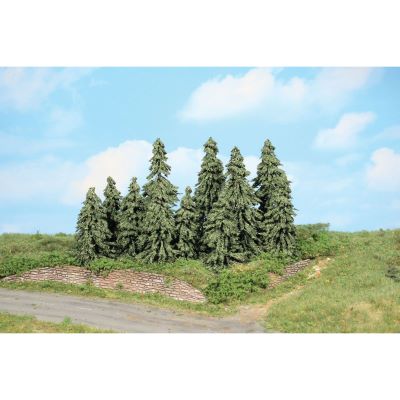
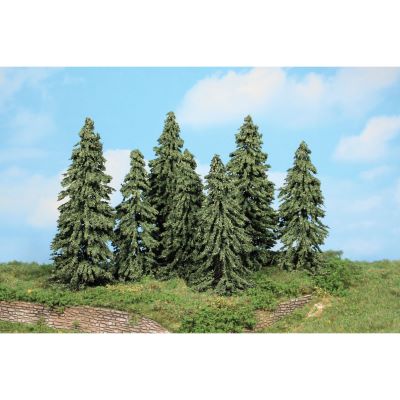
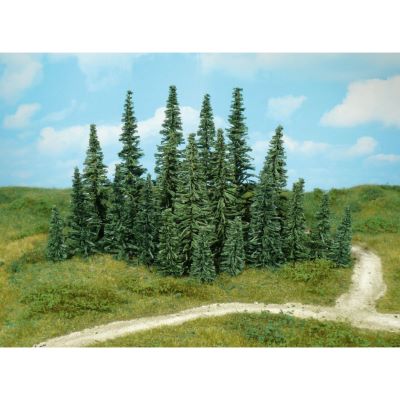
Irregularly grown weathered spruces are suitable for exposed slopes, high ground and natural woodland edges.
View Weathered Spruces →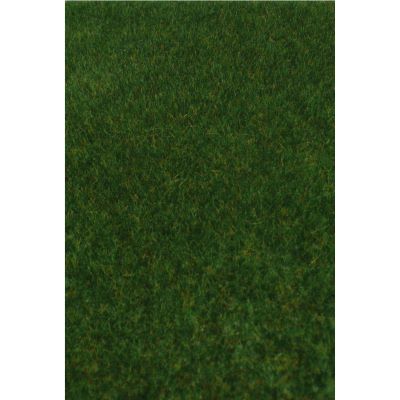
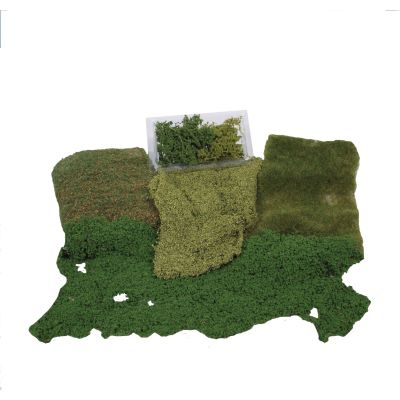
Mats and fleeces form the base, while fibres, bushes and individual plants subsequently add height and depth.
View Wild-Grass Fleece →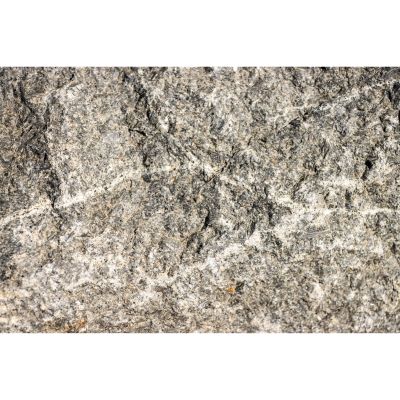
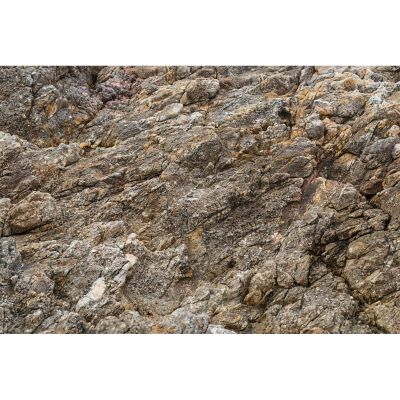
Shapeable foil permits cuttings, slopes and banks to be constructed with little weight and clean processing.
View Crumpled Rock Foil →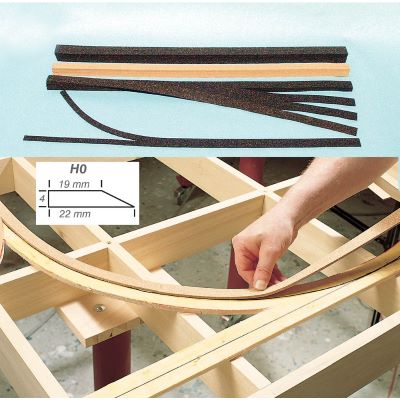
Cork bedding, ballast and embankment material should suit the gauge, track profile and intended appearance.
View Superflex →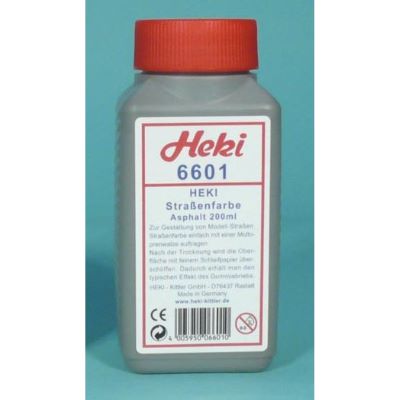
Asphalt paint, edge strips, pigments and vegetation connect roads naturally to buildings and surrounding terrain.
View Road Paint →Begin with stable, accessible terrain. Then add a suitable base colour and ground material before applying grass, flor and low vegetation. Trees, bushes, rocks, roads and characteristic details complete the visible scene.
Each layer should be tested and allowed to dry before the next material is applied. This keeps track, points, water courses and roads accessible and prevents incompatible adhesives or colours from being combined unintentionally.
Plan a stable substructure, track alignment, access openings, roads and water courses before permanent scenery is added.
Earth, rock or asphalt tones prevent bright gaps and create a suitable base for soil, ballast and woodland ground.
Short fibres form the first layer. Wild grass, mats, flor, bushes and individual plants subsequently provide variation.
Different heights, species, deadwood, stones and small details give the scene a recognisable location and history.
The core range is especially relevant to H0, TT, N and Z. Paints, adhesives, rock foils, spreading material and further scenery products can frequently be used across several scales.
| Gauge / Scale | Typical HEKI Applications | Check Before Buying | Useful Wish Direction for 2027 |
|---|---|---|---|
| H0 · 1:87 | large tree selection, grass, flor, roads, rocks and track bedding | tree height, leaf size, grass length and visible terrain proportions | regional forest types and contemporary urban greenery |
| TT · 1:120 | medium-sized trees, finer foliage, short and medium grass | reduced textures, tree heights and grain sizes | coordinated vegetation and railway embankments |
| N · 1:160 | small trees, fine grass, microflor and compact rock structures | smaller foliage, short fibres and fine ground materials | extra-fine woodland edges and rock structures |
| Z · 1:220 | very fine scatter, flor, short fibres and small vegetation | use coarse materials sparingly and preserve visual scale | microflor and the finest ground materials |
| Gauge 0 · approximately 1:45 | selected large trees and universal rock or ground materials | sufficient height, volume and visible structural detail | large specimen trees and detailed undergrowth |
| Gauge 1 and G | selected large trees, rock foils, paints and terrain materials | precise dimensions and suitability for the intended environment | robust large-scale vegetation and rock systems |
| Multi-Scale | paints, adhesives, boards, rock foils, ballast and scatter | grain, colour, material properties and processing method | coordinated complete sets with clear application guidance |
 Open the HEKI Manufacturer Page →
HEKI’s history began in 1953 with small hand-made hunting stands, feeding racks and cardboard tunnels. Trees, firs and further model railway decoration subsequently expanded the range.
The current product world includes deciduous and coniferous trees, bushes, hedges, grass mats, fibres, foliage, rocks, roads, track bedding, paints and model-making boards.
A coherent project should be planned according to scale, region, season and intended visual effect. Combining several related materials generally produces a more natural result than relying on one uniform surface product.
The form creates a structured wish message. The email button then opens the email application configured on the visitor’s device. The page does not transmit a message automatically.
This area displays only current products whose own individual product page contains an explicit new-product designation for 2027.
No explicitly labelled HEKI new product for 2027 has been detected. Live verification starts when the product finder approaches the viewport.
The finder combines the checked initial selection with current products from model trees, grass, foliage, rocks, ballast, track bedding and further scenery categories. Product cards deliberately contain no prices or delivery information.
Current English HEKI categories will be loaded when this section approaches the viewport.
These answers explain publication status, product worlds, scales, scenery construction and automatic product verification.
As of 31 August 2026, HEKI officially presents its 2026 new-product programme. A complete regular programme for 2027 has not yet been published.
They include the renovation and decoration set 16000, weathered spruce assortments 21802 and 21803 and crumpled rock foils 3515 to 3518 with granite and red-sandstone appearances.
HEKI specialises in model scenery accessories, including model trees, grass, flor, foliage, rocks, ballast, track bedding, road materials, paints and adhesives.
H0, TT, N and Z are especially important. Many paints, adhesives, rock foils and ground materials can also be used across several scales.
The scale, tree species and position are decisive. Larger, more detailed trees are convincing in the foreground, while smaller models strengthen depth in the background.
Use different heights and tree species. Add woodland ground, bushes, deadwood and open edge areas instead of positioning all trees evenly in rows.
A grass mat covers larger areas quickly and evenly. Wild grass, fleece and loose fibres create irregular transitions, embankments and taller vegetation.
The foil is carefully crumpled and shaped. It is then fixed to the base and blended at the edges with soil, scree or vegetation.
The current foils are described as waterproof and can therefore be used beside streams, banks or lakes. The adhesive must be suitable for the particular base material.
The gauge, track profile, grain and colour must suit one another. Rail heads and moving point components must remain clear, and the track should be tested before permanent fixing.
No. Wording such as “no longer in our range”, “archived”, “product removed” or a B-stock designation results in exclusion from the dynamic overview.
No. The cards contain the product name, image, product world, gauge and scenery theme, but no price, delivery or availability information.
Potential candidates are checked on their own individual product pages. Only an explicit designation such as “New Product 2027” or “Neuheit 2027” results in inclusion.
Yes. The form creates a prepared message and opens the email application configured on the visitor’s device. The text can still be reviewed and changed before sending.
Discover further guidance on terrain, mountains, rocks, tunnels, retaining walls, slopes, vegetation and complete layout planning in the main Model Railway Guide.