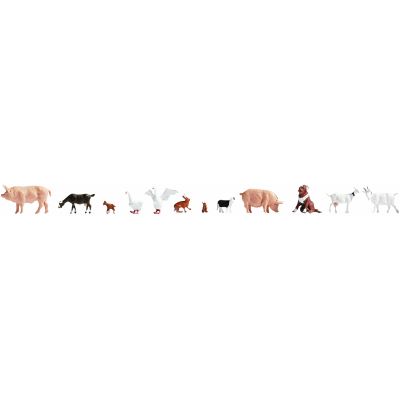
Smallholding
A farmhouse, small stable, barn and a few machines are sufficient. This is ideal for villages, branch lines and compact layouts representing earlier and middle railway eras.


From a historic smallholding to a modern agricultural business: buildings, farmyards, field tracks, animals and machinery need a clear function so that individual models become one believable working farm.
Designing model railway farms involves much more than placing a farmhouse beside a field. A farm is a working environment. The farmhouse, stable, barn, storage buildings, machinery and traffic areas all perform different tasks and should be positioned accordingly.
A traditional farm may consist of a farmhouse, barn and stable. Depending on the type of agricultural business, it can also include a vehicle shed, machinery hall, granary, silage clamp, manure heap or other ancillary buildings. A horse farm requires stables, paddocks and shelters, while an arable farm benefits from larger storage buildings, machinery sheds and wide access routes.
The open space between the buildings is just as important as the buildings themselves. Tractors and trailers need to reach doors and turn within the farmyard. Frequently used areas can appear compacted, dusty or dirty. Grass should grow mainly along edges rather than evenly across regularly used wheel tracks.
The detailed Model Railway Farming guide connects farms with fields, harvesting machinery, livestock and railway operation. This page focuses specifically on the design of the farm itself.
A farmhouse, small stable, barn and a few machines are sufficient. This is ideal for villages, branch lines and compact layouts representing earlier and middle railway eras.
Arable farming and livestock are combined. A barn, stable, fields, pasture and a varied machinery fleet create particularly diverse rural scenes.
Cattle housing, cows, pasture or an exercise yard and feed storage form the centre of the scene. Modern farms can use larger open or loose-housing cattle sheds.
Large machinery sheds, grain storage, trailers and extensive fields define the scene. Livestock can be omitted completely.
Horse stables, paddocks, shelters and riders create a dedicated theme. It is especially effective in larger scales where animals, fences and stable details are clearly visible.
Large agricultural storage halls, extensive livestock buildings, fuel facilities and substantial machinery fleets are suitable for East German scenes of the later Era III and Era IV. LPG refers here to a GDR agricultural production cooperative.
A convincing farm makes it clear how people, animals and machinery move between buildings, fields and the public road.
Decide which agricultural work should be visible. Only then select the stable, granary, machinery shed and outdoor working areas.
Test the floor plan with a tractor and trailer. A farmyard that is too tight not only looks wrong but also fails to show a believable working process.
The farm access road leads to the public road, while field tracks continue towards fields and pastures. The Model Railway Paths & Squares guide provides further ideas for designing these surfaces.
Functional open areas belong in front of barn doors, silage clamps and machinery sheds. They give larger agricultural machines the space they realistically require.
Planning tip: before permanently fixing the buildings, drive the largest tractor and trailer combination through every intended route. This quickly reveals whether gates, bends and yard surfaces are actually large enough for the chosen era.
The farmhouse forms the residential part of the site and can include a garden, fruit trees and a quieter section of the yard. Barns and machinery sheds, by contrast, need easily accessible large doors. A stable should have a believable connection to an exercise yard, pasture or paddock.
Granaries and silage clamps belong closer to the working areas. Grain storage needs access for tractors, trailers and lorries and can even be connected to a railway loading point. This allows a farm to form a logical part of a rural station and local freight operation.
Residential space, garden and the human centre of the farm.
Hay, straw, implements and vehicles require large doors and suitable access.
Livestock becomes understandable when the building connects to an exercise area, feed store or pasture.
Large doors and hard-standing surfaces suit modern farm machinery.
Arable farming, harvesting and transport gain a clear visible destination.
A characteristic feature of larger livestock farms with a substantial manoeuvring area in front.
The Tractors and Agricultural Machines category includes tractors, combine harvesters, trailers, ploughs, fertilising equipment and many other agricultural vehicles. A tractor looks most convincing when its purpose is immediately clear.
A trailer can wait beside the granary, a plough belongs on or near a cultivated field, and a combine harvester needs a sufficiently large harvest scene. Modern agricultural machines are considerably larger than early tractors and therefore require wider gates, field tracks and farmyards.
The period is particularly visible in GDR agricultural scenes. Fortschritt, Belarus and IFA vehicles work well with LPG agricultural storage halls and large fields. A small historic farm, by contrast, looks more convincing with compact tractors or even draught animals.
Cattle, horses, sheep, pigs, goats, chickens and geese can be found in the Modellbahnshop Animals category. Correct placement matters more than sheer quantity. Arrange animals in small groups around stables, water troughs, feeding areas or pastures.
Paddocks and pastures can be separated using Fences, Railings and Gates . Grass can be shorter and bare soil more visible around frequently used gates. An open stable should lead directly to an exercise area, a horse stable to a paddock and a chicken house to a smaller enclosed area close to the farmyard.
| Era | Typical Farm | Suitable Equipment |
|---|---|---|
| I–II | Small mixed farm | Timber framing, draught animals, carts, small barns and limited mechanisation. |
| III | Family farm with increasing mechanisation | More widespread tractors, trailers, older farm buildings and newer machinery sheds. |
| IV | Modernised family farm or LPG agricultural cooperative | Larger machines, agricultural storage halls, silage clamps and more extensively surfaced farmyards. |
| V–VI | Specialised agricultural business | Large machinery halls, modern livestock buildings, wide access routes and high-capacity machines. |
| Gauge | Scale | Strength | Recommendation |
|---|---|---|---|
| Z | 1:220 | Wide agricultural landscapes in very little space | Keep the farm compact and use the scale for expansive fields. |
| N / Nm | 1:160 | Complete farm with extensive fields | Ideal for spacious rural layouts and long scenic views. |
| TT / TTm / TTe | 1:120 | Excellent balance between detail and space | Particularly interesting for GDR and LPG agricultural scenes. |
| H0 / H0m / H0e / H0f | 1:87 | Widest choice of buildings and vehicles | Combine farms, livestock and machinery in highly detailed scenes. |
| 0 / 0e / 0m | approx. 1:45 | Strong visible detail | Model one section of a farm rather than a complete large agricultural business. |
| 1 / Im | 1:32 | Vehicles and animals appear particularly three-dimensional | Use a barn, stable or paddock as a detailed individual scene. |
| G / IIm | often approx. 1:22.5 | Large stables and garden railway scenes | Give buildings, paddocks and tracks generous dimensions. |
Select a smallholding, arable farm, dairy farm, horse farm or LPG agricultural cooperative as the main theme.
Doors and entrances should face accessible farmyard or outdoor areas.
Connect the public road, farmyard and cultivated land logically.
Heavily used areas should show more bare ground and less uniform grass.
The Model Railway Fields & Meadows guide provides suitable landscaping ideas.
Choose tractors, trailers and implements to suit the type of farm and the era being represented.
Define paddocks with fences and arrange animals in a small number of natural groups.
Position small details where the agricultural working process provides a logical reason for them.
Farmhouses, barns, stables, granaries and agricultural halls.
Tractors, trailers, combine harvesters and implements for farms and fields.
Cattle, horses, sheep, pigs, goats, poultry and other animals.
Grass fibres and mats for pastures, farm edges and rural scenery.
Earth and scatter materials for fields, wheel tracks and farmyard surfaces.
Separate paddocks, pastures and working areas visibly.
Cars, vans, lorries and everyday vehicles for farms and village roads.
Materials for paths, terrain, vegetation and the surrounding countryside.
Three-building farm ensemble with dwelling house, large drive-through barn and stable for a classic agricultural scene.
View Product →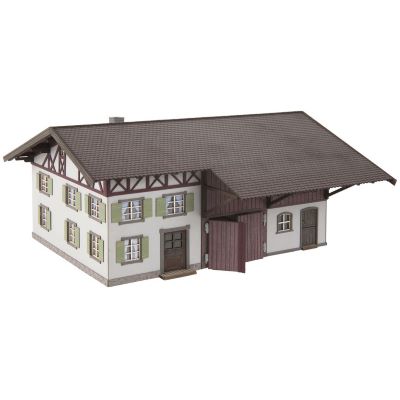
Compact laser-cut farm with fine cardboard detailing and an access ramp that can be omitted for a smaller footprint.
View Product →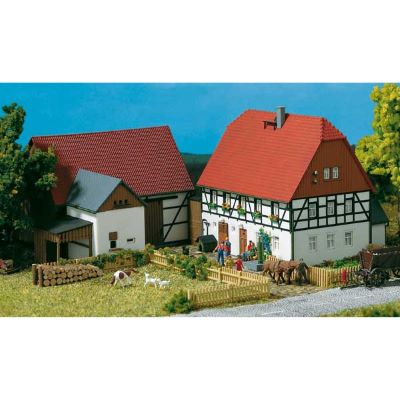
Compact Saxon-style farmstead for village and rural branch-line scenes.
View Product →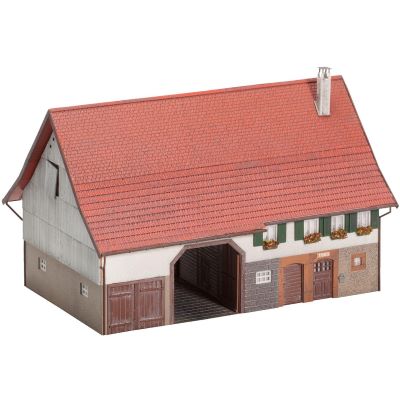
Traditional agricultural building combining residential, stable and barn functions beneath one roof.
View Product →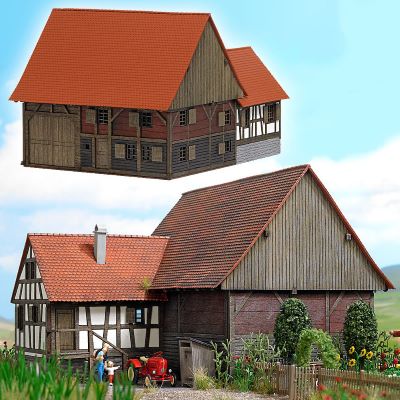
Historic small farmhouse with real-wood elements for regionally inspired rural scenes.
View Product →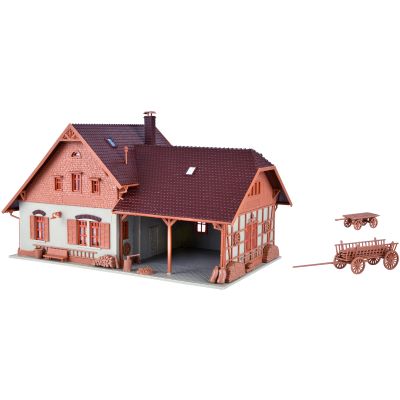
Compact farmhouse with adjoining farm outbuilding and rural details for a family-farm scene.
View Product →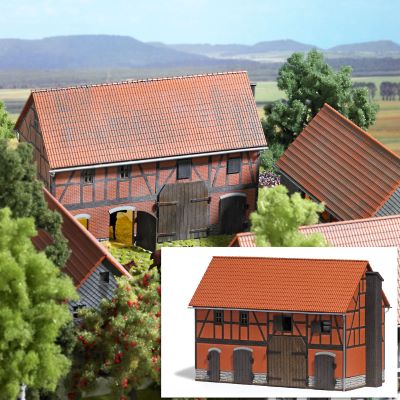
Large agricultural building with drive-through access and several stable entrances.
View Product →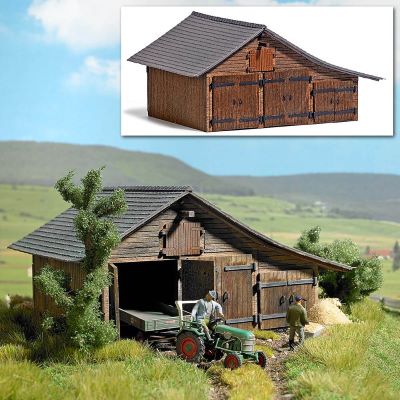
Real-wood barn suitable for machinery, vehicles, hay, straw and a wide range of rural scenes.
View Product →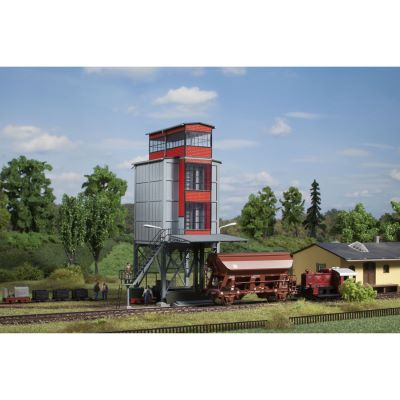
Grain-storage facility for harvest, loading and agricultural freight scenes, including links to road or railway transport.
View Product →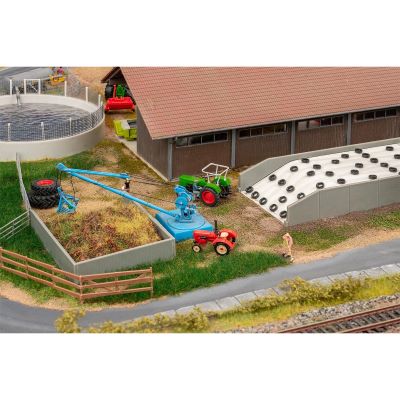
Functional working area for a larger livestock farm, with silage storage and a clearly defined agricultural yard scene.
View Product →
Typical GDR agricultural cooperative building for weather-protected storage of machinery, hay, straw and other agricultural products.
View Product →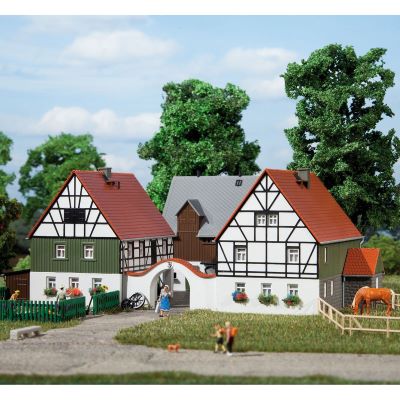
Erzgebirge farm ensemble with dwelling house, agricultural building and barn.
View Product →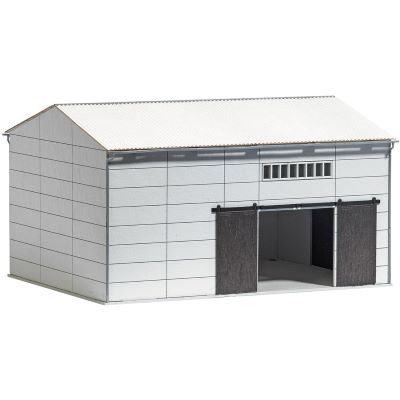
Large TT agricultural storage building for machinery, hay, straw and feed, with large sliding gates.
View Product →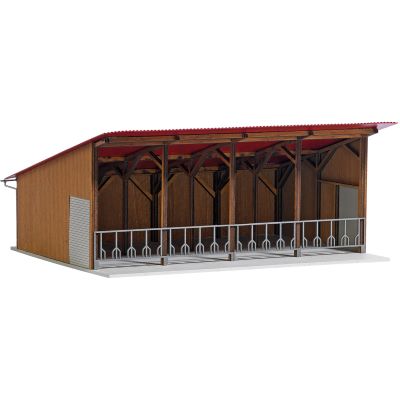
Spacious timber livestock building with an open feeding side for contemporary agricultural scenes.
View Product →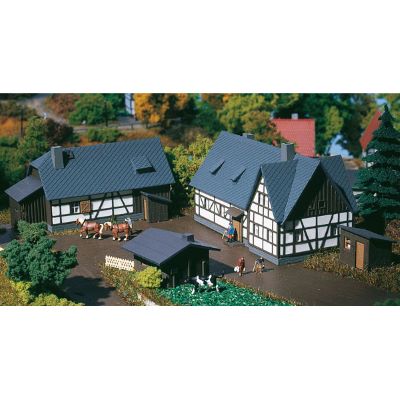
Multi-part N-scale ensemble with farmhouse, barn and freely positionable ancillary buildings.
View Product →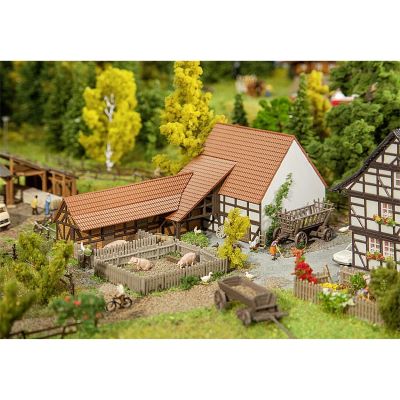
Historic half-timbered agricultural building with stable area and farm details for rural N-gauge scenes.
View Product →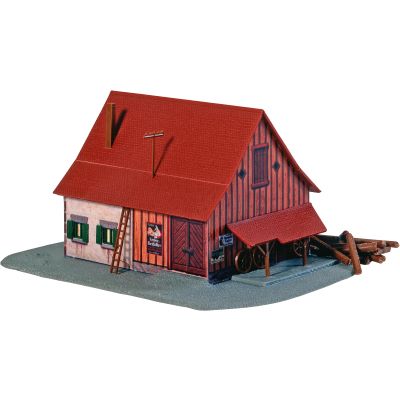
Compact historic farmhouse for villages, farm scenes and rural railway surroundings.
View Product →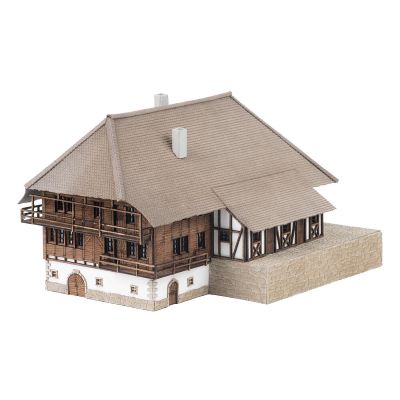
Traditional farm building as a compact focal point for mountainous Z-gauge landscapes.
View Product →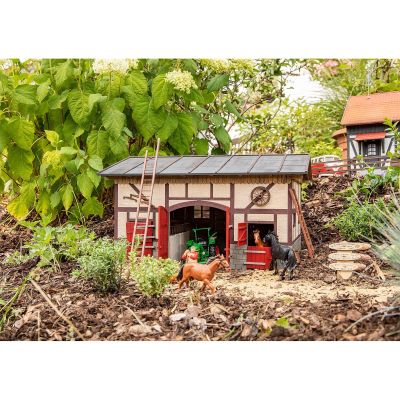
Large half-timbered stable with central stable aisle and movable doors for garden railway and large-scale scenes.
View Product →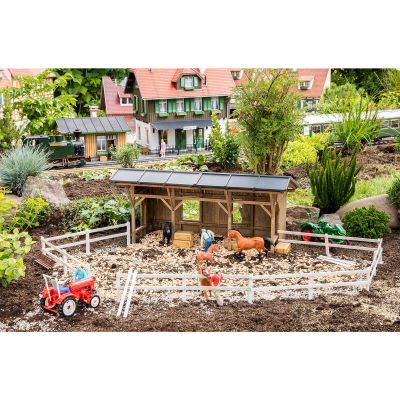
Shelter and paddock fencing create a complete large-scale horse scene with very little additional construction.
View Product →The finder checks current English shop pages for agriculture buildings, tractors and agricultural machines, animals, grass, ground materials and fences. Recognised archive, B-stock and clearance products are excluded. Prices, delivery times and availability information are not displayed on the product cards.
Current farm products will be loaded when this section approaches the viewport …
Buildings, animals and agricultural machines from different manufacturers can be combined effectively. Scale, era and the type of agricultural operation are more important than using a single brand throughout.






An Auhagen farm can be combined with Busch agricultural machinery, NOCH animals and Preiser figures. The important point is that scale and the represented period produce one coherent working farm.
Typical buildings include a farmhouse, stable and barn. Depending on the type of farm, granaries, machinery sheds, silage clamps, vehicle sheds and further ancillary buildings can be added.
In addition to the building footprints, open farmyard space is required. Tractors and trailers need to reach doors and turn in front of stables, barns and machinery sheds.
A farmhouse with a barn, short access road and a field cut by the edge of the layout is already sufficient. Buildings or cultivated land can appear to continue beyond the visible scene.
Cattle, horses, pigs, sheep, goats, chickens and geese are typical farm animals. Dogs and cats add further everyday detail.
Larger machinery sheds, wide doors, surfaced yards, modern livestock buildings, silage clamps and larger agricultural machines clearly distinguish a modern business from a historic farm.
Large agricultural storage and machinery halls, livestock buildings, fuel facilities and functional utility structures are particularly suitable. Fortschritt, Belarus and IFA vehicles complement a GDR agricultural production cooperative scene.
Use relatively short grass, occasional bare and worn patches and suitable fencing. Place animals in small natural groups near a gate, water trough or shelter.
H0 offers the widest range of buildings, vehicles and figures. TT and N also provide many possibilities, while rural buildings are additionally available for Z and G.
Yes. Buildings, figures, animals and road vehicles remain at 1:87 scale. Only the modelled railway track gauge is narrower.
A field track can lead to a rural station or loading siding. Grain storage, fertiliser, agricultural machinery and other goods provide believable reasons for local freight traffic.
Wheel tracks, dust, straw, damp patches and worn door areas should appear primarily where work actually takes place. Uniform dirt across every surface is less convincing.
Every season can work. Spring emphasises fresh pasture, summer and autumn are especially suitable for harvest and straw scenes, while winter places more emphasis on stables, feeding and snow-covered farmyards.
Content, English category structure and product links checked on . Please additionally verify footprints, gauge assignments and specific product details on the respective product pages.
Further detailed guides covering farming, fields, meadows, forests, roads, buildings, gauges, track planning and layout construction can be found in the central Model Railway Guide.