Our cookies offer you a fast, relaxed and full-featured shopping experience. Some are necessary to operate the website and its functions. Others help us to improve our services. If you agree to this, simply consent to the use of cookies for preferences, statistics and marketing by clicking on "OK". Alternatively, you can deactivate individual cookies under "Customise cookies" or all cookies, except those required for the function of our website, under "Reject all".
Planning · Layout Building · Operation
Planning a Hidden Staging Yard: Capacity, Turnouts and Access
Plan your hidden staging yard around your longest train and access for maintenance. What matters is usable storage track length, reliable turnout routes and occupancy detection that suits your operations. An easily accessible spare track is often more valuable than squeezing in one last turnout.
A hidden staging yard is a storage area outside the visible scene. Complete trains wait here for their next run. This allows a small visible stretch of railway to support varied operations without constantly swapping rolling stock by hand.
It does not have to sit underneath the layout. It can also be hidden from viewers behind a scenic divider, in an adjoining room or on an open lower level. The right solution depends on your space, train fleet and operating concept. This guide to planning a hidden staging yard: tracks and access brings these decisions together.
Turn train length into space requirements
Capacity calculator for individual storage tracks
The calculator assumes tracks of equal length, each independently accessible and holding one train. Enter the clear length between the two fouling points, rather than the total length of track laid. Turnout ladders are excluded. The margins are your own planning allowances; they must match the stopping performance you have verified for your rolling stock.
Through tracks, dead-end sidings or storage roads?
Choose the yard type to suit how you want to alternate trains. A large number of storage spaces is of little use if one train blocks several others from leaving. Start by sketching three typical operating sequences and check which trains can move at the same time.
Four concepts and their planning implications
Yard type
Strength
Points to consider
Through staging yard
Trains enter and leave forwards; individual storage tracks remain directly accessible.
Turnout ladders at both ends take up length. Shared approach tracks limit simultaneous movements.
Dead-end sidings
Only one turnout ladder; suitable for multiple units and push-pull trains.
Locomotive-hauled trains without a driving trailer require reversing, a locomotive change or another operating solution.
Several trains stored in line
Long storage roads provide extra spaces.
Without a bypass, the train at the front leaves first. Each section needs an appropriate detection and stopping arrangement.
Open fiddle yard or cassette
Direct access by hand and straightforward changes of rolling stock.
Track interfaces must lock into precise alignment and be protected against falls; operating space is still required.
A reversing loop is an additional track function. On two-rail systems, its polarity switching must be coordinated with insulated gaps, feedback and the instructions for the module used.
Determine usable length and actual storage capacity
Measure each train from its outermost ends, including couplings and other projections. Record fixed formations, the longest planned additions and short railcars separately. This lets you allocate short tracks to suitable trains while keeping long tracks available for long trains.
The usable length ends where a stored vehicle would foul the adjacent route. This point is not automatically at the turnout toe or a rail joiner. The MOROP recommendation NEM 119 explains clearance markers and vehicle overhang. Detection boundaries must also take these overhangs into account.
In addition to train length, you need margins for stopping tolerances and the planned arrival movement. A long braking section may partly overlap the space the train will eventually occupy; do not simply add its entire length to the train length without checking. The key requirement is that the train stops short of the fouling point under the least favourable operating conditions.
Worked example: A train length of 180 cm plus a freely chosen margin of 10 cm at each end requires 200 cm. This is not a general recommendation for braking distance. Six suitable tracks with one kept clear provide five planned storage spaces. A separate through track is not counted as a storage space.
Design turnout routes for reliability
Start with the geometry of your track system. More gently angled turnouts usually require more length but may allow smoother vehicle movements. Compact curved turnouts or slips are not automatically a planning mistake; their suitability must be confirmed in practice with your longest coaches and most sensitive couplings.
Avoid a sharp reverse curve immediately after a diverging turnout if it puts lateral strain on the coupled vehicles. Include a suitable straight section between curves or use a more generous alignment. Test both hauled and propelled trains, in both directions and at low speed. Minimum specifications for individual vehicles do not replace testing the complete train.
Position turnout drives so that screws, tie bars and connecting wires remain accessible. Surface-mounted drives can be particularly easy to service in hidden areas. With under-baseboard drives, no framing timber should prevent removal. Plan maintenance openings before laying track; track accessories and servo drives must suit the system concerned.
Sending a switching command does not prove that a turnout has actually moved to the required position. Distinguish between a command display and true position feedback. Set up frog power supplies and decoder outputs according to the manufacturer's instructions; not every drive accepts the same control method.
Check access by hand and with tools
The clearance needed for a vehicle to pass is not the same as the space required for maintenance. You need to reach between stored trains, and there must be room to lift a derailed wagon. Measure the clear distance from rail level to the lowest obstruction, including cross-members, cable ducts and drives on the level above.
First build a simple mock-up using boards or cardboard. Place rolling stock on every planned track, hold a cover at the proposed height and try to remove the rearmost vehicle. Repeat the exercise with the tools needed to replace a turnout drive. Adjust the height, depth and openings to suit your actual reach.
Place turnout ladders as close as possible to an access opening.
Provide removable fascia panels without permanently attached cables.
Keep scenery, furniture and braces clear of service hatches.
Install even task lighting and clearly legible track numbers.
Fit accessible protective barriers along open edges.
Mount electronics on accessible, labelled panels.
Cameras make it easier to watch arrivals and the rear of a train. They replace neither occupancy detection nor physical access. Test viewing angles and lighting with all storage tracks occupied so that vehicles in the foreground do not hide critical areas.
Plan wiring and feedback from the outset
Mark track power feeds, detection sections and turnout addresses directly on the track plan. Document which insulated gap belongs to which connection. Additional power feeds must not accidentally bypass monitored sections. Disconnect the power before wiring and follow the wiring diagrams for your components.
On two-rail systems, current sensors detect loads within a section. An unlit wagon with insulated wheelsets will not automatically be detected. Detecting occupancy along the full train therefore requires a suitable detection strategy for the rolling stock used. On centre-rail systems, isolated contact sections can work through conductive wheelsets; track modifications and detectors must be compatible.
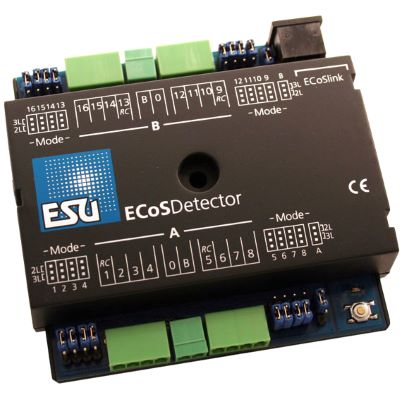
Check the feedback bus, interface, input type and permitted electrical ratings separately. For example, ESU distinguishes between current-sensing and switching inputs on the ECoSDetector. A matching connector alone does not prove compatibility.
The number of detection sections each track needs depends on the control system, direction of travel and stopping method. Plan entry, braking, stopping and full clearance together. Routes must only be released once the entire train has left the conflict area. Include a stop button and a documented restart procedure after faults in your operating concept.
Choose suitable dimensions, from Z gauge to garden railways
Z, N and TT
Small vehicles allow many tracks to fit into a narrow space. That is precisely why access for hands and cleaning must not shrink with them. With Tillig TT and other systems, the actual turnout geometry, vehicle overhang and couplings determine the space required.
H0 and narrow gauge
Plan different routes for long passenger coaches than for short branch-line trains. H0e, H0m, TTm, Nm and other narrow gauges require checks using their own rolling stock and clearance profiles. ROCO LINE and Märklin H0 are different track systems.
S, 0 and 1 gauge
Larger vehicles need more room for lifting and safe places to put them during recovery. In addition to track length, check the baseboard structure, vehicle weight and operating aisles. An open storage area may be easier to oversee than a level closely covered by the layout above.
G, IIm and large-scale narrow gauge
A dry storage room with an accessible entrance can make handling rolling stock easier. Plan weather-protected electronics, clean track interfaces and adequate curve radii separately. The same track gauge does not mean the same vehicle envelope at different scales.
For standard gauge, the MOROP recommendation NEM 112 on track spacing and NEM 102/103 on clearance profiles provide a starting point. Vehicle overhang must be considered on curves; NEM 104 additionally covers narrow gauge. Maintenance space is required on top of the clearance needed by the vehicles.
Consider approaches, expansion and costs together
An extra level needs a suitable connection to the visible railway. Calculate the height difference, including the thickness of the trackbed and supporting structure, before drawing a ramp or helix. Check the actual running distance available, the transitions and the tractive effort on the proposed curves. Even a staging yard with generous tracks remains impractical if its approach cannot reliably handle the longest train.
Plan future expansion right up to the physical connection point. Spare decoder outputs alone are of little help if an additional turnout would end up behind a structural brace. Reserve space for another turnout area, cable passages and accessible mounting panels. Mark expansion points on the plan and keep them securely closed off until needed.
When budgeting, compare complete storage spaces: each track also needs a drive, a decoder output where required, feedback inputs, wiring and installation work. Shared components can serve several tracks. Include maintenance openings, lighting and spare materials too. A smaller first stage with connections prepared for expansion keeps the work manageable and provides experience for the next stage.
From design to a tested storage area
Example project with six through tracks
This planning example uses 180 cm trains, at least 200 cm of clear length per track and one spare operating space. Turnout ladders and approaches are outside this length. A parts list can only be drawn up from a scale plan using the chosen track system.
Prepare materials and tools
You will need track, turnouts, suitable drives, fixings, insulated rail joiners, power feeds, detectors, terminals and labelled wiring. Add a tape measure, square, suitable side cutters, screwdrivers and a meter. Keep spare joiners and the relevant instructions to hand.
Build one complete route first
Assemble the entrance, one storage track and the exit as a test route. Test the planned approach, including its gradient, with the most demanding train. Add further tracks only after successful mechanical and electrical testing.
Checks before building over the yard
Run different trains over every route in both directions.
Check stopping positions, the rear of each train and adjacent routes together.
Test every detection section with the intended rolling stock.
Practise removing a drive and recovering a vehicle from a rear track.
Test stopping, loss of power and a controlled restart.
Keep a permanent record of the plan, connection numbers and photographs.
Fix common problems systematically
The train is standing across the turnout ladder
First check its actual length and the fouling point, then the stopping tolerance and detection position. Incorrect allocation to a short track cannot reliably be corrected by moving the stopping point closer to the limit.
Vehicles always derail in the same place
Check track alignment, joiners, switch blades and any reverse curve immediately afterwards. Then test wheelsets and couplings. A single wagon hauled slowly can reveal different problems from a complete train being propelled.
The section shows clear too early
Check detector assignments, insulated gaps and additional power feeds. Then place the last vehicle of a train in the section on its own. If it remains undetected, the detection strategy must be adjusted.
Cleaning requires dismantling the layout
Enlarge openings or make fascia panels removable. Track cleaning cars can help with maintenance, but they do not replace access to turnouts, contact problems and trapped foreign objects.
Frequently asked questions about hidden storage
How many tracks does my staging yard need?
Count the train formations you need to store at the same time and plan spare operating spaces to suit your timetable. Allow for trains that remain on the running line or in the visible station. A large collection does not all have to fit in the staging yard.
How much space do I need between two levels?
Enough for the rolling stock, your hand and the necessary tools to fit below the lowest obstruction. The right height depends on reach depth, working posture and vehicle size. Check it with a mock-up at the intended dimensions.
Can I operate a staging yard with analogue control?
Yes. Tracks that can be switched off, suitable stopping sections and clear operating logic allow analogue operation. Unpowered sections and their lengths must suit the behaviour of the rolling stock. Digital control simplifies certain procedures but does not solve tight track geometry.
Can I store several trains on one track?
Yes, with separately monitored storage sections and a matching control method. Without an additional exit route, the order of trains on the track determines which can leave first. The simple calculator above does not cover this arrangement.
Do I need a camera or feedback?
Automated operation requires suitable feedback to the control system. A camera provides an additional visual check. Even with both aids, rolling stock and equipment must remain accessible.
Should I ballast hidden tracks?
Decorative ballast is not required for operation. Clean, stable track fixing that can be undone later makes alterations and repairs easier. Take particular care that fixings and adhesive do not obstruct moving turnout parts.
Components for trackwork and feedback
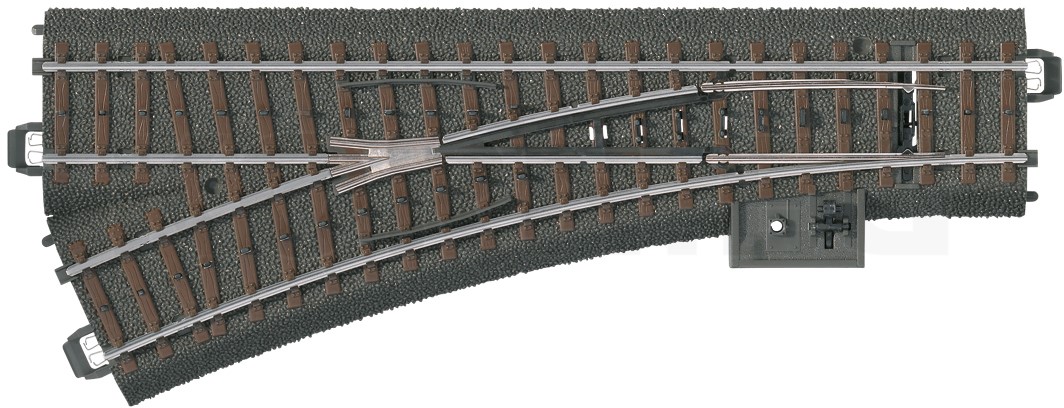
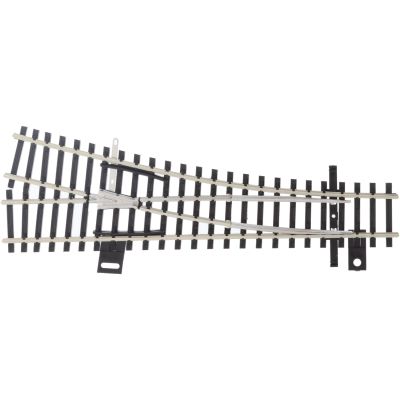
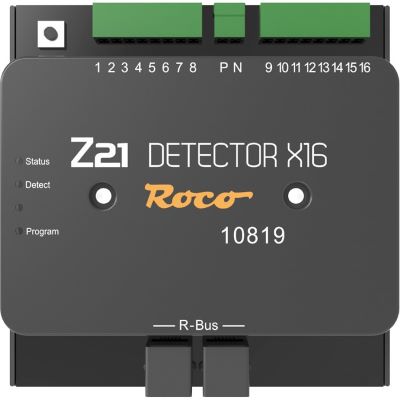
These examples illustrate different tasks. Choose track, drives and detectors to suit your system; this selection is not a complete set intended to be used together.
Manufacturers of track, drives and digital control equipment
Compare geometry, feedback buses and connection options within each manufacturer's range. What matters is the specific combination of rolling stock, track system and control equipment.
Product search for your staging yard
Choose a category and narrow the results by manufacturer, gauge listing or search term. For example, search for “turnout drive”, “feedback module”, “insulated rail joiner” or an item number. All catalogue pages in the selected category are loaded; you can reveal further results in batches.
Start with track planning and turnouts. Then add drives, detectors and connecting materials. Select digital cables and modules by their interface; a gauge listing alone does not confirm technical compatibility. Track cleaning cars must also be able to negotiate tight approaches and run through longer storage tracks.
Cookies are small piece of data sent from a website and stored on the user's computer by the user's web browser while the user is browsing. Your browser stores each message in a small file, called cookie. When you request another page from the server, your browser sends the cookie back to the server. Cookies were designed to be a reliable mechanism for websites to remember information or to record the user's browsing activity.
Necessary
More information
Technically required cookies ensure that you can view our website and navigate in our offers. Basic functions such as filling the shopping cart, login or the display and selection of products on our websites are not possible without them.
Preferences
More information
Cookies are used here to make your visit to our website as convenient as possible. Already confirmed information or personal settings will be saved during your next visit. Cookies also enable functions such as the display of recommendations or the creation and administration of wish lists. This applies to both registered users and guests without an account.
Marketing
More information
We store information about your user behavior on our website and use this data for individual offers and campaigns in the context of direct marketing and for more comfort when using our website. These cookies are used, for example, to present you with special offers on the website itself or in mailings. Furthermore, we want to make surfing on our website as attractive as possible for you. The responsibility and control for data processing lies with us.
Statistics
More information
We use cookies for statistical purposes in order to better understand your user behavior and to support you in your navigation on our offer pages. This also enables us to record your navigation on our offer pages and to use this information for the design of our services to meet your needs.