Limited rooms
Complete train operation is possible on compact tabletop, shelf or folding layouts.

European N gauge combines a scale of 1:160 with a model track gauge of 9 millimetres. This makes it possible to build realistic main lines, extensive stations and long passenger or freight trains in apartments and smaller hobby rooms.
At a scale of 1:160, a 24-metre passenger coach is reduced to approximately 15 centimetres. One kilometre of prototype railway corresponds to approximately 6.25 metres in the model. Even a medium-sized layout can therefore provide sufficient space for platforms, storage sidings and longer open sections of railway.
The selection is extensive: steam, diesel and electric locomotives, multiple units, international express trains, freight wagons, buildings and several track systems are available. Important brands include Fleischmann, Minitrix, PIKO, Arnold and Kato.
N gauge is suitable for conventional analogue operation as well as DCC, mfx-compatible vehicles and modern command stations with smartphone control. Many current locomotives have a Next18 interface or are already fitted with a sound decoder.
Wheels, pickup contacts, rail profiles and rail joiners should be inspected regularly. Contact problems affect lightweight N-gauge vehicles more quickly than models in larger scales.
Complete train operation is possible on compact tabletop, shelf or folding layouts.
InterCity, ICE, Railjet and freight trains can operate credibly with several coaches or wagons.
Usable track lengths, platforms, storage groups and shunting areas require considerably less space than in H0.
Valleys, bridges and long scenic routes can be arranged more generously around the railway.
Next18, sound decoders, DCC and app-compatible command stations are also widely used in N gauge.
Extensive train formations require comparatively little space in display cases and storage drawers.
Begin with the intended type of operation. A continuous circuit for watching trains requires a different track plan from a terminus, branch line or double-track main line.
Include access, the backdrop, lighting and wiring in the plan.
A radius of 192 mm is compact; long coaches look better on wider curves.
Test platforms and storage sidings before constructing the scenery.
Tunnels and hidden yards require safe access openings.
| Planning area | Recommendation | Practical reason |
|---|---|---|
| Curves | Observe the minimum radius of every vehicle | Long coaches and steam locomotives require more freedom of movement. |
| Gradients | Keep them as gentle as possible and use smooth transitions | Lightweight vehicles lose tractive effort on steep gradients. |
| Platforms | Build them for the longest planned train | Platforms that are too short limit future train formations. |
| Hidden yard | Plan generous track spacing and access | Derailed vehicles must remain accessible. |
| Power feeds | Use several feeds rather than a single connection point | Long track routes remain supplied evenly. |
For N gauge, divide the prototype measurement by 160. A platform measuring 160 metres in real life is exactly one metre long in the model.
The calculator also compares the model length with Z, TT and H0. This shows which train and layout lengths can be accommodated within the available base area.
Enter the prototype length in metres.
A controller changes the voltage and polarity. The system is straightforward and suits individual trains or separate electrical circuits.
Each locomotive receives an address. Several vehicles can operate independently while lighting and sound are controlled separately.
Common interfaces include Next18 and NEM 651. The decoder size, motor current and heat dissipation must suit the vehicle.
Next18, NEM 651 and hard-wired decoders are not freely interchangeable. Use the vehicle instructions and the decoder-interface comparison.
| Track system | Construction | Particular strength | Suitable for |
|---|---|---|---|
| Fleischmann piccolo | Track with integrated roadbed | Quick construction and a complete track geometry | Beginners, permanent layouts and starter sets |
| Minitrix | Track without a fixed ballast bed | Individual scenery and ballast design | Conventional layouts and Märklin digital sets |
| Kato UNITRACK | Robust roadbed track with clip connectors | Frequent assembly and dismantling with reliable connections | Portable, modular and temporary layouts |
| Peco | Fine track and flexible track without roadbed | Free track planning and prototypical turnouts | Custom layout and module construction |
Track systems use different rail-profile heights, roadbeds, rail joiners and geometries. Transitions should therefore be constructed using suitable rail joiners and accurate height compensation.
| Gauge | Scale | Particular strength | Typical space requirement |
|---|---|---|---|
| Z | 1:220 | Maximum route length within the smallest area | Very low |
| N | 1:160 | Long trains and a wide product range | Low |
| TT | 1:120 | A good compromise between size and route length | Medium |
| H0 | 1:87 | Very large selection and clearly visible details | Higher |
| 0, 1 and G | Approximately 1:45 to 1:22.5 | Large models with a strong presence | Very high |
Before purchasing, check the power system, minimum radius, interface, digital equipment and the track system in use.
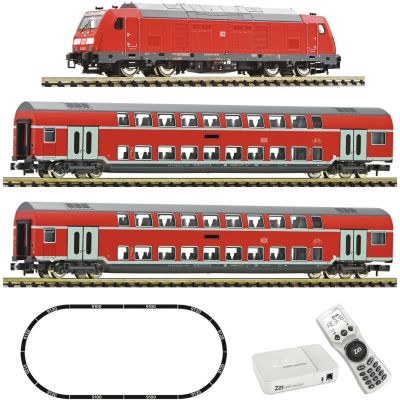
Modern regional train with Z21 start and multiMAUS.
View product
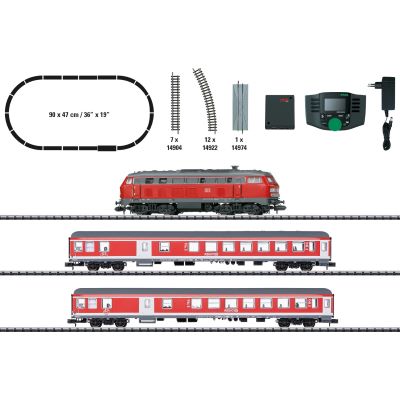
Class 218, regional coaches, sound and Mobile Station.
View product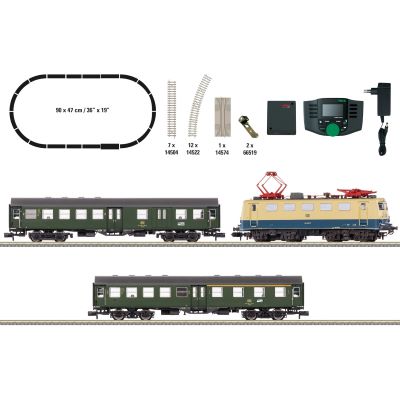
Class 141, rebuilt coaches, sound and Mobile Station.
View product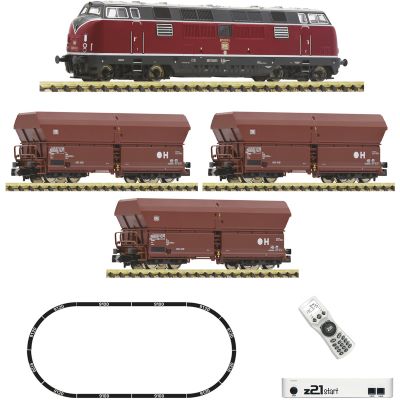
DB freight train with z21 start and roadbed track.
View product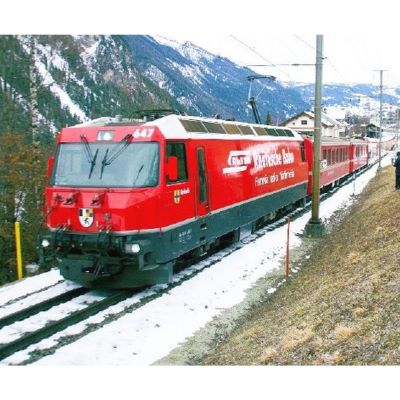
RhB train, UNITRACK oval and analogue controller.
View product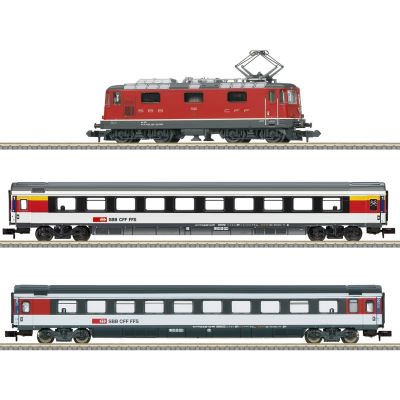
Re 4/4 II, express coaches, sound and Mobile Station.
View product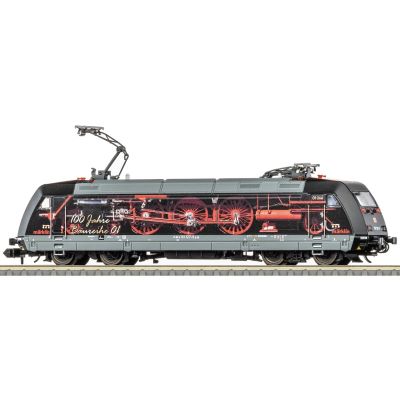
Advertising locomotive with an mfx/DCC decoder and sound.
View product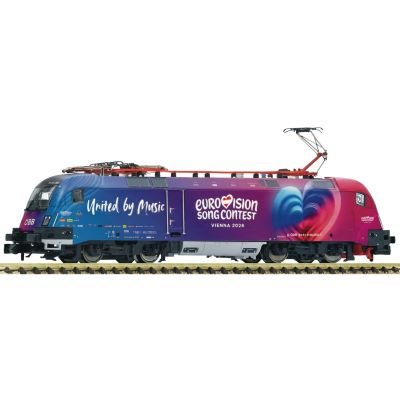
Special Taurus model with sound and lighting functions.
View product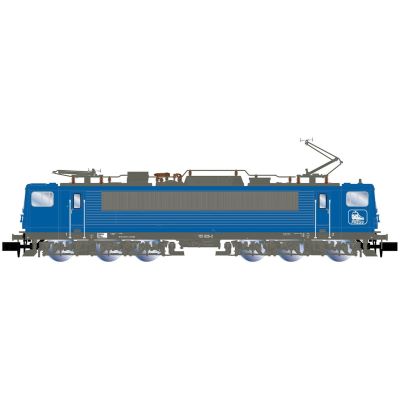
Private-railway locomotive with a Next18 interface and direction-dependent lighting.
View product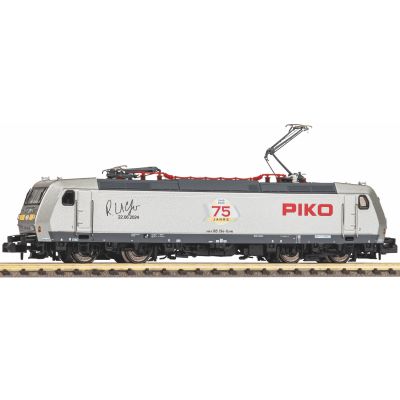
Anniversary locomotive with a Next18 interface and direction-dependent lighting.
View product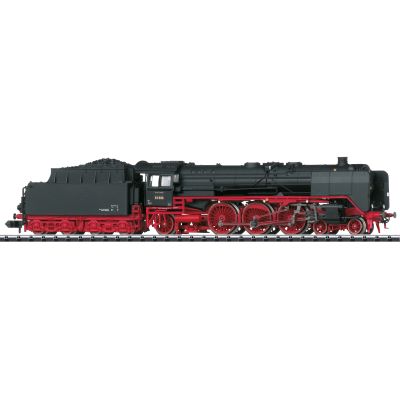
Museum locomotive with a digital decoder and steam sound.
View product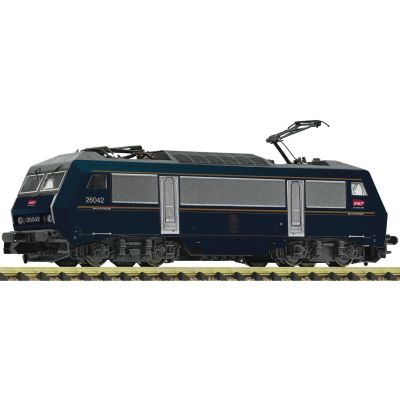
French Sybic electric locomotive with a Next18 sound decoder.
View product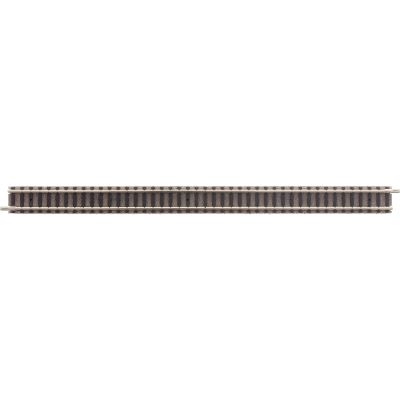
Straight piccolo track with integrated roadbed.
View product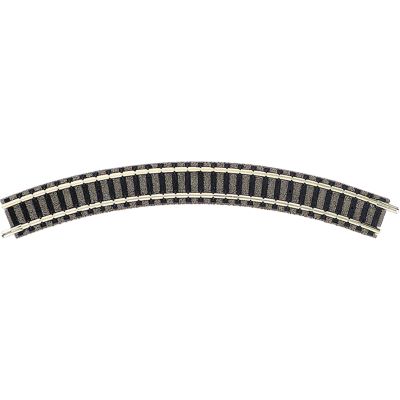
Compact piccolo curved track with integrated ballast bed.
View product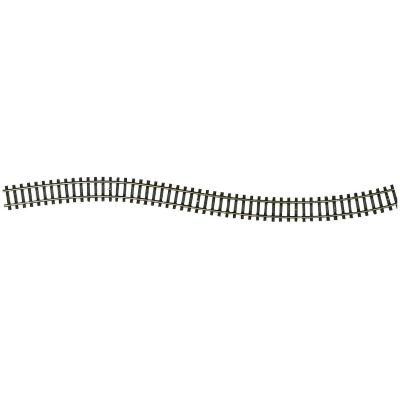
Flexible track without roadbed for free track alignment.
View product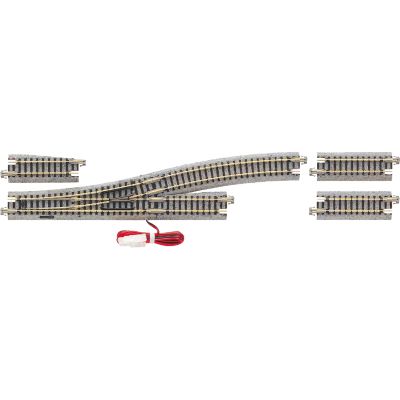
Electric UNITRACK turnout with a concealed drive.
View product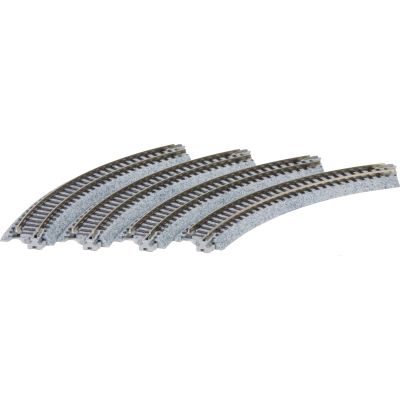
Four compact curved track sections with integrated roadbed.
View product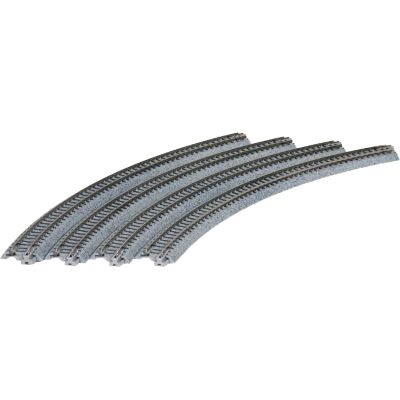
Wider curves for long coaches and multiple units.
View product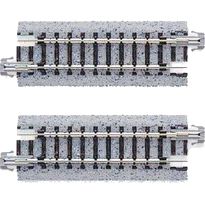
Two short UNITRACK sections for length compensation.
View product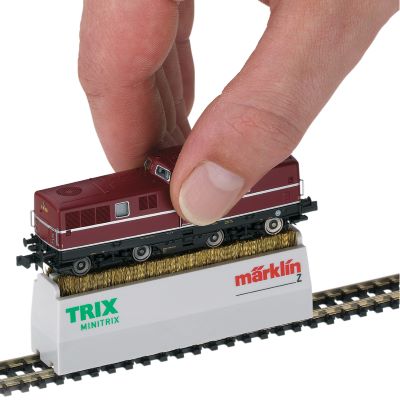
Cleans powered locomotive wheels while they are turning.
View product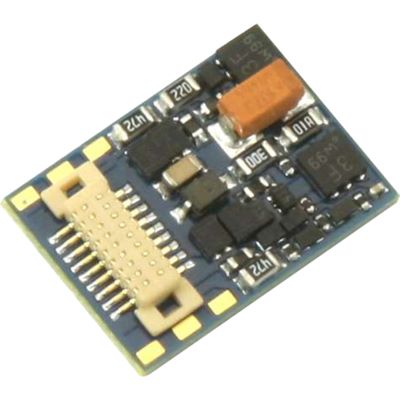
Compact multi-protocol decoder with a Next18 interface.
View product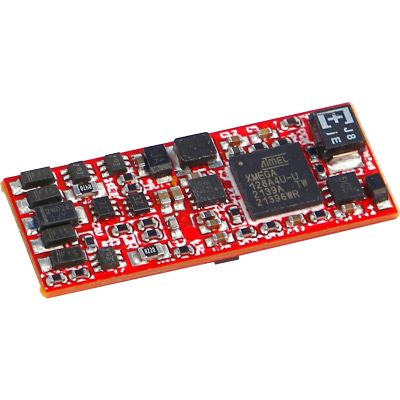
Blank Next18 sound decoder for compact vehicles.
View product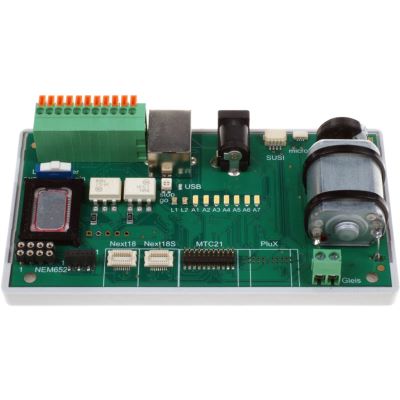
Test decoders with Next18, NEM 651 and other interfaces.
View product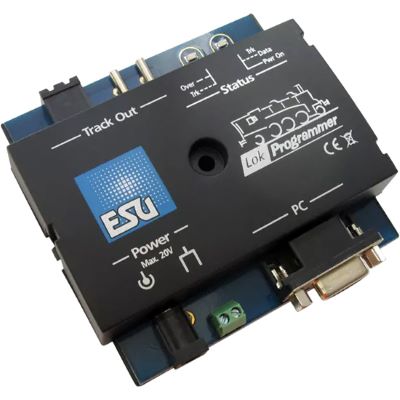
Edit LokPilot and LokSound projects conveniently.
View productIn continental Europe, N gauge is normally produced at a scale of 1:160. The model track gauge is 9 millimetres.
Depending on the track system, a simple starter oval requires approximately 85 × 40 to 90 × 47 centimetres. Wider curves and stations require correspondingly more space.
Yes. Digital and analogue starter sets include vehicles, track and control equipment. The small scale merely requires additional care during track construction and maintenance.
Many compact vehicles can operate from approximately 192 millimetres. Long coaches and large locomotives look considerably better on radii of approximately 249 millimetres or more.
Yes. DCC is widely used, while Minitrix also offers mfx/DCC-capable vehicles. Next18 is a commonly used modern interface.
Fleischmann piccolo and Kato UNITRACK have integrated roadbed and can be assembled quickly. Minitrix and Peco provide greater freedom for individual ballast design.
Common causes include dirty wheels, track or contacts. Loose rail joiners and insufficient power feeds can also cause interruptions.
The track gauge is the same, but the rail-profile height, roadbed and rail joiners differ. Transitions require accurate height compensation and suitable rail joiners.
Many European vehicles have a coupling pocket according to NEM 355. Manufacturer-specific couplings and close-coupling systems are also common.
Yes. Modern vehicles are available with sound decoders and compact loudspeakers. Sound quality and volume depend strongly on the installation space and sound enclosure.
Further gauges, manufacturer guides, planning tools and technical instructions are available in the central model railway guide.